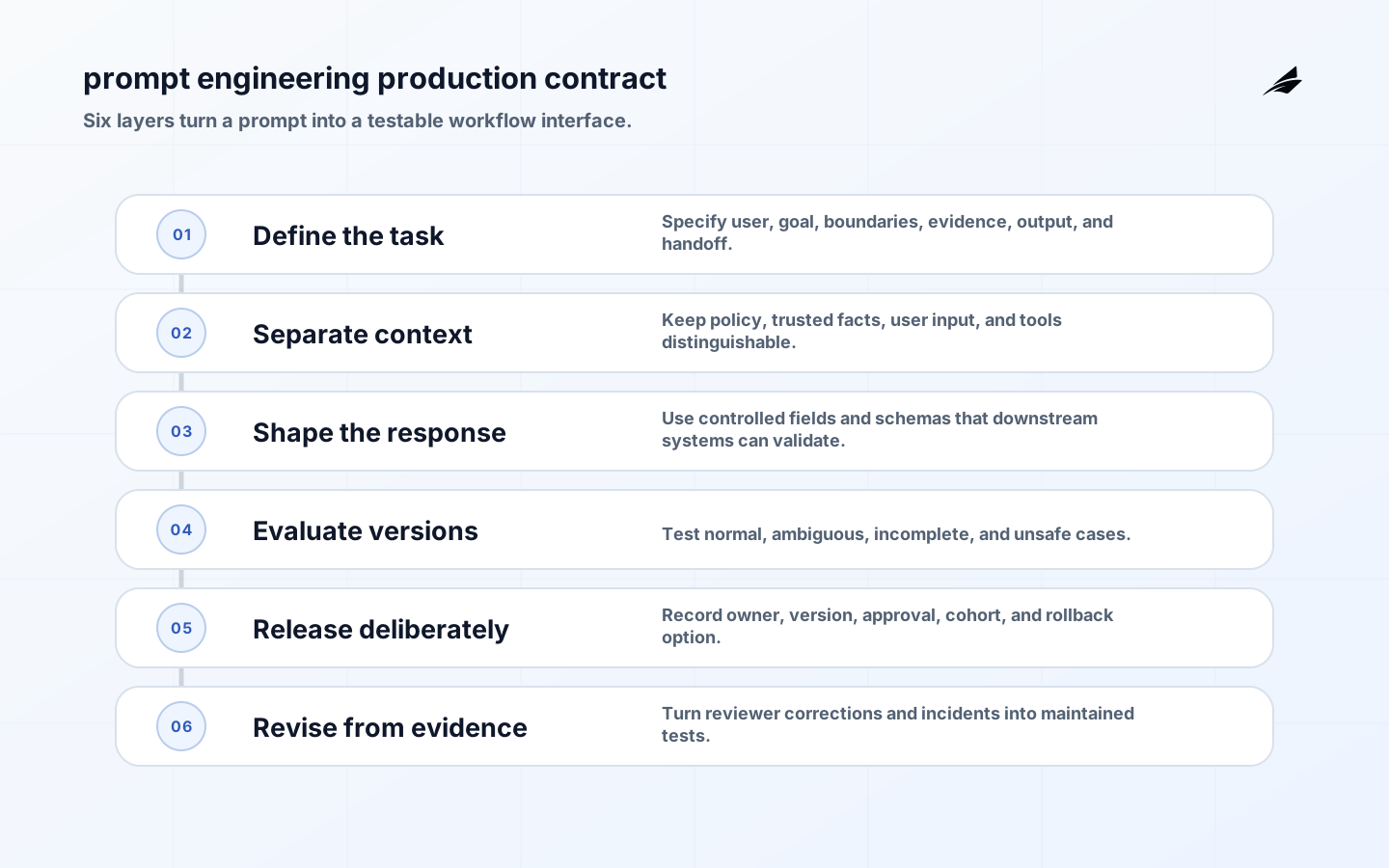
Prompt engineering changes character in production. During exploration, a prompt may be a fast way to test a capability; in a live service, it becomes part of the contract between a user, a model, trusted data, and downstream software. Engineering teams should therefore ask what job the prompt owns, what inputs it may use, what shape it must return, and how a person can detect that it has failed. The OpenAI prompt engineering guide offers practical instruction patterns, but a reliable workflow requires more than a well-worded message. It needs version control, evaluation, safe context handling, and deterministic checks around any consequential effect. This practical prompt-engineering guide explains the wider operating model.
Write A Task Contract
Describe the task in operational language before drafting instructions. For example: produce a customer-response draft that quotes the current policy, identifies missing facts, and never sends the message. That is testable. By contrast, an undefined support request leaves success, authority, and failure unclear. The contract should name the user, the intended audience, allowed data, policy hierarchy, required output fields, prohibited behavior, and escalation rule. Place stable business rules in a maintained instruction layer; pass case-specific facts as structured context; and make external tools declare their arguments and results. This separation makes reviews less subjective because a defect can be located in the task definition, source data, context assembly, or output validator rather than blamed on an unspecified prompt.

| Prompt layer | What belongs there | What to avoid |
|---|---|---|
| Task instruction | Role, goal, boundaries, and response format | Transient case facts that change per request. |
| Trusted context | Approved policy excerpts and records with provenance | Unfiltered document dumps or stale summaries. |
| User input | The user's request and declared fields | Implicit authority to override policy or permissions. |
| Validator | Schema, required evidence, and action gates | Natural-language hopes that output will be correct. |
Separate Context From Instructions
Models consume a combined context, but the application should preserve the origin and trust level of every part. Treat user text, uploaded files, retrieved material, and tool responses as data that may contain misleading instructions. Label content clearly in the assembled request and constrain what it can influence. A document may be relevant evidence, for instance, without being entitled to redefine the service's rules. The OWASP Top 10 for LLM Applications highlights why prompt injection needs defensive boundaries rather than clever wording alone. Permissions, request validation, and action authorization should remain conventional code. The prompt can recommend; the surrounding system decides whether a requested effect is allowed.
- Keep policy instructions short, explicit, and owned by a named business steward.
- Pass case facts in fields with clear labels, source references, and freshness expectations.
- Use schemas or typed tool interfaces for information that downstream software must consume.
- Exclude secrets and unnecessary personal data from context by default.
- Record the prompt version and relevant context references with each evaluated production result.
Validate The Output Boundary
A valid-looking response is not necessarily safe to use. Validate structure, required fields, cited sources, numeric ranges, and policy conditions before output crosses into an email, ticket, or database. For a response draft, validation might require a case identifier, an approved policy citation, and a flag for missing facts. For a classification, it might reject values outside a controlled vocabulary. Keep those gates deterministic and readable. This does not make the model unnecessary; it focuses the model on interpretation and drafting while software protects the boundary where errors become effects. That distinction is crucial when a team moves from a chat interface to a workflow embedded in systems people depend on.
Evaluate Versions Against Work
Prompt changes deserve the same discipline as code changes. Build a case set from real work, with expected outputs or reviewer criteria, then include hard examples: vague requests, conflicting instructions, incomplete records, irrelevant retrieved text, and cases that must be escalated. The OpenAI evaluations guide usefully distinguishes task-specific evaluation from casual inspection. Compare candidate prompts on evidence use, structured-output validity, correct abstention, reviewer edits, latency, and cost. Keep a small standing set for regression checks and add examples when incidents reveal a gap. A single favorite example is useful for demos; it is not evidence that a new prompt is ready for production.
| Failure pattern | Why it happens | Control |
|---|---|---|
| Policy drift | Instruction text changes without a review path | Version prompts with owner approval and effective date. |
| Brittle format | Downstream code parses prose | Require a schema and reject invalid responses. |
| Context takeover | Untrusted text impersonates instructions | Label inputs and enforce policies outside the model. |
| Silent regression | A revision helps one case and harms another | Run a representative evaluation suite before release. |
Operate Prompt Changes
Give each production prompt a repository, owner, release record, and rollback path. Monitor results at the workflow level: completion time, reviewer acceptance, correction categories, escalation volume, and downstream failures say more than a vague quality score. The NIST AI RMF is useful for deciding who reviews material changes and how evidence informs risk decisions over time. Roll out to a narrow cohort when possible, compare outcomes with the prior version, and retain enough traceability to reproduce a disputed result without storing more sensitive content than necessary. Prompt engineering becomes durable when teams can answer what changed, who approved it, and which evidence justified the change.
Maintain A Prompt Library
A prompt library should make intent and change history easier to see, not become a cabinet of nearly identical strings. Organize prompts by user task and service boundary, then store the instruction, input schema, output schema, supported tools, evaluation cases, owner, and release status together. Record the policy or source dependencies that affect expected behavior. This arrangement helps an engineer trace why a prompt changed and helps a domain owner recognize when a business rule was moved into the wrong layer. Avoid copying prompts across workflows without reviewing their authority and data assumptions. A customer-service draft and an internal incident summary may share a tone pattern while requiring entirely different evidence, retention, and escalation rules. Periodically retire unused variants, consolidate intentional defaults, and protect approved production versions from ad hoc dashboard edits. The library is successful when a new maintainer can locate the task contract and reproduce a release decision without asking the original author to translate a conversation into engineering requirements.
- Name prompts after the user task and workflow boundary, not a model vendor or experiment number.
- Keep a machine-readable input and output contract beside the instruction text.
- Link every production version to a reviewed evaluation run and release record.
- Distinguish experimental variants from approved production defaults in access controls and interfaces.
- Review source-policy dependencies when regulations, procedures, or knowledge bases change.
- Remove orphaned prompts and unsupported variants before they become accidental reuse templates.
Review Prompt Change Governance
Prompt changes should have a predictable route from idea to release. A domain owner proposes a changed policy or task behavior, an engineer identifies the prompt and validation surface, and a reviewer checks the representative evaluation evidence. Record whether the change affects instructions, context assembly, output schema, tool use, or only user-facing wording; these carry different risks. Small experiments can be fast, but promotion into a shared workflow should require ownership, a tested version, and an explicit rollback point. This governance reduces late surprises when one team changes a reusable instruction that quietly supports several products. It also creates a useful maintenance rhythm: review active prompts, their source dependencies, correction patterns, and remaining experimental variants on a schedule rather than waiting for a production incident to force a search through informal history.
- Give policy owners a reviewed route to request task or instruction changes.
- Classify whether a revision affects evidence, action authority, format, or reader experience.
- Require evaluation evidence and rollback details before promoting a shared prompt version.
- Keep experimental prompts separated from reusable production contracts.
- Review correction categories for each active prompt at an agreed operating cadence.
- Retire superseded variants so teams do not accidentally reuse an obsolete policy behavior.
Frequently Asked Questions
Should prompts contain every rule? No. Stable, high-level task rules belong in prompts, while permissions, calculations, and consequential decisions belong in deterministic services. Does structured output remove the need for review? No. It makes interfaces safer but does not establish that the underlying claim is true. How often should a prompt be revised? Revise when evidence identifies a meaningful problem, then evaluate the change against a stable case set. Where should a team begin? Pick one high-volume drafting or triage task with a human reviewer and a known definition of done; AI guardrails helps frame the surrounding controls.
Key Takeaways
- Production prompt engineering starts with a testable task contract.
- Separate owned instructions, trusted evidence, untrusted input, and deterministic validation.
- Evaluate revisions on representative work, including cases that should abstain or escalate.
- Version, observe, and roll back prompts as part of the deployed service.
Conclusion
A production prompt is useful because it turns a specific job into a repeatable interface, not because it sounds persuasive. Make its inputs visible, its outputs checkable, and its changes reviewable. With those foundations, prompt engineering can improve work without becoming an undocumented source of operational risk.