AI cost controls are best treated as an operating capability, not a product label. AI cost controls turn variable model, retrieval, tool, and review consumption into an operating decision rather than a month-end surprise. A dashboard total is not enough. Teams need to know which feature, customer, workflow, model route, or failure mode produced usage, whether that consumption improved an outcome, and what response a budget threshold should trigger. Cost is part of reliability when unbounded consumption can degrade or halt a service. The NIST Generative AI Profile offers a practical lifecycle lens: govern the responsibilities, map the context and risks, measure performance and failure, then manage the response. That lens keeps teams focused on the decision and its consequences instead of mistaking a fluent demonstration for a dependable service.
Define the AI cost controls Decision
Choose the unit that connects spend to value: cost per document processed, case resolved, approved transaction, qualified lead, or successful user task. Establish a baseline for the existing workflow and include the costs that do not arrive on an API invoice, such as evaluation, monitoring, storage, human review, incident handling, and support. The FinOps unit-economics guidance is useful because it links technology cost to a product or activity rather than treating it as a disconnected infrastructure total. In practice, write the acceptance condition in the language of the work: what a user can complete, what evidence they can inspect, and what the system must never do. The relevant adjacent guides are model evaluation guide, tool calling guide, LLM observability guide; each is useful when it clarifies a component of the workflow rather than substituting for a local decision boundary.
| Cost driver | Instrument | Control |
|---|---|---|
| Model inference | Model, input and output size, route. | Service tiers, output limit, and cache policy. |
| Retrieval and tools | Candidate count, calls, retries, and latency. | Top-k cap, allowlist, timeout, and retry budget. |
| Human recovery | Escalation, correction, and support time. | Quality gate and workflow redesign. |
Design the Evidence and System Boundary
Instrument each run with a workflow, tenant, feature, model, route, and outcome label. Record input and output size, retrieval volume, tool calls, retries, cache hits, latency, and status without logging unnecessary sensitive text. Design service tiers intentionally: a low-consequence classification task may use a smaller model or a bounded context, while a complex reviewed task may justify a higher-cost route. Make the routing rule inspectable and measurable. The FinOps Framework: Unit Economics is a useful technical reference, but implementation should remain accountable to the organization’s own sources, users, and consequences. Keep a short decision record for material design choices so later reviewers can understand why a source, tool, model route, or review gate was included.
- Name the user, outcome, and accountable owner for the AI cost controls workflow.
- Keep the authoritative source or system of record available to the user and reviewer.
- Make uncertainty, denial, and incomplete evidence visible states rather than silent failures.
- Record the versioned configuration that materially changes a result or action.
- Give operators a documented way to pause, correct, and recover affected work.
Put Controls at the Point of Consequence
Set hard limits where a request can consume resources: maximum context, retrieval count, tool-call count, concurrency, retry budget, output length, and spend or quota per tenant. Enforce them in the service layer, not just in user guidance. OWASP lists unbounded consumption among the concerns for LLM applications; an attacker or a buggy loop can exploit a workflow that retries, expands context, or calls tools without a ceiling. Fail with a clear, recoverable status rather than silently changing behavior. The OWASP Top 10 for LLM applications should inform threat modeling, while the NCSC secure AI guidance helps connect those controls to design, deployment, and ongoing operation. The practical rule is simple: use a model to interpret context where it helps, but use deterministic enforcement for identity, permissions, schemas, destinations, and irreversible transactions.
| Threshold signal | Possible cause | Operating response |
|---|---|---|
| Cost per successful task rises | Retries, long context, or route drift. | Inspect traces and compare quality before changing limits. |
| Tenant quota nears limit | Legitimate growth or misuse. | Notify owner, shape traffic, and confirm entitlement. |
| Tool calls spike | Loop, dependency failure, or prompt change. | Trip circuit breaker and investigate the run pattern. |
Measure Work Quality and Failure
Review cost alongside outcome quality. Track cost per successful task, cache effectiveness, retry rate, abandoned or failed runs, model-route mix, review burden, and the share of spend caused by exceptions. Segment the analysis by customer and workflow, because an average can hide an expensive route that yields little value or a valuable route whose cost rises after a source or prompt change. Pair any optimization with a quality and safety comparison. Do not collapse these signals into a single “accuracy” number. A production decision needs both quality and control evidence: the right result for the right person, at an acceptable time, with a response that remains safe when the evidence is weak. Put reviewed failures into the next evaluation set and classify whether the correction belongs in the source, interface, workflow, model configuration, or policy.
Release in Bounded Steps
Begin with observability and budget ownership before aggressive optimization. Assign a person or team to act on each threshold, decide whether their response is investigation, traffic shaping, model routing, customer communication, or a temporary pause, and rehearse that response. Test a degraded provider, repeated tool failure, and an unexpectedly long document so cost controls do not create duplicate work or unhelpful user errors. A small release is valuable when it is instrumented, reviewed, and reversible. It is not a waiver for access control, evaluation, or incident preparation. Use the early evidence to decide whether to expand, redesign, hold the boundary, or stop; all four can be rational outcomes when they protect users and the organization.
Operate AI cost controls as a Living Service
Revisit unit economics whenever model pricing, task volume, architecture, or user behavior changes. The cheapest request is not automatically the best outcome if it creates more corrections, escalations, or customer effort. Conversely, a more capable route may lower total cost by avoiding retries and manual rework. Keep the decision tied to measured workflow results and retain the release evidence for changes to routing, caching, or quotas. Keep a change log that links a release to the affected workflow, test evidence, owner, rollout date, and rollback condition. That record makes it possible to distinguish a genuine improvement from a silent shift in policy interpretation or user experience.
Assign Accountable Owners
The AI cost controls workflow needs clear ownership across product, source or data stewardship, identity and security, and day-to-day operations. The product owner accepts the workflow trade-off; the source owner defines what is authoritative; the platform owner keeps the system reliable; and the risk or security owner helps test the boundaries. Shared review is important because an incident often crosses these responsibilities. Ownership should be visible in the runbook, release decision, and escalation route, not inferred after a problem.
Review Changes With the People Who Own the Work
Make cost review a cross-functional operating ritual, not a procurement afterthought. Engineering can explain retries, routing, and architecture; product can explain user value and adoption; operations can see the manual work created by failure. Review savings claims against correction and support data. A cheaper route that increases customer effort is a cost shift, while a more capable route can be economical when it prevents repeat work or unnecessary escalation.
Build cost controls into the execution path
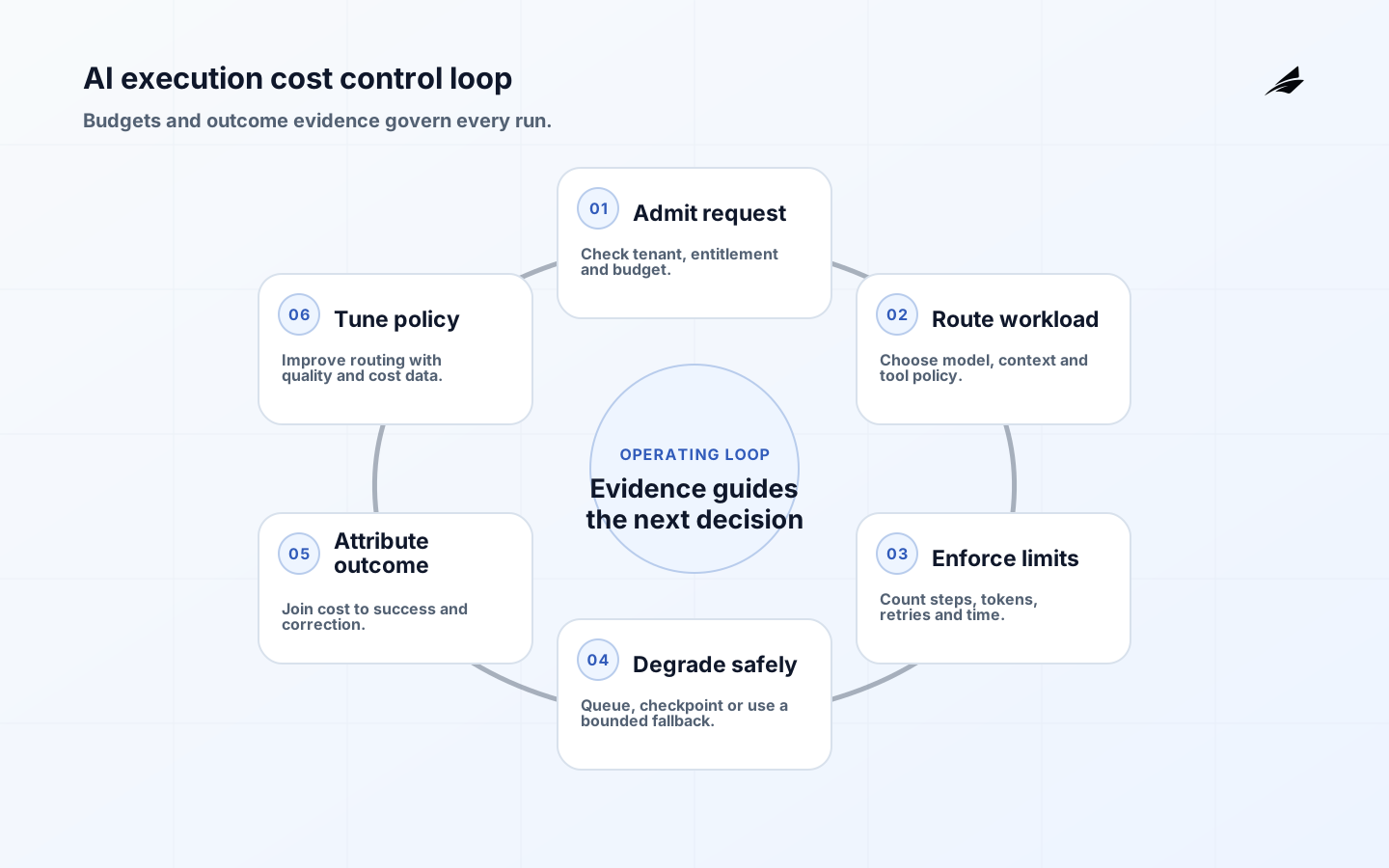
Engineering AI cost controls mean preventing unbounded work before the invoice arrives. At request admission, assign a tenant, workflow, feature, model policy and maximum budget. During execution, count model input and output, retrieval, tool calls, retries and wall-clock time against that budget. Stop loops with explicit terminal states, not a hopeful prompt. After completion, attribute actual cost to the outcome and record whether the work succeeded, required correction or fell back to a person. This creates a control loop where cost and quality can be reviewed together.
| Control point | Mechanism | Failure-safe behavior |
|---|---|---|
| Before execution | Entitlement, quota, context estimate and model policy | Reject, queue or request a higher limit explicitly |
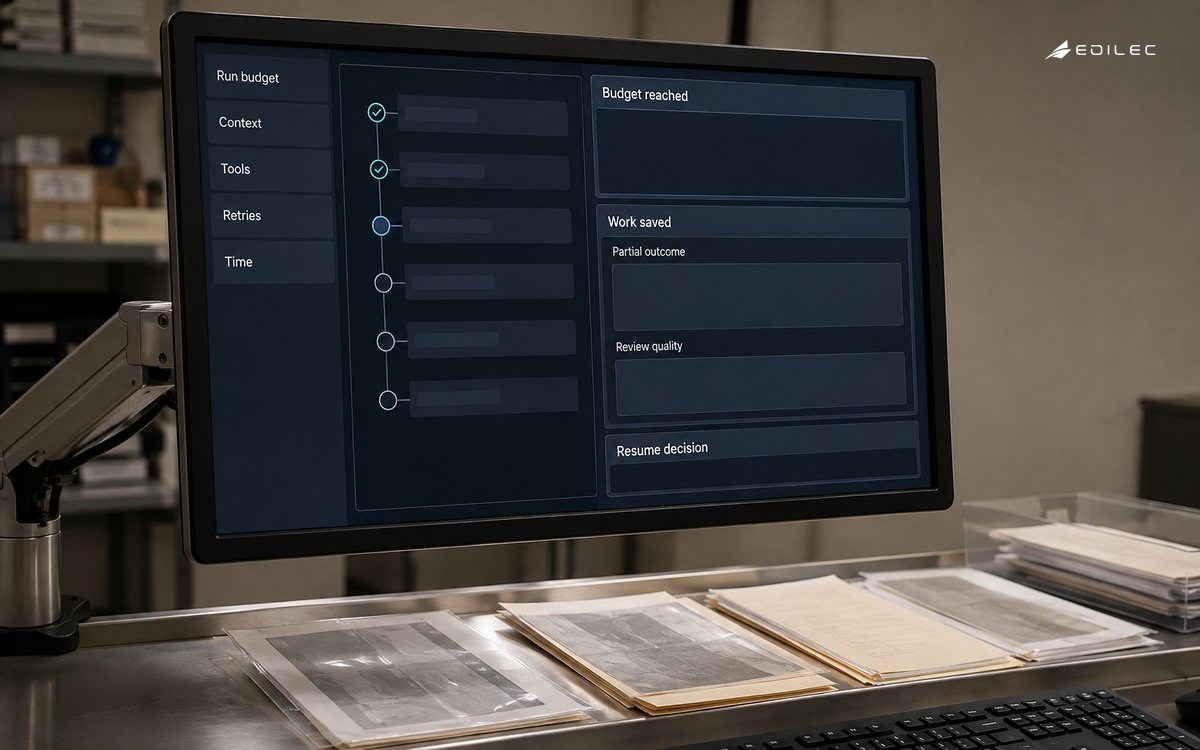
| During execution | Step, token, tool, retry, time and concurrency budgets | Checkpoint state and return a clear partial outcome |
| At expensive branches | Expected-value rule or human approval | Use a cheaper route or stop without hidden degradation |
| After execution | Outcome-linked cost trace and reconciliation | Flag unattributed spend, duplicate work and budget drift |
A cheaper model is not an optimization when it creates more retries, reviewer time or customer failures. Evaluate routing with representative tasks and track cost per accepted outcome. The FinOps Foundation’s unit economics capability provides the business lens, while the NIST Generative AI Profile cautions teams to manage risks and measurement across the lifecycle. Instrument model and agent activity with stable workflow identifiers; OpenTelemetry’s generative AI semantic conventions offer a developing common vocabulary, so pin the convention version and avoid recording sensitive prompts by default. Connect implementation with Edilec’s guides to LLM observability, tool calling in production and the founder view of AI cost controls. Budgets should degrade gracefully, preserve workflow state and explain the next recovery action.
Key Takeaways
- AI cost controls should start with one bounded decision and a named owner.
- Evidence, authorization, and action scope must be explicit before wider adoption.
- Controls are strongest when a service can enforce them at the actual boundary.
- Evaluation needs difficult, absent, stale, and adversarial cases as well as normal work.
- Expansion is a governed operating decision supported by outcomes, not a reward for a convincing demo.
Frequently Asked Questions
The first AI cost control is usually attribution, not a blunt model cap. Once a team can see usage by workflow and outcome, it can use limits, caching, smaller routes, and product changes deliberately. A fixed monthly budget without an owner and response plan is only an alert; it does not protect the service or explain trade-offs to users. The sensible next step is to select a workflow with available evidence, clear ownership, and a recoverable outcome, then make a small evaluation set that domain reviewers can judge. That produces better information than a broad launch whose success criteria are unclear.
Conclusion
AI cost controls should protect useful work, not merely reduce tokens. Attribute consumption, bound the risky paths, and optimize against quality, recovery, and the value of the completed task. The durable pattern is to make the job, evidence, authority, controls, and learning loop visible enough for people to inspect and improve.