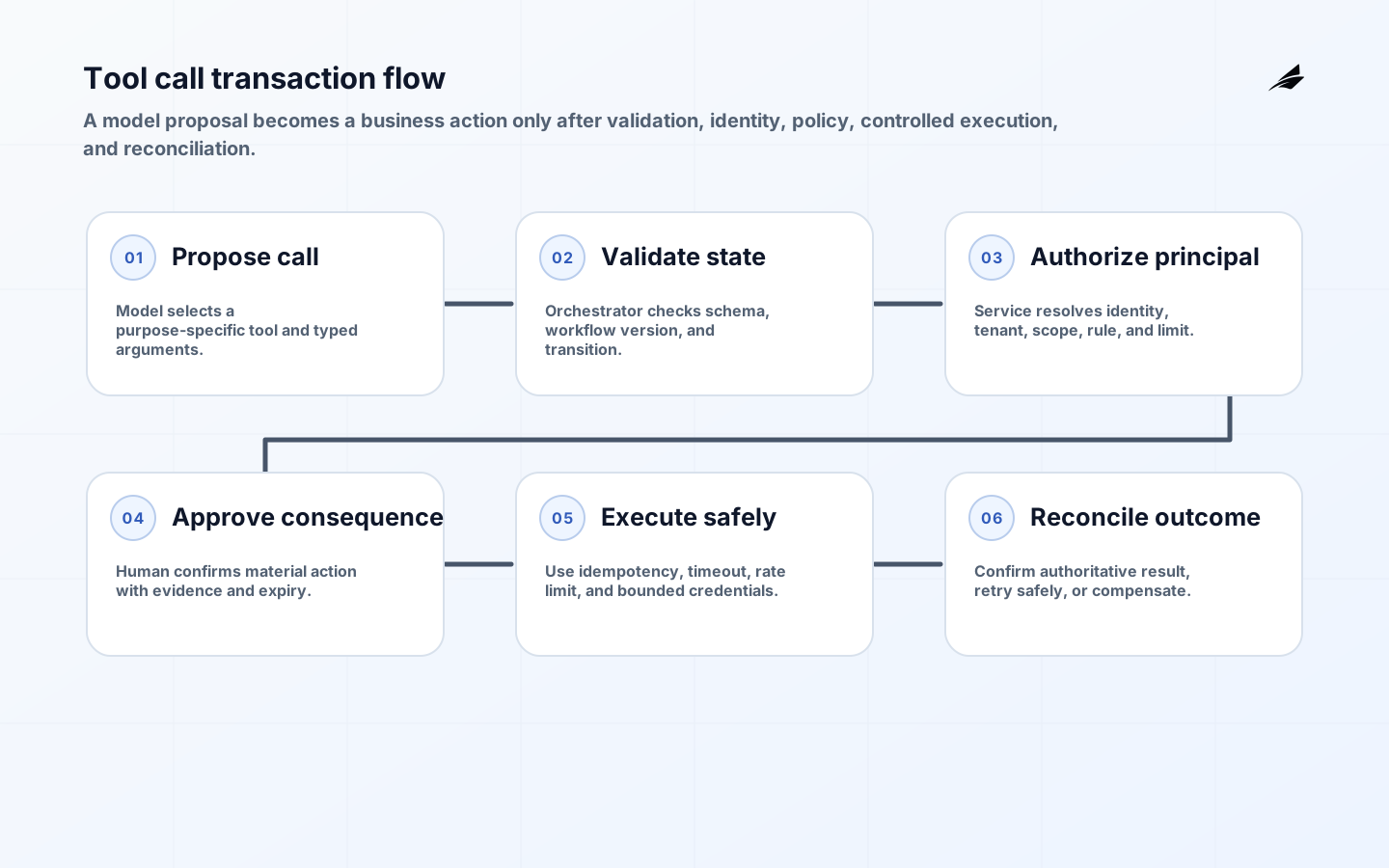
Tool calling for AI automation lets a model propose structured requests to software functions, but it does not make the model an authorisation system or a transaction manager. A production design must separate interpretation from enforcement. The model can choose a candidate tool and arguments; trusted code must validate the schema, authenticate the user or workload, evaluate policy, apply business constraints, execute idempotently, and record the result. Tool output should return as untrusted context, especially when it contains external text that could influence another model turn. This guide explains the complete path from tool contract and identity to approval, execution, reconciliation, observability, and incident response.
Use the OpenAI function-calling guide for the tool-description and schema contract, the OWASP Top 10 for LLM applications for prompt-injection and agency risks, the NIST Generative AI Profile for lifecycle risk actions, and the NIST AI Risk Management Framework for governance and measurement. Edilec’s guides to tool calling for IT managers, model evaluation, and LLM observability extend the implementation path.
Define The Delegated Action
Begin with whether to look up, draft, change, or commit a business action. Describe the user, the case boundary, the evidence or state needed to proceed, the acceptable result, and the condition under which the system must stop. A vague request invites improvised behavior and makes later failures impossible to classify. The weak alternative is putting a broad administrative API behind a conversational description. Instead, write a decision brief that can be reviewed by the person who owns the business outcome and the engineer who owns the service. It should distinguish suggestions from effects, specify who receives exceptions, and state the cost of a false positive, false negative, delay, or unnecessary handoff. For this part of the system, name the accountable owner, supporting evidence, exception route, and next measurable check.
| Decision question | Weak pattern | Operational pattern |
|---|---|---|
| Scope | putting a broad administrative API behind a conversational description | Name the user, case, permitted input, and abstention point. |
| Evidence | Assume fluent output is enough. | Require source, state, or policy evidence appropriate to the effect. |
| Authority | Let model instructions imply permission. | Enforce identity, role, tenant, and current-state checks in software. |
| Change | Treat a revised model or input as harmless. | Evaluate material changes against representative cases before expansion. |
Design The Capability Design
The tool calling service needs a durable boundary between language interpretation and authoritative operations. Maintain typed arguments, user-bound authority, idempotency, and fresh state checks. Keep canonical facts in the appropriate system of record, and make every derived claim traceable to a source or rule. A model can help select, summarize, or structure information, but it should not quietly redefine the data’s owner or lifetime. This distinction protects both users and operators: a reviewer can see where a proposal came from, and an incident responder can identify what changed without reconstructing an entire conversation. Within this design choice, name the accountable owner, supporting evidence, exception route, and next measurable check.
- Name a business owner and a technical owner for the tool calling workflow.
- Record approved inputs, access conditions, and the facts that must be fetched live.
- Make uncertainty and unavailable information visible to the user.
- Provide a defined handoff for exceptions rather than an endless retry loop.
- Retain a change record for model, prompt, data, tool, policy, and interface revisions.
Apply Controls At The Boundary
For delivery teams working on tool calling for AI automation, this operating decision should connect governed inputs, model behavior, permitted tools, human judgment, and recorded outcomes to evidence an accountable owner can inspect. Controls work when they are enforced where a request can read data or cause an effect. Do not rely on a prompt to decide authorization, validate a critical field, or block a prohibited action. Treat user text, documents, retrieved content, and connected responses as untrusted input that may try to influence the model. The OWASP Top 10 for LLM applications explains why prompt injection and excessive agency need conventional safeguards. Use minimum permissions, structured inputs, deterministic validation, safe defaults, rate limits where appropriate, and an audit trail that relates the user request to the final result. In this operating review, move beyond the operating decision only after the owner can show the accepted result, the exception path, and the signal for another review.
Measure The Workflow
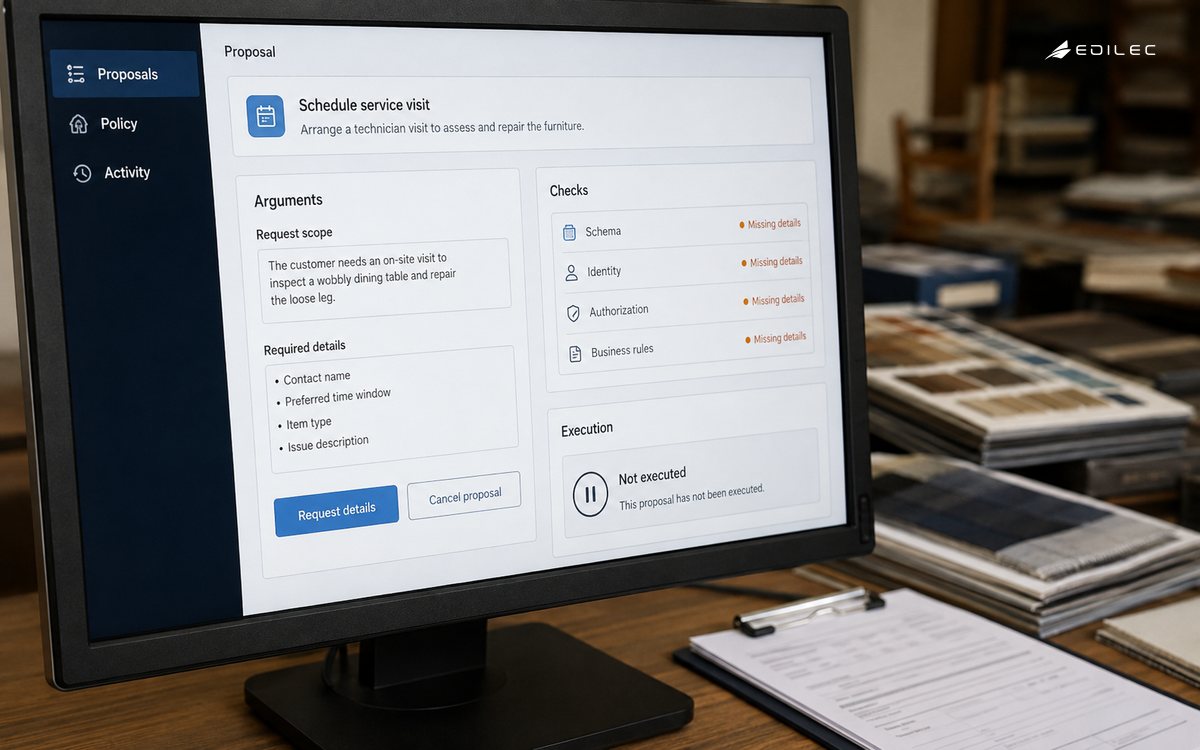
Evaluate the assembled workflow rather than an isolated model answer. Build a reviewed set from representative work, including ordinary cases, ambiguity, missing facts, conflicting instructions, permission limits, and inputs that must be rejected. Inspect failures at the stage where they occur: a missing record is not repaired by changing prose, and a valid draft does not excuse an invalid action. Track unsafe-call rejection, correction rate, duplicate effects, and policy denials. The NIST AI Risk Management Framework provides a helpful lifecycle frame: governance, context mapping, measurement, and risk management must remain connected as the system changes. Before releasing this evaluation, name the accountable owner, supporting evidence, exception route, and next measurable check.
| Signal | What it reveals | Next action |
|---|---|---|
| Evidence gap | The output lacks the material needed to support a claim. | Inspect source selection, freshness, permissions, and context assembly. |
| Correction pattern | People repeatedly repair the same part of a result. | Diagnose the task contract, source quality, or unclear policy. |
| Control failure | A request reaches or fails at the wrong boundary. | Review authentication, authorization, validation, and escalation. |
| Outcome drift | A change alters completion, rework, or harm. | Compare versions on standing cases and a staged production sample. |
Release And Operate
Release tool calling in a bounded workflow first, preferably where effects are read-only, reversible, or reviewed. Preserve a disable path and make operational traces accessible to the people who investigate failures. A useful trace ties together the case, the permitted context, the relevant version, any tool or policy decision, the user-visible response, and the final workflow state. The NIST Generative AI Profile emphasizes that generative AI risks are managed across a lifecycle; a release is therefore the start of observation and correction, not the end of design. While operating this operating step, name the accountable owner, supporting evidence, exception route, and next measurable check.
Ownership And Change
Someone must be able to answer who owns the decision, who owns the technical service, who may pause it, and who handles a disputed result. Put those answers in a runbook with review cadence, incident contacts, approved change types, and records of material decisions. This is particularly important when tools is connected to evolving sources or third-party services. A small change in a source, model, access rule, or dependency can alter behavior without a visible interface change. Treat it as a release candidate until the reviewed cases and controls say otherwise. When changing this part of the system, name the accountable owner, supporting evidence, exception route, and next measurable check.
Run A Tool Calling Operating Review
Review every proposed tool action against what the service authorized and what it finally committed. Test malformed inputs, stale state, duplicates, and cross-tenant identifiers. The gap between proposal, policy, and effect is the evidence that matters. During support for this part of the system, name the accountable owner, supporting evidence, exception route, and next measurable check.
Tool Calling Practical Checklist
- Choose one bounded decision before scaling tool calling.
- Define evidence, permissions, validation, escalation, and recovery conditions.
- Test ordinary, ambiguous, unsafe, and unavailable-information cases.
- Instrument the path from input to business outcome with privacy-aware traces.
- Stage changes and retain a rapid rollback or disable option.
- Convert confirmed corrections and incidents into a test, control, or explicit operating decision.
Frequently Asked Questions
Does tool calling replace normal application controls? No. It can improve interpretation, retrieval, drafting, or orchestration, but authorization and state changes remain responsibilities of deterministic services and accountable people. Is a confidence score enough to automate a decision? No. Confidence must be interpreted alongside evidence quality, consequence, permissions, source freshness, and the ability to recover. Where should a team start? Pick a high-frequency, bounded task with a clear owner and a reviewable definition of success. The OpenAI Agents guide is useful for agent patterns, while the surrounding workflow still needs its own product, security, and operations design. To validate this part of the system, name the accountable owner, supporting evidence, exception route, and next measurable check.
Prepare For The Next Change
Before adding a write tool, rehearse the exact rollback and customer communication path. A downstream API may accept a request even when a later business validation fails, so an idempotency key and compensation plan are part of the tool contract. Keep privileged actions separate from exploratory tools, and require fresh authorization at execution time. These limits make it possible to expand automation while preserving a clear boundary for consequential work.
Trace one tool call as a business transaction
Suppose an assistant helps a customer-success manager issue a subscription credit. The model may infer the account, reason, and requested amount, then propose an issue_credit call. The gateway should resolve the authenticated employee, fetch delegated limit and tenant scope, validate account state and currency, require approval above a threshold, create an idempotency key, and invoke the billing service. A successful HTTP response is not enough: the workflow must confirm the credit exists in the authoritative ledger and present the resulting reference to the user. If the provider times out after committing, retrying blindly could create a duplicate. Reconciliation and idempotency therefore belong in the product contract, not in an error-handling footnote.
Threat-model both tool selection and tool output. OWASP describes excessive agency as excessive functionality, permissions, or autonomy and recommends reducing each dimension. Give the assistant a purpose-specific credit tool rather than a generic HTTP client or database command. Obtain user-context credentials or a narrowly scoped workload identity at execution time rather than placing broad secrets in prompts. Treat retrieved documents, email, web pages, and tool responses as untrusted data that cannot redefine policy. The OpenAI function-calling guide explains structured tool definitions and strict schemas; those mechanisms improve argument shape but do not replace service-side authorization, rate limits, confirmation, or monitoring. Evaluate denied calls, malformed arguments, prompt injection, duplicate submission, dependency failure, partial completion, and stale approval alongside the normal path.
| Boundary | Trusted responsibility | Evidence to retain |
|---|---|---|
| Model | Propose tool and typed arguments | Model/configuration version and proposal |
| Orchestrator | Validate schema, state and allowed transition | Case, tool version and validation result |
| Identity and policy | Authenticate principal and authorise exact action | Principal, scope, rule version and decision |
| Approval | Obtain meaningful consent for consequence | Reviewer, evidence, limit, expiry and rationale |
| Executor | Perform bounded idempotent operation | Request key, dependency response and committed reference |
| Reconciler | Confirm business outcome or compensate | Authoritative state, retry, correction and closure |
Key Takeaways
- Tool Calling should serve a specific operational decision, not a vague promise of automation.
- Evidence, permissions, validation, and recovery are product requirements.
- Measure the complete workflow and locate failures at their actual stage.
- Visible ownership and gradual releases make improvements safer and more useful.
Conclusion
Tool Calling earns its place in an AI automation program when it makes useful work easier without obscuring accountability. Bound the decision, govern the inputs and effects, inspect real outcomes, and keep the system easy to pause or correct. That is how an interesting capability becomes a dependable service. To govern this part of the system, name the accountable owner, supporting evidence, exception route, and next measurable check.