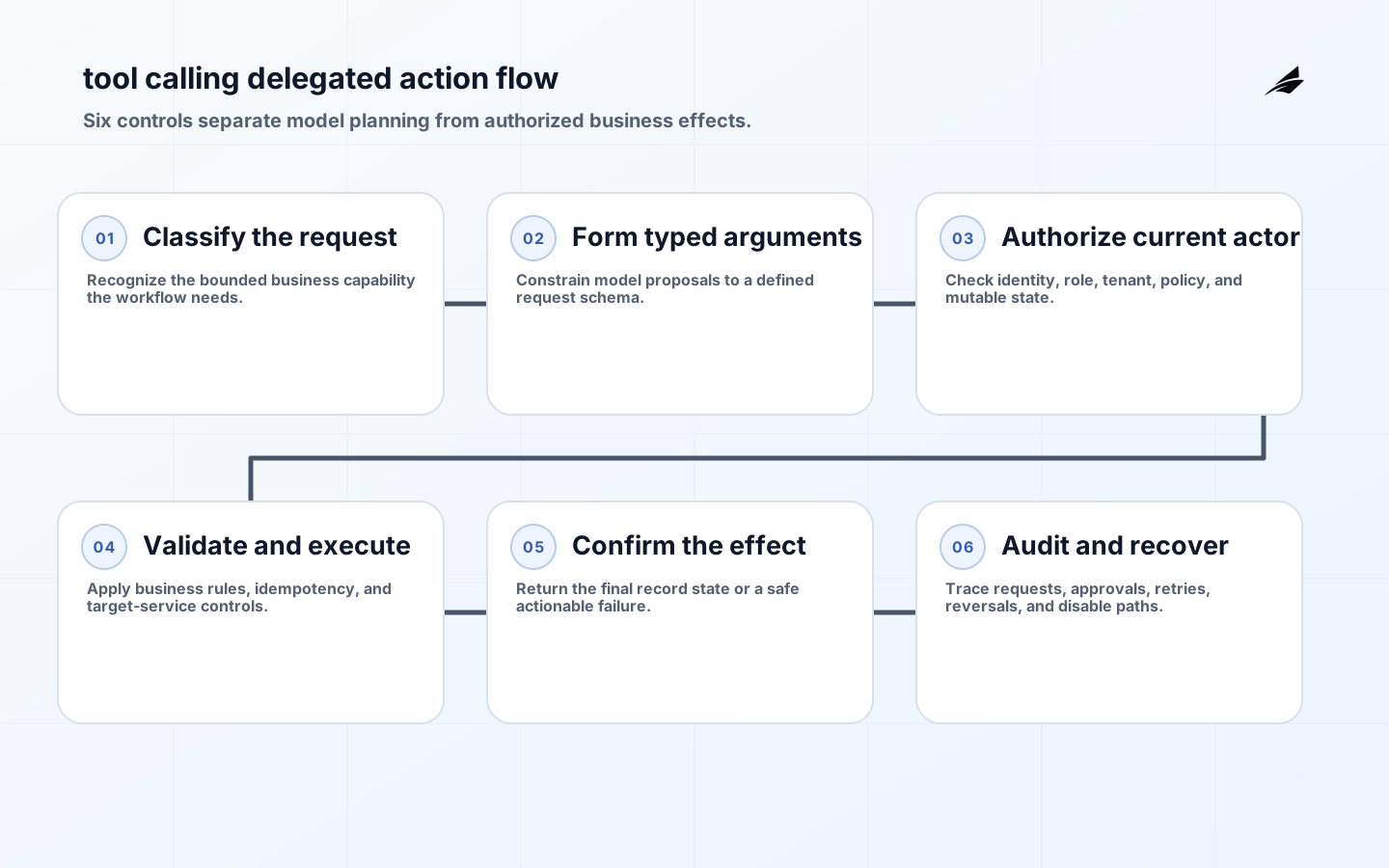
Tool calling is the moment an AI system moves beyond explanation and asks another system to do work. That shift changes the engineering question from answer plausibility to whether the right principal invoked the right capability with valid arguments at the right time. Production tool calling must be designed as a capability boundary. The model may select a tool and draft arguments, but the service that owns the effect still authenticates, authorizes, validates, executes, records, and recovers. The OpenAI function calling guide describes structured tool interaction; the production concern is what sits behind each declaration. For operating context, read Tool Calling for AI Automation.
Define A Capability Contract
Make a tool small enough that its outcome and failure modes can be understood. A broad customer-update capability is an invitation to ambiguity; a draft address-change request for the authenticated account gives engineers something to constrain. Define inputs, allowed values, response schema, side effect, actor, preconditions, idempotency behavior, timeout, and compensation path. Prefer read-only lookup and draft-creation tools before actions that commit money, access, or customer communications. A model should never gain broad database access merely because it can phrase a request fluently. Capability design is where an operations team makes least privilege concrete and keeps automation from quietly inheriting powers no human user was granted.
| Tool property | Production requirement | Example |
|---|---|---|
| Scope | One bounded business effect | Create a reimbursement draft instead of a general expense-management capability. |
| Arguments | Typed and validated server-side | Currency, amount, account, and reason use controlled fields. |
| Authority | Derived from the caller and current policy | A support agent cannot approve their own high-value exception. |
| Recovery | Idempotent or compensating behavior | A retry returns the prior request rather than issuing a duplicate payment. |
Bind Tools To Real Authority
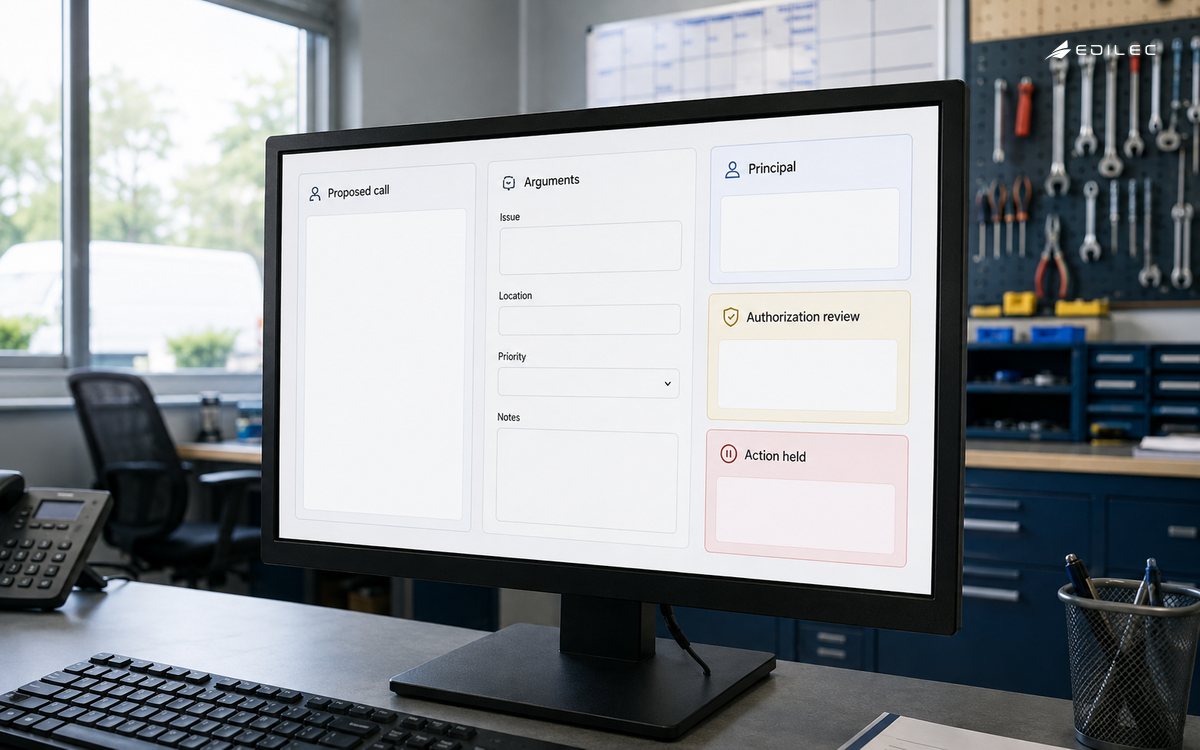
Do not convert model intent into permission. Bind every tool call to an authenticated user, service identity, tenant, environment, and policy decision. Re-check mutable state at execution time: an approval may have expired, a record may have changed, or a user may no longer have the role they held when the conversation began. The OpenAI agents guide is helpful for orchestration patterns, but authorization remains an application responsibility. Make approval steps explicit and reviewable for high-impact actions. A human should see the proposed effect, supporting evidence, and current state rather than a vague claim of agent confidence. This is especially important where an action cannot be cheaply reversed.
- Expose only the tools required for the current workflow and user role.
- Validate arguments against business rules in the target service, not just the model response.
- Use idempotency keys and request identifiers for any side effect that can be retried.
- Require confirmation or a second control for payments, external messages, and privilege changes.
- Return actionable, safe errors so the workflow can hand off instead of guessing.
Treat Tool Results As Untrusted Data
Tool output can be incomplete, stale, malformed, or maliciously shaped just as user input can. Parse it with a schema, limit what is inserted into model context, and preserve a reference to the underlying system record. Do not let a search result or an external API response silently alter the agent's instruction hierarchy. The OWASP LLM guidance calls out excessive agency and indirect prompt injection because connected systems widen the attack surface. Design for partial failure: one unavailable dependency should produce a clear status and retry policy, not trigger a cascade of speculative calls. Good tool interfaces reduce uncertainty instead of hiding it behind conversational prose.
Test Effects, Not Just Calls
Test a complete action path with ordinary, ambiguous, denied, duplicate, expired, and dependency-failure cases. Check that the system refuses an action when the model picks the wrong tool, proposes an out-of-range value, or receives text trying to override policy. Review the final state of the system of record, not merely whether a function call was emitted. Track proposal-to-execution rate, policy denials, duplicate prevention, approval latency, error categories, and manual reversals. The NIST Generative AI Profile supports this lifecycle approach: controls should be evidenced in use, then improved as incidents and changes reveal new risks.
| Test case | Expected behavior | Failure to investigate |
|---|---|---|
| Duplicate retry | Return or safely reuse the first operation | A second business effect is created. |
| Permission change mid-task | Deny at execution with a useful handoff | The old conversation identity is trusted blindly. |
| Malformed tool response | Stop or retry according to contract | The model invents missing fields and continues. |
| High-risk action | Present evidence for explicit approval | The effect occurs from a single generated request. |
Operate The Action Path
Start with a narrow, observable action and retain a conventional process alongside it. Give support staff a trace that connects the user request, chosen tool, validated arguments, policy decision, target response, and final record state. Redact sensitive values while retaining identifiers that an authorized investigator can use. Establish owners for the agent behavior, the tool service, and the business policy; these are often different people. Release changes gradually, watch error and reversal rates, and keep a kill switch that disables execution while preserving read-only assistance. This is how tool calling supports operations rather than creating an unaccountable automation layer.
Design For Reversal
Reversal is a product requirement, not a post-incident improvisation. Before an action tool is enabled, identify whether its effect can be cancelled, compensated, or merely recorded and corrected. A submitted payment may require a compensating transaction; a sent message may need a follow-up and an incident record; a changed entitlement may need immediate revoke capability. Build the reversal path with the same identity and evidence checks as the original action, and ensure it can be used when the model service is unavailable. Record the original request, policy decision, target-system response, and who authorized a reversal. Avoid automatic retries for effects whose target service cannot guarantee idempotency. Operations leaders should rehearse a failure in a non-production environment and check that support staff can locate the impacted records, stop new execution, and communicate a known status. A tool that cannot safely fail is too broad for an early agent rollout.
- Classify each side effect as reversible, compensable, or irreversible before exposure to an agent.
- Provide an operations-only disable switch that prevents new execution without losing the evidence trail.
- Store idempotency keys and target record identifiers where authorized staff can retrieve them quickly.
- Test retry, timeout, partial-success, and downstream outage behavior against the real target service.
- Require explicit escalation when a requested action lacks a defined compensation or correction path.
- Review manual reversals weekly to find capability designs that need narrower scope or stronger validation.
Review Tool Capability Changes
Tool contracts need a change review because a small argument or response change can alter a real-world effect. Reassess a capability when its side effect, required evidence, authorization policy, target service, or recovery behavior changes. Compare the deployed schema with the approved contract and test both old and new clients during transition. Require clear versioning when a tool is shared across agent workflows; a silent change to a refund limit or status field can create inconsistent handling long before an error rate rises. Bring the business owner into the review when a change affects who may act or what a user receives. This is a practical way to keep agent behavior aligned with the target system's rules while allowing useful integrations to evolve.
- Review a tool when its side effect, argument schema, authority, or target-service behavior changes.
- Test backward compatibility and safe failure for existing agent clients during a transition.
- Version shared tool contracts and make intended deprecation dates visible to owners.
- Require business approval when a capability expands the effect or eligible actor set.
- Rehearse rollback and confirm whether in-flight requests can complete or must be contained.
- Retire unused tools and credentials before an abandoned capability becomes an incident path.
Frequently Asked Questions
Can a model directly call a database? It can technically send a request, but broad direct access is rarely an appropriate production design. Put a purpose-built service between the model and the data store. Are approval prompts enough for risky actions? No. Use an authenticated, server-enforced approval with the exact proposed effect and current state. What is the first tool to ship? A read-only lookup or draft creator with a clear owner and measurable value. How does this relate to human review? Human-in-the-loop automation explains how to design the handoff as a workflow, not an apology after a failure.
Key Takeaways
- Tool calling should expose bounded capabilities, not broad system access.
- Bind every execution to current identity, policy, validated arguments, and system state.
- Treat tool results as untrusted data and test the final business effect.
- Use idempotency, approvals, traces, and a disable path to make automation recoverable.
Conclusion
Production tool calling succeeds when language-based planning is kept separate from authority and effects. Let the model help select the next step, while services enforce the rules that make that step safe, reversible, and explainable. That separation gives operations leaders a real foundation for useful agent automation.