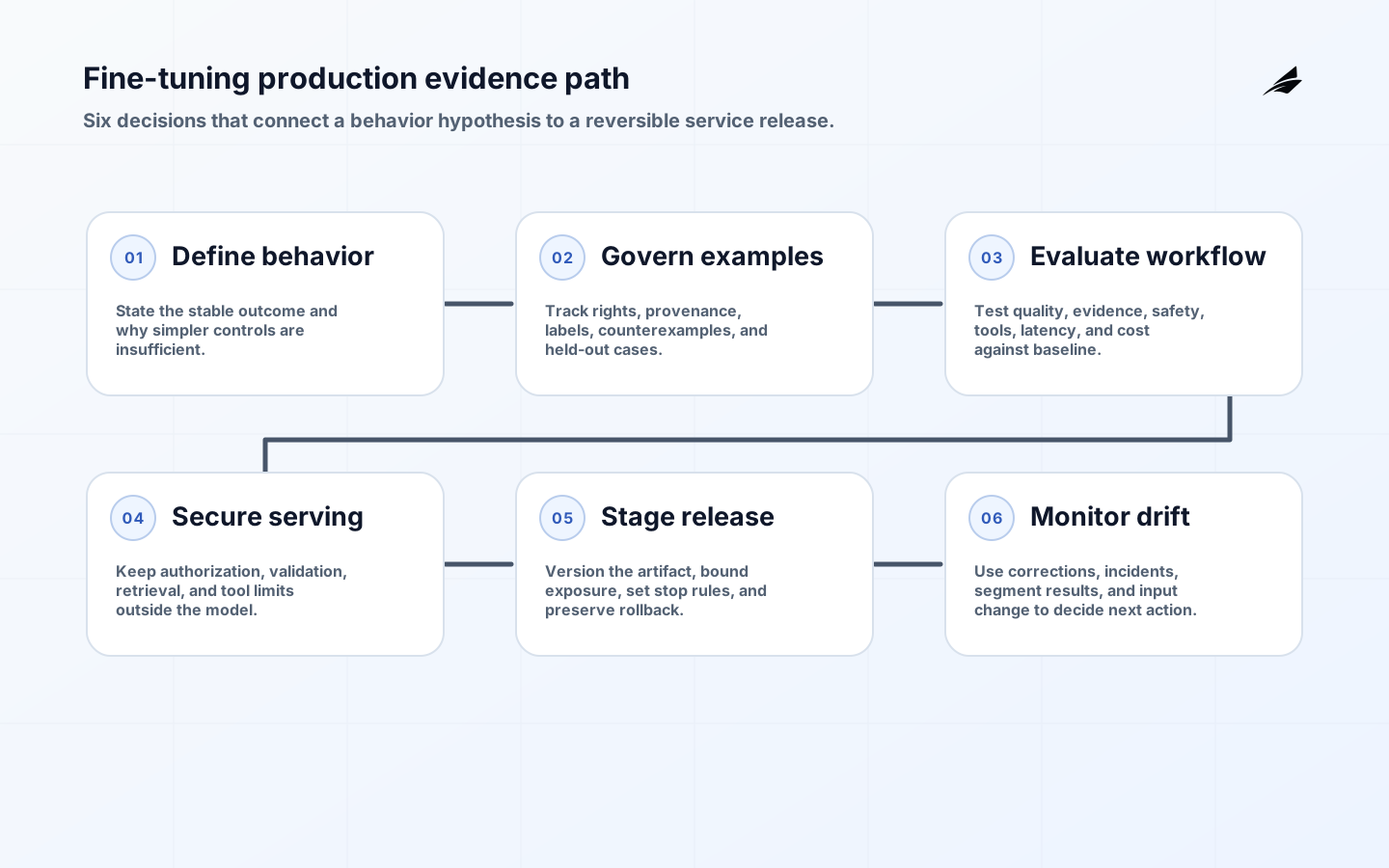
Fine-tuning is often discussed as if it were a model setting. In production, it is a decision about where behavior should live, which evidence may shape it, how the result will be evaluated, and how a team will recover when the new behavior is wrong. A model update can change refusal patterns, formatting, tool choices, tone, latency, and cost at the same time. The NIST Generative AI Profile frames generative AI risk across governance, provenance, testing, and incident disclosure. Those concerns make fine-tuning a lifecycle choice, not a one-time optimization. Compare it with the fine-tuning decisions buyer and CTO guide before committing to a training path.
Set the fine-tuning boundary
Define the problem before choosing a training method. The OpenAI fine-tuning guide documents the training workflow, but the product boundary still determines whether tuning is appropriate. Fine-tuning can be appropriate when a stable behavior must be repeated across many requests, such as a controlled output format, a domain-specific style, or a narrow classification task. It is a weaker answer when the challenge is current knowledge, changing policy, user-specific data, or a missing tool. Retrieval can provide fresher evidence, while a tool call can access an authoritative system. A prompt and evaluation change may solve an issue that does not justify new training data. The boundary should be written as a hypothesis: which behavior should improve, for which cases, and why simpler controls cannot deliver it?

| Need | First option to assess | Why it may be preferable |
|---|---|---|
| Current facts or policy | Retrieval from a governed source | The source can be updated without retraining. |
| A repeated instruction or format | Prompt, schema, or constrained output | The control is easier to inspect and change. |
| A system action | Tool calling with authorization | The model does not need to memorize live state. |
| Stable behavior at high volume | Fine-tuning | The behavior may become more consistent or efficient. |
| User-specific memory | Scoped memory or profile data | Training should not absorb individual private context. |
Build a provenance-ready dataset
Training data is a product asset with a risk profile. Record how each example was collected, who may use it, what policy version applied, how sensitive fields were handled, and why the target answer is acceptable. Remove duplicates, contradictory labels, secrets, irrelevant personal data, and examples that teach an unsafe shortcut. Keep a held-out evaluation set that is not used for tuning. The goal is not the largest dataset; it is a dataset whose examples map clearly to the behavior the product needs. The research foundation for retrieval-augmented generation also reinforces the distinction between knowledge stored in parameters and knowledge supplied as external evidence. That distinction helps avoid training a model with information that belongs in a governed source.
- Write the intended behavior and unacceptable behavior before collecting examples.
- Track source, consent or authorization, policy version, reviewer, and transformation history.
- Separate development, validation, and holdout data so the release score remains meaningful.
- Remove secrets and unnecessary personal information before examples reach a training workflow.
- Preserve counterexamples that show when the model should abstain, ask, or escalate.
Evaluate behavior, not just style
A fine-tuned model can look more polished while becoming less reliable. Evaluate the complete workflow against representative cases, including ambiguous inputs, missing evidence, conflicting instructions, prompt injection, permission failures, and rare high-consequence scenarios. Use exact checks for schemas and classifications, expert rubrics for evidence and policy, and targeted tests for refusals and tool calls. Compare the candidate with the current production baseline rather than asking whether it feels better in isolation. The NCSC secure AI guidance emphasizes security across development and operation; that means keeping security and recovery cases in the evaluation set instead of treating them as a later review.
| Evaluation dimension | Question to answer | Release concern |
|---|---|---|
| Task quality | Does the workflow complete the intended job? | A style improvement can hide a lower completion rate. |
| Evidence use | Are claims supported by the right source? | Training may make unsupported answers sound confident. |
| Safety | Does the system refuse, isolate, or escalate correctly? | Small regressions can create disproportionate harm. |
| Tool behavior | Are calls valid, authorized, and idempotent? | A better answer is not useful if the action is unsafe. |
| Operations | Can the service meet latency and cost limits? | A quality gain that breaks the budget is not deployable. |
Place controls at serving time
Training cannot replace runtime boundaries. Keep authorization, input validation, rate limits, content checks, retrieval filters, tool restrictions, and human approval at the point where a request becomes consequential. The OWASP supply-chain guidance is a useful reminder to keep training inputs, dependencies, and release artifacts under application-level controls. A model may be trained to behave well and still receive malicious context or be given a tool with too much authority. Runtime controls should be independently testable and should fail closed when the model output is malformed or the caller lacks permission.
Release fine-tuning changes with a bounded rollback
Treat a candidate model as a versioned production artifact. Record the data snapshot, training configuration, evaluation results, serving settings, system instructions, dependent retrieval sources, and approval decision. Start with offline tests, then expose a small cohort or a shadow path where outputs can be compared without triggering irreversible actions. Define stop conditions before rollout: a safety regression, an unacceptable error class, a cost ceiling, a latency breach, or a meaningful drop in user correction quality. Rollback must cover the model pointer and any coupled prompt, routing, or schema changes. Releasing a model without a known previous-good version turns an experiment into a live incident.
Operate data and model drift
Fine-tuning does not freeze the problem. User language changes, policies change, the source distribution shifts, and the workflow may acquire new tools or users. Monitor the input mix, abstention and escalation rates, reviewer edits, unsupported claims, safety events, latency, cost, and performance by important segment. Sample real outcomes with appropriate privacy controls and add newly discovered failures to a regression set. A retraining request should identify which observed change it addresses and what evidence will show that the change worked. Avoid periodic retraining on a calendar alone; the cadence should follow drift, risk, and the cost of being wrong.
- Version training data, evaluation cases, model artifacts, prompts, and serving configuration together.
- Compare candidate behavior with the current baseline on both common and consequential cases.
- Monitor segment-level failures instead of relying on one average score.
- Require a rollback owner and tested previous-good artifact before expanding exposure.
- Use incidents and reviewer corrections to improve the dataset and the product boundary.
Decide when not to fine-tune
The strongest fine-tuning decision may be to defer it. If the desired behavior is underspecified, the evaluation set is weak, the data rights are unclear, or runtime controls are absent, training will create false confidence. A retrieval pipeline, schema constraint, prompt revision, model choice, or human review may address the actual bottleneck more directly. Review the opportunity cost: engineering time, retraining operations, validation effort, serving complexity, and the burden of explaining why a behavior changed. Fine-tuning becomes easier to defend when the team can show that the behavior is stable, the data is governed, the improvement is measurable, and the release is reversible. The model evaluation engineering notes can help structure that evidence.
Account for training operations and economics
The cost of fine-tuning includes more than the training run. Teams must collect and label examples, remove sensitive material, maintain evaluation cases, store artifacts, serve the candidate, monitor drift, and repeat the process when behavior changes. Estimate those activities before comparing fine-tuning with retrieval, prompt constraints, or a different model. If a small accuracy gain requires a permanent data pipeline and specialist review, the operational cost may outweigh the benefit. Conversely, a stable high-volume task may justify the investment when the serving cost or consistency improvement is material and measurable.
Human labeling needs a quality plan. Define the rubric, train reviewers, measure agreement, and retain examples that explain ambiguous cases. Do not resolve disagreement by averaging away a policy question. If reviewers cannot agree on the target behavior, the product contract is not ready for training. Include negative examples and safe abstentions so the dataset does not reward confident completion of every request. Revisit labels when policy changes, because a clean dataset can become wrong without any change to the model or code.
Model compatibility is part of the release surface. A change in tokenizer, context window, tool protocol, structured-output behavior, or provider safety layer can alter the effect of the fine-tuned weights. Test the candidate with the same retrieval, system instructions, tool schemas, and post-processing that production will use. Pin the serving configuration and document any provider-specific behavior. The artifact name alone is not enough to reproduce a result; the complete assembled workflow is the unit that deserves approval.
A safe rollback also requires a decision about data written by the candidate. If a model classifies cases, routes tickets, or creates summaries, changing the model pointer does not repair earlier outputs. Retain the model version and evidence used for consequential actions, sample candidate-created records for correction, and define whether downstream consumers can distinguish old and new behavior. The rollback plan should say when to stop using prior outputs, who owns remediation, and how the team communicates a material correction to affected users.
Treat fine-tuning as one option in a portfolio of behavior controls. A prompt can make a policy explicit, a schema can reject malformed output, retrieval can supply current evidence, a tool can enforce authorization, and a human can resolve an ambiguous case. The strongest design often combines these controls with a narrow trained behavior. Review the portfolio whenever a fine-tuning request arrives: what failure is being addressed, where should the control live, and what evidence will show that the chosen layer improved the outcome without moving risk somewhere else?
Serving strategy can change the economics of a fine-tuned model. Compare token usage, latency, batching, caching, routing, and fallback behavior with the current baseline. A candidate that is more accurate but requires a larger model for every request may be better reserved for uncertain cases, with a smaller model or deterministic path handling routine work. Document the routing policy and evaluate the combined system, because a fallback can change the observed quality and safety distribution. Optimization is successful only when it preserves the behavior contract while making the service sustainable.
The approval record for a training change should remain understandable months later. Include the original problem statement, data snapshot, rubric, baseline, candidate, evaluation results, known limitations, serving configuration, approvers, and rollout scope. Link production incidents and user corrections back to the model version that produced them. This evidence supports a rational decision about retraining, rollback, or retirement and prevents the organization from repeating a training experiment without knowing why the previous one was accepted.
Frequently asked questions
Question: What makes an AI approval meaningful? Answer: The reviewer sees the evidence, has authority matched to consequence, and can reject, defer, or reverse the action. Question: When should approval expire? Answer: When the decision's facts, scope, identity, policy, or time window changes.
When is fine-tuning justified?
Answer: Use it when a stable, measurable behavior cannot be achieved economically through prompting, retrieval, tools, or workflow controls and the dataset can support the intended change.
What must a fine-tuning dataset prove?
Answer: It should have provenance, rights, representative coverage, quality checks, sensitive-data controls, versioning, and a clear relationship to the target behavior.
How should a fine-tuned model be released?
Answer: Compare it with the base model on holdout and adverse cases, preserve lineage, canary serving changes, and keep a tested route back to the prior model.
Does fine-tuning keep a model's knowledge current? Usually not; current facts belong in retrieval or tools. Is more training data always better? No. Provenance, label quality, coverage, and counterexamples matter more than volume alone. Can fine-tuning remove the need for guardrails? No. Runtime authorization and validation remain necessary. Read embeddings for AI automation and retrieval pipelines when the problem is changing knowledge rather than stable behavior. Should a team fine-tune for every customer? Usually not; customer-specific context is better handled through scoped data and retrieval unless the behavior itself is stable and authorized. What should be approved first? The behavior hypothesis, data rights, evaluation plan, and rollback path before a training run consumes significant time or creates a deployment expectation.
Key takeaways
- Choose fine-tuning for stable behavior, not for mutable facts or private user context.
- Treat training data as a governed asset with provenance, rights, labels, and counterexamples.
- Evaluate the assembled workflow for quality, safety, tool use, latency, and cost.
- Keep authorization and other high-consequence controls at serving time.
- Release a versioned candidate in bounded steps with explicit stop conditions and rollback.
Conclusion
Fine-tuning moves into production when a behavior hypothesis becomes a maintained service. The team must know why training is the right intervention, where the examples came from, how improvement will be measured, which runtime controls remain independent, and how the previous behavior can be restored. That operating model turns a promising experiment into an accountable production decision.