Fine-tuning for AI automation is a delivery lifecycle, not a training command. Once a team has shown that model customization is the right intervention, it must contract the task and data, create reproducible runs, evaluate an independent holdout, review security and privacy, register the artifact, release it gradually, observe real outcomes, and preserve rollback. The surrounding application still owns retrieval, permissions, tool execution, validation, human approval, and business records. A tuned model should improve a defined behavior without becoming an unreviewed authority.
Use the companion fine-tuning decision framework before this implementation guide. The NIST AI RMF and NIST Generative AI Profile provide lifecycle risk practices that apply to data, model, application, people, and operation. Define owners for task quality, dataset, security, privacy, model release, application integration, and incidents before the first full run.
Contract the task, dataset, and release objective
Write the target behavior in terms reviewers can score. State inputs, expected outputs, allowed variation, prohibited content, tool and retrieval context, languages, latency, and consequence. Name the current baseline and required gain. Fine-tuning may target structured extraction, classification, response style, instruction following, domain terminology, or tool routing; each requires different examples and metrics. Avoid mixing unrelated tasks unless the model and evaluation can show that multi-task training helps rather than causing interference.
Create a dataset contract covering source, rights, purpose, permitted models, data classification, geography, schema, labeling guidance, quality checks, deduplication, split method, retention, deletion, and owner. Track every dataset version. Keep the holdout isolated by source or near-duplicate, not merely random rows. Remove secrets and unnecessary personal data, but preserve enough context to represent deployment. Include difficult, negative, refusal, and abstention examples instead of teaching the model that every input deserves a confident answer.
| Dataset gate | Question | Required evidence |
|---|---|---|
| Authority | May this material be used for tuning? | Owner, license, consent, and purpose |
| Coverage | Does it represent deployment tasks and critical slices? | Distribution and gap analysis |
| Label quality | Can qualified reviewers apply the rubric? | Guideline, agreement, and adjudication |
| Isolation | Is evaluation independent? | Split logic and near-duplicate check |
| Privacy | Is sensitive data necessary and protected? | Classification, minimization, and access |
| Lifecycle | Can records be corrected or deleted? | Version, lineage, retention, and disposal |
Prepare examples without teaching hidden shortcuts
Normalize examples consistently and validate schema before a paid run. Inspect distribution by task, class, source, language, length, difficulty, and outcome. Remove exact and semantic duplicates that would overweight common templates or leak into evaluation. Look for label artifacts: a phrase, file path, author, or formatting pattern that reveals the answer but will not exist in production. Preserve a sample of raw source and transformation history so errors can be traced to collection, preprocessing, or labeling.
Use expert review where labels encode business judgment. Measure agreement and adjudicate disputed cases. If reviewers cannot agree, refine the task or permit uncertainty instead of forcing one truth. Add counterexamples that distinguish nearby classes and examples that should be rejected. Control access to dataset exports and annotation tools, and prevent production prompts from being copied into training without classification. The UK NCSC's secure AI system development guidelines organize secure design, development, deployment, and operation responsibilities.
- Version raw, transformed, labeled, training, validation, and holdout sets.
- Record who or what produced each label.
- Keep critical and rare cases visible during sampling.
- Remove leaked answers, secrets, and irrelevant personal data.
- Include refusals, abstentions, malformed inputs, and adversarial cases.
- Freeze the evaluation set before choosing the winning run.
Run reproducible, isolated tuning jobs
Record base model and revision, tuning method, dataset version, code or API version, hyperparameters, random seed where available, region, compute, start and end times, logs, output artifact, and operator. Use a dedicated project and service identity with least privilege. Restrict network and storage, encrypt data, and separate training from production credentials. Managed services such as Google Cloud's supervised fine-tuning workflow and OpenAI's fine-tuning guide define platform-specific files and jobs; capture those platform records in your own release inventory.
Begin with a small, representative run to validate the pipeline and rubric. Compare multiple configurations only when the evaluation can distinguish them and the search budget is bounded. Watch training and validation behavior for overfitting, but do not select solely on training loss. A lower loss may not improve business quality or safety. Keep failed runs and reasons long enough to avoid repeating unproductive configurations, while applying the dataset's retention policy.
| Run artifact | Why it matters | Release use |
|---|---|---|
| Dataset manifest | Identifies examples and lineage | Reproduce or delete affected model |
| Training configuration | Explains method and parameters | Compare runs and investigate drift |
| Model artifact | Identifies the exact deployable version | Registry, signature, and rollback |
| Evaluation report | Shows quality and risk by slice | Release gate and approval |
| System card | Documents purpose, limits, owners, and controls | Operator and reviewer reference |
| Change record | Connects model to application release | Deployment, incident, and retirement history |
Evaluate the tuned system against baseline and alternatives
Run the same holdout through the current production system, improved prompt or retrieval alternative, untuned candidate base model, and tuned model. Score task quality, unsupported content, schema validity, safety, privacy, robustness, fairness where relevant, latency, throughput, and cost. Segment by source, language, task, length, risk, and user group. Use repeated samples when generation variability matters. Inspect errors manually and preserve example identifiers so the data or prompt owner can act.
Evaluate the complete workflow. A tuned classifier may be accurate while the interface encourages blind acceptance; a tool-routing model may choose correctly but pass unsafe arguments; a concise model may omit required evidence. Test authorization, retrieval, validation, human review, fallback, and system-of-record update. Run privacy and memorization probes appropriate to the data. Evaluate prompt injection and unexpected input even if fine-tuning was not intended as a security control.
Use explicit fine-tuning release gates
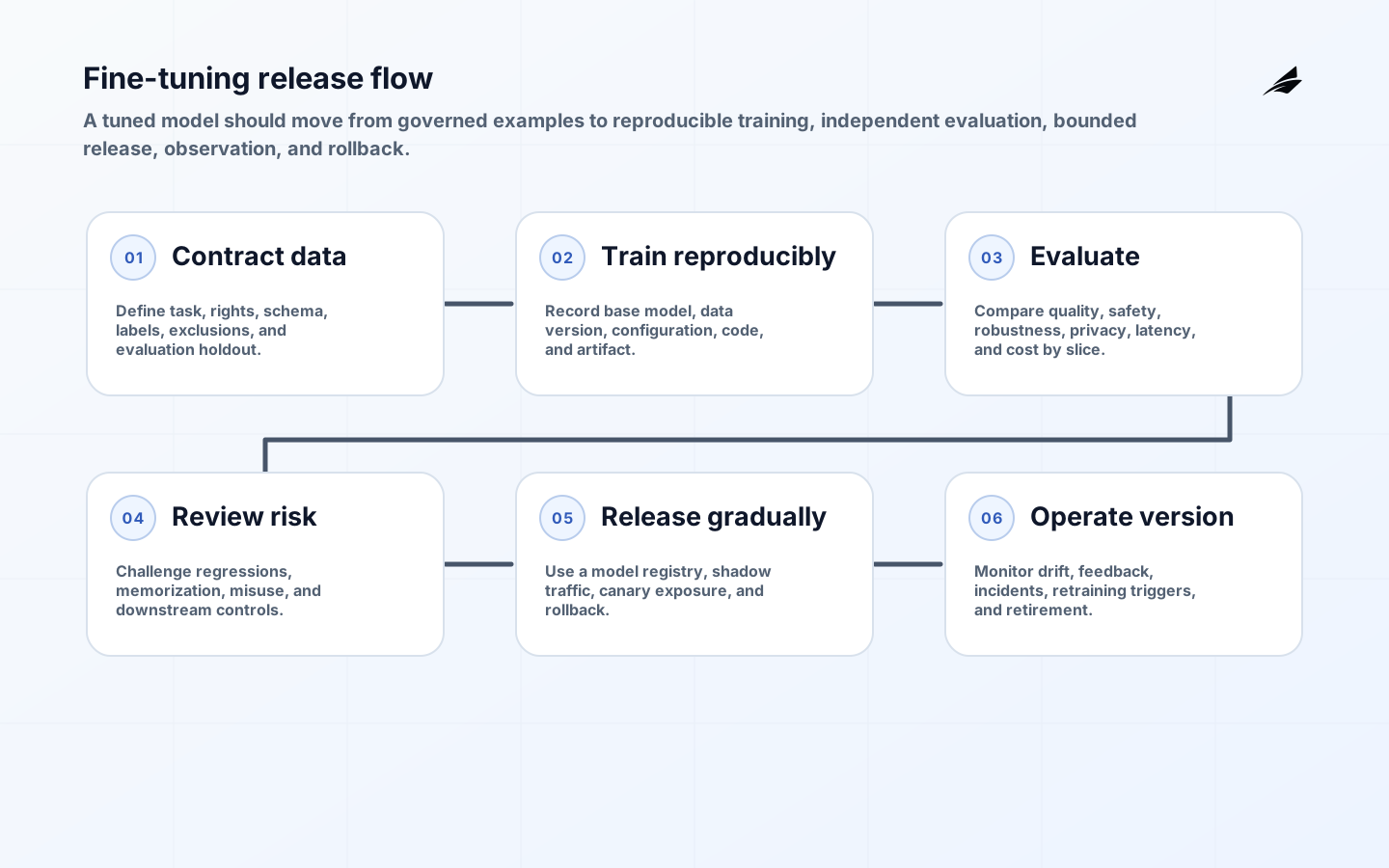
The release flow connects dataset authority to model operation. Each gate should produce a signed or attributable decision: data accepted, run reproducible, evaluation threshold met, risk reviewed, rollout authorized, and operating owner ready. Store the model in a registry with status, base, dataset, evaluation, intended use, owner, and retirement date. Do not let an experiment endpoint become production merely because an application can call it.

Release gradually with a model and application rollback
Begin with offline evaluation, then shadow traffic where lawful, reviewer assistance, a small internal group, or a canary cohort. Route a stable percentage by recorded policy so results can be compared. Define stop conditions for quality, safety, latency, cost, correction, escalation, and user harm. Keep the previous model, prompt, parser, and application contract deployable. If the tuned model emits a different structure or tool behavior, application rollback may be as important as model rollback.
Require human review at the consequence boundary, not merely during the pilot. The model should not gain new authority because its benchmark improved. Use deterministic validation and permissions for every downstream action. Calibrate confidence or uncertainty on deployment data and allow abstention. Document known limitations for operators and users. The maintained prompt library guide helps version runtime instructions separately from model weights.
Observe production behavior and manage change
Record model and prompt version, request class, retrieval and tool context, validation result, latency, token or compute use, policy decisions, human correction, and downstream outcome with appropriate privacy controls. The OpenTelemetry generative AI semantic conventions provide common telemetry concepts; use them carefully because raw prompts and outputs may contain sensitive data. Prefer identifiers, classifications, scores, and protected sampled traces over indiscriminate content logging.
Monitor input and outcome distributions, evaluation samples, schema failures, unsupported claims, refusal, safety events, override, appeals, latency, cost, and drift by critical slice. Use the LLM observability checklist to connect traces with evaluations and human review. Trigger investigation when upstream data, business policy, base models, providers, prompts, tools, or user populations change. Do not automatically retrain on raw user feedback; validate and govern feedback before it becomes training data.
Plan retraining, incident response, and retirement
Define retraining triggers and a minimum evidence window. Every new dataset and run repeats the contract, evaluation, review, and release gates. Preserve comparability with prior versions while adding tests for newly observed failures. Incident plans should support disabling the tuned route, restoring the baseline, blocking a data class, locating affected outputs, revoking credentials, and deleting artifacts when required. Link incidents back to dataset records, model versions, and application releases.
Retire a tuned model when the task disappears, a base model performs as well with simpler controls, rights expire, maintenance cost exceeds value, or a provider ends support. Stop traffic, retain required evidence, revoke serving access, apply dataset and artifact disposition, and update documentation. Verify no background workflow still references the endpoint. Retirement is a successful simplification when the customized artifact no longer earns its operating burden.
Key takeaways
- Contract the task, required gain, and dataset before training.
- Preserve rights, lineage, split integrity, label quality, and deletion behavior.
- Record enough run metadata to reproduce and investigate each artifact.
- Evaluate the full system and critical slices against the current baseline.
- Release gradually with explicit stop conditions and rollback for model and application.
- Monitor real outcomes, govern feedback, repeat gates for retraining, and plan retirement.
Frequently asked questions
Can production conversations be used for retraining?
Only under a defined lawful purpose, notice or consent where required, access controls, minimization, quality review, and retention policy. Remove secrets and unrelated personal data. Human feedback is not automatically a correct label.
Does a small team need a model registry?
It needs the capability, even if implemented simply: exact artifact, base model, dataset, configuration, evaluation, owner, deployment status, rollback, and retirement. A managed registry or controlled metadata store can provide it.
How often should a tuned model be reevaluated?
Evaluate before release, after material model or workflow changes, on a risk-based schedule, and when monitoring shows drift or incidents. Use fresh representative samples while preserving a stable benchmark for comparison.
Conclusion
Fine-tuning becomes professional engineering when the organization can explain the data, reproduce the run, compare the result, control the release, observe the outcome, and reverse the change. Keep model behavior inside an application that still enforces permissions, validation, evidence, and accountable approval. A governed dataset and release lifecycle make customization useful; without them, a better demonstration can become a harder production system.