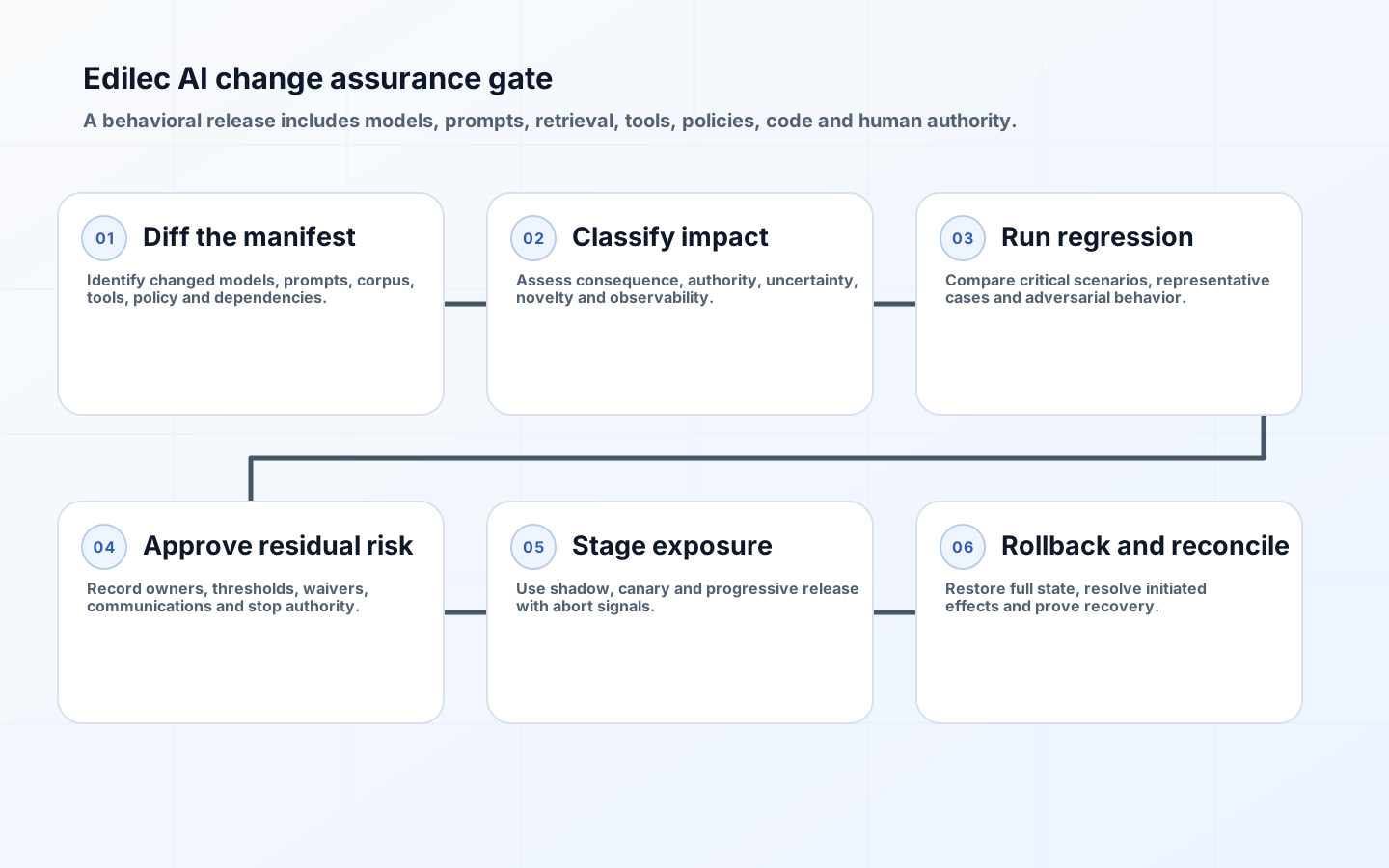
AI change management controls every component that can alter system behavior, not just application code. A provider can silently route to a new model; a prompt edit can change refusal behavior; a retrieval re-index can expose stale or unauthorized content; a tool schema can expand authority; and a policy threshold can increase automatic approvals. Each may leave the executable unchanged while materially changing outcomes. The change record must therefore describe the behavioral system and the evidence needed to release it.
The method below complements Edilec's model-monitoring guide, LLM evaluation framework, and prompt-library governance guide. Monitoring discovers what escaped; change control creates a defensible decision before exposure and a known route back when evidence fails.
Define the complete AI system change unit
Maintain a deployable manifest containing model and provider version, system and developer prompts, retrieval corpus snapshot and embedding configuration, tool schemas and endpoints, safety filters, evaluation suite, routing rules, policy versions, application code, and infrastructure. Link each production inference or transaction to the manifest version. Without that identity, teams cannot compare releases, investigate incidents, or know whether rollback restored the prior behavior.

The NIST GenAI Profile addresses risks that emerge across the generative-AI lifecycle. Use that breadth to define change sources. Include data curation, fine-tuning, grounding, model access, user interface, tool authority, human review, and monitoring. Treat a provider's announced or detected model update as an external change request even when the customer cannot approve its deployment; the organization still controls continued use, routing, compensating safeguards, and exit.
| Change type | Behavioral risk | Required comparison | Rollback object |
|---|---|---|---|
| Model or route | Capability, calibration, safety and latency shift | Representative quality, safety, cost and tool-selection suite | Prior pinned model or alternate route |
| Prompt or policy | Instruction priority and boundary change | Target cases, adversarial cases and refusal review | Versioned prompt/policy bundle |
| Retrieval corpus | Provenance, freshness, permission and injection change | Retrieval relevance, ACL probes and poisoned-document cases | Prior index snapshot and corpus manifest |
| Tool or schema | New authority, arguments or side effects | Authorization, malformed input, sequence and failure tests | Prior tool registration or disabled capability |
| Threshold or human gate | More automated decisions or reviewer burden | Outcome distribution, overrides and capacity simulation | Prior threshold and queue configuration |
Classify changes by behavioral impact and uncertainty
Use standard, significant, and emergency classes. Standard changes are low-impact, repeatable, and covered by a preapproved procedure. Significant changes affect a consequential outcome, data boundary, model family, authority, evaluation threshold, or regulatory assumption. Emergency changes address active harm or critical vulnerability under expedited authority. Add novelty and observability: a small edit with unclear effects or weak production detection may deserve significant review. Never let line count determine AI change risk.
The requester should state intended outcome, affected use cases, components, risk scenarios, evidence plan, migration, monitoring, rollback, and communications. An independent reviewer challenges classification. Use automation to identify dependent systems and required approvals from the manifest. NIST SP 800-218A provides generative-AI secure-development practices that can inform provenance, protection, testing, and release evidence. Map only relevant practices and preserve local accountability.
Build regression evidence around decisions, not averages
Create a stable core suite for contractual and policy requirements, a release-specific suite for expected effects, adversarial cases for misuse and prompt injection, and sampled production cases representing actual distributions. Evaluate task success, groundedness, harmful content, subgroup performance, refusal quality, tool selection, argument validity, latency, cost, and human override as relevant. Report paired differences and failure examples. A higher overall score cannot offset a newly catastrophic error in a protected scenario.
Control evaluation-set changes separately. Version cases, expected properties, graders, rubrics, and model-based evaluator prompts. Review contamination and evaluator drift. Require domain experts for high-consequence judgments and resolve disagreement transparently. The NIST AI RMF Playbook can provide prompts for mapping, measurement, and management activities; the release decision should still cite the organization's specific thresholds and accepted residual risks.
Approve, stage, and observe the release
Approval should match risk: component owner confirms implementation, evaluation owner confirms evidence, security reviews authority and data boundaries, business owner confirms outcome, and risk or legal owners address high-impact obligations. Segregate requester from final approval where consequence warrants it. The release record should make unresolved failures visible and time-bound. A waiver needs scope, compensating controls, accountable acceptance, expiry, and a trigger for immediate reconsideration.
Use shadow evaluation, tenant or user canaries, limited authority, and progressive traffic where architecture permits. Predefine abort thresholds and monitor both technical and business outcomes. Compare to a concurrent baseline to avoid blaming the release for unrelated demand changes. Communicate material changes to operators and customers using contract criteria. The Commission's GPAI guidance underscores information needs along the model value chain; contracts should secure the notices and documentation needed for downstream change control.
Prove rollback and manage external provider changes
Rollback must cover state and authority, not only code. Restore the prior manifest, model route, prompts, index, tool registration, policies, and thresholds; handle transactions already initiated under the new version; and verify that stored outputs or caches do not preserve harmful behavior. Exercise rollback before high-risk releases and record restoration time. If a provider removes an old model, test the approved alternate route before the deadline rather than calling migration a rollback plan.
| Gate | Required evidence | Reject or pause when | Accountable role |
|---|---|---|---|
| Scope | Complete manifest diff and dependent use cases | Unknown consumer or unversioned component exists | System owner |
| Risk | Scenarios, classification and obligations | Material impact lacks assessment | Risk owner |
| Evaluation | Paired results, failures and reviewer sign-off | Critical threshold fails or dataset is invalid | Evaluation owner |
| Release | Canary, monitoring, abort and rollback plan | No authoritative rollback or alert path | Operations owner |
| Closure | Observed outcomes and issue reconciliation | Canary anomalies remain unexplained | Business owner |
Measure control quality and govern emergency changes
Track unplanned-change detection, percentage of releases linked to complete manifests, evaluation failures found before production, rollback exercise success, emergency-change aging, provider notices received before impact, waivers past expiry, and incidents tied to change. Avoid rewarding change volume or zero rollbacks; those measures encourage concealment. Review false confidence cases where tests passed but outcomes degraded, then improve coverage and release segmentation.
Emergency authority should be narrow and logged. The commander can disable a tool, pin a route, strengthen review, or remove a source to stop active harm. Preserve the before-state where safe, state the hypothesis, run minimum critical tests, monitor intensely, and require retrospective review within a short policy-defined period. Convert the emergency state into an approved release or roll it back. Emergency cannot become a permanent route around evaluation and owner acceptance.
Coordinate change windows and separate incompatible releases
Maintain a calendar of provider migrations, corpus refreshes, policy updates, tool releases, and application deployments for material systems. Avoid changing the model, prompt, retrieval index, and evaluator simultaneously unless urgent; otherwise a regression has no clear comparison or rollback target. When combined change is necessary, use a staged plan that can attribute effects. Freeze unrelated releases during serious incident containment. Coordinate with business cycles: a payroll, clinical, or financial-close assistant may require narrower windows and rehearsed manual fallback. Record downstream consumers and customer notice commitments. After release, compare observed traffic and outcomes with evaluation assumptions; an apparently successful deployment can still be invalid if adoption or input distribution differs materially.
A release dossier should be reproducible after the team changes. Store the approved manifest, request, classification, risk scenarios, evaluation dataset and runner versions, results, reviewer comments, waivers, deployment events, observed canary metrics, communications, and closure decision under one release identity. Reference protected datasets rather than copying them into broad tickets. Define retention according to consequence, contracts, and regulation. Periodically select a production outcome and trace it backward to the exact release, then select a release and trace it forward to exposed users and observed results. Failure in either direction is a configuration and evidence gap, even when current quality appears acceptable.
Define who may pause a release. Evaluation, security, operations, legal, and business reviewers should be able to raise a documented stop when a critical threshold, obligation, or rollback assumption fails, without needing to persuade the requester privately. Establish an escalation route for disputed stops and protect urgent risk communication from delivery incentives. Record the resolution and supporting evidence. A formal approval chain is weak when reviewers believe that only a senior sponsor can say no.
Key takeaways for AI change management
- Version the complete behavioral manifest so every outcome can be tied to a release.
- Classify by consequence, authority, uncertainty, and observability rather than code size.
- Use paired, scenario-based regression evidence and never let averages hide critical failure.
- Stage exposure with predefined abort thresholds and prove full-state rollback.
- Treat provider updates as external changes that trigger downstream evaluation and decisions.
FAQ about AI system change control
Does every prompt edit require a committee? No. Preapprove bounded low-risk changes with automated tests and auditability. What if a provider updates without notice? Detect behavior and version shifts, route through an alternate model where possible, and enforce contract notice rights. Is monitoring a substitute for pre-release evaluation? No; it is a complementary control for distribution change and unknown failures. Can an evaluation suite change in the same release? Yes, but version and review it independently so weaker tests do not manufacture an apparent improvement.
Conclusion: control the behavior that users actually receive
AI releases are configurations of models, knowledge, tools, policies, and human authority. Managing only source code leaves the most consequential changes outside review. A complete manifest, risk-based classification, decision-centered regression evidence, staged exposure, and exercised rollback make change governable even when some components come from external providers. The goal is not to prevent adaptation; it is to ensure that every meaningful behavioral shift has an owner, evidence, and a reversible production decision.