A prompt library stops being a folder of useful prose when several teams depend on it. At that point, each prompt is part of an application contract: it expects specific inputs, runs with a particular model and configuration, produces an output shape, invokes policies and must meet measurable acceptance criteria. A change that reads better to one author can break extraction, increase refusals, alter tool behavior or quietly remove a safety instruction elsewhere.
The goal is not to centralize every sentence people type into a chat product. It is to manage prompts that influence repeatable business or product behavior. Those prompts need an owner, stable identity, version history, test evidence, controlled release and runtime observability. A good library makes the approved path easier than pasting a prompt from an old message, while leaving room for disciplined experimentation.
Decide what belongs in the prompt library
Inventory prompts by use case rather than by author. Include system and developer instructions, reusable templates, few-shot examples, output schemas, tool descriptions, routing prompts and evaluator rubrics that ship with an application. Exclude personal scratch prompts unless they are promoted into a shared workflow. This boundary keeps the catalog useful and clarifies when a prompt change requires review.
| Asset | Library treatment | Why |
|---|---|---|
| Production system instruction | Version, test and release | It defines persistent application behavior |
| Reusable task template | Define variables and output contract | Multiple callers depend on stable inputs and results |
| Few-shot examples | Version with the prompt and check data rights | Examples materially influence outputs and may contain sensitive data |
| Evaluator rubric | Version separately and calibrate | Changing the judge can make trend lines incomparable |
| One-off exploration | Keep in a sandbox until promoted | Early iteration should not burden production governance |
Treat each prompt as a typed interface
A reusable prompt needs more than a name and text. Define required and optional variables, their types, allowed values, size limits, trust level and escaping or serialization rules. Describe the expected output with a machine-validated schema where possible. Record the supported model family, inference settings, tool set, context sources, token budget, language and fallback behavior. The runtime should reject missing or unexpected inputs before calling the model.
Separate stable instructions from dynamic data. Message roles or structured sections can make that boundary clearer, but they do not make untrusted content safe. OWASP notes that prompt injection arises because natural-language instructions and data can share the model's context. Treat retrieved pages, emails, uploaded documents and tool output as untrusted inputs. Do not place secrets in prompts, and do not rely on wording alone to enforce authorization or tool limits.
Define a minimum record for every managed prompt
| Field | Purpose | Example |
|---|---|---|
| Stable ID and owner | Find the asset and the accountable team | support.reply-draft owned by Support Platform |
| Purpose and non-goals | Prevent reuse outside the evaluated context | Draft replies; never send or change an account |
| Input contract | Validate variables and trust boundaries | question, approvedcontext, customerlocale |
| Output contract | Enable parsing and downstream validation | JSON with answer, citations and escalation_reason |
| Runtime configuration | Support reproducibility | Model, parameters, tool policy and context limit |
| Evaluation suite | Define promotion evidence | Regression, edge, safety and refusal cases |
| Release metadata | Trace production behavior | Version, change reason, approver and deployment time |
Names should communicate domain and task, not the current model or employee. A stable ID such as finance.invoice-extraction remains useful when the implementation changes. Human-readable descriptions should say what the prompt does, what it must not do and who consumes the result. Tags can help discovery, but avoid using free-form tags as the only ownership or release mechanism.
Use immutable versions and controlled aliases
Never overwrite the production prompt in place. Create an immutable version with a change description and link it to test results. A deployment alias such as staging or production can point to a version, but changing that alias is a release event. MLflow's Prompt Registry documents this pattern with immutable versions, metadata, model configuration and aliases; Google Cloud also exposes prompt version resources. Teams can implement the same principles in source control, a registry or both.
Pin production workloads to a resolved version and log that identifier with every trace. Loading latest at runtime makes rollback and incident analysis unreliable. Keep model and tool configuration linked to the release because identical words can behave differently across models or available tools. When changing a model, run the prompt's suite as if the prompt itself changed. Provider upgrades and context-window changes are dependency changes, not invisible infrastructure maintenance.
- Require a concise reason for every new version.
- Show a semantic diff for instructions, examples, variables and output schema.
- Resolve environment aliases to immutable versions at deployment time.
- Retain the previous production version and a tested rollback procedure.
- Log prompt version, model snapshot, parameters, tools and application release together.
- Use access controls so experimentation cannot silently alter production.
Make evaluation the release gate
Prompt review by reading is necessary but insufficient. Begin with explicit success criteria and representative examples, a sequence reflected in first-party guidance from Anthropic, OpenAI and Google. Build a dataset from real task categories, known failures and deliberately difficult cases. Include expected structured fields or reference answers where they exist, plus rubrics for qualities that require judgment. Keep a held-out set so authors do not optimize only for familiar examples.
Evaluation should compare a candidate with the current production version, not merely ask whether the candidate looks acceptable. Measure task correctness, schema validity, groundedness where context is supplied, refusal behavior, latency and cost. Add security cases for direct and indirect prompt injection when the application processes untrusted content. Human reviewers should calibrate subjective rubrics and inspect disagreements with automated judges. An aggregate win must not hide a severe failure in a high-risk slice.
| Test layer | Question | Release evidence |
|---|---|---|
| Contract | Are variables valid and outputs parseable? | Schema and boundary tests pass |
| Task quality | Does the prompt solve representative cases? | Candidate meets per-slice thresholds and baseline |
| Safety and security | Does it resist misuse and preserve policy behavior? | Adversarial and prohibited-use cases reviewed |
| Operational | Are latency, token use and failure rates acceptable? | Load and cost envelope checked |
| Human review | Are outputs useful to the people doing the work? | Domain reviewers approve sampled cases |
Create a lightweight review and release workflow
Governance should be proportional. A spelling fix in a low-risk summarizer does not need the same committee as a prompt that proposes account actions. Define change classes. Routine changes may require peer review and automated tests; changes to policy language, tools, sensitive-data handling or high-impact decisions should include security, domain or risk owners. The prompt owner remains accountable for quality after release.
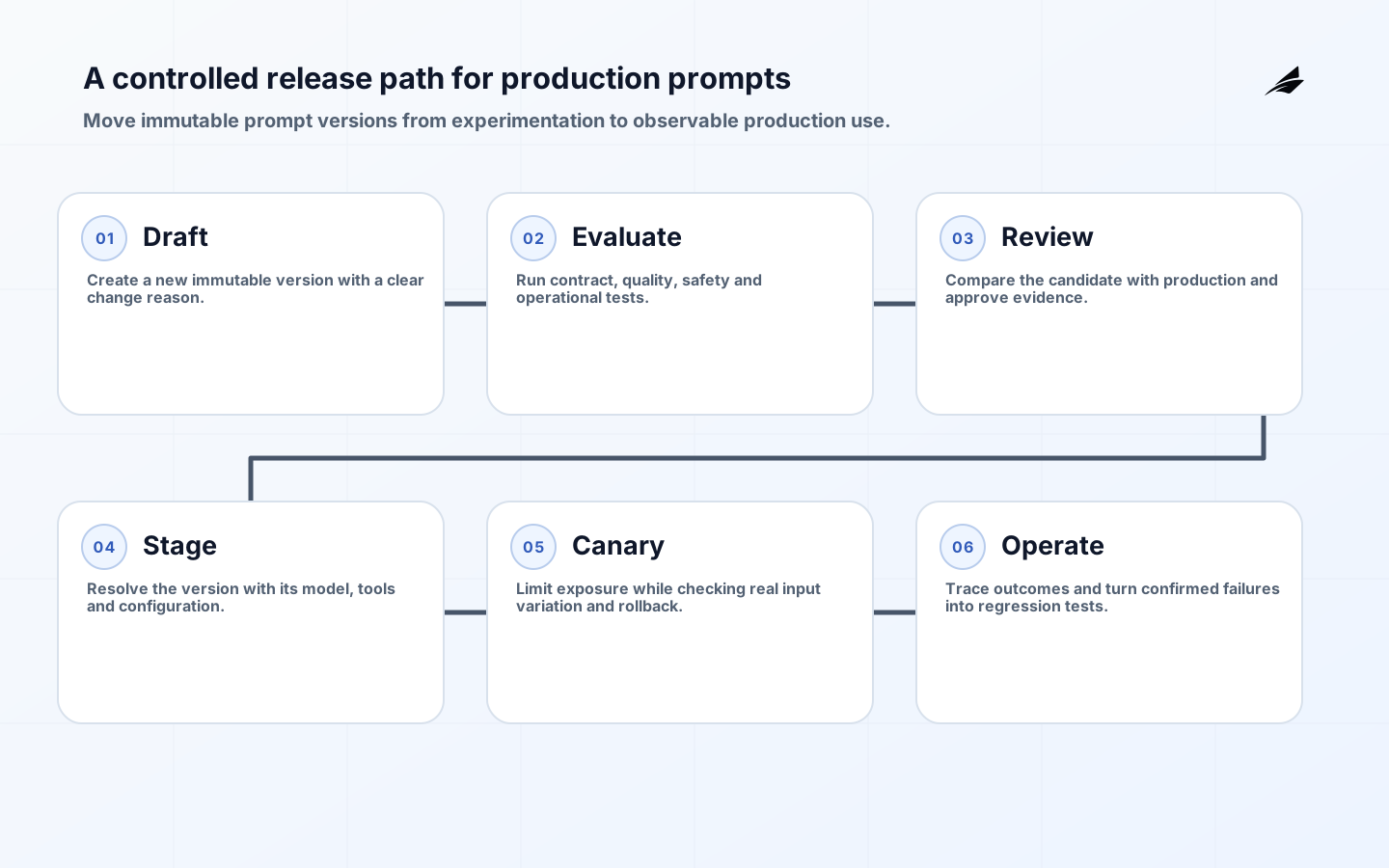
A practical flow is draft, sandbox evaluation, peer review, staging, canary, production and observation. Promotion records the candidate version, baseline, datasets, results, reviewers and rollback target. Canary traffic should be small enough to contain harm and large enough to expose real input variation. Do not let users unknowingly receive inconsistent high-impact decisions during an experiment; use shadow evaluation or explicit safeguards where live comparison would be inappropriate.
Observe prompts as production dependencies
Log the prompt ID and resolved version, model, request category, validation result, latency, token use, tool calls, output status and user correction signal. Redact or minimize sensitive content and follow retention policy. Dashboards should segment by version and use case, otherwise a busy successful workflow can conceal a failing one. Alerts should detect schema failures, refusal spikes, tool-denial spikes, cost changes and drift in outcome distributions.
Feedback needs structure. A thumbs-down without a reason rarely tells an author what to change. Capture categories such as missing context, wrong fact, poor format, unsafe suggestion, unnecessary refusal and tone mismatch. Route urgent safety issues separately from ordinary quality work. Add confirmed failures to the evaluation suite before releasing the fix, preserving a record of which regression each case protects.
Migrate from scattered prompts without stopping delivery
Inventory where prompts currently live: source files, workflow tools, provider consoles, spreadsheets and personal documents. Rank them by production use and consequence. For the first few high-value prompts, capture current text and runtime settings, assign an owner, define the interface, collect representative traces and create a baseline evaluation. Register the existing behavior before trying to improve it. That separation makes migration risk visible.
Next, replace embedded text with a stable prompt reference in one application, pin an immutable version and verify rollback. Expand the pattern through shared client libraries or deployment tooling, not a rule that every team must adopt a complex platform immediately. Deprecate duplicates with redirects and owners rather than deleting them silently. Quarterly catalog review can archive unused assets, confirm ownership and identify applications that still bypass the managed path.
Key takeaways
- Manage prompts that drive repeatable application behavior, not every personal experiment.
- Define typed inputs, structured outputs, supported runtime configuration and non-goals.
- Use immutable versions, controlled environment aliases and production pinning.
- Compare candidates with the production baseline on representative and adversarial cases.
- Trace versions at runtime and turn confirmed failures into permanent regression tests.
Frequently asked questions
Should prompts live in source control or a prompt registry?
Either can provide immutable history when used carefully. Source control fits engineering-led releases and code review; a registry can improve discovery, controlled aliases and collaboration with domain specialists. Many teams use both, with one declared source of truth and automated synchronization. The essential properties are ownership, versioning, evaluation lineage, access control and reproducible deployment.
Who should own a production prompt?
Assign one accountable product or engineering team, with named domain and risk reviewers where needed. A central AI platform team can provide tooling and standards, but it usually should not own the business meaning of every prompt. Ownership includes responding to incidents, maintaining tests and approving lifecycle changes.
Does changing the model require a new prompt version?
At minimum it requires a new evaluated release configuration. Whether the prompt text receives a new version depends on the registry design, but the deployed combination of prompt, model, parameters and tools must be identifiable and reproducible. Run the complete suite because model behavior can change without any text change.
Can system prompts safely contain secrets or confidential policy?
Do not treat a system prompt as a secret store. Applications may expose prompt content through logs, debugging, misconfiguration or injection attacks. Keep credentials in a secrets manager, enforce policy in code and disclose only the instructions and data needed for the current task.
Conclusion
A prompt library survives growth when it behaves like a dependable software supply chain. Stable interfaces reduce accidental coupling, immutable versions make releases traceable, evaluations turn edits into evidence and runtime telemetry reveals what happens after launch. Start with the prompts that carry real operational consequence, register their current behavior and build a release habit that teams can follow without slowing ordinary experimentation.