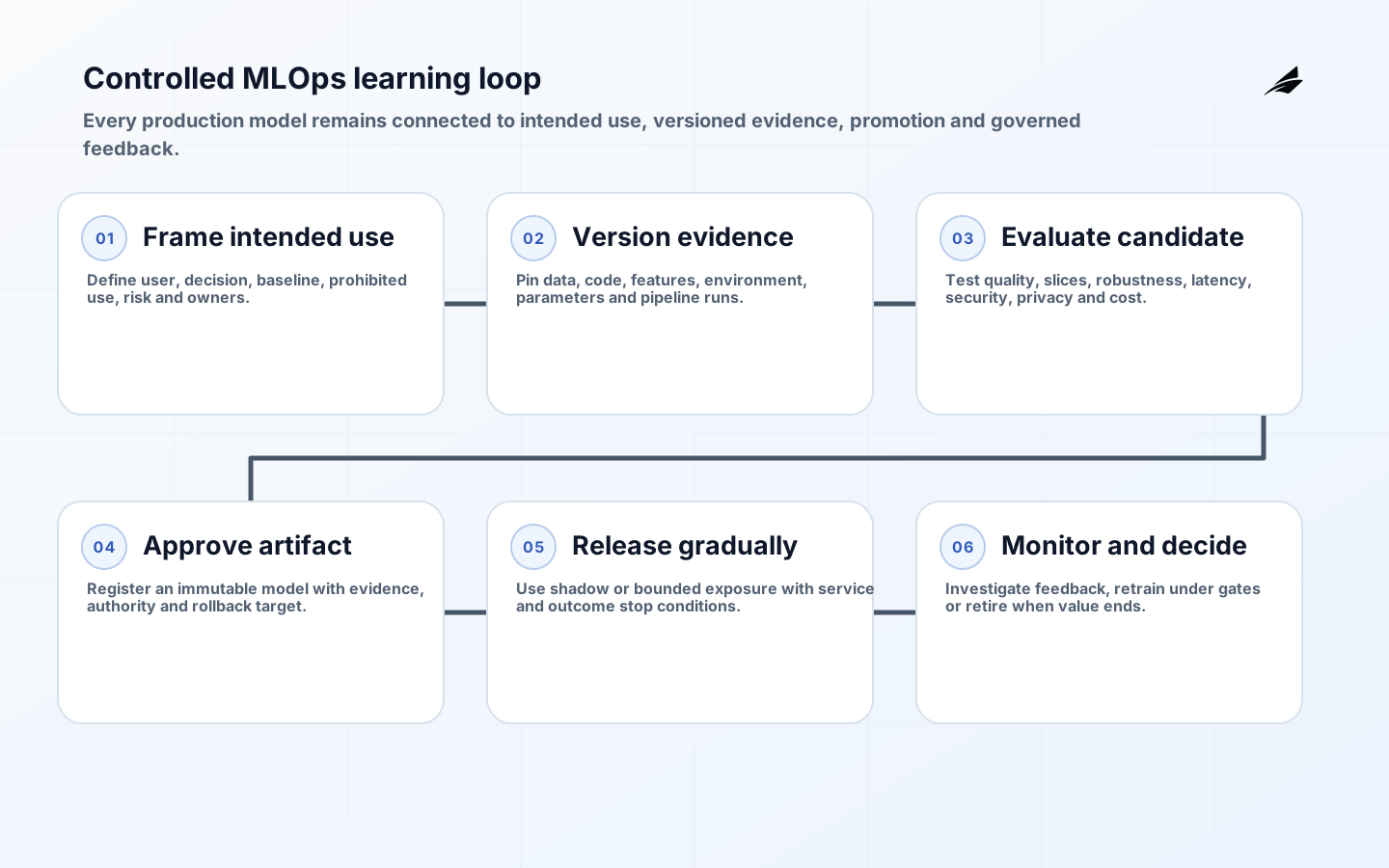
AI services MLOps is the engineering and governance system that moves a model from experiment to controlled production behavior. It includes data, code, features, training, evaluation, registry, deployment, monitoring, feedback, security and retirement. A model endpoint without those capabilities can serve predictions, but it cannot reliably explain which artifact is active, detect degradation, reproduce a decision or recover after a bad release.
This guide helps buyers and technical leaders define scope, cost, risk and delivery. Use it with the MLOps implementation checklist, MLOps production FAQ and AI services scope guide. MLOps should be proportional: a stable quarterly batch model does not need the same automation as a high-volume decision service, but both need ownership and reproducible evidence.
Scope the decision, risk and operating cadence
Define intended use, user, prediction, intervention, prohibited use and consequence of error. Establish business and model baselines, evaluation slices, latency, availability, freshness and explanation needs. Classify whether the system is advisory, automated or safety-related and identify affected people. Record applicable legal and contractual duties. NIST AI RMF organizes risk work around Govern, Map, Measure and Manage, with governance crossing the complete lifecycle.
Choose retraining and release cadence from data change, label availability, value and risk. Automatic continuous training is not a maturity requirement for every system. Google Cloud's MLOps guidance distinguishes manual processes, automated ML pipelines and CI/CD pipeline automation; the appropriate level depends on frequency and complexity. A system that rarely changes may benefit more from a reproducible manual approval than an unattended retraining pipeline.
| Scope area | Decision to record | Evidence | Owner |
|---|---|---|---|
| Intended use | Allowed users, context and intervention | Use-case and risk assessment | Product owner |
| Data | Sources, rights, labels and freshness | Contract, lineage and quality report | Data owner |
| Model | Baseline, metrics and slices | Evaluation package | Model owner |
| Release | Approval, exposure and rollback | Registry and deployment record | Service owner |
| Operation | Monitoring, feedback and incident path | Dashboard and runbook | Operations owner |
| Retirement | Replacement, records and deletion | Exit and retention decision | Governance owner |
Design a traceable model lifecycle
Version source code, pipeline definitions, environments, data references, feature logic, parameters, model artifacts and evaluation results. Assign each run a stable identifier and record producer, time, inputs and outputs. A registry should distinguish candidate, approved, deployed and retired state rather than act as an artifact folder. Keep the deployed endpoint or batch job linked to exact model, preprocessing, schema and policy versions.
Separate experimental notebooks from production pipeline components while preserving a path to reproduce useful research. Validate data before training, validate models against a baseline and required slices, and validate serving compatibility before exposure. Use the same feature definitions for training and serving where feasible to reduce skew. Define behavior when features are missing, stale or outside range. Pipeline automation should stop on failed evidence instead of publishing the newest artifact by default.
Estimate full lifecycle cost and scaling drivers
Separate discovery, data acquisition, labeling, experimentation, platform setup, integration, validation and change management from recurring storage, training, inference, observability, human review, support and reassessment. Include security, privacy, legal and domain-expert time. For external models, include token or request pricing, rate limits, evaluation, provider changes and fallback. For self-hosted models, include accelerators, capacity headroom, patching and specialized operations.
Model unit cost per useful prediction, reviewed case or completed business outcome, not only compute per request. Low model cost can be overwhelmed by feature retrieval, logging or manual review; expensive inference may be justified if it replaces a costly decision with controlled accuracy. Forecast average and peak demand, batch size, model count, retraining frequency, retention and regions. Add a cost guardrail to experiments and production so unexpected loops cannot consume an open budget.
| Cost driver | Scaling unit | Hidden component | Control |
|---|---|---|---|
| Training | Runs, data volume and accelerator time | Failed experiments and tuning | Budgets and early stopping |
| Serving | Requests, tokens or batch records | Feature lookup and headroom | Autoscaling limits and caching |
| Data | Stored versions and transfer | Labels, lineage and deletion | Retention and dataset ownership |
| Evaluation | Models, slices and test cases | Domain review and red-team work | Risk-based evaluation plan |
| Monitoring | Predictions and retained signals | Sensitive-log controls | Sampling and tiered retention |
| Operations | Models and incident load | Retraining and provider changes | Service catalog and ownership |
Control data quality, rights and feedback
Document source, permitted use, collection period, population, exclusions, labels, transformations, quality and retention. Prevent train-test leakage and evaluate time or entity splits that reflect deployment. Test meaningful subgroups and edge conditions. For feedback data, distinguish observed outcomes from proxy labels and operator choices. A model can reinforce its own decisions if only selected cases receive ground-truth review. Preserve an unbiased sampling or audit path where practical.
Minimize personal and sensitive data, enforce access and support correction or deletion obligations. Track lineage to the model and downstream decisions. Prevent secrets and unrestricted records from entering prompts, features or telemetry. Validate third-party dataset and model licenses. If synthetic data is used, show what properties it preserves and where it fails. Data contracts should identify schema, quality, timeliness and responsible producer; consumer pipelines should reject incompatible change explicitly.
Secure the software, model and supply chain
Apply NIST SSDF practices to pipeline code, images, dependencies and infrastructure: protect source, review changes, build traceable artifacts, manage vulnerabilities and respond to findings. Threat-model data poisoning, model or prompt manipulation, artifact substitution, model extraction, unsafe serialization, exposed endpoints and compromised registries. Sign or verify artifacts where appropriate, isolate training and serving identities, restrict egress and separate production approval from experiment authority.
Evaluate risk beyond aggregate accuracy: validity, reliability, security, resilience, privacy, harmful bias, transparency and accountability may matter according to context. The EU AI Act classifies systems by intended purpose and sets obligations for some high-risk uses, including risk management, data quality, logging, documentation, human oversight, robustness and cybersecurity. Obtain applicable classification and evidence requirements early; a late compliance review can require redesign of data and logging.
Release models through explicit promotion gates
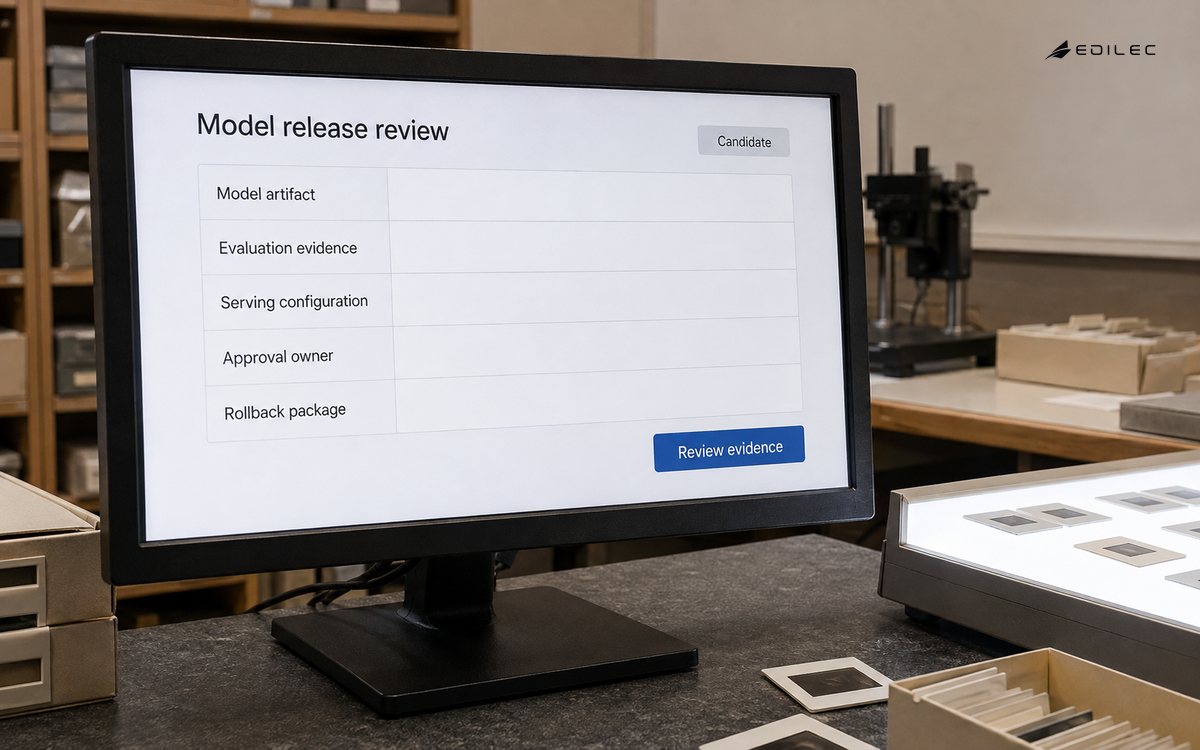
Define acceptance against the current production champion or non-model baseline. Require data checks, performance slices, robustness, security, privacy, latency, cost and operational compatibility. Review material changes in intended use or data separately from routine retraining. Promote an immutable model package with evaluation and approval attached. A deployment should expose a named version and support rollback or traffic control without rebuilding an old model from a notebook.
Use shadow, canary or bounded cohorts according to consequence. Shadowing tests live inputs without affecting users but may miss intervention effects. Canary exposure provides outcome evidence but needs segmentation, monitoring and stop thresholds. Test batch and asynchronous paths as carefully as online endpoints. Rollback includes feature logic, preprocessing, cache and downstream policy, not only model weights. Record decisions made during exposure for reconciliation.
Operate a controlled learning loop
- Frame intended use, baseline, risk tier, owners and release cadence.
- Version data, code, features, environment and pipeline execution evidence.
- Train and evaluate against technical, business, slice and safety thresholds.
- Register and approve an immutable candidate with complete evidence.
- Release gradually with service, cost and outcome stop conditions.
- Monitor, investigate, retrain or retire through governed feedback.
Monitor service, model, data and business outcomes
Monitor availability, latency, errors and resource saturation; schema, missingness and feature freshness; output distribution, confidence and abstention; labeled performance and slices; human overrides; business outcome; cost and policy violations. Set each alert to an owner and action. Labels often arrive late, so use leading indicators without pretending they are quality. Sample safely when full prediction logging would be expensive or invasive.
The incident plan should identify active versions, affected decisions, exposure period and rollback authority. Preserve evidence, contain access or output, switch to a baseline or manual process and notify affected owners. Reconcile consequential decisions made during the window. Post-incident work may change data controls, evaluation, deployment or product design. Track model and provider deprecations, retraining failures and unowned experiments as operational risks, not only accuracy drift.
Deliver MLOps in bounded phases
Phase one establishes use-case evidence, data contract, baseline model and manual reproducibility. Phase two packages the pipeline, registry, evaluation and a nonproduction serving path. Phase three releases a bounded production version with monitoring and fallback. Phase four automates recurring, well-understood steps and scales to additional models. Do not build a broad feature store or platform before repeated demand proves the abstraction; shared components should remove demonstrated duplication.
Acceptance includes a reproduced run, independent evaluation, traceable deployment, access review, incident exercise, rollback, cost report and owner handover. A partner should transfer repositories, infrastructure, data contracts, model and pipeline records, test sets, runbooks, credentials under customer control, licenses and known limitations. Verify the receiving team can promote a safe change and diagnose a failed run before closing delivery.
Key takeaways
- Scale MLOps automation to model cadence, consequence and operational need.
- Version the complete data-to-decision chain, not only model weights.
- Budget evaluation, human review, monitoring, security and retirement alongside compute.
- Promote immutable candidates through evidence and gradual exposure gates.
- Monitor business outcomes and govern feedback, incidents, retraining and exit.
Frequently asked questions
Should a team buy an MLOps platform first?
Usually prove one production lifecycle and its constraints first. Buy or build components where they remove recurring work and integrate with identity, data, delivery and governance. A platform cannot define intended use or accountable thresholds.
How often should models retrain?
Retrain when new evidence can improve a model and the full validation and release process can run safely. Triggers may include enough new labels, changed conditions or planned improvements. A fixed schedule is useful only when data and decision cadence justify it.
Can an existing DevOps team own MLOps?
It can own platform and delivery capabilities, but production accountability also needs data, model, domain, product, risk and operations owners. MLOps extends software delivery with data and model evidence; it is not a separate team that absorbs every decision.
Conclusion
MLOps makes machine learning a governable production capability. Scope the decision and risk, preserve complete lineage, evaluate against useful baselines, release through explicit gates and monitor the outcome users experience. Automation should deepen only after the team understands and owns the lifecycle it is automating.