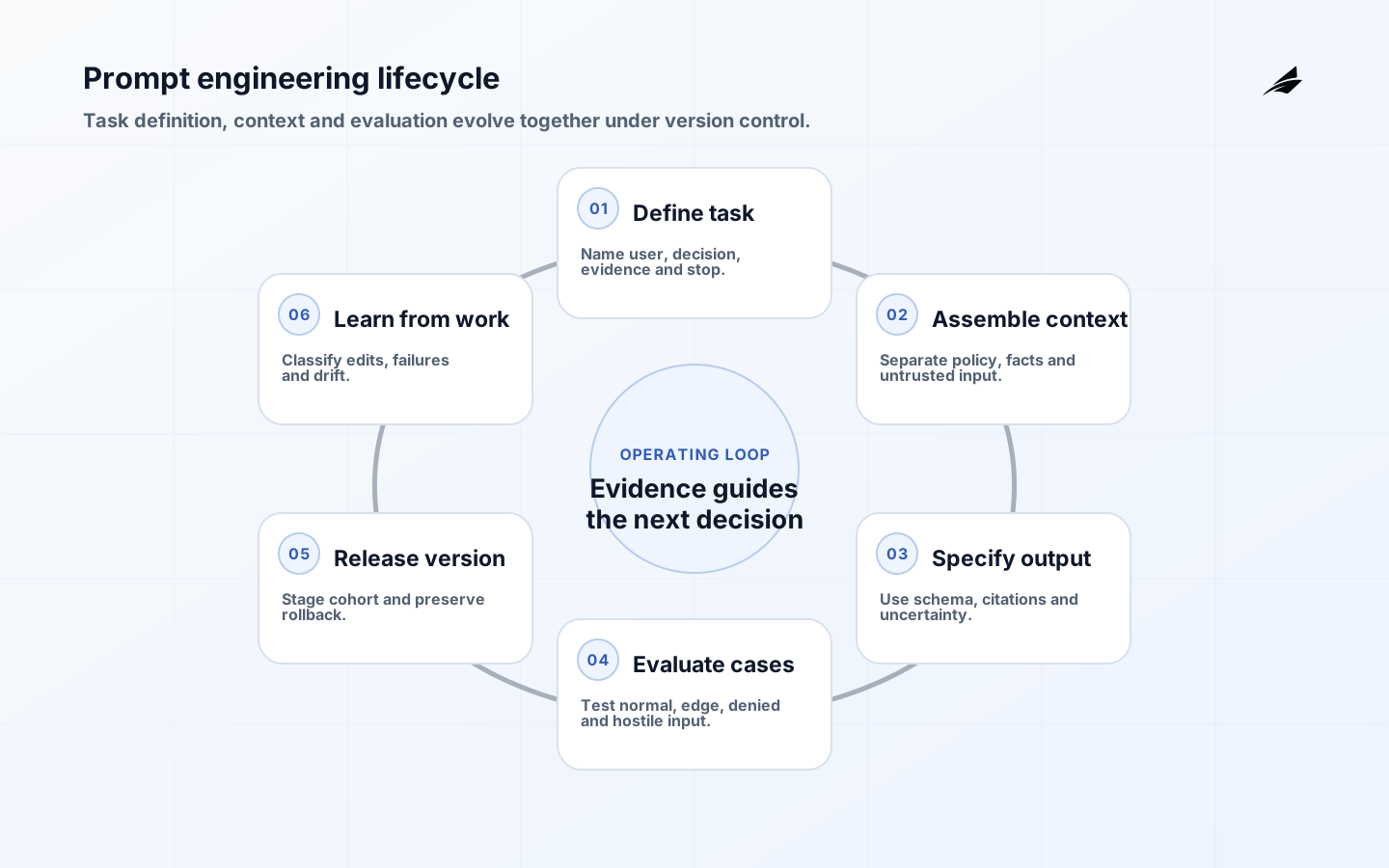
Prompt engineering for AI automation is the practice of defining a model’s task, context, constraints and output contract so the surrounding workflow can use the result predictably. The prompt is important, but it is not the entire application and it cannot confer authorization. Production quality depends on approved data, clear role separation, structured outputs, deterministic validation, representative evaluation and a versioned release process. A good prompt helps the model distinguish instructions from evidence, handle ambiguity and return a result another component can check. A dependable automation also knows when to abstain, route an exception and preserve the user’s work when the model or a dependency is unavailable.
For connected implementation decisions, see How Product Teams Should Think About Prompt Engineering, How IT Managers Should Think About Tool Calling, How Founders Should Think About Model Evaluation, and Tool Calling for AI Automation. These guides are most useful when their controls are adapted to the same records, owners and consequences rather than applied as independent checklists.
Write a task contract before polishing wording
Define the user, decision, approved inputs, required evidence, permitted output, uncertainty behavior and downstream consumer. The OpenAI prompt engineering guide emphasizes clear instructions and relevant context, while Google’s prompt design strategies cover instructions, examples, context and decomposition. Keep stable policy separate from case data, delimit untrusted material and request a schema that represents the workflow result. Examples should demonstrate meaningful edge cases, not merely teach a preferred writing style.
Evaluate the assembled behavior with standing cases before release. The OpenAI evaluations guide supports an iterative cycle of defining the task, running tests and analyzing results. Include ordinary cases, missing evidence, conflicting instructions, long inputs, malformed records, restricted content and inputs that must be declined. The NIST Generative AI Profile places measurement inside lifecycle risk management, and the OWASP GenAI Top 10 explains why prompt injection and improper output handling require controls outside the prompt.
Define The Task Contract
Begin with the task of producing a cited customer-response draft. Describe the user, case boundary, evidence needed to proceed, acceptable result, and condition under which the system must stop. Adding another instruction whenever an answer disappoints produces a prompt whose rules have no clear priority or owner. Instead, write a task contract that the business owner and service engineer can review together. Distinguish a suggestion from an external effect, specify who receives exceptions, and state the cost of a false positive, false negative, delay, or unnecessary handoff. This turns prompt revisions into testable changes rather than subjective wording experiments.
| Decision question | Weak pattern | Operational pattern |
|---|---|---|
| Scope | adding more instructions whenever an answer disappoints | Name the user, case, permitted input, and abstention point. |
| Evidence | Assume fluent output is enough. | Require source, state, or policy evidence appropriate to the effect. |
| Authority | Let model instructions imply permission. | Enforce identity, role, tenant, and current-state checks in software. |
| Change | Treat a revised model or input as harmless. | Evaluate material changes against representative cases before expansion. |
Design The Context Separation
The service needs a durable boundary between language interpretation and authoritative operations. Maintain stable policy, case facts, source evidence, and a structured response shape as separate inputs. Keep canonical facts in the appropriate system of record, and make every derived claim traceable to a source or rule. A model can select, summarize, or structure information, but it should not quietly redefine the data’s owner or lifetime. This separation lets a reviewer see where a proposal came from and lets an incident responder identify what changed without reconstructing an entire conversation.
- Name a business owner and a technical owner for the prompt engineering workflow.
- Record approved inputs, access conditions, and the facts that must be fetched live.
- Make uncertainty and unavailable information visible to the user.
- Provide a defined handoff for exceptions rather than an endless retry loop.
- Retain a change record for model, prompt, data, tool, policy, and interface revisions.
Apply Controls At The Boundary
Controls work when they are enforced where a request can read data or cause an effect. Do not rely on a prompt to decide authorization, validate a critical field, or block a prohibited action. Treat user text, documents, retrieved content, and connected responses as untrusted input that may try to influence the model. The OWASP Top 10 for LLM and GenAI explains why prompt injection and excessive agency need conventional safeguards. Use minimum permissions, structured inputs, deterministic validation, safe defaults, proportionate rate limits, and an audit trail that relates the user request to the final result.
Measure The Workflow
Evaluate the assembled workflow rather than an isolated model answer. Build a reviewed set from representative work, including ordinary cases, ambiguity, missing facts, conflicting instructions, permission limits, and inputs that must be rejected. Inspect failures at the stage where they occur: a missing record is not repaired by changing prose, and a valid draft does not excuse an invalid action. Track format validity, evidence use, reviewer edits, and escalation quality. The NIST AI Risk Management Framework provides a lifecycle frame in which governance, context mapping, measurement, and risk management remain connected as the system changes.
| Signal | What it reveals | Next action |
|---|---|---|
| Evidence gap | The output lacks the material needed to support a claim. | Inspect source selection, freshness, permissions, and context assembly. |
| Correction pattern | People repeatedly repair the same part of a result. | Diagnose the task contract, source quality, or unclear policy. |
| Control failure | A request reaches or fails at the wrong boundary. | Review authentication, authorization, validation, and escalation. |
| Outcome drift | A change alters completion, rework, or harm. | Compare versions on standing cases and a staged production sample. |
Release And Operate
Release the prompt in a bounded workflow first, preferably where effects are read-only, reversible, or reviewed. Preserve a disable path and make operational traces accessible to the people who investigate failures. A useful trace ties together the case, permitted context, relevant version, tool or policy decision, user-visible response, and final workflow state. The NIST Generative AI Profile emphasizes lifecycle risk management; release is therefore the start of observation and correction, not the end of design.
Ownership And Change
Someone must be able to answer who owns the decision, who owns the technical service, who may pause it, and who handles a disputed result. Put those answers in a runbook with review cadence, incident contacts, approved change types, and records of material decisions. This is particularly important when a prompt is connected to evolving sources or third-party services. A small change in a source, model, access rule, or dependency can alter behavior without a visible interface change. Treat it as a release candidate until reviewed cases and control tests support promotion.
Run A Prompt Engineering Operating Review
Review prompts as versioned task contracts. Classify each edit by missing evidence, unsupported assumption, output format, policy ambiguity, or escalation need. That diagnosis avoids a growing instruction block whose individual rules no longer have an owner. Record why the change was made, which cases prove it, and what production signal would justify reversal.
Prompt Engineering Practical Checklist
- Choose one bounded decision before scaling prompt engineering.
- Define evidence, permissions, validation, escalation, and recovery conditions.
- Test ordinary, ambiguous, unsafe, and unavailable-information cases.
- Instrument the path from input to business outcome with privacy-aware traces.
- Stage changes and retain a rapid rollback or disable option.
- Convert confirmed corrections and incidents into a test, control, or explicit operating decision.
Frequently Asked Questions
Does prompt engineering replace normal application controls? No. It can improve interpretation, retrieval, drafting, or orchestration, but authorization and state changes remain responsibilities of deterministic services and accountable people. Is a confidence score enough to automate a decision? No. Confidence must be interpreted alongside evidence quality, consequence, permissions, source freshness, and the ability to recover. Where should a team start? Pick a high-frequency, bounded task with a clear owner and a reviewable definition of success, then capture representative examples before changing the prompt.
Prepare For The Next Change
Before changing a prompt, run the same cases with controlled context and validators. Record whether the revision made the system more explicit about uncertainty or merely more verbose. Prompts should make a workflow easier to inspect, not relocate business logic into untested narrative instructions. When an exception recurs, decide whether it belongs in a policy service, a retrieval rule, a form, or an escalation route before adding another line of text.
Version a cited customer-response prompt
A support team wants an AI service to draft a response using an approved knowledge base. The task contract requires a concise answer, citations for material claims, a list of missing facts and a handoff when policy sources conflict. The context builder supplies the customer’s product tier, current issue state and permission-filtered passages. The prompt labels each component and asks for a structured object with answer, citations, uncertainty and escalation reason. Software verifies the schema and confirms that every cited identifier was actually retrieved before rendering a draft.

When reviewers repeatedly remove an unsupported troubleshooting step, the team should not append another warning and hope. Classify the failure: the source may be stale, retrieval may favor a generic article, the task contract may allow invention, or the evaluator may ignore citation entailment. Add representative failed cases, correct the responsible layer and compare the new version with the current production baseline. Release behind a bounded cohort, record prompt and context-builder versions, monitor reviewer edits and keep the prior version available. This creates an engineering change process rather than a growing block of fragile prose.
| Prompt component | Design question | Evaluation evidence |
|---|---|---|
| Task | What exact result supports the workflow? | Reviewed success and abstention examples |
| Context | Which facts and sources are approved now? | Source IDs, permission result and freshness |
| Instructions | How should evidence and uncertainty be handled? | Conflict, missing-data and injection cases |
| Output contract | What structure can software validate? | Schema validity and field-level checks |
| Release | Which version is running and how is it reversed? | Version, cohort, metrics and rollback result |
Key Takeaways
- Prompt Engineering should serve a specific operational decision, not a vague promise of automation.
- Evidence, permissions, validation, and recovery are product requirements.
- Measure the complete workflow and locate failures at their actual stage.
- Visible ownership and gradual releases make improvements safer and more useful.
Conclusion
Prompt engineering earns its place in an AI automation program when it makes useful work easier without obscuring accountability. Bound the task, govern inputs and effects, inspect real outcomes, and keep the service easy to pause or correct. Versioned instructions, representative evaluations and deterministic controls turn an interesting model capability into dependable operational software.