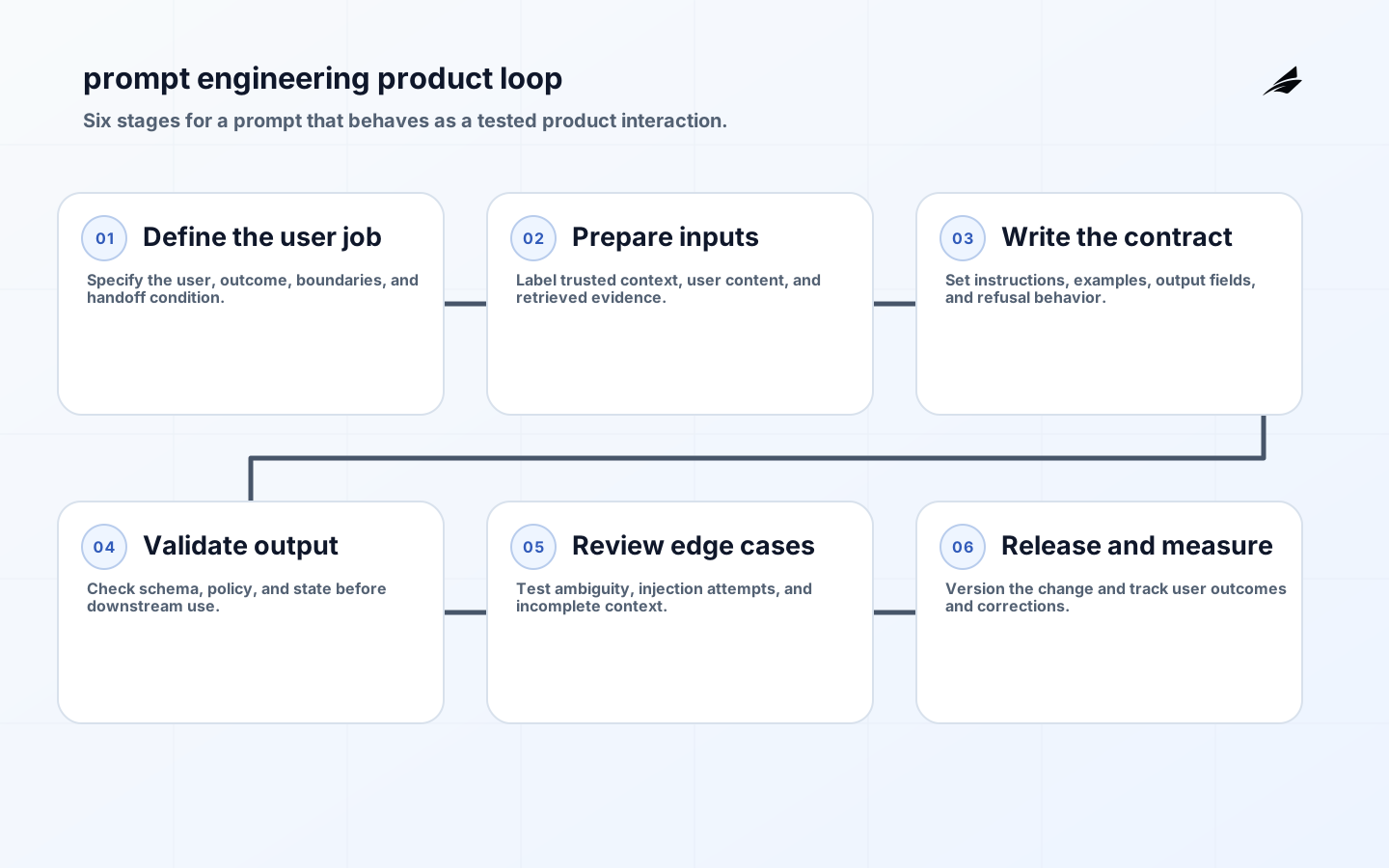
Prompt engineering is the design of the instructions, context, examples, and output constraints that shape how a model participates in a product interaction. It is not a substitute for product requirements, data design, or business rules. A good prompt can help a model classify an inbound request, draft a response, or explain a result in plain language. It cannot establish identity, calculate a binding price, or decide whether a payment should be released. Product teams get better results when they treat prompts as versioned interface behavior: a visible part of a system with users, inputs, expected outputs, failure modes, and owners. That view aligns with the lifecycle focus in the NIST Generative AI Profile.
Define The Product Job
Write the smallest user job the model is helping with and the boundary around it. “Turn a customer’s issue description into a draft support category and a concise next-step explanation” has an observable result. “Make support smarter” does not. Name the user, the information available at that moment, the allowed tone, the output schema, the response time expectation, and the human or deterministic system that owns the final action. This prevents prompt work from drifting into a collection of clever phrases detached from the experience. It also helps teams decide where AI copilots can assist rather than silently take control.
| Prompt element | Why it matters | Product decision |
|---|---|---|
| Role and task | Sets the limited job the model should perform. | Describe the service behavior, not a fictional personality. |
| Context | Gives facts needed for the current interaction. | Pass approved, relevant records; do not rely on the model to infer hidden state. |
| Output contract | Makes the response usable by software and people. | Request fields, choices, citations, or a refusal state that can be validated. |
| Examples | Clarify edge cases and acceptable style. | Use reviewed examples that represent real product ambiguity, not only ideal cases. |
Shape Inputs Before Instructions
Much prompt instability is really input instability. A product can send a stale account plan, an unbounded chat history, conflicting records, or free-form text that contains instructions copied from outside the trust boundary. Normalize the data before it reaches the model. Label what is user content, what is trusted application context, and what has been retrieved from an external source. Trim history according to a documented retention rule. Pass dates, amounts, and statuses in clear structured fields rather than relying on prose. When the answer must refer to policy, provide the specific approved excerpt and require a citation. This reduces ambiguity and makes it possible to reproduce a problematic interaction later.
- Version prompts alongside the application code and configuration that supplies their inputs.
- Keep sensitive fields out of prompts unless the task genuinely requires them.
- Separate user instructions from system-owned policy and from retrieved source material.
- Prefer structured response fields for downstream workflows.
- Make an explicit no-answer or handoff response part of the contract.
Keep Decisions Outside The Prompt
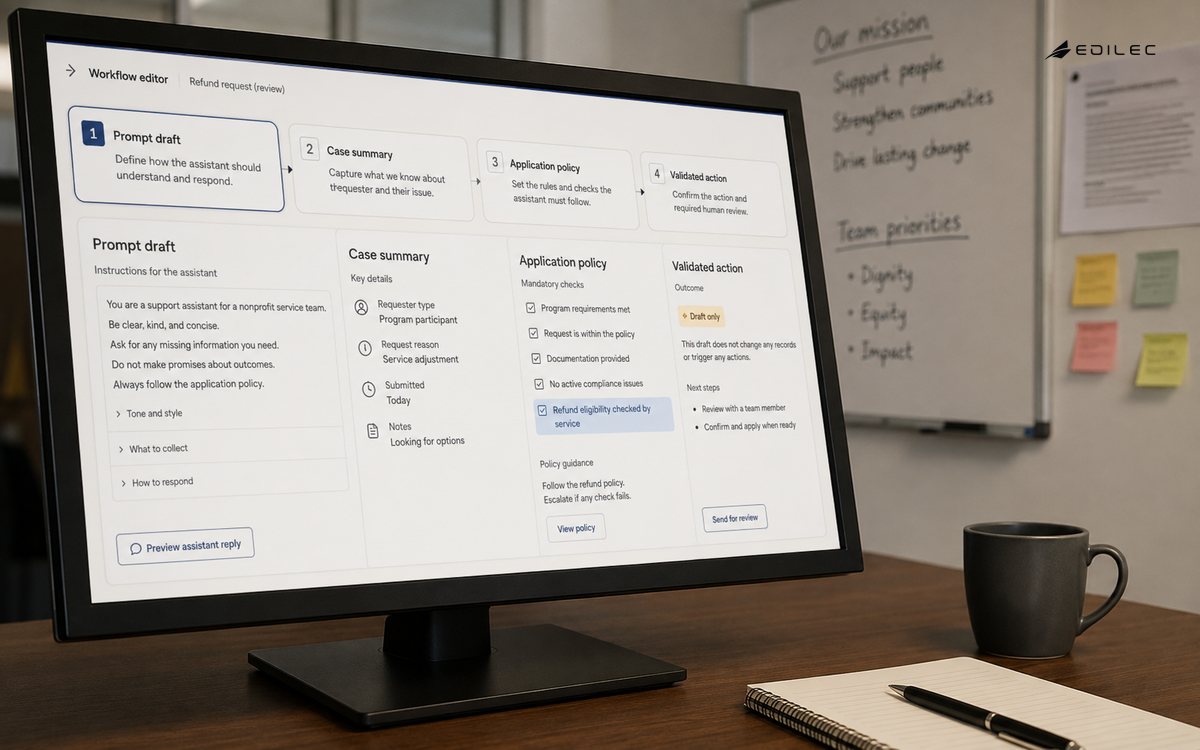
Prompts should guide language and bounded reasoning; they should not carry authority that belongs in software policy. A prompt saying “only issue refunds below a limit” can be ignored, misunderstood, or changed accidentally. Instead, have the application compute eligibility, enforce role checks, and expose only the permitted choices. The model can summarize the case or collect missing information, while deterministic code validates the final payload. This design also limits prompt injection: text from an uploaded document or a customer message must never be allowed to redefine system policy. OWASP’s LLM application guidance is especially relevant where generated output can trigger a tool or workflow.
Evaluate Product Behavior
Evaluate prompts against representative product cases before exposing a change broadly. Include short and long inputs, conflicting facts, requests that should be refused, unsupported languages, ambiguous user intent, and attempts to override instructions. Score the dimensions that matter to the experience: correct classification, grounded explanation, schema validity, respectful tone, appropriate escalation, and time to resolution. Review failures by category rather than simply averaging a model score. A system that is excellent at routine summaries but occasionally invents an eligibility reason needs a different remedy from one that returns malformed data. The secure AI development guidance reinforces the need for testing throughout design and operation.
| Observed failure | Likely cause | Useful response |
|---|---|---|
| Correct prose, wrong action | Business rule exists only in instructions. | Move the rule to validated application logic and expose a narrower choice. |
| Inconsistent JSON | Output contract is underspecified or not checked. | Use a schema, validate every response, and retry or hand off safely. |
| Answer ignores current account state | Context is stale or incomplete. | Trace the input assembly and fetch the live record where appropriate. |
| Unhelpful refusal | The handoff path is vague. | Return what is missing, what can happen next, and who owns the case. |
Release And Observe Prompt Changes
A prompt edit is a product change. Record its version, the model configuration, the input schema, the evaluation set, and the reason for release. Use staged exposure for material changes, compare results with a control where possible, and preserve the previous version for quick rollback. In production, watch validation failures, refusals, overrides, corrections, latency, and the downstream outcome rather than token counts alone. Sample real interactions under a privacy policy that limits retention and access. When support or sales reports a surprising behavior, the team should be able to reconstruct the relevant prompt, approved context, response, and validation result. That is how prompt work becomes maintainable product engineering.
Create A Prompt Change Practice
Set up a lightweight prompt change practice before the feature has many users. A change record should identify the product job, prompt version, input contract, model settings, evaluation cases, expected effect, owner, and rollback condition. Require a peer to inspect changes that affect external communication, eligibility explanations, or tool selection. The review is not about literary taste. It asks whether new language conflicts with policy, makes an unsupported promise, removes a refusal state, or changes a structured field that downstream software trusts. Keep configuration close to the application release so the team can reproduce the behavior that a customer encountered.
Over time, teams usually discover that the highest-value changes are not wordsmithing. They clarify what context is authoritative, split one overloaded task into two smaller ones, enforce a JSON schema, or move an eligibility rule out of the prompt. Preserve those lessons as examples and acceptance tests. When an experiment works for one segment but not another, do not quietly broaden the prompt until it sounds universal; examine the data and user journey that differ. Product teams earn confidence by making the AI interaction predictable in context, while retaining an obvious route for users to correct, bypass, or escalate it.
| Release check | What to inspect | Decision |
|---|---|---|
| Task coverage | Does the test set represent the requests this surface actually receives? | Do not promote a prompt trained only on ideal inputs. |
| Input contract | Are trusted fields, user content, and retrieved text separated and current? | Fix context assembly before changing instructions. |
| Output validation | Can every downstream consumer reject malformed or unsafe fields? | Block release until the failure path is safe. |
| User recovery | Can a user edit, retry, or hand off after an unhelpful result? | Ship the interaction only with a usable recovery route. |
Prompt engineering also benefits from product analytics that respect the interaction’s purpose. Track where a suggested draft is edited, where a structured output fails validation, where a user abandons the flow, and where a handoff resolves the issue. Do not interpret a long conversation as engagement without asking whether the user completed the job. Pair these signals with qualitative review of a small set of cases. That gives the team a way to see whether a change made the product more concise, more accurate, or merely more talkative. A prompt is successful when it improves the surrounding experience and remains understandable to the team responsible for maintaining it.
A practical ownership boundary is simple: product owns the job and acceptable user experience, engineering owns the runtime contract and validation, and domain owners own the policy and source facts. When those three views are recorded together, prompt changes become easier to debate and safer to ship.
Before a broad release, run a content review that reads the prompt and examples as a user would. Look for accidental promises, jargon that obscures a limitation, and instructions that conflict with the visible product copy. This is especially important when product, legal, and support teams will later need to explain the same behavior in different channels.
Key Takeaways
- Start from one user job and an observable outcome.
- Stabilize and label inputs before refining language instructions.
- Use prompts for bounded assistance, not authorization or business-rule enforcement.
- Require structured outputs where software must consume the result.
- Evaluate edge cases and release prompt changes with rollback evidence.
Frequently Asked Questions
Should product managers edit prompts directly? They should help own the intended behavior, examples, and success criteria. Engineering should provide versioning, validation, access controls, and a release path so edits are tested rather than becoming invisible production changes.
When is fine-tuning a better answer? Consider it only after the team has a stable task, a reviewed data set, and evidence that prompt, retrieval, or workflow changes cannot deliver the required consistency. See the fine-tuning decisions guide for that comparison.
Conclusion
Prompt engineering earns its place in a product when it makes a defined interaction clearer, safer, and easier to improve. Ground it in a real user job, give it disciplined inputs and validated outputs, keep authority in deterministic controls, and measure the behavior users actually experience. The result is not a magic prompt; it is a dependable part of the product.