Agent memory is information retained or retrieved so an AI agent can continue work beyond the immediate model request. It may include conversation state, unfinished tasks, user preferences, confirmed facts, prior actions, summaries, examples, or procedural guidance. Memory can reduce repetition and improve continuity, but it also introduces a persistent data store whose content may be wrong, sensitive, stale, malicious, or recalled in the wrong context. A useful architecture therefore asks not only what an agent can remember, but who may write, read, correct, expire, and inspect each memory.
Do not treat the model's context window, chat history, retrieval index, and durable memory as one feature. The Amazon Bedrock AgentCore memory documentation distinguishes short-term event history from long-term strategies such as semantic facts, summaries, preferences, and episodes. LangChain long-term memory similarly describes persistent JSON documents organized by namespace and key. These implementations differ, but both make scope and storage explicit. Product teams should create an independent memory contract that survives a framework change.
Classify memory before designing storage
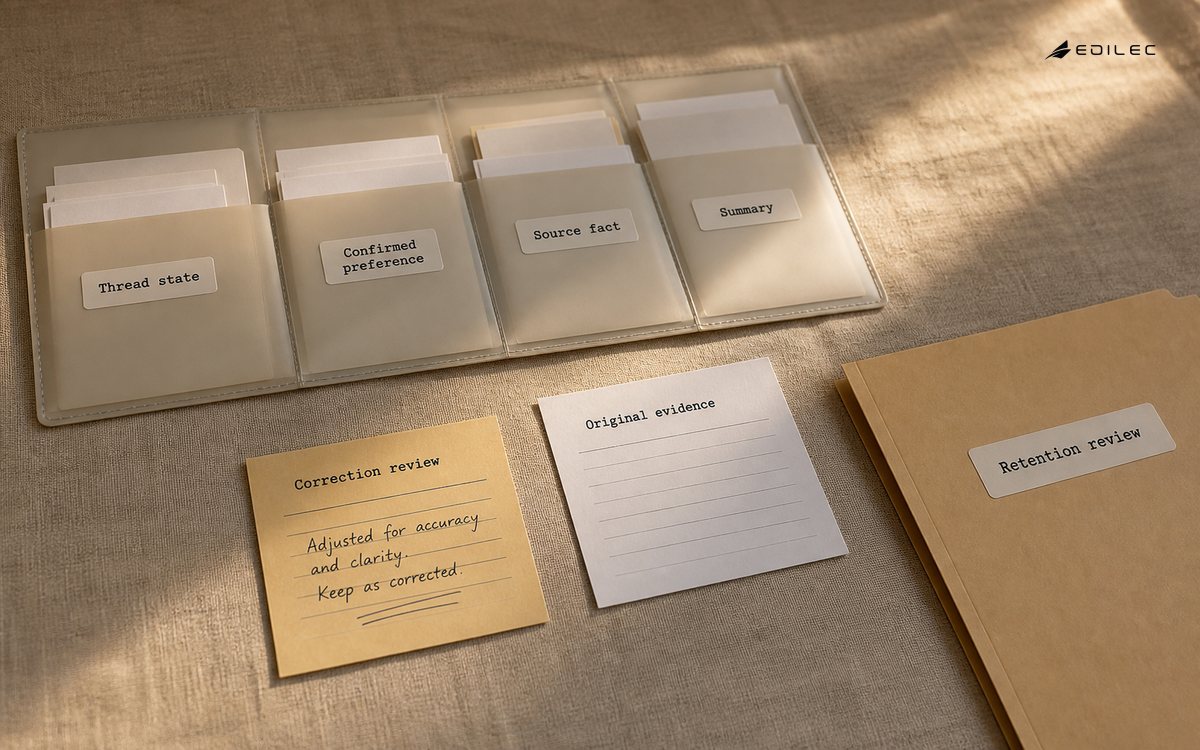
Short-term state supports one thread or workflow: recent messages, tool calls, intermediate results, and pending steps. Durable semantic memory stores validated facts such as an approved preference or account property. Episodic memory records prior events that may guide a similar case. Procedural memory supplies maintained instructions, policies, or skills. A summary compresses history but may omit qualifiers. External knowledge remains an authoritative source retrieved on demand and should not be copied into personal memory merely for convenience.
For each class, define purpose, source, data owner, sensitivity, allowed scope, write trigger, validation, retrieval rule, retention, correction, and deletion. A user statement such as ‘I usually prefer morning meetings’ may be a candidate preference, while ‘our refund limit is ₹50,000’ belongs in a governed policy source, not personal memory. An agent's inference about health, identity, or intent should not silently become a durable fact. Use explicit confirmation where memory affects future treatment or consequential decisions.
| Memory class | Appropriate example | Primary control |
|---|---|---|
| Thread state | Current case and pending tool result | Thread scope and short expiry |
| Preference | Confirmed display or communication preference | User visibility and correction |
| Semantic fact | Validated account or project fact | Authoritative source and freshness |
| Episode | Prior resolution and observed outcome | Provenance and similarity limits |
| Procedure | Approved triage or escalation instruction | Versioned owner-controlled publication |
| Summary | Compressed history for context limits | Link to original events and uncertainty |
Authorize and validate every durable write
A durable memory write is a data mutation. Route it through a service that validates actor, tenant, purpose, schema, sensitivity, provenance, and retention class. Distinguish user-provided, tool-verified, model-inferred, and human-reviewed content. Store source references, confidence where meaningful, created and updated times, version, and the rule that permitted the write. Do not allow untrusted documents or prompt text to instruct the agent to create hidden persistent memories.
Use a write policy. Explicit user commands may create or correct eligible preferences. A successful system transaction may update a verified fact through an event. A model may propose a memory, but the service should reject restricted categories and require confirmation for uncertain or sensitive information. Deduplicate and supersede rather than accumulating contradictory records. If a summary is generated, preserve the source event range and mark it as derived. The OWASP Top 10 for LLM Applications is relevant because prompt injection, sensitive-data disclosure, data poisoning, and excessive agency can all affect memory.
- Never let model text write directly to an unrestricted store.
- Keep source, scope, sensitivity, version, and retention with each record.
- Separate confirmed facts from inferences and summaries.
- Require explicit consent or authority for personal memory.
- Block credentials, secrets, and prohibited data classes.
- Make corrections supersede old records without erasing required history.
Isolate memory by tenant, actor, agent, and purpose
The namespace is part of authorization. Scope records by organization or tenant, user or actor, agent or application, thread or workflow, and data class. Derive these identifiers from authenticated context, not a model-supplied string. Enforce access in storage and retrieval services, including caches, indexes, exports, backups, and observability. Test cross-tenant, cross-user, shared-device, delegated-support, and removed-access scenarios. A vector database filter is not sufficient if an alternate query path omits it.
Encrypt data in transit and at rest, restrict administrative access, and separate production content from debugging tools. Minimize copied data. The NIST Privacy Framework helps organizations identify and manage privacy risk across data processing. Document purpose, notice, access, correction, deletion, retention, and regional requirements. Do not retain a full conversation indefinitely merely because the architecture can summarize it later. Delete or de-identify source events when their purpose expires and ensure derived memory follows the same disposition.
| Boundary | Failure to test | Expected behavior |
|---|---|---|
| Tenant | Same semantic query in another tenant | No cross-tenant record can rank or leak |
| Actor | Shared agent serves a different user | Personal memory remains isolated |
| Thread | New case reuses an old identifier | State does not cross workflow |
| Purpose | Support memory used for marketing | Policy blocks incompatible use |
| Revocation | User or employee loses access | Retrieval stops within defined time |
| Deletion | Source is erased or consent withdrawn | Derived records and indexes follow policy |
Retrieve selectively with provenance and limits
Retrieval should begin with task and policy, not a broad similarity search over everything remembered. Select permitted namespaces, memory classes, time range, and maximum records. Combine semantic relevance with recency, confidence, source authority, and explicit priority. Return record identifiers and provenance so the prompt can distinguish confirmed account data, user preference, prior episode, and maintained procedure. Do not present memory as system instruction unless it is an approved procedural source.
Manage context budget deliberately. Too much memory can distract the model, revive stale facts, and increase cost. Summaries reduce length but can amplify an earlier mistake. Retrieve a compact set, label it, and permit abstention when records conflict. For consequential tasks, revalidate material facts against their authoritative system before action. Microsoft's Semantic Kernel agent-memory documentation discusses user and thread scoping and short-term whiteboard context, while also marking parts of the feature experimental; that status is a reminder to isolate framework-specific behavior behind an application contract.
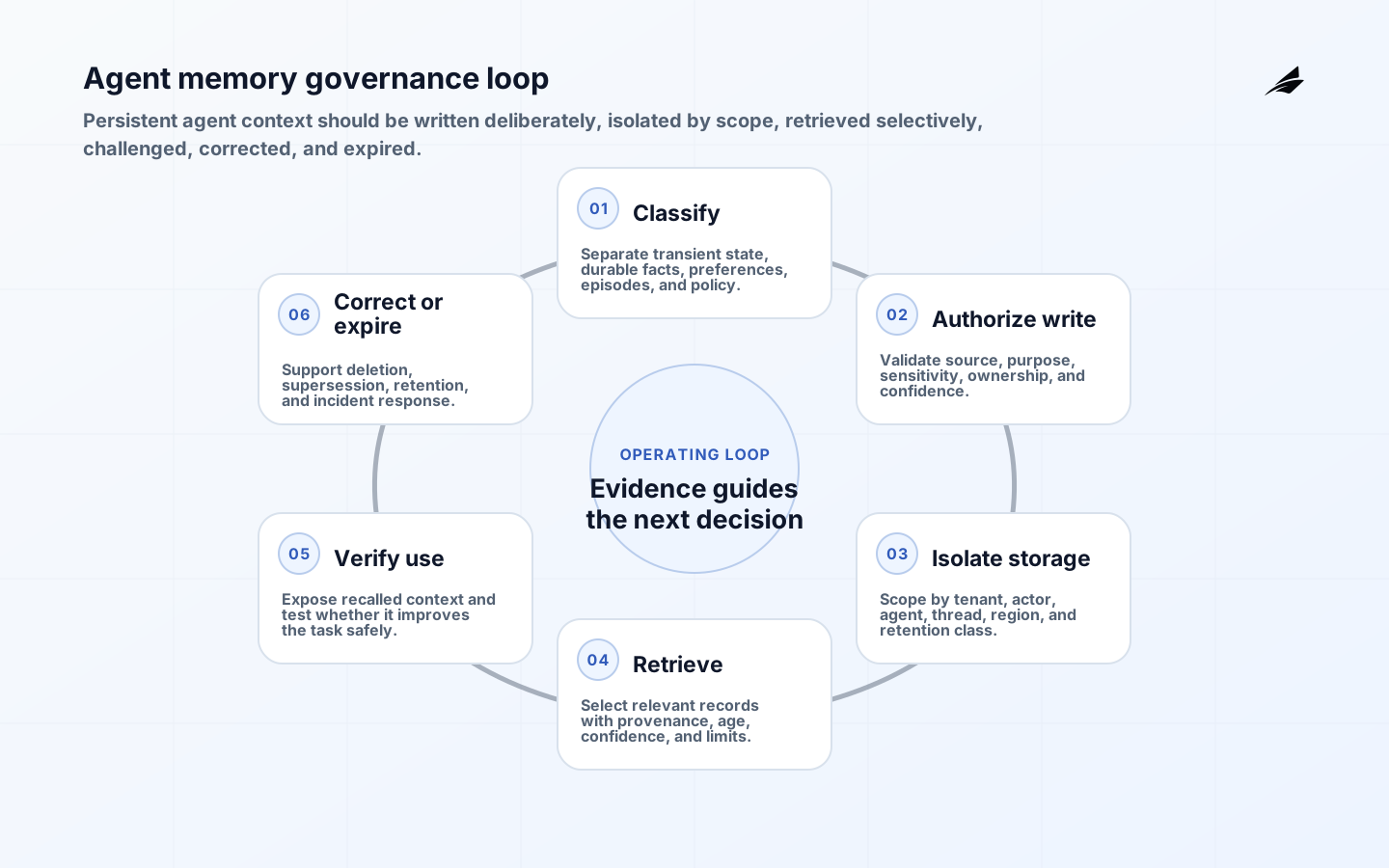
Use an agent memory governance loop
The governance loop treats classification, writing, storage, retrieval, use, and correction as separate decisions. Users and operators should be able to see why a memory exists and how it affected a response. The loop complements the broader AI agent workflow guide: memory supplies context, while deterministic authorization, tools, state, and human approval still govern business effects.
Evaluate usefulness, correctness, and privacy
Build evaluation cases for no memory, correct relevant memory, correct irrelevant memory, stale memory, conflicting records, poisoned content, wrong tenant, deleted memory, missing source, and an overconfident summary. Compare task success, factual correctness, unsupported personalization, retrieval precision and recall, latency, token use, correction rate, and human effort. Evaluate protected slices and long-running sessions. A system that performs better on average but occasionally leaks another user's information is not acceptable.
Run ablation tests: remove memory and determine whether outcomes actually worsen. This distinguishes genuine value from a feature that merely makes responses sound personal. Test whether the model cites or exposes memory unnecessarily, whether a user can correct it, and whether correction changes future retrieval. Include adversarial content that tells the agent to remember secrets or override policy. Review retrieval traces without exposing raw sensitive text to broad monitoring access.
Operate correction, expiry, observation, and incidents
Provide users and administrators with appropriate memory visibility, correction, and deletion. Some records may require retention or restricted handling, so explain when immediate deletion is unavailable. Apply time-to-live by class, refresh authoritative facts, and expire summaries when their source window changes materially. Record the model, retrieval query, selected memory identifiers, policy result, and downstream outcome for debugging. The LLM observability checklist shows how to correlate AI behavior without turning telemetry into an uncontrolled prompt archive.
Prepare incident playbooks for cross-tenant retrieval, unauthorized write, sensitive-data capture, poisoned memory, correction failure, index lag, and deletion failure. Stop writes or retrieval by namespace, quarantine affected records, identify derived outputs, notify owners, repair indexes, and verify recovery. Review whether the failure originated in identity, policy, application code, model behavior, or operations. The human approval design guide is useful when memory influences decisions that need accountable review.
Key takeaways
- Agent memory is a governed data product, not a larger chat history.
- Classify thread state, facts, preferences, episodes, procedures, and summaries separately.
- Authorize durable writes and preserve source, scope, sensitivity, and retention.
- Enforce tenant and actor isolation throughout storage, retrieval, cache, and telemetry.
- Retrieve the smallest relevant set and revalidate consequential facts.
- Evaluate leakage, staleness, poisoning, correction, and deletion as well as task quality.
Frequently asked questions
Is agent memory the same as RAG?
No. Retrieval-augmented generation usually retrieves governed knowledge for a query. Agent memory retains context about a thread, actor, or prior experience. They may use similar storage technology, but their authority, scope, retention, and correction rules differ.
Should an agent remember every conversation?
Usually not. Retain only data with a defined purpose, authority, scope, and lifetime. Full histories increase privacy and security risk and can make retrieval worse. Short-lived thread state and selective confirmed memory are easier to govern.
Should users be able to inspect and delete memory?
Provide appropriate transparency, correction, and deletion controls, especially for personal preferences and inferred information. Explain records that must be retained for legal, security, or transaction purposes and restrict their use accordingly.
Conclusion
Agent memory can make automation continuous and context-aware, but persistence changes the trust boundary. Classify what may be remembered, authorize each write, isolate every namespace, retrieve selectively, expose provenance, and support correction and expiry. Measure whether memory improves real work without creating leakage or stale personalization. When memory is designed as an owned lifecycle rather than a hidden model feature, it can support useful continuity while preserving control.