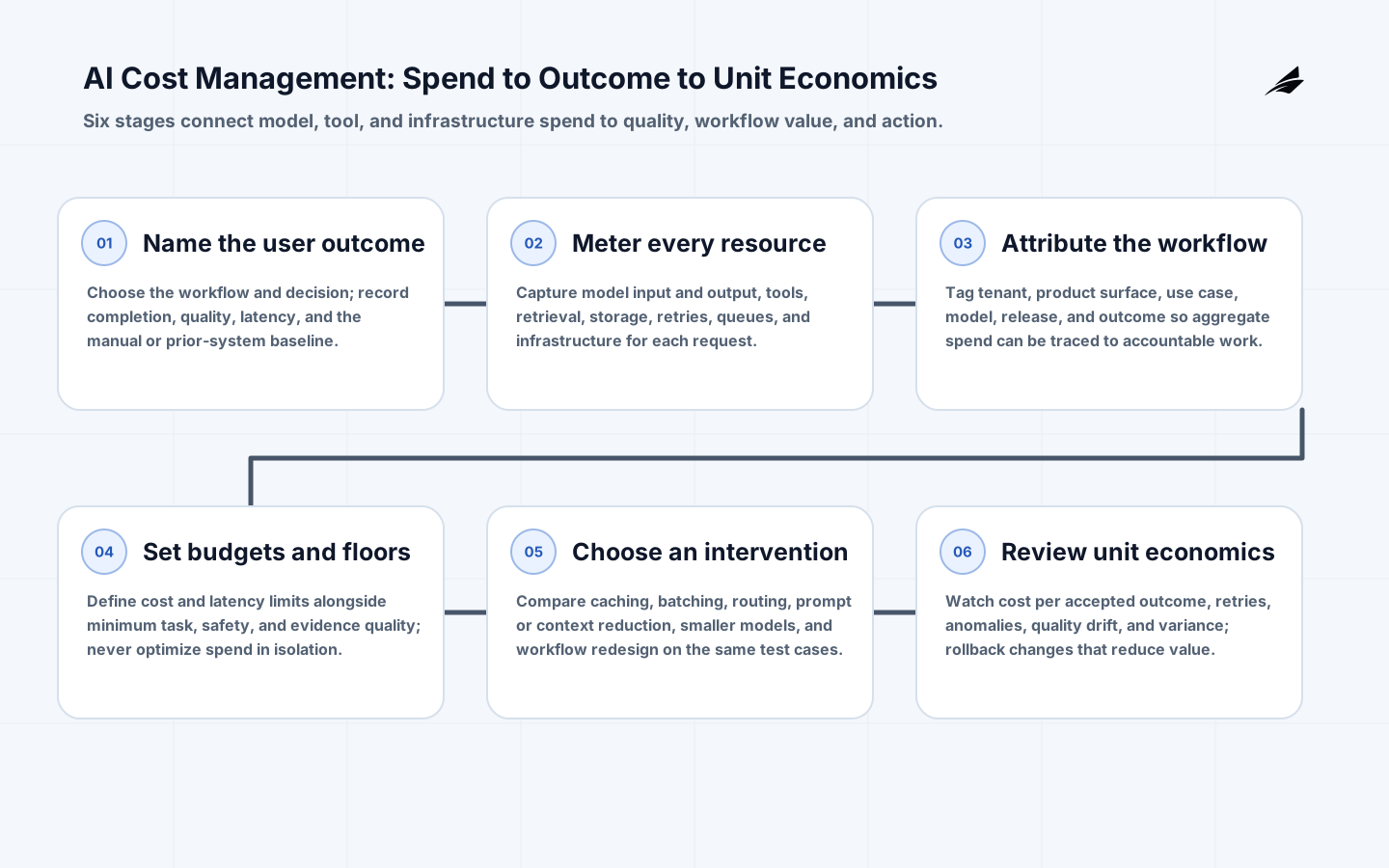
AI cost management is not a hunt for the cheapest model. It is the operating discipline of connecting each meaningful unit of user work to the prompts, tokens, retrieval steps, tool calls, retries, and human review that made it possible. With that chain visible, a team can reduce waste without quietly lowering answer quality or blocking a valuable workflow. This guide shows how to define the economic unit, instrument the request, set useful controls, and review spend as a product signal. For a broader trace design, see LLM Observability for AI Automation.
Start with the Unit of Work
A provider invoice tells you what was purchased; it does not tell you whether the purchase completed a useful job. Choose a unit that a user or operator recognizes: a resolved support case, a verified document field, a prepared but approved account change, or a research brief accepted by an editor. Define when that unit starts, when it is complete, what counts as rework, and which outcomes are unacceptable. Cost per request can then be reported alongside cost per accepted outcome, which is a far more useful planning measure.
| Cost dimension | What to attribute | Question for the owner |
|---|---|---|
| Inference | Input tokens, output tokens, model, region, and request count. | Did the selected model produce the required result for this risk level? |
| Context | Retrieved passages, embeddings, reranking, cache use, and context size. | Are we sending evidence that changes the decision, or merely repeating it? |
| Workflow | Tool invocations, orchestration steps, retries, timeouts, and background jobs. | Is extra work recovering from a real dependency failure or from a looping design? |
| Outcome | Completion state, reviewer correction, escalation, abandonment, and downstream value. | What did the spend enable, and how much human effort remained? |
Instrument the Whole Request
Assign a stable work-item identifier before the first model call and carry it through retrieval, generation, validation, tools, human review, and the final business event. Store model and prompt versions, token counts, cache status, latency, retry reason, tenant or team allocation, and the outcome class. Protect content and personal data; the cost record needs enough metadata for allocation and diagnosis, not a copy of every sensitive prompt. The AWS cost optimization guidance is a concrete example of combining token metrics, budgets, tags, logs, and workflow telemetry.
- Use a request ledger that can reconcile provider usage with an internal work item and billing period.
- Tag model calls by product, environment, workflow, tenant, and risk class before the first production launch.
- Separate planned retries from accidental loops and distinguish a user retry from an infrastructure retry.
- Record whether a response was accepted, corrected, escalated, abandoned, or rejected by a hard policy check.
- Make missing cost or outcome metadata an observable data-quality failure rather than silently assigning it to overhead.
Do not optimize only the visible model call. A short response can still be expensive if the application retrieves too many passages, runs a large reranker, invokes several tools, or repeats the whole chain after a validation error. Conversely, an apparently long request may be economical when it replaces substantial manual investigation. The cost ledger should let the team compare the entire work loop, not just a single API line item.
Use Budgets as a Control Plane
A budget is useful when it changes behavior before a bill becomes a surprise. Set limits at more than one level: per request, per work item, per tenant or team, and per deployment period. Define what happens at each threshold. A low-risk classification may switch to a smaller approved model; a long context may be summarized or cached; a consequential action may pause for confirmation; a hard limit may route the work to a person. Never let a budget silently turn a required safety check into an unvalidated shortcut.
| Threshold event | Controlled response | Evidence to review |
|---|---|---|
| One request exceeds its normal context or retry envelope. | Stop automatic looping, preserve the trace, and ask for a human or a narrower input. | Prompt growth, retrieval volume, tool error, and whether the user received a usable explanation. |
| A team approaches its period allocation. | Notify the owner and apply an approved routing policy for low-risk work. | Outcome quality, demand change, queue age, and remaining review capacity. |
| A model or workflow version creates a spend spike. | Freeze expansion, compare against the previous version, and investigate before scaling. | Token distribution, cache rate, retry rate, latency, and accepted-outcome rate. |
| A hard service or privacy limit is reached. | Fail closed for the affected action and route to a documented manual path. | Who was affected, what work was preserved, and whether recovery was timely. |
Reduce Waste Without Harming the Result
Shape Context Before Choosing a Model
Start with the smallest evidence set that supports the decision. Remove duplicate passages, retrieve by the user's permission scope, cap irrelevant history, and separate instructions from untrusted content. A context budget should be tied to answer quality and citation or validation requirements, not an arbitrary character count. Where the same approved material is used repeatedly, evaluate caching; Google Cloud's Vertex AI pricing guidance documents context caching as one provider-specific way to reduce repeated input processing.
Route by Risk and Work Shape
Use a smaller model for tasks that have a narrow label set, strong validators, and low consequence when wrong. Reserve a more capable model for ambiguous synthesis, complex reasoning, or a clearly valuable exception path. Route based on declared task and evidence quality, not on a model's self-assessment of confidence. Keep the routing rule versioned and compare accepted outcomes after a change; a lower unit price is not a saving if reviewers spend longer correcting the result. When an economical route depends on an adapted model, apply the release and rollback controls in Fine-Tuning Governance.
Control Retries, Tools, and Background Work
Every retry should have a reason, a maximum, and a different expected path to success. Retry a transient provider failure differently from a schema violation, and do not call the same failing tool repeatedly with unchanged arguments. Make asynchronous enrichment cancellable when the user abandons the work. Record downstream side effects before allowing a replay, because an apparently cheap retry can duplicate an email, case update, or external transaction.

Scenario: A Support Assistant with an Honest Budget
Consider a support assistant that proposes a response from a customer's ticket and approved product documentation. The product owner defines a completed unit as a response accepted by an agent and sent through the existing support system. A request ledger links the ticket to retrieval volume, model calls, validation, reviewer edits, and the final send event. The team discovers that a small group of tickets triggers repeated retrieval and generation because the source documents disagree. The right response is to surface the conflict and route the case, not to keep spending until a model invents a resolution.
For ordinary cases, the system can reuse a permitted context, select the lower-cost approved model, and stop after a validated draft. For an ambiguous case, it can spend more once, show the evidence conflict, and request review. The dashboard reports cost per accepted response, correction time, refusal and escalation rate, and the share of work that reached the fallback. That tells the owner whether a cache, a source cleanup, a routing change, or a staffing decision will create the next improvement.
Measure Value, Quality, and Reliability Together
Review cost metrics beside outcome measures at the same grain. Useful views include cost per accepted unit, cost per corrected unit, cost by workflow stage, input and output token distribution, cache hit rate, retrieval volume, retry rate, latency, human minutes, escalation rate, and hard-policy rejection. Break them down by model version, prompt version, tenant, risk class, and source collection. A single average can hide a costly tenant, a degraded cohort, or a small set of looping requests.
| Pattern | Likely explanation | Next investigation |
|---|---|---|
| Tokens rise while accepted outcomes stay flat. | Prompt or retrieval context is expanding without improving the decision. | Compare retrieved evidence, duplicate content, context limits, and answer corrections. |
| Cost per request falls but reviewer time rises. | A cheaper route is producing weaker drafts or more uncertainty. | Compare correction reasons and total human-plus-model effort before keeping the route. |
| Spend spikes with latency and tool errors. | Retries or orchestration loops are amplifying an upstream failure. | Trace the first failure, cap replay, and make the dependency state visible to support. |
| High cache rate coincides with stale answers. | Reuse duration or invalidation rules do not match source freshness. | Tie cache lifetime to the source's change contract and test invalidation explicitly. |
NIST's AI RMF Core is helpful here because it connects measurement to management, monitoring, and recovery. Cost is one operational characteristic among several. A control that saves money by increasing unauthorized disclosure, failed work, or manual correction is not an optimization; it is a deferred cost with a worse owner.
Assign Ownership and Review Cadence
The product owner owns the value definition and quality trade-offs. Engineering owns instrumentation, routing, idempotency, and recovery. Finance or platform operations owns allocation and forecasting. Security and privacy reviewers set non-negotiable boundaries for data and access. Meet on a cadence that matches volatility: inspect new versions promptly, review recurring outliers weekly during a pilot, and revisit unit economics when demand, providers, source volume, or review policy changes.
- Every dashboard number should have a named source, aggregation grain, owner, and freshness expectation.
- Every budget alert should name the allowed response and the person who can approve an exception.
- Every model route should have a quality baseline, a maximum context or retry envelope, and a rollback path.
- Every cost anomaly should be checked for demand, version, prompt, retrieval, tool, and infrastructure causes.
- Every optimization should be judged on accepted work and residual human effort, not invoice reduction alone.
Key Takeaways
- Define a completed unit of user value before setting a model budget.
- Carry one work-item identifier through model, retrieval, tool, review, and outcome events.
- Control context, routing, retries, and background work as carefully as model choice.
- Use threshold actions that preserve quality, safety, and a documented manual fallback.
- Measure cost per accepted outcome beside correction time, latency, refusals, and escalations.
- Treat cost anomalies as evidence about product and workflow design, not only as finance exceptions.
Frequently Asked Questions
Should every request use the cheapest model?
No. Route by risk, work shape, evidence quality, and the cost of correction. A lower-priced call is sensible when validators and the consequence of error support it; a consequential or ambiguous task may justify a more capable route or a person.
What belongs in an AI budget?
Include inference, retrieval and embedding work, tool and orchestration calls, storage or cache costs, observability, and the human review capacity required to complete the workflow. State the time period, owner, allocation method, and response at each threshold.
How do we prove that an optimization helped?
Compare the old and new routes on the same outcome definition and a representative period. Check cost, accepted work, correction effort, safety gates, latency, and fallback use together. Keep the change only when the total operating result improves or a deliberate trade-off has an accountable owner.
Conclusion: Make Spend Explainable
AI cost controls work when spend can be traced to a real work item and discussed with the person responsible for its result. Instrument the complete loop, budget for behavior rather than surprise, and optimize the evidence and workflow around the model as much as the model itself. The strongest cost decision is the one that preserves useful outcomes, makes failure visible, and gives the team a controlled next move.