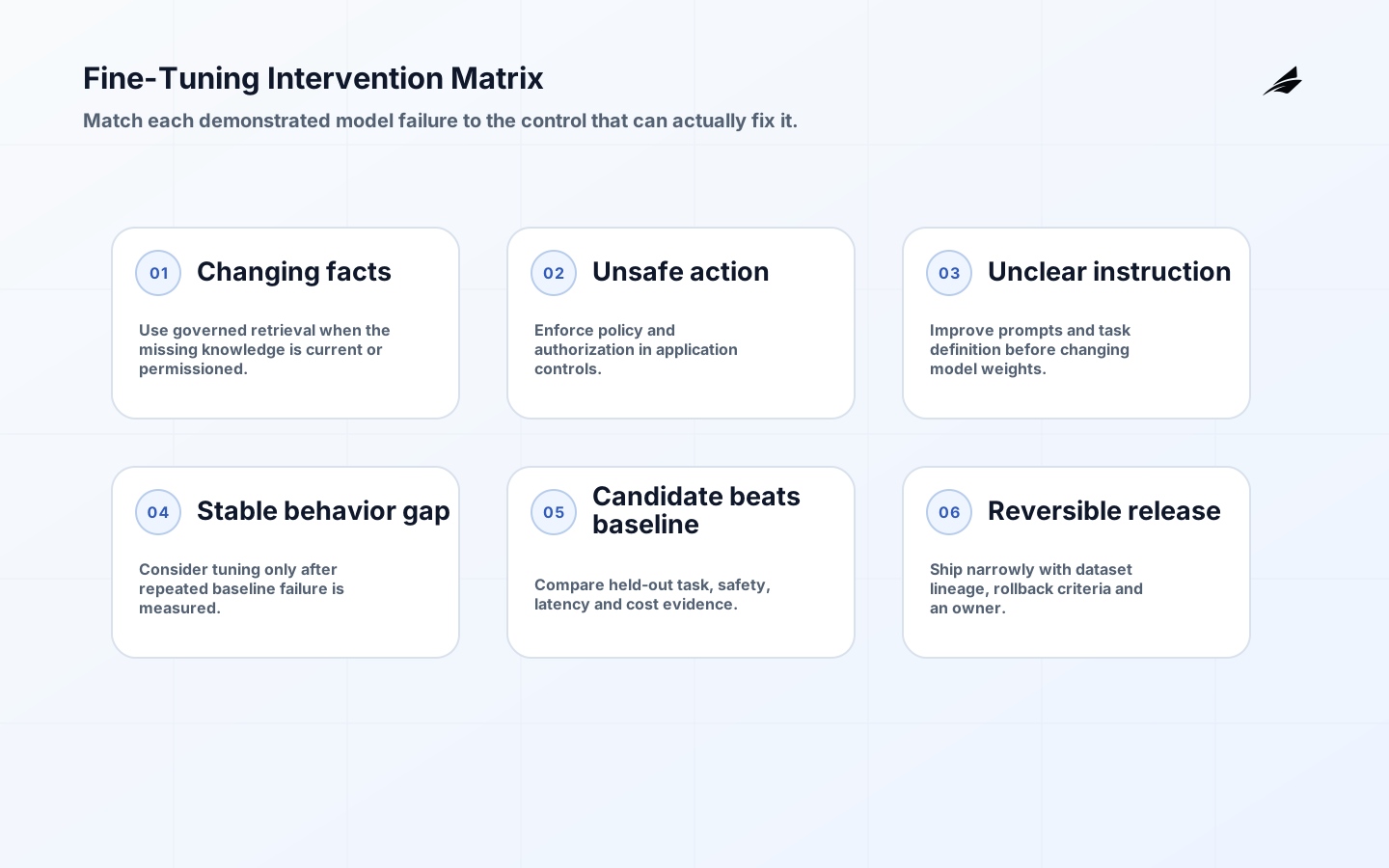
Fine-tuning changes model behavior using examples, so it should be a response to a demonstrated behavior gap rather than a reflex when an AI feature disappoints. Many apparent fine-tuning problems are actually weak source retrieval, unclear task instructions, missing application rules, poorly shaped outputs, or an evaluation set that does not resemble production work. A growing team should first identify the repeated decision that needs improvement and the evidence that a tuned model could improve it. The question is not whether training can make a demo look better; it is whether it improves an accountable workflow enough to justify new data, evaluation, deployment, and rollback obligations.
Decide whether fine-tuning is the right intervention
Diagnose the failure before collecting examples. If the system lacks current company facts, improve retrieval and source governance. If it produces an unsafe action, enforce policy in application controls. If it cannot reliably follow a stable, well-defined output pattern despite a suitable base model and prompt, fine-tuning may be worth testing. Write the target behavior, affected users, acceptable error, non-goals, and fallback. The NIST AI Risk Management Framework provides a useful structure for linking this technical choice to measurable risk and business context.

| Observed problem | First remedy to test | When fine-tuning may help |
|---|---|---|
| Outdated facts | Improve retrieval and source lifecycle. | Rarely; facts continue to change. |
| Incorrect permission or action | Fix application policy. | Not as a security control. |
| Inconsistent output format | Schema, examples, and validation. | When stable examples show a persistent gap. |
| Domain-specific classification | Clarify labels and evaluate baseline. | When a held-out set shows material improvement. |
Prepare data with ownership and consent
Training examples are product data with a lifecycle. Document where each example came from, who owns it, which use is permitted, how sensitive fields were handled, and how it was labeled. Remove or transform unnecessary personal data and confidential details. Separate instructions, inputs, expected outputs, and rationale that must not be learned or exposed. A small, carefully reviewed data set can reveal whether the task is coherent; a large uncurated archive tends to reproduce historical inconsistency. Keep a versioned data card that describes sampling, exclusions, label definitions, and known gaps.
- Use examples from the actual task, including valid refusals and edge cases.
- Review labels with the business owner, not only the technical team.
- Create a held-out set before training so evaluation is not a memorization exercise.
- Record the right to remove examples and the procedure for rebuilding a model version.
Evaluate behavior and operational trade-offs
Compare the tuned candidate with a documented baseline on a held-out, versioned test set. Measure task-specific accuracy or agreement, structured-output validity, refusal behavior, latency, cost, and the effect on different request types. Review failure slices such as unfamiliar terminology, incomplete input, or high-consequence cases. The scaling laws research is a useful reminder that model behavior and resource use have trade-offs; in a product, the decision needs observed workflow value rather than an abstract benchmark gain. Human review should inspect why a candidate wins or loses.
| Evaluation area | Question | Release evidence |
|---|---|---|
| Task quality | Does it improve the defined decision? | Held-out results and reviewer notes. |
| Safety | Does it preserve valid refusal behavior? | Adversarial and out-of-scope cases. |
| Reliability | Does it produce usable structured output? | Schema-validity and retry rates. |
| Operations | Can it meet cost and latency limits? | Production-like load test. |
Keep workflow controls independent
A trained model should receive only the context needed for its task, return a constrained result, and operate behind validation. Use schema checks, range checks, authorization, rate limits, and approval rules around it. Do not encode changing business policy solely in examples; that makes a policy update a training and deployment event. The NCSC secure AI guidance reinforces the value of secure development, dependency awareness, and maintenance planning. Retain model, dataset, evaluation, and configuration versions so a production result can be investigated.
- Validate outputs before they create records, messages, or tool calls.
- Route low-evidence or out-of-distribution cases to a human or established fallback.
- Limit access to training artifacts and document who can approve a release.
- Monitor drift in input patterns and reviewer corrections after deployment.
Release fine-tuned models as reversible changes
Start with shadow evaluation or a limited user group, preserving the current model as a fallback. Release a model only with its dataset version, training configuration, evaluation report, rollback criteria, and named owner. Watch production outcomes that the offline set cannot expose: input drift, unexpected categories, correction rates, latency spikes, and customer-impacting failures. Revisit the decision when the task, policy, or source environment changes. Fine-tuning is not a one-way upgrade; it is one component in an operating system that needs maintenance.
Run fine-tuning as a controlled experiment
Before training, write an experiment brief that a non-specialist owner can challenge. It should name the baseline configuration, target use case, success threshold, representative inputs, held-out evaluation set, safety checks, cost limit, and decision rule for release. Keep prompts, retrieval configuration, output validators, and reviewer instructions stable while comparing candidates whenever possible; otherwise a gain may be impossible to attribute. If multiple changes are necessary, stage them and retain the intermediate results. Record qualitative reviewer observations beside numerical metrics, especially on rare cases where a single unsafe response matters more than a small average improvement. A good experiment can conclude that fine-tuning is not justified. That is a valuable result because it avoids creating a new operational dependency without evidence.
After a candidate wins offline evaluation, test it against production-like constraints. Verify that it handles the same input validation, access boundaries, fallback, and logging as the baseline. Check that a model update does not alter a downstream parser's assumptions or make error messages harder for support staff to interpret. Give the data owner a route to report examples that should be removed or corrected, and make retraining cadence a conscious choice rather than a reaction to every complaint. In many teams, the best maintenance plan is periodic evaluation against changed workflow data, with retraining only when a documented behavior gap returns. That approach keeps fine-tuning attached to observable product needs rather than turning it into an endless cycle of undocumented examples.
Fine-tuning decision checklist
- Describe the repeated behavior gap and show why retrieval, prompting, policy, or validation cannot solve it.
- Set a measurable task outcome, acceptable error, non-goals, owner, and fallback before collecting examples.
- Document example origin, permitted use, sensitivity handling, label definition, and removal procedure.
- Include ordinary cases, valid refusals, incomplete inputs, and costly edge cases in reviewed training data.
- Create a held-out evaluation set before training and protect it from repeated tuning decisions.
- Compare every candidate with a stable baseline using task, safety, latency, cost, and schema metrics.
- Inspect qualitative failures with the process owner instead of relying only on aggregate scores.
- Keep prompts, retrieval, validators, and reviewer instructions stable while testing a model change.
- Validate all generated output before it creates a record, message, tool call, or external effect.
- Use shadow traffic or limited cohorts and preserve the baseline model as a recovery option.
- Version datasets, training parameters, evaluations, model configuration, and release approvals together.
- Monitor input drift, correction rates, refusal behavior, latency, and downstream failures after release.
- Give data owners a route to remove or correct examples and trigger a documented reassessment.
- Retest when policy, workflow, or source environment changes rather than assuming training remains suitable.
- Treat a decision not to fine-tune as a successful outcome when the evidence favors a simpler remedy.
Use a decision log to record why a candidate was promoted, retained as an experiment, or rejected. Include the held-out evidence, the affected workflow segment, unresolved risks, and the date the decision will be revisited. This prevents a successful test from becoming a vague mandate to fine-tune every adjacent feature. It also protects the team when a later change alters the baseline: they can see whether the original gain came from training data, a configuration change, or a different evaluation condition. Clear experiment records are especially valuable when the people maintaining the model were not present for the original evaluation.
Schedule the reassessment in advance. That date creates a deliberate moment to compare the model with the current workflow rather than assuming yesterday's evaluation remains persuasive after the task has changed.
Document the decision owner and review date clearly.
Key takeaways
- Prove a behavior gap before deciding that fine-tuning is necessary.
- Treat training examples as governed product data with ownership and removal paths.
- Compare candidates with a held-out task set, not a persuasive demonstration.
- Keep authorization, validation, and recovery outside the tuned model.
Fine-tuning decisions FAQ
Should we fine-tune to add company knowledge? Usually start with retrieval. Company knowledge changes, needs permissions, and benefits from visible citations. Fine-tuning is more appropriate for stable behavior patterns than for a changing document library.
How much data is enough? There is no universal count. Begin with enough reviewed examples to define the task and a held-out set to test it. Add diverse, high-value cases when evaluation reveals a specific gap.
Can a fine-tuned model replace review? Only after the team has evidence that a clearly defined, low-consequence category can be completed safely. High-impact decisions still need appropriate authority and controls.
Conclusion
Fine-tuning decisions are strongest when they begin with diagnosis. Solve facts with governed retrieval, solve policy with enforceable controls, and reserve training for a measured, stable behavior gap. With accountable data, a held-out evaluation set, and reversible release practices, a growing team can use fine-tuning as a deliberate capability rather than an expensive substitute for workflow design.