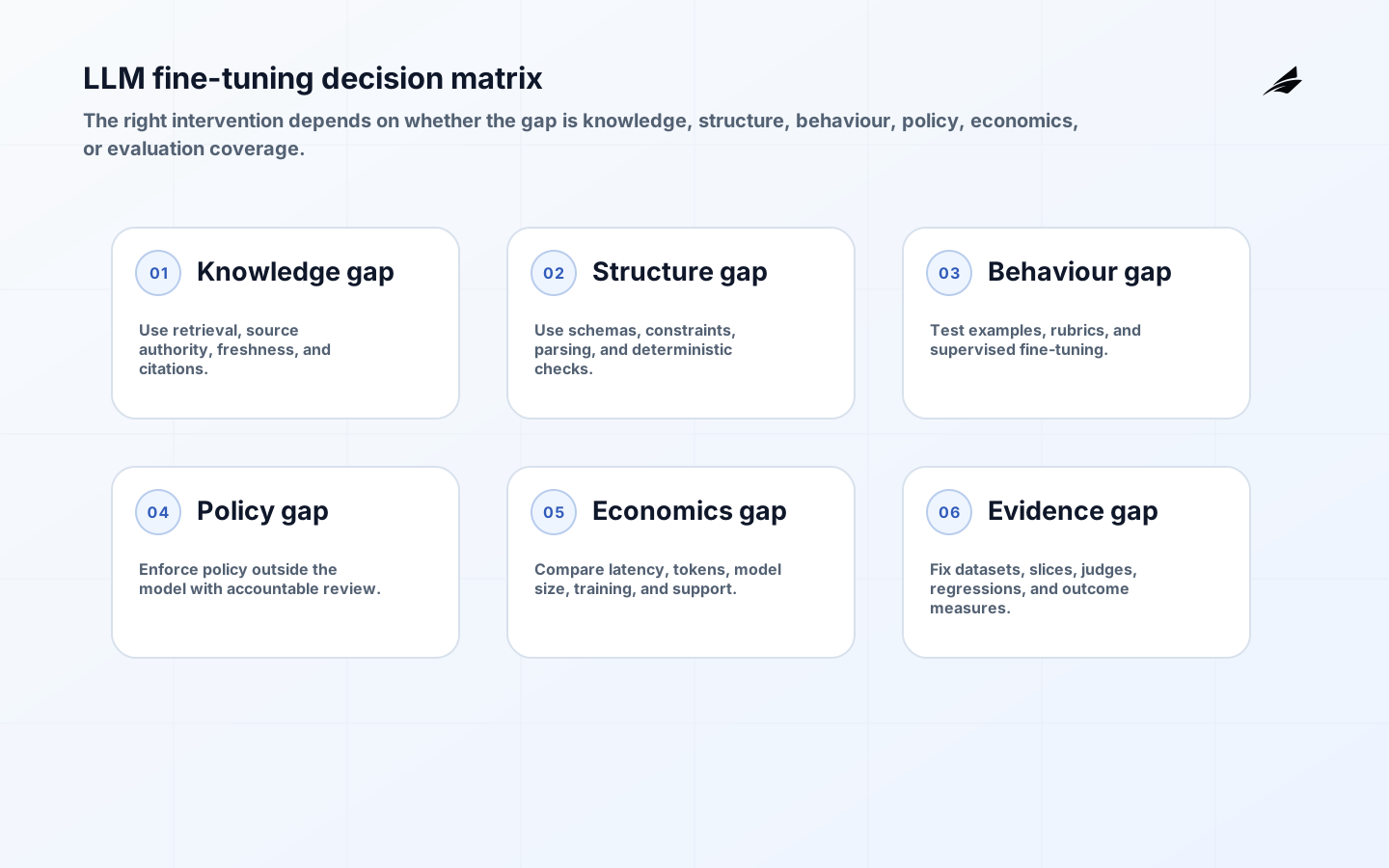
LLM fine-tuning decisions should begin with a measured behaviour gap, not a desire to own a custom model. Fine-tuning can improve repeatable output style, task-specific formatting, classification, or instruction adherence when good examples exist. It is usually the wrong first fix for missing current knowledge, weak retrieval, ambiguous policy, insecure tool access, or an evaluation set that cannot distinguish improvement from preference. A CTO must compare the complete systems: prompt and workflow changes, retrieval, deterministic validation, a different base model, and fine-tuning. The winning option is the one that meets the task’s quality, latency, cost, privacy, and operating requirements with evidence the organisation can sustain after the first training run.
The comparison should use the provider’s current fine-tuning guide, NIST’s Generative AI Profile, the original retrieval-augmented generation paper, and the broader NIST AI Risk Management Framework. Related Edilec guides cover retrieval-pipeline decisions, prompt engineering controls, and AI cost controls.
Describe the behavior gap in testable terms
Turn a complaint such as “the model is unreliable” into a measurable statement. Specify the input, desired output, unacceptable output, affected users, and consequence. Collect representative examples, including cases the system must decline. Separate factual knowledge gaps from behavioral gaps: changing policies and product data usually belong in a governed retrieval or system-of-record path, whereas a repeatable transformation or classification may be a training candidate. Establish a baseline using the existing model, prompt, workflow, and retrieval configuration. Without a baseline, a fine-tuned result can appear impressive because it is compared with an informal demonstration rather than the strongest practical alternative.
| Observed problem | First alternative to test | When fine-tuning may help |
|---|---|---|
| Missing current facts | Improve source retrieval and citations. | Rarely; training facts will age. |
| Inconsistent structured output | Use schema constraints and validation. | When stable examples improve recurring behavior. |
| Domain classification errors | Clarify labels and add deterministic rules. | When a well-governed labeled set captures the task. |
| Unsafe external action | Add approval and policy enforcement. | Never as the sole safety control. |
Compare the full system alternatives
Run controlled comparisons among prompting, retrieval, constrained interfaces, deterministic rules, workflow routing, and fine-tuning. Evaluate each option on quality, safety, latency, cost, explainability, operational burden, and change velocity. A fine-tuned model may reduce tokens or improve adherence in one path while making iteration slower, obscuring why an answer changed, or requiring additional data governance. Use the same held-out cases for every alternative, and include adverse cases such as incomplete inputs, conflicting evidence, and attempts to bypass a policy. Retrieval pipelines remain necessary even when a model is customized, because customers and policies do not stand still.

Treat training data as a governed product asset
Training examples need provenance, permission to use, a clear label definition, and a known relationship to the production task. Remove or protect sensitive information according to the applicable policy; do not assume an internal transcript can automatically become training material. Review examples for duplication, leakage of desired answers into the test set, narrow representation of users or cases, and subtle labels that reviewers cannot reproduce. Keep a data version and a decision record explaining why each source was included. Quality matters more than volume for a bounded behavior. If experts disagree on the correct outcome, document the disagreement and consider whether the work needs a review process instead of a learned shortcut.
| Evidence gate | Question | Release artifact |
|---|---|---|
| Data rights | May these examples be used for this purpose? | Approval and provenance record. |
| Label quality | Can independent reviewers apply the rule? | Guideline and agreement sample. |
| Held-out evaluation | Does behavior improve outside training examples? | Versioned results by task slice. |
| Operational readiness | Can the team monitor and roll back it? | Runbook, owner, and rollback test. |
Measure behavior by consequence and slice
Use a fixed, held-out evaluation set and score the properties that matter to the work: correctness, groundedness, structured validity, appropriate refusal, human correction effort, and latency. Segment results by language, case complexity, source availability, and impact level where relevant. Compare error modes, not just an aggregate score. A modest average improvement may be unacceptable if the changed model is worse on high-consequence cases or more likely to produce an unsupported confident answer. Human review of samples remains important because automatic metrics can miss nuance. NIST’s guidance supports documenting intended use, limitations, and measurement so that a model decision remains reviewable after the original experiment ends.
Operate a customized model as a versioned service
Deploy gradually with the model version, data version, evaluation result, prompt, tools, and fallback route recorded together. Monitor outcome quality, correction rate, cost, latency, safety events, and changes in the task distribution. Define who can approve a new training run, who can roll back, and how affected cases will be handled if a defect is discovered. Re-evaluate when source policies, user groups, or the base platform change. The AI cost controls guide can help compare recurring inference and review costs with the operating work introduced by customization.
Implementation checks
| Operating check | Concrete practice | Why it matters |
|---|---|---|
| Problem statement | Describe the behavior gap with input, desired result, harm, and owner. | The project can be evaluated against a baseline. |
| Alternative trial | Test retrieval, workflow, prompts, and constraints before custom training. | Fine-tuning is compared with simpler remedies. |
| Data approval | Record rights, provenance, privacy review, and permitted training purpose. | Examples are not reused without authority. |
| Label guide | Define edge cases and measure agreement between qualified reviewers. | Training targets reflect a reproducible decision. |
| Held-out set | Keep representative cases isolated from training and iteration. | Reported gains are not memorization artifacts. |
| Slice analysis | Compare performance by impact, language, complexity, and missing context. | Averages cannot hide material regressions. |
| Deployment record | Release model, data, prompt, evaluation, and fallback as one version. | Operators can identify the behavior behind an outcome. |
| Retirement rule | Set re-evaluation triggers for task, policy, base-model, or data changes. | A customized model does not persist beyond its evidence. |
A CTO should require a decision record that says why the team is training rather than retrieving or constraining. Include the expected durability of the behavior, the data-rights decision, the evaluation criteria, the estimated operating cost, and the foreseeable rollback event. This prevents a custom model from becoming an undocumented dependency that nobody feels authorized to question. It also forces an honest discussion about whether the organization has enough stable, well-labeled examples to teach the behavior it wants. In some cases, the right outcome is to defer training until the underlying process is more consistent.
After release, inspect failures with the same rigor used before training. Determine whether a wrong result came from a new task distribution, an inadequate label, a source gap, a platform behavior change, or an interface that invited an invalid use. Preserve enough information to reproduce the evaluation without retaining unnecessary sensitive data. Re-training should be a controlled response to evidence, not a routine reflex after every complaint. A small number of carefully diagnosed updates is usually more defensible than a rapidly changing model whose actual behavior and training history are unclear.
Consider the exit conditions before funding a fine-tuning program. A behavior may become obsolete when a policy changes, a source system becomes available, a product flow is redesigned, or the required labels can no longer be maintained. Define what evidence would trigger retirement, fallback to a baseline model, or a re-evaluation of the task itself. This avoids a common lifecycle failure in which customized behavior persists because it is technically deployed, not because it remains the best way to serve users. A clear exit condition is also a useful test of whether the team understands the model’s ongoing value.
Write the fine-tuning investment case before creating a dataset
A defensible investment case names the target behaviour and the slice where it fails. “Improve support answers” is too broad; “produce policy-compliant triage labels and a three-field rationale for English billing cases without changing quoted account facts” can be evaluated. Build a held-out set before training and compare at least three baselines: the current prompt and model, the best feasible prompt or structured workflow, and the proposed fine-tuned model. If the gap is factual freshness or source coverage, retrieval is the more direct control. If the gap is an invalid transaction, use schema and business validation. Fine-tuning should solve a model-behaviour problem that remains after these boundaries are sound.
Budget for the lifecycle rather than the training job. Examples need provenance, rights, redaction, quality review, versioning, and a representative distribution. Evaluation needs blind or well-defined judging, consequence-weighted slices, regression cases, and operational tests for latency and cost. Deployment needs a model registry, release evidence, fallback, monitoring, and a trigger for retraining or retirement. The OpenAI fine-tuning guide describes supervised and preference-oriented methods and emphasises examples and evaluation; NIST’s Generative AI Profile broadens the view to governance, measurement, provenance, privacy, and incident response. A custom model can reduce per-request prompt complexity, but it also creates a new software and data supply chain that someone must own.
| Observed gap | First intervention to test | When fine-tuning may be justified |
|---|---|---|
| Missing or changing facts | Retrieval with citations and freshness controls | Rarely; weights are not a current knowledge store |
| Inconsistent output structure | Schema, constrained decoding and validation | When examples still materially improve adherence |
| Domain tone or transformation | Prompt examples and clear rubric | When high-volume examples show stable repeatable behaviour |
| Policy violations | Deterministic policy checks and human review | Only for supporting behaviour, never as sole enforcement |
| Latency or token cost | Shorter prompt, caching, smaller base model | When measured customisation improves total economics |
| Poor edge-case quality | Clarify task and expand evaluation coverage | When representative labelled examples address the slice |
Key takeaways
- State the behavior gap and establish a baseline before considering fine-tuning.
- Compare retrieval, workflow, constraints, and prompting using the same held-out cases.
- Use only governed examples with rights, provenance, and reproducible labels.
- Measure quality and safety by meaningful task slices, not one headline score.
- Keep authorization, current facts, and irreversible actions outside the training objective.
- Version data, model, evaluation, and rollback evidence together.
Frequently asked questions
Will fine-tuning make a model know current company policy? It may memorize examples, but it is not a dependable mechanism for frequently changing facts; use governed retrieval. How much data is enough? Enough to represent the bounded behavior and provide a held-out test; quality and coverage matter more than a raw count. Can a fine-tuned model replace review? No. Review requirements should follow consequence and evidence, not model customization.
Conclusion
Fine-tuning is justified when it beats simpler alternatives on a defined behavior and the team can govern its data and lifecycle. Make the decision from evidence, deploy it with a fallback, and keep the critical controls outside the model.