Data and AI becomes useful when a business treats it as a managed way to improve a decision or workflow, not as a collection of dashboards and model experiments. A practical program connects an outcome, the data needed to support it, an accountable owner, a delivery method and controls proportionate to the consequence of error. This guide helps business, operations and technology teams make those choices together.
The term covers more than generative AI. Descriptive analytics explains what happened; predictive models estimate what may happen; optimization recommends an allocation or sequence; generative systems create or transform content; and workflow automation applies approved rules or actions. The right answer may combine several of these, or may be a data-quality fix with no model at all.
Start with the decision, not the model
Write the use case as a change in work: who makes which decision, using what evidence, at what frequency, and what happens when the result is wrong. This exposes whether the need is insight, prediction, content assistance or automation. It also identifies the actual beneficiary. A forecast that is statistically sound but arrives after inventory has been committed is not operationally useful. A support summary that saves reading time but omits contractual commitments may create more risk than value.
| Business need | Likely approach | Evidence of value |
|---|---|---|
| Understand a past trend | Curated metrics and descriptive analytics | Fewer conflicting reports and faster review |
| Estimate demand or risk | Predictive model with a decision threshold | Improvement against a simple baseline and useful lead time |
| Find information across documents | Search or retrieval-grounded assistant | Answer correctness, source coverage and citation quality |
| Draft or summarize content | Generative assistant with review | Accepted output, editing effort and harmful-error rate |
| Execute a repeatable process | Rules, workflow automation and bounded AI assistance | Cycle time, exception rate and successful completion |
Prioritize use cases on value, feasibility and consequence
A credible portfolio is intentionally selective. Score each candidate on expected business value, frequency, data availability, process stability, integration effort, reversibility and consequence of error. Do not let a large theoretical benefit hide missing labels, disputed definitions or a workflow with no owner. Begin with a frequent, bounded task where users can review results and where a baseline already exists.
- Name one accountable business owner and one technical owner.
- Define the current baseline using cycle time, quality, cost or risk evidence.
- Describe the user action that changes when the output arrives.
- List affected customers, employees and third parties, including those who may bear an error.
- State which outcomes require human judgment, appeal or escalation.
- Set a stop condition for a pilot that fails quality, security or adoption criteria.
Check organizational readiness alongside technical feasibility. The people who perform the work should help define examples, failure categories and review screens; managers should explain how released capacity will be used; and support teams need a route for questions and corrections. Budget for data stewardship, evaluation and operations after launch. Without those recurring responsibilities, a successful pilot can still deteriorate as sources, users and business rules change.
Build a data foundation that can be operated
Data readiness is specific to a use case. A company does not need to clean every dataset before starting, but it must understand the sources used by the selected workflow. For each important field or document, identify the system of record, owner, allowed purpose, refresh behavior, quality rules, retention requirement and access policy. Preserve lineage from source through transformation to model input and business output. That makes a wrong answer diagnosable instead of mysterious.
Quality should be expressed in operational terms. Completeness asks whether required values exist; validity checks format and business rules; consistency looks for disagreement across systems; timeliness tests whether data is current enough for the decision; and representativeness asks whether evaluation data covers the population and edge cases the system will encounter. Assign remediation to the source owner rather than silently repairing every defect in an AI pipeline.
| Asset | Minimum operating record | Key control |
|---|---|---|
| Source data | Owner, purpose, classification, quality rules and refresh schedule | Purpose-based access and retention |
| Transformation | Version, inputs, outputs and validation results | Reproducible pipeline and lineage |
| Model or service | Provider, version, approved uses and known limitations | Evaluation and change approval |
| Prompt or workflow | Version, tools, policies and fallback path | Tested release with rollback |
| Business output | Recipient, decision, evidence and correction route | Audit trail and human accountability |
Design the operating architecture around boundaries
Separate intake, data preparation, model inference, business rules, human review and system-of-record updates. This prevents a model output from becoming an action merely because both occur in the same application. Authenticate users and services, authorize access at the data and action layers, validate model output before downstream use, and give high-consequence actions explicit approval gates. Logs should record versions and outcomes while minimizing unnecessary personal or confidential content.
For example, a service team may want suggested case priority. Intake validates the case and customer identity. A model classifies topic and urgency, attaching evidence and confidence. Deterministic rules apply contractual service levels and protected-customer flags. An agent accepts or corrects the suggestion. Only the workflow service updates the queue, and every correction becomes labeled evaluation material after appropriate review. The model assists interpretation; it does not own policy.
Apply governance in proportion to risk
NIST organizes AI risk work into Govern, Map, Measure and Manage. In practice, govern establishes roles and policy; map documents context and affected parties; measure evaluates performance and harmful failure modes; manage prioritizes treatment, monitoring and response. ISO/IEC 42001 adds a management-system structure for setting objectives, assessing risk and continually improving controls. These frameworks do not choose a universal threshold for approval. The organization must define one for its context and obligations.
| Risk | Practical control | Signal to monitor |
|---|---|---|
| Poor or unrepresentative data | Data contract, profiling and segmented evaluation | Error rates by relevant group and scenario |
| Privacy overreach | Purpose limitation, minimization, access review and retention rules | Sensitive-data events and access exceptions |
| Unauthorized action | Least privilege, allowlisted tools and approval gates | Blocked and reversed actions |
| Model or data drift | Versioned baselines, monitoring and re-evaluation triggers | Quality trend and input-distribution changes |
| Supplier dependency | Contract review, export path, fallback and exit test | Availability, material changes and switching effort |
| Automation bias | Evidence display, review sampling and correction workflow | Override patterns and reviewer disagreement |
Evaluate the whole system, not only the model
Model accuracy alone does not show whether a workflow works. Build a representative evaluation set from real, permitted examples, including ordinary cases, rare cases, poor-quality inputs and adversarial or ambiguous requests. Compare against a simple baseline. Then run end-to-end tests covering retrieval, rules, permissions, integrations, latency, failure handling and the user interface. Re-run the set whenever the model, prompt, data source, policy or integration changes materially.
- Business outcome: completed work, decision quality, avoided loss or useful capacity released.
- System quality: task success, harmful-error rate, citation support, calibration and fallback success.
- Operations: latency, availability, queue age, integration failure and incident recovery.
- Adoption: eligible users, repeat use, accepted outputs, corrections and manual bypasses.
- Economics: total cost per completed task, including inference, retrieval, review and support.
- Risk: privacy events, access violations, complaints, appeals and control failures.
Use a staged rollout with explicit exit criteria
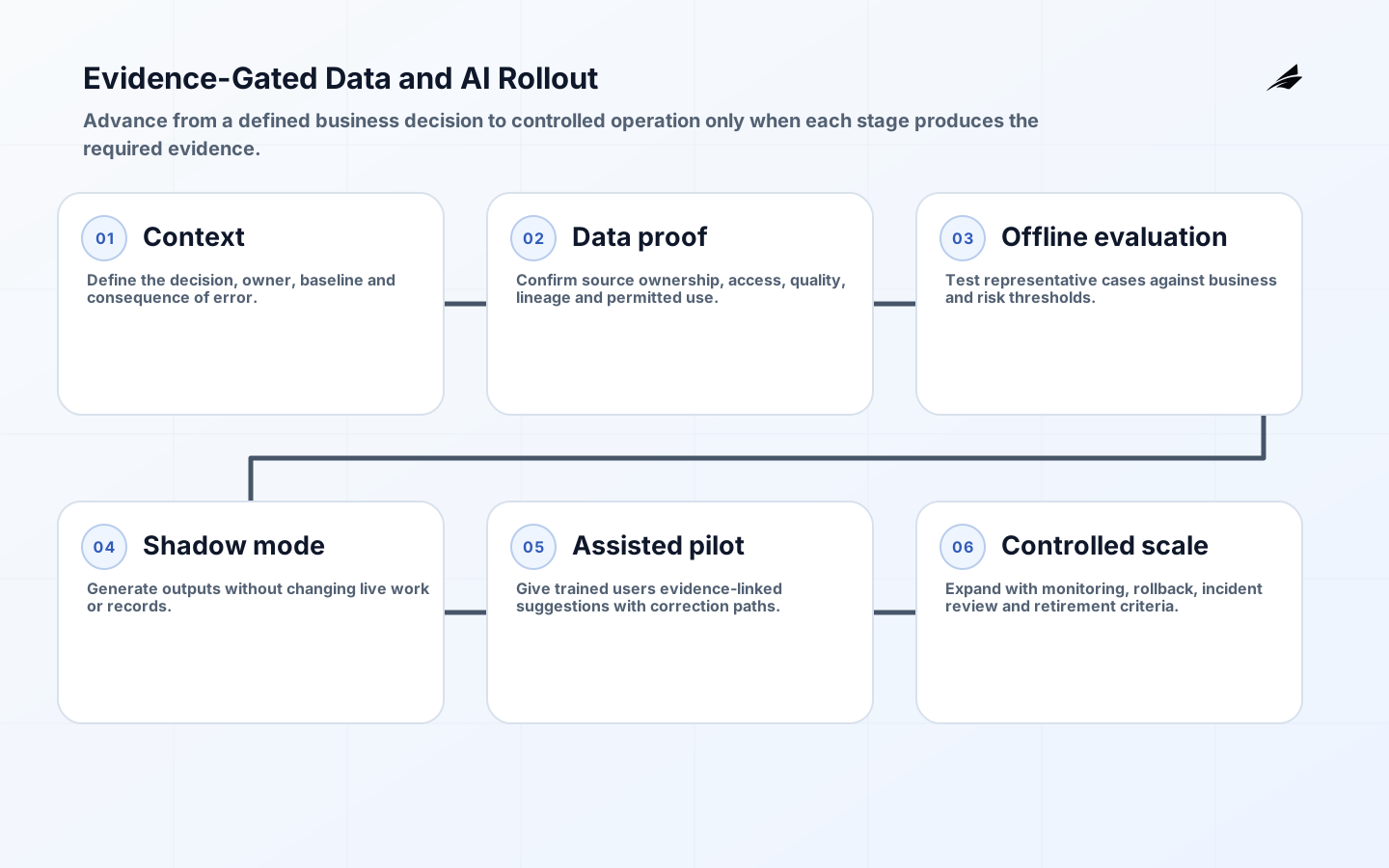
Stage one documents the decision, baseline, data and risk classification. Stage two proves access and data quality with a small offline evaluation. Stage three runs in shadow mode, producing outputs without affecting work. Stage four gives a trained pilot group suggestions with visible evidence and an easy correction path. Stage five expands only after quality, security, support and adoption gates pass. Stage six establishes periodic review, incident exercises, supplier monitoring and retirement criteria.

Promotion should depend on evidence, not elapsed time. Define who can pause the system, how users return to the previous process and how pending work is reconciled. Keep model and configuration changes releasable independently where possible, but evaluate their combined behavior. A production owner should review exceptions and metrics on a fixed cadence and turn recurring corrections into data, product or policy improvements.
Key takeaways
- Begin with a measurable business decision or workflow, not a preferred model.
- Prepare and govern only the data required for the selected use case.
- Keep probabilistic model output separate from policy and authorized action.
- Evaluate business value, system quality, risk, adoption and cost together.
- Expand through evidence-based stages with monitoring, fallback and accountable owners.
Do we need a new data platform before starting AI?
Not necessarily. Start with the sources required for one bounded use case and test whether ownership, access, quality and refresh behavior are adequate. A broader platform investment may be justified when many valuable use cases share the same fragmented data, but it should have explicit consumers and operating ownership.
Should a business build or buy its AI capability?
Buy commodity capabilities when requirements fit and supplier controls are acceptable; build the integration, policy and experience that reflect distinctive operations. Evaluate data terms, configurability, model changes, observability, export, support and exit cost. Many effective systems combine a managed model with organization-owned workflow and evaluation assets.
Who should own a data and AI initiative?
A business owner should be accountable for outcome and acceptable residual risk. Data owners govern source quality and use; technology owners operate the system; security, privacy and legal teams advise according to context; and users supply workflow evidence. A central AI group can set standards, but it should not become the owner of every business decision.
When is a pilot ready to scale?
Scale after representative evaluation meets agreed thresholds, material risks have owners, integrations and fallback paths have been tested, users understand limitations, support can handle incidents, and unit economics remain acceptable at expected volume. Continue sampling real outcomes because launch evidence can become stale.
Conclusion
A durable data and AI capability begins with a real decision, trustworthy inputs and named accountability. It separates probabilistic assistance from policy and action, evaluates performance in context and expands through evidence. Teams that build those habits can adopt new models without rebuilding governance each time, because the enduring asset is the operating system around the technology.