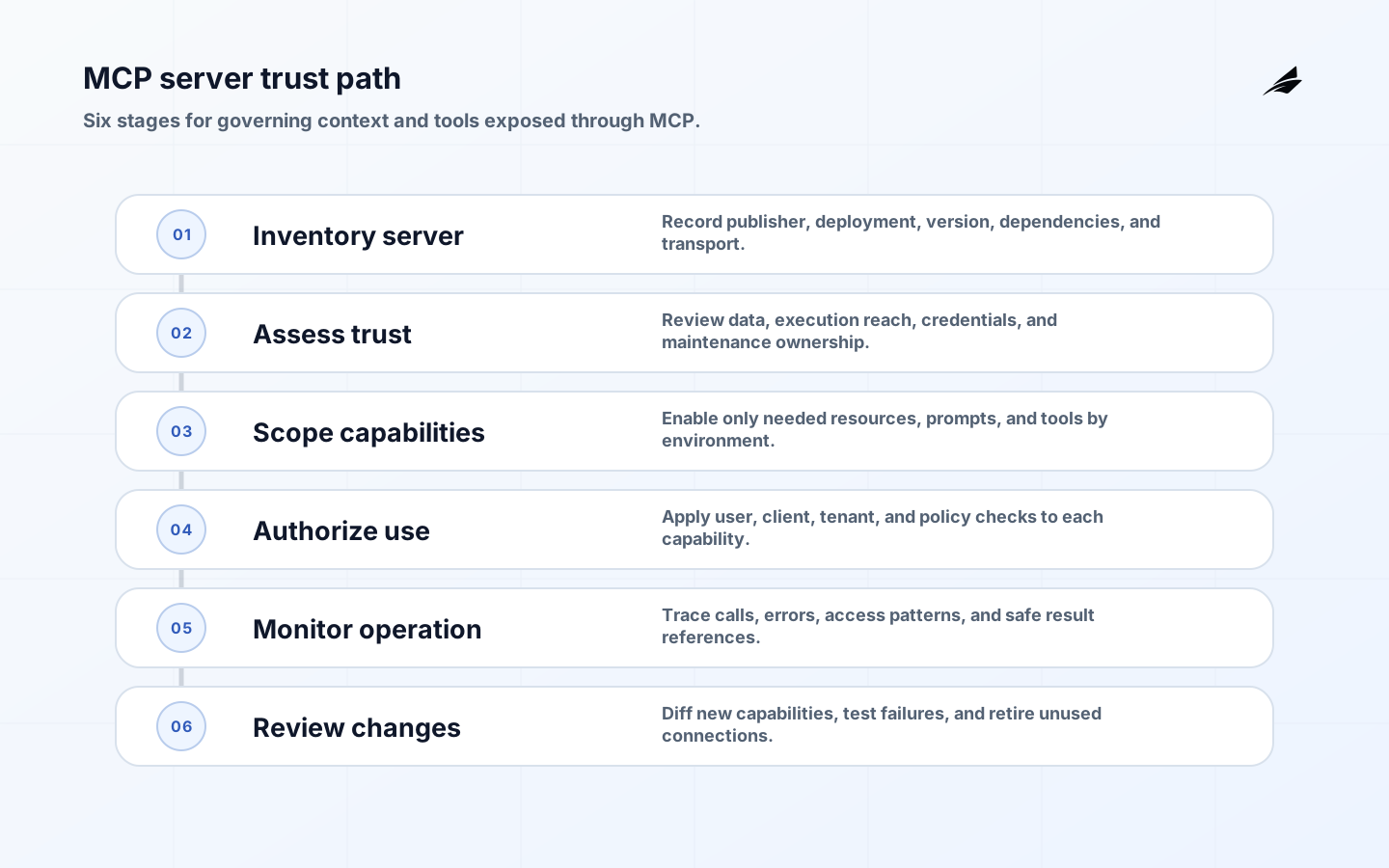
Model Context Protocol, or MCP, is an open protocol for connecting AI applications with external context and capabilities. Its building blocks include resources, prompts, and tools, and it uses structured messages between host applications, clients, and servers. That standardization can reduce bespoke integration work, but it does not turn a server into a trusted service. An MCP server may expose data, execute code, or influence what a model sees. IT managers therefore need the same disciplines they apply to any connected service: identity, authorization, data classification, change control, monitoring, incident response, and supplier assessment. The MCP specification explicitly calls out consent, privacy, and tool safety.
Inventory The Server And Capabilities
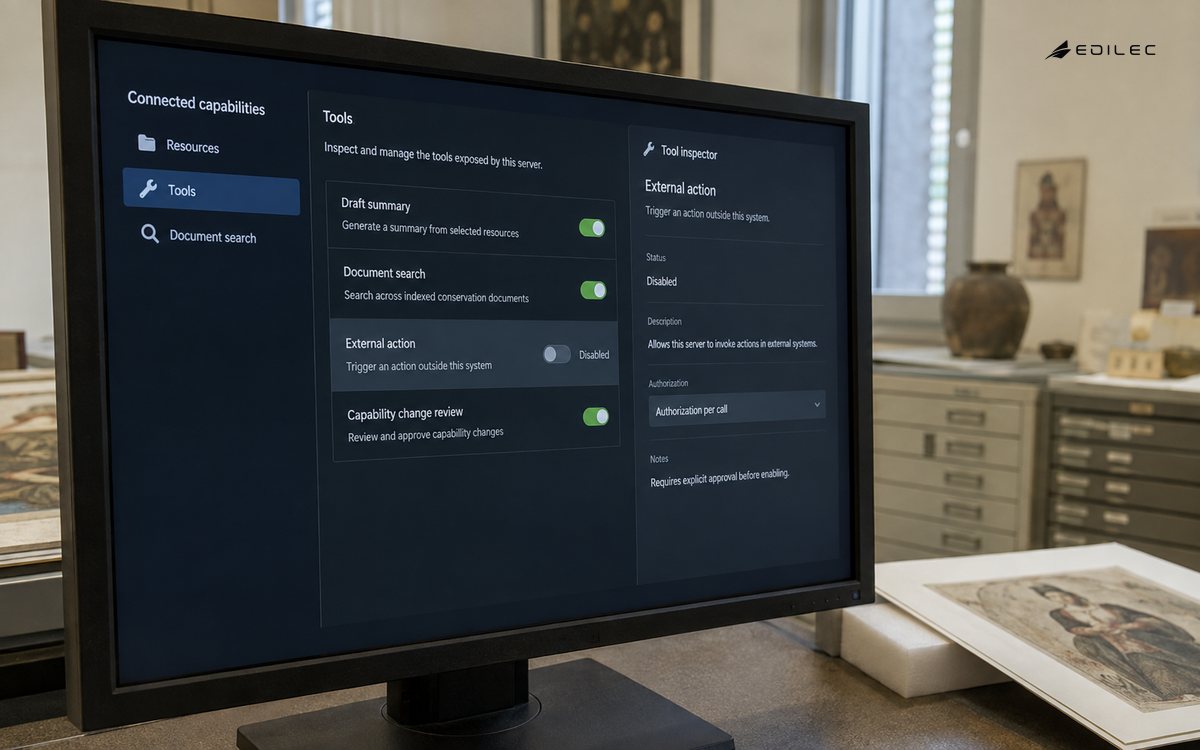
Do not approve “an MCP server” as a single object. Inventory its publisher, deployment location, transport, version, dependencies, authentication method, data sources, network reach, and every resource, prompt, and tool it exposes. A server that reads internal documentation presents a different risk from one that can write files, send messages, or invoke cloud administration APIs. Record whether capabilities are read-only, draft-producing, reversible, or high impact. The protocol’s capability negotiation helps clients discover what is offered; the organization still decides what to enable in each environment. The tool calling guide is a useful companion for evaluating tool consequences.
| Question | Why it matters | Evidence to collect |
|---|---|---|
| Who operates it? | Publisher and operator affect patching and incident responsibility. | Repository, owner, release process, support contact, and dependency inventory. |
| What can it expose? | Resources and prompts may contain sensitive data or instructions. | Data classes, tenant boundaries, access scopes, and retention behavior. |
| What can it do? | Tools can create side effects or execute arbitrary code paths. | Tool schema, required approval, credentials, idempotency, and audit events. |
| How does it change? | A new capability can widen risk without a client code change. | Version pinning, capability diff, review gate, and rollback plan. |
Establish A Trust Boundary
Treat server-provided descriptions, resources, and tool annotations as potentially untrusted until the server has been assessed and the content has been constrained for the use case. A model can be persuaded by text that it receives through a connected service, so a user should not need to recognize every malicious instruction for the system to remain safe. Keep secrets and broad environment access outside the server where possible. Scope credentials to a specific client, server, and capability; never give a generic integration token unrestricted reach because the protocol connection looks convenient. The MCP specification notes that tools represent arbitrary code execution paths and should be treated with caution.
- Allow only assessed servers in managed production environments.
- Pin or review server versions and capability changes before rollout.
- Use separate identities and credentials for each client-server relationship.
- Limit data and tool scopes to the application’s supported workflow.
- Require explicit user understanding for actions that affect their data or systems.
Authorize Each Capability
Authentication proves a client or user identity; authorization decides what that identity may do in the current context. Apply it to every resource read and tool invocation, not just to the initial connection. A client that can browse one workspace should not automatically gain the ability to query all workspaces. A model selecting a tool should not bypass policy because the user previously connected a server. Where a tool has a meaningful side effect, add a deterministic policy check and an approval interaction appropriate to the consequence. OWASP’s LLM application guidance reinforces that excessive agency needs controls beyond prompt instructions.
Test Change And Failure Modes
Test an MCP integration with revoked authorization, unavailable servers, malformed results, a newly exposed tool, a deceptive resource, and a client that attempts an out-of-scope call. Verify that timeouts fail safely, retries do not duplicate side effects, and users can understand when data is unavailable. Run capability-diff checks as part of server updates. Assess dependencies and deployment images as carefully as the server code itself. The NCSC secure AI guidance is useful for this full lifecycle view, including secure design, development, deployment, and ongoing management.
| Event | Required response | Operational owner |
|---|---|---|
| New tool appears | Block or quarantine until scope and controls are reviewed. | Platform or integration owner. |
| Server returns unexpected content | Treat as data, do not execute instructions, and log the event. | Application owner and security team. |
| Credential compromised | Revoke the specific client-server credential and investigate its use. | Identity and service owner. |
| Server outage | Present a clear degraded mode and preserve pending work safely. | Service owner and operations team. |
Operate A Managed Ecosystem
Maintain a registry of approved MCP servers, enabled capabilities, owners, environments, data classifications, versions, and expiration or review dates. Collect telemetry that records the server, capability, caller, authorization outcome, latency, errors, and a safe reference to the result. Review usage for unexpected access patterns and tools that are no longer needed. Separate development experimentation from production access so a new local server cannot silently inherit sensitive credentials. The payoff of MCP comes from reusable integration patterns; the operational requirement is making those patterns as governable as any other shared platform service.
Adopt MCP Through Managed Stages
Begin with a development sandbox that contains no production secrets and only approved test data. Install a small number of well-understood servers, inspect their advertised capabilities, and exercise the client’s consent and authorization paths. Next, promote one read-only, low-sensitivity workflow into a managed test environment with server version pinning, centralized logs, and an owner on call. Review the resulting traces and capability inventory with security and operations before adding more connections. This staged path gives teams time to establish a reusable onboarding checklist instead of treating each new server as an exception.
Procurement and dependency management deserve a place in that checklist. Know whether the server is maintained, how updates are signed or reviewed, where it sends data, what libraries and containers it depends on, and how quickly a critical issue can be patched. Decide whether a server can be used only by a named internal application or by many clients. When the organization eventually operates dozens of connections, these answers are the difference between a useful integration catalog and an untraceable mesh of implicit privileges. Standards create leverage only when the surrounding operating model keeps that leverage visible.
| Connection check | Evidence to inspect | Decision |
|---|---|---|
| Server identity | Verified publisher, deployment endpoint, release version, and support owner. | Allow connection only in approved environments. |
| Capability diff | Comparison of newly offered resources, prompts, and tools against the reviewed set. | Block unexpected expansion until assessed. |
| Policy test | Current user and client scopes are enforced for reads and actions. | Confirm the connection cannot inherit excessive privilege. |
| Resilience test | Outage, malformed response, and revoked credential leave a safe, visible state. | Approve production use only with a defined degraded mode. |
The host application is an important control point. It should make server identity, requested scopes, available capabilities, and planned actions visible enough for users and administrators to make an informed choice. Do not rely on a long generic consent screen that appears once and is forgotten. For sensitive or destructive tools, show the resource and consequence at the relevant moment, then record what was authorized. This improves security and supportability: when a user reports an unexpected action, the team can tell whether it came from server content, client policy, user confirmation, or a downstream service failure.
Keep the inventory current by making server onboarding and retirement part of the ordinary platform change process. An unused connection should lose its credentials and approval, not remain available merely because nobody has had time to remove it.
Review server metadata and tool descriptions with the same skepticism used for external API documentation. They are useful inputs to a client experience, not a security proof. Revalidate the connection when its operator, deployment, authorization model, or advertised capability set changes materially.
For internal servers, publish an ownership and support model alongside the technical interface. Consumers need to know how to request a capability, report a defect, learn about a breaking change, and understand the service level. A protocol ecosystem becomes durable when its operational relationships are as clear as its message schema.
Document a tested containment procedure for each connection: disable the capability, revoke its credential, preserve relevant audit evidence, and notify dependent workflow owners. A fast, rehearsed response is more valuable than a theoretical security statement when a server begins returning unsafe data or unexpected tools.
For every approved connection, identify the business workflow it serves. That association makes periodic access review practical and exposes integrations that remain technically live after their original purpose has disappeared.
Key Takeaways
- Inventory individual resources, prompts, and tools rather than approving a server in the abstract.
- Assess publisher, deployment, dependencies, data exposure, and side effects.
- Authorize every capability under current user and application policy.
- Review capability changes and test server failures before production rollout.
- Operate an approved-server registry with owners, telemetry, and expiry reviews.
Frequently Asked Questions
Does MCP replace APIs? No. MCP can expose capabilities to AI applications, while the underlying services still need well-designed APIs, validation, authorization, and operational controls. It is an integration protocol, not a substitute for service design.
Can users connect any MCP server? In a managed environment, allowlisted and assessed servers are safer. A personal experiment should not automatically receive production data, credentials, or unrestricted network access.
Conclusion
MCP servers can make AI integrations more composable, but composability increases the importance of governance. Inventory capabilities, establish trust boundaries, authorize each use, and monitor change. With those controls, IT teams can gain reuse without making a protocol handshake stand in for security judgment.