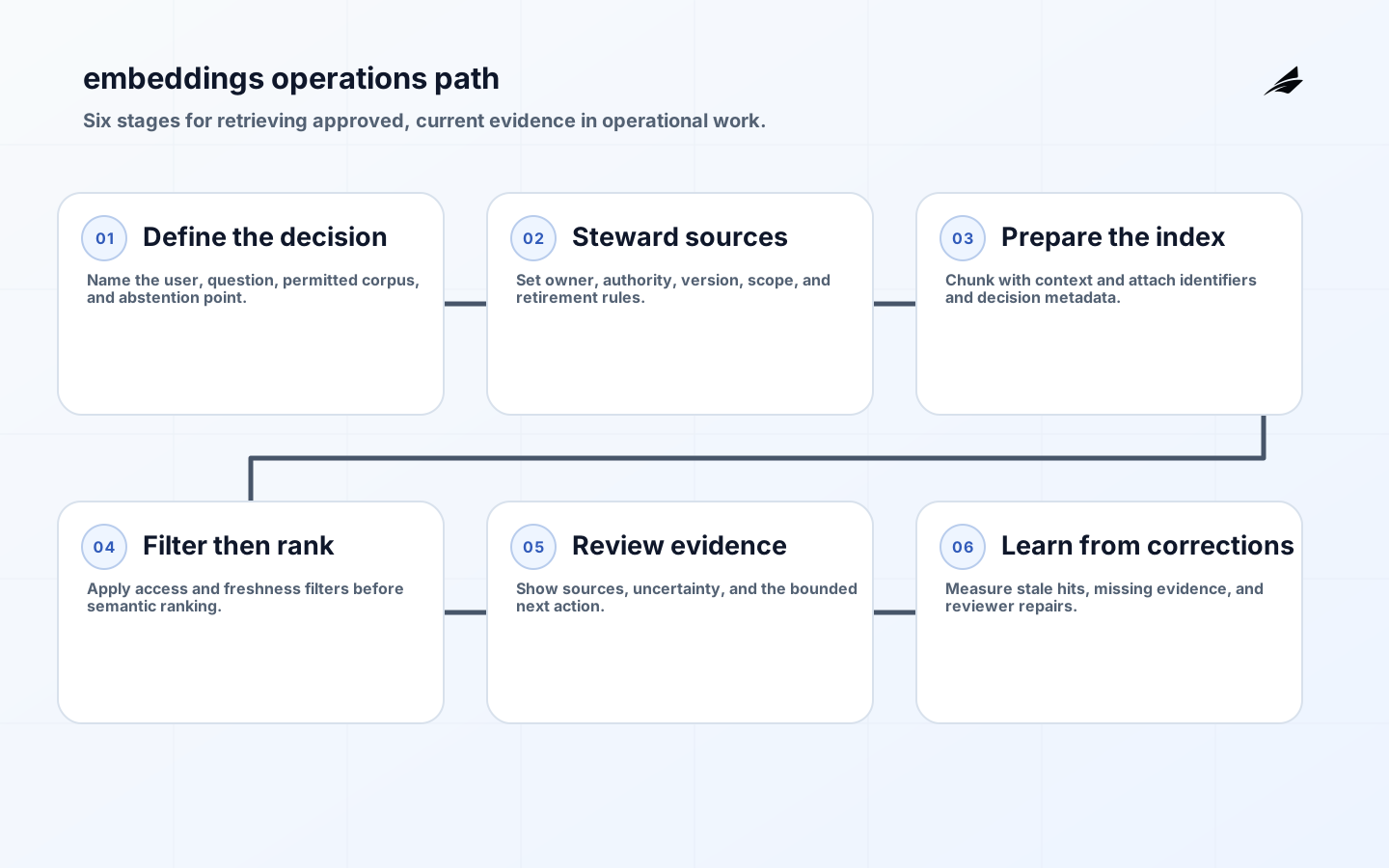
Embeddings are numerical representations that let software compare the meaning of text, images, or records. For an operations leader, their value is not an abstract similarity score. It is the ability to help a person find the current, permitted evidence needed to resolve a case without opening twenty tabs. A support specialist might need the right entitlement rule; a dispatcher might need the most relevant procedure; an analyst might need prior incidents that resemble a new one. The NIST Generative AI Profile is a useful starting point because it treats risk as a lifecycle concern. Embeddings become reliable only when the workflow, source ownership, access rules, and review path are designed together.
Define The Retrieval Decision
Start with a bounded question that an employee already answers from records. Specify who asks it, what response is useful, which systems are authoritative, and when the system must say that it cannot answer. For example, “Which current installation checklist applies to this equipment and region?” is testable. “Help with field service” is not. This framing prevents a common mistake: loading every available document into a vector store before anyone has decided what a good result looks like. It also reveals whether the task needs a structured lookup, ordinary keyword search, semantic retrieval, or a combination. The companion vector search guide helps teams separate those roles.

| Decision | Weak approach | Operationally useful approach |
|---|---|---|
| Corpus | Index every document that a connector can see. | Name approved sources, owners, effective dates, tenant scope, and a withdrawal path before indexing. |
| Question | Ask the model to be generally helpful. | Define a user, case type, evidence requirement, response shape, and abstention condition. |
| Access | Assume a relevant result is safe to show. | Apply identity and document policy filters before ranking candidates and before any action. |
| Quality | Judge a polished answer as success. | Check whether the selected evidence was authoritative, current, permitted, and sufficient. |
Prepare Source Records For Retrieval
An embedding does not know that a policy is superseded, that a manual applies only to one product revision, or that a customer record has a restricted audience. Those distinctions must arrive as metadata and operating rules. Give each item a stable identifier, owner, authority level, version or effective date, access scope, language, and retirement state. Preserve the parent document and nearby context so a retrieved clause can be interpreted. Chunking should be tested against real questions: a short chunk may rank well while omitting the exception in the preceding paragraph. Keep canonical facts in the system of record. The retrieval service should locate evidence and explain it, not quietly become the new database of truth.
- Require a named owner for every source collection.
- Remove or re-index material when a rule, permission, or product version changes.
- Keep metadata filters visible in traces so a missing result can be diagnosed.
- Store source, section, and version identifiers with each candidate passage.
- Use a separate route for questions that require live transactional data.
Make Permissions Part Of Retrieval
Semantic relevance is not authorization. A phrase from another customer account may be highly similar to a question, and a retired instruction may be a better textual match than the new one. Design the retrieval call to receive the requester identity and the case context, then apply tenant, role, jurisdiction, and freshness filters before reranking. Treat retrieved text as untrusted input too: it can contain misleading instructions or hostile content copied from a source. OWASP guidance on LLM applications is clear on the broader point that prompt behavior cannot replace conventional access control. A model may summarize a procedure; deterministic software must decide whether the person may see data or execute a change.
Test The Evidence Chain
Build a reviewed set from real operational questions, including the awkward cases: an obsolete procedure, conflicting source records, a user without access, near-duplicate product names, and a question with no answer. For each case, label the expected source or record and the unacceptable outcome. Inspect retrieval before reading the generated answer. If the right item never appears, changing the answer prompt will not repair the fault. If it appears but loses to a weaker passage, investigate metadata, chunk boundaries, lexical matching, and reranking. Include the people who handle escalations; they can identify exceptions that a product demo rarely exposes. The NCSC secure AI guidance supports this continuous, evidence-led approach.
| Signal | What it reveals | Next investigation |
|---|---|---|
| Evidence recall | The expected approved source did not enter the candidate set. | Check ingestion, filters, chunking, source retirement, and vocabulary. |
| Citation precision | The answer cites a related passage rather than the passage that supports its claim. | Review reranking, context assembly, and claim-to-source checks. |
| Stale-hit rate | Withdrawn or expired material is still being shown. | Trace the source change through caches, indexes, and replicas. |
| Useful abstention | The system either guesses or escalates routine questions. | Adjust the decision threshold using the cost of each error type. |
Operate A Changing Corpus
A retrieval service changes when the business changes. New terminology, revised procedures, altered permissions, and new data connectors can all move quality without a model release. Track source freshness, indexing lag, retrieval latency, correction reasons, and the share of questions resolved with sufficient evidence. Sample traces regularly with appropriate redaction: an operator should be able to reconstruct the request, filters, candidate identifiers, selected sources, model version, and outcome without retaining more personal data than necessary. Release meaningful changes gradually against the standing test set and retain a reversal path. This is the same discipline that makes an AI guardrails guide useful in production rather than decorative.
Build A Practical Implementation Plan
A sensible first implementation is deliberately small. Select one source collection with a capable owner, one user group, and twenty to forty reviewed questions that recur in ordinary work. Inventory access rules and document lifecycle events before any bulk ingestion. Build a baseline with the team’s current search or manual process so a claimed improvement has something honest to compare against. During the first release, keep the answer limited to cited evidence and a specified escalation route; do not attach a write tool simply because the retrieval looks promising. Give source owners a correction channel and set a service level for removing withdrawn material. This plan produces evidence about the full path from document change to user result, including the seams that a prototype normally skips.
The operating review should ask concrete questions. Which questions did users abandon? Which retrieved documents were corrected most often? Did a permission or source-freshness check prevent a bad exposure? How long did re-indexing take after a source update? These answers let the team choose between improving metadata, changing the workflow, narrowing the scope, or investing in different retrieval methods. They also make ownership visible: the content steward resolves authority disputes, engineering maintains the pipeline and policy enforcement, and the workflow owner decides whether the service achieved its business purpose. That division is more durable than assigning every disappointing result to “the AI.”
| Implementation checkpoint | Evidence of readiness | Owner |
|---|---|---|
| Source change event | A controlled update removes or refreshes a known document in every retrieval path. | Content steward and platform engineer. |
| Access test | A reviewer can demonstrate that two roles receive different eligible evidence for the same question. | Identity owner and workflow owner. |
| Question review | Operations reviewers agree that expected sources and abstention outcomes are defensible. | Workflow owner. |
| Release review | The team can compare candidate retrieval results with a baseline and reverse the change. | Engineering release owner. |
This kind of readiness check also keeps procurement and architecture choices in perspective. A vector database, embedding model, or reranker should be selected after the team knows its corpus size, filters, latency target, data residency needs, and operational ownership. An expensive model cannot fix a missing retirement event, and a fast index cannot correct a source that nobody owns. Make the first success criterion modest: a defined group can find current evidence faster with fewer unsupported answers. Once that holds across reviewed cases and a controlled production sample, expand by source or workflow. The evidence path should become stronger as the service gets broader, not disappear beneath more automation.
As the service expands, publish a compact service contract for its users: what sources it covers, what it cannot answer, how freshness is maintained, and how a result can be challenged. That transparency helps people use embeddings as a fast evidence-finding aid rather than mistaking semantic similarity for an official decision.
Key Takeaways
- Use embeddings to find evidence for a defined decision, not to create a vague knowledge layer.
- Assign ownership, dates, scopes, and retirement rules to the corpus.
- Authorize before retrieval and keep protected actions behind deterministic controls.
- Evaluate evidence selection separately from fluent writing.
- Turn reviewer corrections into source, metadata, or workflow improvements.
Frequently Asked Questions
Do embeddings replace a search engine? Usually no. Exact identifiers, part numbers, and policy names often benefit from keyword or structured search, while embeddings help with meaning and varied language. Many operational systems blend the methods and then rerank only records the requester is allowed to use.
What should an operations team measure first? Start with evidence recall on a small reviewed case set, stale-source incidents, and correction reasons. Those signals tell the team where the service is unreliable before broad satisfaction scores blur the diagnosis.
Conclusion
Embeddings are most valuable when they shorten a well-understood evidence search without obscuring accountability. Give the system a narrow decision, trustworthy records, explicit permission checks, reviewed examples, and a way to learn from corrections. That combination lets operations improve a real workflow while preserving the ability to explain, challenge, and repair each result.