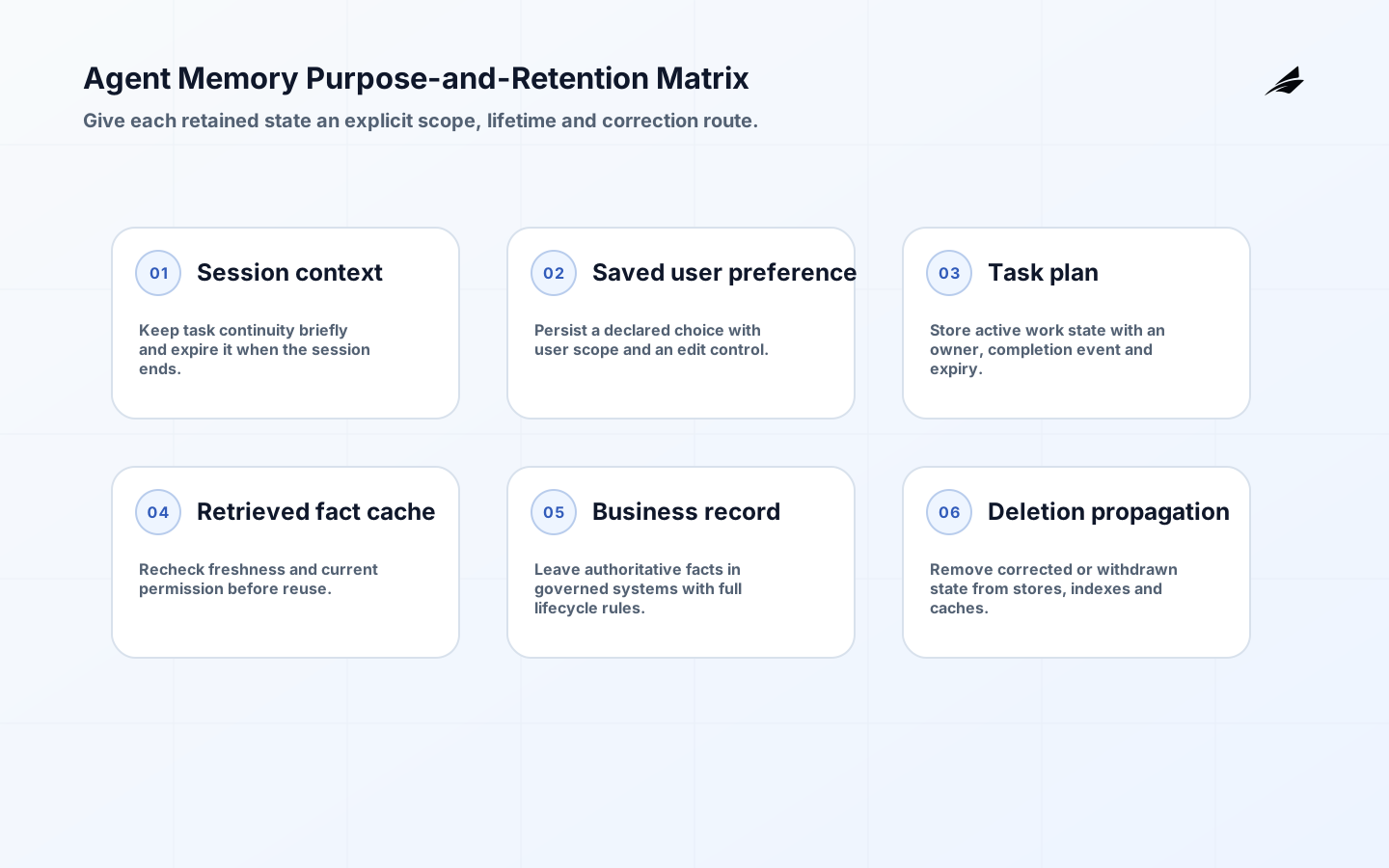
Agent memory is information a system carries from one model interaction to another. That may be a short-lived conversation summary, a user preference, a task plan, a retrieved fact cache, or a durable business record. Calling all of it “memory” makes architecture and governance harder. A CTO should instead ask what data is retained, why it is retained, who can access it, how it influences later behavior, and how it is corrected or deleted. The NIST Generative AI Profile emphasizes context and lifecycle risk; memory is precisely where those questions become concrete. Retained state can improve continuity, but it can also preserve stale, sensitive, or incorrect assumptions.
Classify Memory By Purpose
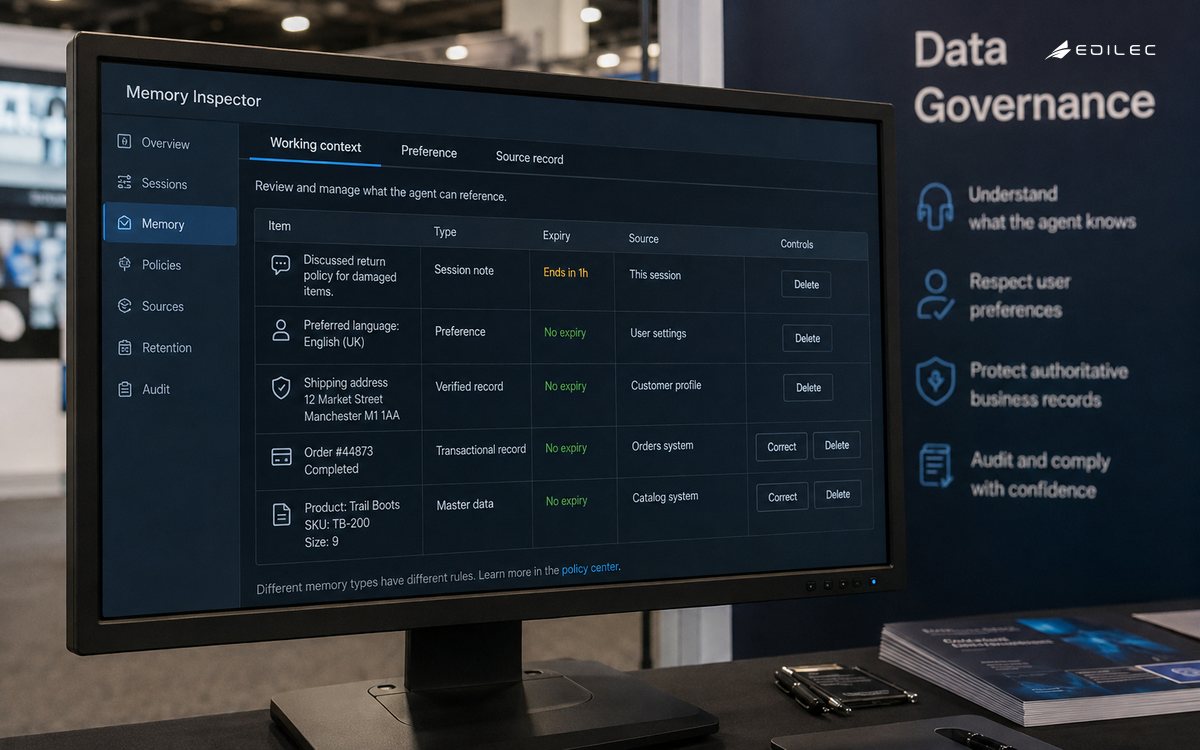
Separate working context from durable knowledge and from business records. Working context helps finish a single session and can often expire quickly. A preference such as a user’s desired report format may persist if the user expects it and can manage it. A case status, entitlement, or approval is not agent memory at all; it belongs in its system of record and should be retrieved under current authorization. This distinction avoids a dangerous shortcut in which a chat summary becomes a shadow customer profile. It also makes product behavior easier to explain: the application can tell a user which facts are temporary, which are saved, and which remain authoritative elsewhere.
| State type | Appropriate use | Governance question |
|---|---|---|
| Session context | Maintain continuity during one bounded interaction. | When does it expire, and is it excluded from later sessions? |
| User-managed preference | Remember a stable choice such as format or locale. | Can the user view, change, and remove it? |
| Task scratchpad | Track steps or intermediate results while work is in progress. | What should survive a restart, and what must never become durable? |
| System-of-record fact | Use current account, policy, or approval data. | Why is this copied instead of retrieved from the authoritative service? |
Set Purpose And Retention Boundaries
For every retained field, document its purpose, origin, sensitivity, user or tenant scope, retention period, access path, and deletion behavior. Store less by default. A summary of a completed conversation can be more useful and less risky than a full transcript, but summaries are fallible and need provenance. Do not retain inferred attributes merely because they might someday be useful. If the system remembers a preference or a workflow fact, give users and operators a way to inspect and correct it. Treat retention changes as product and security changes: extending a time limit alters the risk surface even when the model has not changed.
- Use stable record identifiers instead of copying whole business objects into a prompt store.
- Keep tenant and subject boundaries in every memory lookup.
- Attach source, timestamp, confidence, and expiry to derived summaries.
- Provide correction and deletion workflows that propagate to indexes and caches.
- Limit privileged operator access and audit inspection of sensitive state.
Retrieve Memory Under Current Policy
A fact that was visible when it was stored may not be visible later. Authorization must be evaluated when memory is retrieved or used, not only at write time. That matters after a role change, a tenant transfer, a legal hold, or a correction. It also matters because stored text can contain instructions or claims that should not control a later model turn. Keep retrieved memory clearly labeled as data, apply freshness and policy filters, and let application rules decide what it can influence. OWASP guidance is relevant because excessive agency and sensitive disclosure often arise from uncontrolled context, not just an unsafe final answer.
Test Drift And Correction
Test the cases where memory is most likely to become harmful: a user changes a preference, an account moves tenant, a policy changes, a conversation contains a false claim, or an employee asks the system to forget something. Verify that the next interaction uses the corrected state and that old copies disappear from retrieval paths. Measure stale-memory retrieval, correction latency, deletion completion, unauthorized lookup attempts, and disagreement between a summary and its source record. Run scenarios across session restarts and deployments. The NCSC secure AI guidance is helpful for treating these tests as operating controls, not just privacy paperwork.
| Memory failure | Why it happens | Design response |
|---|---|---|
| Stale preference changes behavior | No expiry or update event reached the store. | Use versioned preferences with a clear source and invalidation path. |
| Summary invents a fact | Compression loses nuance or mixes threads. | Keep provenance, allow correction, and retrieve the source for consequential use. |
| Cross-tenant recall | Scope was omitted from an index or cache key. | Enforce tenant filters at every retrieval and test isolation explicitly. |
| Deletion is incomplete | Vectors, logs, and caches follow separate paths. | Maintain a deletion inventory and verify each dependent store. |
Choose Architecture By Need
Avoid adding a generic long-term memory service before the product has a specific continuity problem to solve. Many applications only need session context plus authoritative retrieval at the next visit. Others need a small preference service with user controls. Complex agents may need task state with checkpoints and auditable transitions. Choose the narrowest architecture that supports the job, then design migrations before data accumulates. The human-in-the-loop automation guide is a useful companion where a person must validate remembered context before an irreversible step.
Implement Memory With Observable Boundaries
Before storing a new category of memory, write a short data contract. It should name the record schema, producer, consumer, scope key, authorization check, storage location, retention event, correction endpoint, deletion dependencies, and audit owner. Build an administrative view that can answer whether a record exists for a given subject without exposing unrelated data. For user-facing preferences, provide understandable controls rather than hiding persistence behind a chat experience. For task state, make checkpoints explicit so a restart cannot silently resume work with assumptions that are no longer valid. These controls can feel prosaic, but they are what make retained context safe to operate at scale.
Plan for migrations before the first store becomes sticky. A change from free-form summaries to structured state, a new encryption boundary, or a revised retention policy needs a way to identify affected records, transform or delete them, verify completion, and revert if the migration damages continuity. Run a periodic access and retention review with security, product, and operations representatives. They should examine real records, not only configuration statements. That review catches mismatches between intended policy and actual behavior, such as a cache that outlives a deletion request or a support role that can see more history than the workflow requires.
| Memory review | Evidence to inspect | Decision |
|---|---|---|
| Purpose review | A named user benefit and workflow requirement for each retained field. | Remove speculative data that has no current purpose. |
| Lifecycle test | Proof that correction, expiry, and deletion reach dependent stores. | Approve retention only when removal is operationally credible. |
| Access review | Tests for changed roles, tenant boundaries, and privileged support access. | Verify current policy governs recall. |
| Quality review | Samples that compare summaries and derived state with source records. | Identify drift that could mislead later interactions. |
Memory budgets are useful even when storage is cheap. Set limits on how much session context, summary history, or task state a workflow can use, and decide what happens when the limit is reached. The answer may be a user-visible summary, a deterministic lookup of the authoritative record, or a clean handoff. Unbounded accumulation increases cost, makes behavior harder to reproduce, and raises the odds that irrelevant history will distort a later result. A deliberate budget forces the team to articulate which prior facts continue to matter and which should remain in the record system without being inserted into an agent’s working context.
When users ask what the agent knows, the product should be able to answer in plain language. Explain whether it is using the current session, saved preferences, a task record, or a live system lookup. That explanation is not merely a privacy feature; it helps users spot incorrect context before it shapes a consequential request.
For shared or delegated work, be explicit about whether memory belongs to an individual, a team case, or an organization. A note that helps one support agent may be inappropriate to surface in a different team’s workflow. Ownership and scope should travel with the record instead of being inferred from conversational wording.
Separate backup and disaster-recovery requirements from ordinary conversational retention. A system may need resilient recovery of an approved task record, while a temporary session summary should still expire normally. Conflating the two creates pressure to retain every interaction indefinitely and obscures which data is essential for service continuity.
Key Takeaways
- Classify session context, preferences, task state, and authoritative records separately.
- Retain data for a named purpose with scope, provenance, expiry, and deletion rules.
- Reauthorize memory when it is used, not just when it is written.
- Test stale, incorrect, cross-tenant, and deleted state explicitly.
- Choose the smallest memory architecture that solves a real continuity need.
Frequently Asked Questions
Should an agent store chat transcripts? Only when there is a clear purpose, legal and product basis, access model, retention period, and user expectation. A bounded session or an approved summary is often a better fit than indefinite transcript retention.
Can vector search be used as memory? It can retrieve semantically related prior material, but it does not solve source authority, access control, correction, or lifecycle management. Those requirements still need explicit design.
Conclusion
Agent memory should make a workflow more continuous, not make the system’s state less legible. Distinguish temporary context from governed records, retain only what has a purpose, enforce current policy at use time, and prove that correction and deletion work. CTOs who do that keep memory useful without turning it into an unowned data estate.