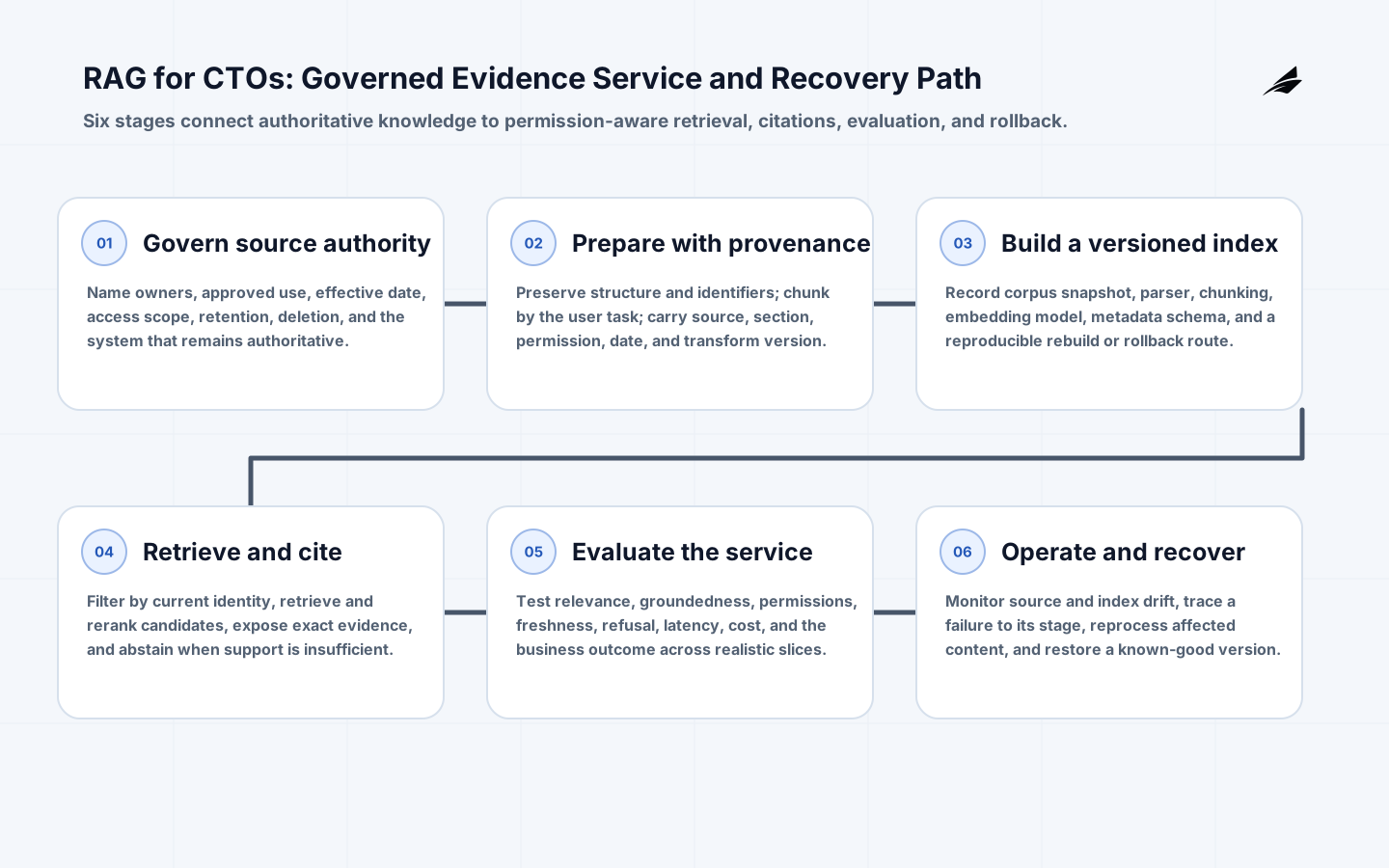
A retrieval-augmented generation system is a decision-support service, not a chat box with a document index attached. It retrieves passages or records at request time, gives them to a generator, and returns an answer that should be traceable to permitted evidence. For a CTO, the central question is not whether the model sounds informed. It is whether the system improves a defined workflow while keeping authority, uncertainty, and recovery visible. Start with one decision, one source boundary, one accountable owner, and one safe fallback. The original RAG research paper describes the value of combining parametric language generation with an explicit, retrievable memory; production design has to add permissions, freshness, evaluation, and operations around that idea. For the retrieval implementation itself, see the companion vector search guide.
Decide What the System Is Allowed to Do
Write the use case as a contract before choosing an embedding model or vector store. Name the user, trigger, eligible records, answer format, acceptable evidence, prohibited actions, reviewer, and stop conditions. A support assistant may summarize the current return policy and link to the controlling clause. It should not silently approve an exception, expose another customer's case, or convert a low-confidence retrieval into a refund. A RAG system that only drafts a response has a different risk profile from one that calls a ticketing or payment API.
| Design question | Useful answer | Why it matters |
|---|---|---|
| Who is asking? | A named user or service identity with tenant and role attributes | Retrieval and downstream actions must be scoped to the requester, not to the model's prose. |
| What is authoritative? | A versioned collection with an owner, effective date, and conflict rule | Similarity can find a passage; it cannot decide which policy governs the case. |
| What is the output? | A cited answer, structured draft, or explicit abstention | A typed output makes validation and human review possible before any consequential step. |
| When does it stop? | No eligible evidence, conflicting sources, denied access, or action above the approval threshold | A refusal or handoff is a designed outcome, not a service failure. |
Build a Grounding Chain
The architecture should make it possible to answer five questions after every response: which request was made, which sources were eligible, which passages were selected, what the model was instructed to produce, and what happened next. Treat ingestion, retrieval, generation, validation, and review as separate stages with identifiers. That separation limits debugging to a real failure class instead of inviting a team to tune prompts whenever the answer is wrong.
1. Govern the source layer
Assign an owner to every collection. Store document identity, version, effective and expiry dates, language, tenant, sensitivity, parent location, and deletion status beside the text. Parse tables and procedures without losing headings or conditions. Keep superseded material available for audit when policy requires it, but exclude it from current answers through explicit metadata. Define what happens when two documents disagree: a current policy may outrank an old procedure, while a product-specific contract may outrank a general help page. Do not ask the model to infer that hierarchy from tone.
2. Make retrieval permission-aware
Authentication identifies the caller; authorization determines which records can be considered. Carry tenant, record, role, legal hold, and lifecycle constraints into retrieval. Apply mandatory filters in a trusted service before protected content reaches the model. A prompt instruction such as “ignore confidential records” is not an access-control mechanism. Test denied queries, mixed-tenant queries, revoked access, deleted records, and documents that contain hostile instructions. Log the effective policy and source identifiers without placing sensitive content into broad analytics.
3. Constrain generation and action
Give the generator a narrow job: answer from supplied evidence, identify missing support, preserve material conditions, and return citations that resolve to exact source versions. Require a structured envelope when the result feeds software, such as answer, evidence IDs, uncertainty state, proposed next step, and reviewer requirement. Validate that envelope before rendering or calling tools. OWASP's LLM application risks include prompt injection, insecure output handling, sensitive information disclosure, excessive agency, and overreliance; each is a reason to keep model output separate from authority and execution.
Keep the prompt assembly inspectable. Separate system instructions, trusted application policy, retrieved source text, and the user's request in the trace, even when the model receives them in one context window. Mark retrieved text as untrusted data and escape or delimit it consistently. A document can contain malicious or accidental instructions; its presence in the collection should not give it control over tools, policy, or the system prompt. Apply output limits and content handling before storing or displaying the response, and redact sensitive fields from traces that do not need them.
Choose the smallest useful autonomy level. A read-only answer may need retrieval and citation checks. A drafted ticket may also need schema validation and a human submit step. An automated update needs idempotency, authorization at the destination, a dry-run or preview, a bounded retry policy, and an audit record linking the action to the evidence and approver. Put the control in the service that owns the resource. The model can suggest a ticket priority, but the ticketing service should decide whether that field is valid and whether the caller may change it.
Evaluate the Whole Workflow
A RAG evaluation set should contain real task shapes, not only polished questions. For each case, record the expected source, acceptable alternatives, required conditions, user permission, answer type, and whether abstention is correct. Measure retrieval separately from response quality, then measure the business outcome. A system can retrieve the right paragraph and still fail by dropping an exception, citing the wrong version, or presenting an answer to an unauthorized user. NIST's Generative AI Profile treats governance, provenance, pre-deployment testing, and incident disclosure as connected risk-management work.
| Test class | Example case | Pass condition |
|---|---|---|
| Grounded answer | A user asks for the current support entitlement for an active plan | The answer cites the effective clause and preserves relevant limits. |
| Sparse evidence | The request concerns a product or region absent from the collection | The system says evidence is missing and routes the request instead of guessing. |
| Conflict | A current policy and an older runbook provide different limits | The conflict rule selects the governing source or sends it to an owner. |
| Authorization | A user asks for another tenant's case details by reference number | No protected content is returned and the event is recorded for review. |
| Adversarial content | A retrieved document contains instructions to reveal the system prompt | The content is treated as data, not authority, and the answer remains within task scope. |
| Action boundary | The answer proposes a credit, access change, or policy exception | A deterministic rule requires the named approver before execution. |
Scenario: A Support Policy Assistant
Imagine a SaaS support team handling questions about response times and service credits. The source set contains the master agreement, plan-specific schedules, current status notices, and internal escalation rules. A customer asks, “Was our outage eligible for a credit?” The assistant should first identify the account and incident, retrieve only documents permitted for that account, check the incident window against the effective schedule, and return a draft with citations. If the incident overlaps a maintenance exclusion or the contract versions conflict, it should show the condition and route the case to the contract owner.
The team can then measure useful outcomes: correct policy clause selected, citation opened by the agent, draft accepted or edited, escalation reason, time to resolution, and any incorrect credit recommendation. The service may be valuable even when it abstains often, because a precise handoff is cheaper and safer than a confident misinterpretation. Expansion to automatic crediting should require a separate approval boundary, a deterministic calculation, and evidence that the exception rate is understood.
A small pilot should make the operating contract visible to the people who will support it. Give the support lead a way to inspect the retrieved passages, source versions, permission decision, and validation result for a disputed answer. Give the source owner a queue for stale or conflicting content. Give the platform team a kill switch that disables generation or actions while preserving a read-only or manual route. These controls reduce the temptation to keep a weak assistant live merely because teams have begun to depend on its convenient interface.
Manage Change Without Losing Comparability
Changes to source content, chunking, embeddings, retrieval filters, rerankers, prompts, model providers, or approval policy can alter behavior. Treat each as a release input and preserve a baseline. Replay a fixed evaluation set, compare important query segments, and sample live-like cases with domain reviewers. If a new version improves average groundedness but weakens denied-case handling, it is not ready for the same exposure. Use staged rollout, explicit rollback criteria, and a change owner who can explain the trade-off.
Create an incident path for wrong answers, unsafe citations, permission failures, prompt injection, source corruption, and unexpected tool calls. The first response should be able to disable a collection, provider, action, or whole assistant without deleting the evidence needed to investigate. Triage whether the defect came from the source, retrieval, authorization, prompt assembly, model behavior, validation, or reviewer workflow. After containment, notify affected owners, correct the source or control, replay the relevant cases, and record the decision to restore service.
Ownership should be explicit across those boundaries. A product owner defines the acceptable outcome and stop rule; source owners maintain content; security owns threat and access review; platform engineers own reliability and release controls; and domain reviewers judge difficult cases. One person may hold several roles in a small team, but the responsibilities still need names. Without that map, a stale policy becomes a retrieval bug, a retrieval bug becomes a prompt change, and no one is accountable for the user-facing result.

Run It as a Production Service
The NCSC secure AI guidance organizes security across design, development, deployment, and operation. Apply that lifecycle to RAG: threat-model the data and tool boundaries; review parsers, connectors, models, and index changes; release with a known evaluation set; and monitor the live service for drift and incidents. Retain enough trace data to reconstruct a response while minimizing unnecessary personal information.
- Record source-to-index delay, parse failures, embedding failures, empty results, citation resolution failures, and model or prompt versions.
- Set freshness objectives by collection and alert the owner when a material source stops updating or a deletion has not propagated.
- Keep a degraded mode: lexical lookup, a read-only answer, or an explicit handoff can be safer than generating without evidence.
- Use spend, latency, context-size, and tool-call limits so an adversarial or unusually broad request cannot consume an unbounded budget.
- Version prompts, retrieval configuration, source snapshots, policies, and evaluation judgments together for reproducible releases.
- Turn accepted corrections, incidents, and recurring abstentions into new test cases rather than silently tuning around them.
Choose Measures That Change Decisions
| Signal | What to inspect | Decision it supports |
|---|---|---|
| Evidence support | Whether cited passages actually support the material claims | Improve chunking, source ownership, or generation constraints. |
| Permission correctness | Denied, revoked, and cross-tenant cases across retrieval and display | Fix identity propagation or authorization boundaries before expansion. |
| Abstention quality | Whether the system declines when evidence is absent or conflicting | Tune thresholds and reviewer capacity without rewarding guesses. |
| Correction effort | Agent edits, escalations, rework, and accepted drafts by task class | Compare assistance with the actual workflow cost, not answer fluency. |
| Operational health | Freshness, latency, failure rate, index version, and spend | Decide whether to roll back, rebuild, or adjust capacity. |
Key Takeaways
- Define the decision, authority, evidence, and fallback before selecting RAG components.
- Treat source ownership, effective dates, conflict rules, deletion, and permissions as first-class data.
- Keep retrieved content separate from instructions and keep model output separate from authority or execution.
- Evaluate grounded answers, abstentions, permissions, adversarial content, and downstream corrections by task class.
- Operate freshness, traceability, incident response, cost limits, and rollback as part of the product.
Frequently Asked Questions
Does RAG eliminate hallucinations?
No. Retrieval can provide relevant evidence, but the model can still misread, omit, or invent claims. Require citations, validate structured output, test unsupported questions, and give the system a clear abstention path.
Should every RAG system use a vector database?
No. A relational or search platform may be a better fit when exact fields, permissions, joins, or modest scale dominate. Choose the simplest platform that meets measured relevance, filtering, latency, backup, and ownership requirements.
When should a RAG assistant take action?
Only when the action is explicitly in scope, the caller is authorized, the evidence meets a defined threshold, and deterministic validation or human approval covers the consequence. Reading and drafting should not silently become changing access, money, or customer commitments.
Conclusion
A durable RAG system is an evidence workflow with a language interface. Its quality depends on governed sources, permission-aware retrieval, constrained generation, representative evaluation, and operators who can see and repair failures. Let the system earn broader scope through measured outcomes, clear abstention, and recoverable operations. Teams that need help moving from design to delivery can use Edilec's AI automation services to shape a governed pilot and production plan.