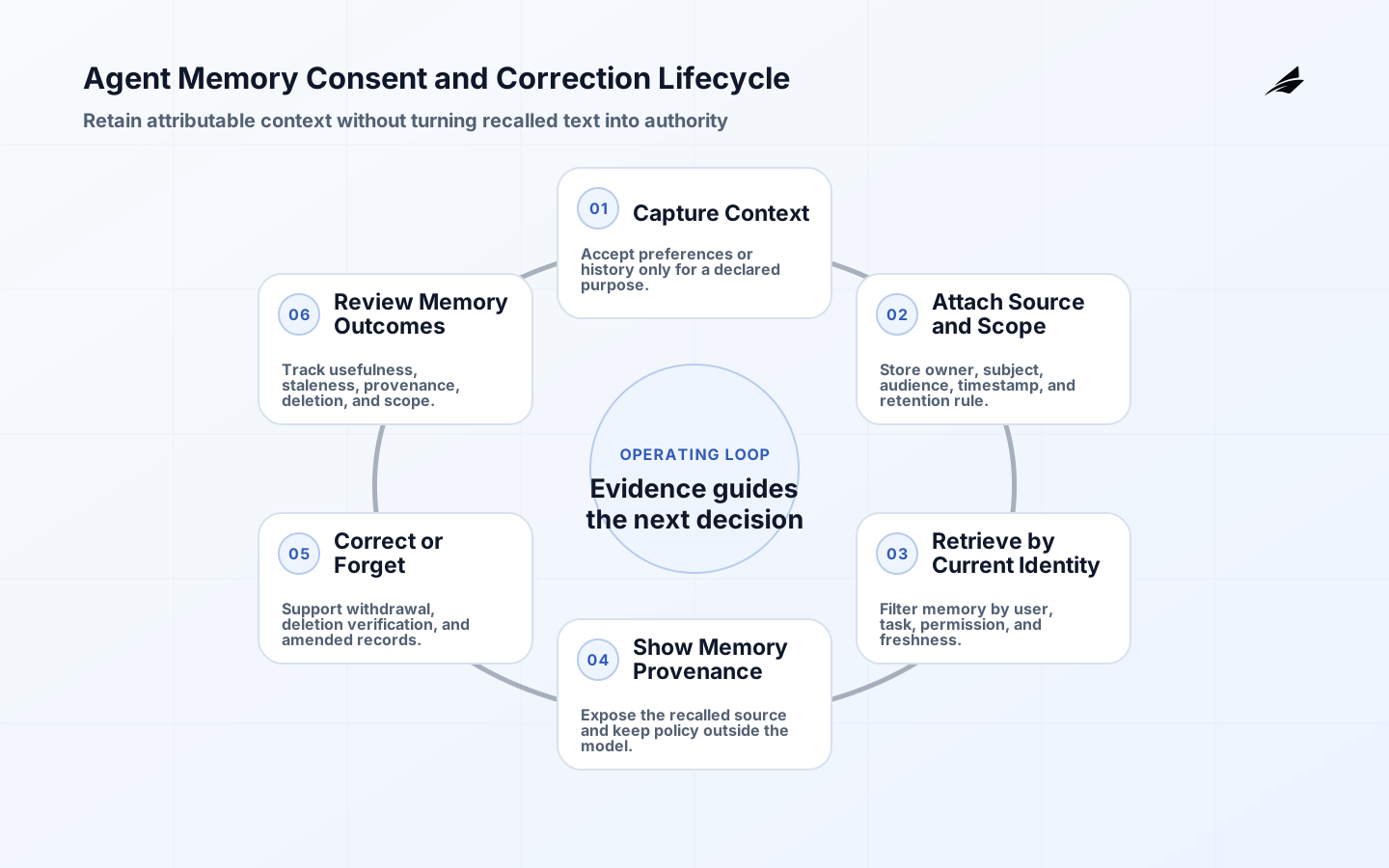
Agent memory is useful when it helps a named person complete a bounded piece of work with better evidence, not when it merely produces fluent output. Picture an internal service assistant remembers a requester preference while resolving a new access request. The team needs a result that can be inspected, corrected, and safely declined when the evidence is weak. This field guide for IT managers treats agent memory as an operating capability: define the decision, control the inputs, make the output reviewable, and learn from real use. agent memory in practice gives useful implementation context, while this article concentrates on the choices that should be settled before a broad rollout. For agent memory, the named user, source record, and allowed result must be explicit.
Start agent memory with a decision boundary
Write a one-sentence operating statement before choosing a model, framework, or interface. For this use case, agent memory should retain useful context without treating past conversation as authority. The permitted outcome is deliberately narrower than the business aspiration: store and retrieve scoped, attributable context; it does not turn unverified memory into a policy or a permission. Name the user, the event that starts work, the evidence that may be used, the recipient of the result, and the action that remains outside the system. A precise boundary converts an abstract capability into test cases and prevents a pilot from quietly acquiring authority it was never designed to hold. For agent memory, ownership and record lifecycle determine whether input is fit for use.
| Boundary question | Practical decision | Evidence to retain |
|---|---|---|
| Who benefits? | IT managers | Named role, process owner, and task description. |
| What enters the workflow? | consented user preferences, ticket history, source timestamps, retention rules, and current identity | Source identifier, owner, version, and access decision. |
| What may it do? | store and retrieve scoped, attributable context; it does not turn unverified memory into a policy or a permission | Output, reviewer choice, and downstream receipt. |
| When must it stop? | When authority, evidence, or policy is missing or contradictory. | Abstention reason, escalation route, and case outcome. |
Make inputs to agent memory governed and attributable
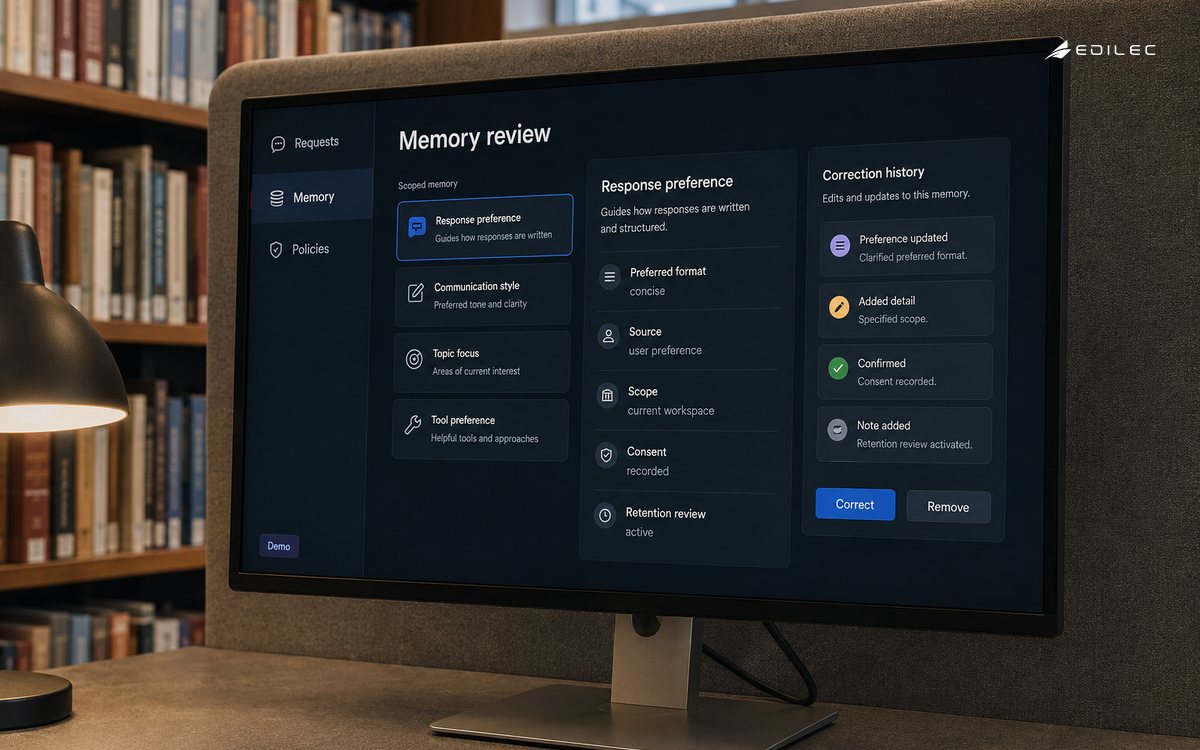
The practical input set is consented user preferences, ticket history, source timestamps, retention rules, and current identity. Each item needs more than text: retain who owns it, when it became effective, what audience may see it, and how it can be corrected or withdrawn. This is particularly important when a record contains instructions, prior decisions, or sensitive context. Treat those contents as data to be interpreted under application controls, not as commands that can override the workflow. Artificial Intelligence Risk Management Framework: Generative AI Profile provides a useful risk lens because it connects governance, measurement, and management to the full system rather than to a model in isolation. For agent memory, the system boundary must remain inspectable when a request changes shape.
- Create and maintain a memory register specifying record type, source, subject, purpose, sensitivity, retention, and deletion route.
- Apply identity and authorization checks before selecting content or invoking a connected capability.
- Keep source references and timestamps beside the result so a reviewer can inspect the basis for it.
- Define a refusal or escalation result for missing, stale, conflicting, or out-of-scope evidence.
Build a reviewable agent memory path
A small first implementation should expose the path from request to result. For agent memory, that means separate session state from durable memory, retrieve by scope, show provenance, enforce retention, and support correction. The design question is not whether one component is intelligent; it is whether an engineer or process owner can identify the source of a wrong outcome without guessing. Keep policy enforcement and consequential side effects in conventional application services. The model may classify, summarize, select, or propose, but the service must independently decide whether the requested output or action is permitted. For agent memory, a failure needs a visible path to a responsible person or service.
This separation also makes change safer. A prompt, model, retrieval setting, tool definition, or parsing rule can change behavior. Version those elements, attach them to the request record, and use a staged release. The secure-development guidance from Guidelines for secure AI system development is a helpful reminder that security work belongs through design, development, deployment, and operation, not in a final review only. production changes for agent memory explores the operating consequences after the first release. For agent memory, test cases should represent the operational conditions that create harm.
| Path element | Minimum control | Useful failure behavior |
|---|---|---|
| Request intake | Authenticate the user and validate task scope. | Reject ambiguous or unauthorized work with a clear reason. |
| Context selection | Filter by access, source status, and relevance. | Return less context or no result when evidence is insufficient. |
| Generation or selection | Constrain format and retain configuration version. | Mark uncertainty instead of filling gaps with plausible detail. |
| Decision or action | Enforce schema, policy, and authority outside the model. | Require approval, dry run, or escalation before a side effect. |
| Record and review | Keep evidence, result, and disposition available to authorized reviewers. | Open a correction path and preserve the original event. |
Place controls where agent memory can fail
The central failure mode is concrete: stale, sensitive, or cross-user context influences a decision without visibility or a valid retention basis. A helpful instruction or a prominent warning alone cannot reliably contain that failure. Use independent checks at the boundary where information becomes a record, recommendation, or action. The OWASP Top 10 for Large Language Model Applications catalog is useful here because risks such as prompt injection, sensitive-information disclosure, insecure output handling, and excessive agency arise from the surrounding application and integrations as well as from a model response. For agent memory, release records must let an investigator reproduce the decision context.
Decide in advance what the system should do when a control fails. A safe response may be to return cited evidence without a recommendation, create a review task, or fall back to the established manual path. The right choice depends on impact, reversibility, and time pressure. Do not hide an uncertain result behind generic confidence language; show the source gap, failed validation, or approval requirement in a form the responsible person can act on. For agent memory, the measurement plan needs to reveal regressions before expansion.
Evaluate agent memory against the work, not a demo
Start with representative historical and synthetic cases that include ordinary work, difficult edge cases, stale records, conflicting evidence, and disallowed requests. Define success before looking at the result. For this guide, measure memory-usefulness rate, stale-memory incidents, deletion completion, provenance coverage, and scope violations. Segment results by source type, user role, task difficulty, and any group that could experience a different consequence. A single average can hide a predictable failure in the very cases where people need the workflow most. For agent memory, a reviewer needs evidence that is close enough to the result to verify it.
Use both automated checks and accountable human review. Automated tests are strong for schemas, citation presence, authorization outcomes, and known policy rules. Human reviewers remain valuable for task usefulness, subtle factual omissions, and whether a refusal was appropriate. Keep evaluator instructions and expected properties versioned with the system under test. AI Risk Management Framework Resources supports the broader discipline of turning claims into evidence rather than relying on a few impressive examples. For agent memory, change control should include dependencies that can alter behavior indirectly.
Release agent memory in observable increments
Begin with a constrained audience or queue where the manual route remains available. Compare the new path with the baseline process, then expand only after the team can explain material errors and corrections. Preserve the request scope, sources considered, configuration version, policy decisions, output, downstream receipt, and reviewer disposition. That record gives operators a usable incident trail: they can distinguish a bad source from a parsing issue, a policy gap, a release regression, or a misunderstood boundary. For agent memory, the recovery route must be practiced while the ordinary manual process exists.
Assign explicit owners for the process, source data, application controls, evaluation, and incident response. Review changes on a cadence that matches the risk of the task, plus whenever an upstream source or connected capability changes. first-build decisions for agent memory is a companion for planning that first increment. The aim is not permanent caution; it is confidence that expansion follows evidence instead of enthusiasm. For agent memory, segmented outcomes matter more than a reassuring aggregate score.
Use operating signals to improve agent memory
- Track memory-usefulness rate, stale-memory incidents, deletion completion, provenance coverage, and scope violations with a named owner and a review rhythm.
- Sample successful cases as well as failures; silent degradation often appears in apparently normal work.
- Record approved overrides and corrections as candidates for source, policy, or evaluation improvement.
- Test recovery: disable the affected capability, preserve audit records, and send work through a known manual route.
- Review cost and latency alongside quality so a seemingly useful path does not become operationally fragile.
Key takeaways for agent memory
- Agent memory needs a named work decision before it needs a broad integration.
- Attributable sources and independent controls make results reviewable and safer to correct.
- A refusal or escalation path is part of useful service design, not a failed interaction.
- Release evidence should reflect the users, sources, and consequences of the real workflow.
- Operational ownership keeps a pilot from becoming an unexamined dependency.
Agent memory FAQ
What is the first practical step for agent memory?
Write the operating statement and collect a small set of representative cases. Include the named user, permitted evidence, allowed result, excluded actions, and escalation route. This gives the team a shared test for every proposed feature and integration. For agent memory, the next improvement should follow observed work rather than an imagined feature list.
When should a person review agent memory output?
Require review whenever the result can create a material commitment, change a record of authority, expose restricted information, or act on incomplete evidence. For lower-impact work, review samples and exceptions so the team can detect drift without turning every interaction into manual rework. For agent memory, exceptions should improve the source, policy, or interface instead of disappearing into a queue.
Can agent memory scale after a small pilot?
Yes, when expansion is tied to evidence. Add one source, role, action, or integration at a time; update the boundary and tests; and confirm that the owners can investigate an incident. Scale is a sequence of accountable decisions, not a switch from prototype to autonomy. For agent memory, a responsible owner should be able to explain both the limit and the value of the service.
Conclusion: make agent memory accountable to the work
A durable agent memory program is less about choosing a clever component and more about making a useful decision path dependable. Start with the bounded task, preserve evidence, enforce authority outside the model, test the failure modes that matter, and make recovery routine. These choices keep the work understandable as the surrounding systems change. For agent memory, the named user, source record, and allowed result must be explicit.
For teams moving from a successful experiment to steady operation, a related operating guide can help frame the next discussion. Keep the original operating statement nearby: it is the simplest way to judge whether a new capability still serves the work it was meant to support. For agent memory, ownership and record lifecycle determine whether input is fit for use.