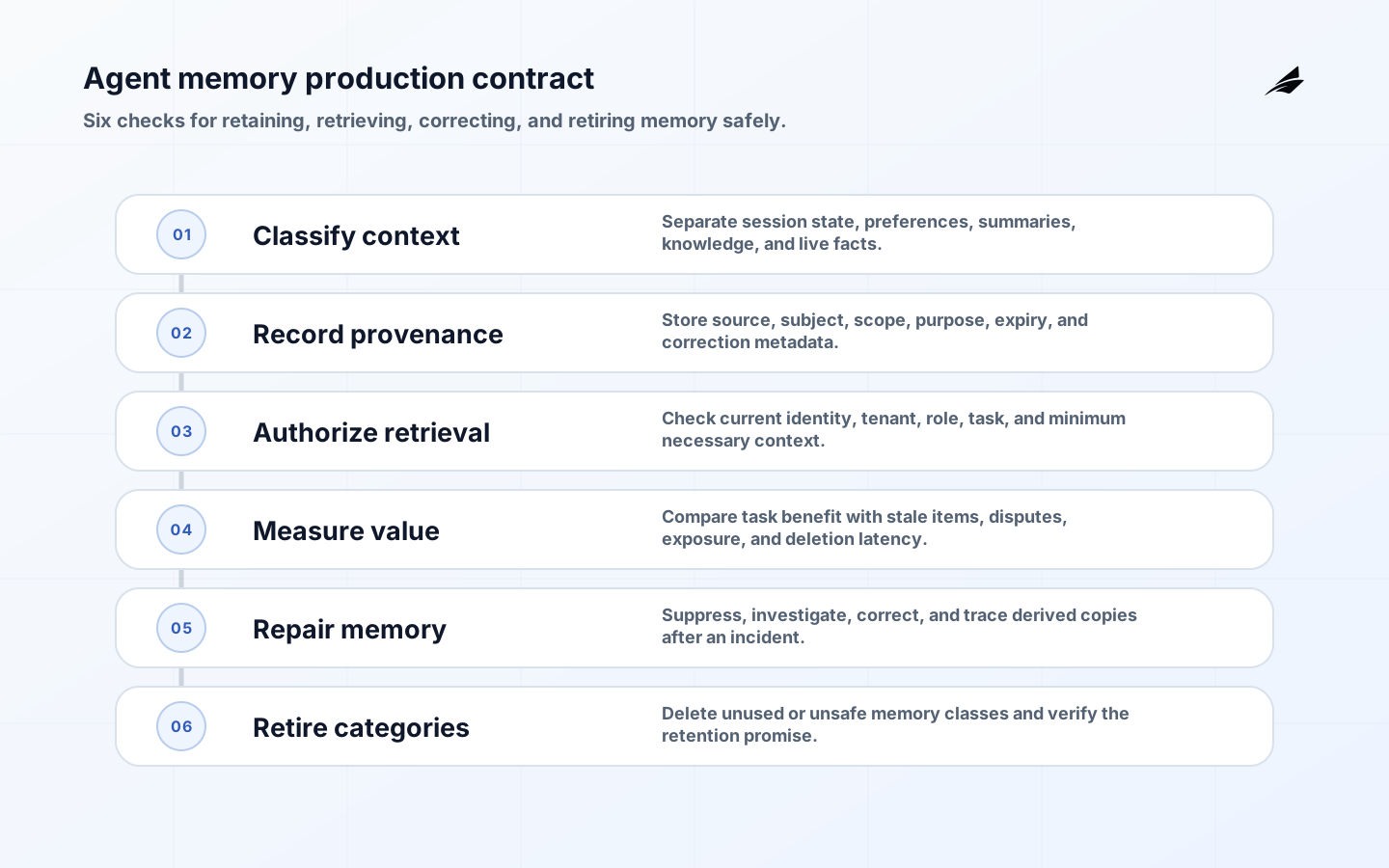
Agent memory is easy to describe as a helpful assistant remembering a preference. In production it is closer to a controlled data product: the system decides what to retain, how to retrieve it, and which future action it may influence. That difference matters because a remembered writing preference is not equivalent to an inferred medical condition, a customer risk label, or an old access decision. The OpenAI agents guide treats state, tools, and orchestration as deliberate parts of an agent system. An operating team must add the persistence rules that keep those parts bounded.
Separate the six kinds of context
Start by distinguishing context that happens to be available from memory that is intentionally carried forward. A live session may contain the current task, a short-lived working summary may support a handoff, and a user-managed preference may remain useful for months. Shared organizational knowledge belongs in an approved retrieval system. Mutable facts such as account status, entitlement, pricing, or an open incident should come from the system of record at the moment they are needed. Treating these categories as one undifferentiated memory store creates stale answers, unclear ownership, and difficult deletion obligations. The category determines the control, not the other way around.

| Context class | Good production use | Boundary to set |
|---|---|---|
| Session context | Complete the task the user is doing now | Expire with the session and do not silently promote it. |
| User preference | Remember an explicitly chosen format or notification setting | Make it visible, editable, and scoped to the right identity. |
| Case summary | Carry a bounded handoff between approved roles | Attach provenance, owner, expiry, and access scope. |
| Shared knowledge | Answer from governed documents and policies | Use retrieval permissions and document freshness checks. |
| Authoritative state | Read balance, entitlement, or incident status | Fetch live from the owning system instead of trusting memory. |
| Model inference | Suggest a possible preference for confirmation | Label as uncertain and avoid durable storage by default. |
Make a memory item a real record
Durable memory should have a schema, not just a string appended to a prompt. Store the subject, tenant, creator or source, timestamp, evidence, confidence where appropriate, visibility rule, purpose, expiry, revision history, and correction route. If a statement can be represented as a pointer to an approved record, prefer the pointer. A summary without provenance becomes more authoritative each time an agent repeats it, even when it began as a guess. A record model also allows operators to distinguish an explicit user instruction from a pattern inferred from one unusual interaction. That distinction is central to fair personalization and to incident investigation.
- Persist an item only when a named product purpose exists beyond the current interaction.
- Separate user-supplied facts, preferences, and model inferences in storage and display.
- Attach tenant, role, source, timestamp, expiry, and correction information to durable items.
- Keep authoritative values live and make the memory layer unable to overrule the owner system.
- Give users and operators a way to inspect the exact item that influenced an answer.
Retrieve with current purpose and permission
Retrieval should be a policy decision made at request time. Check the current identity, tenant, role, task, and data purpose before injecting an item into the model context. Return the smallest relevant set and preserve source labels so a reviewer can see why it was included. Stored text is untrusted input: it may contain an accidental instruction, a misleading summary, or malicious content placed in a document. The OWASP guidance on excessive agency reinforces that an agent must not turn retrieved context into unbounded action. Retrieval controls should therefore sit in the service boundary, not in a prompt alone.
Compare usefulness with harm
A memory feature needs measures for both benefit and restraint. Track whether a preference reduces repeated work, whether a case summary improves a handoff, and whether retrieval reduces time without increasing rework. In parallel, track stale-memory incidents, disputed inferences, unauthorized retrieval attempts, deletion latency, and the number of responses that relied on a memory item when a live lookup was required. The NIST AI RMF Playbook describes trustworthy AI risk management as a lifecycle activity, while the Generative AI Profile highlights governance, provenance, pre-deployment testing, and incident disclosure. Those themes translate into concrete memory questions: where did the item come from, who may rely on it, and how can the team repair it?
| Signal | Likely meaning | Practical response |
|---|---|---|
| High repeat-use with low correction | A bounded preference is creating real value | Keep the category and review its scope periodically. |
| Frequent user correction | The item is inferred, stale, or too broad | Strengthen evidence requirements or stop retaining it. |
| Cross-role retrieval failure | Permission is being checked too late | Move authorization into the memory service and add a regression test. |
| Stale-state incident | Memory was used where live state was required | Reclassify the field and require an execution-time lookup. |
| Deletion backlog | The retention promise is not operational | Automate expiry and trace indexes, caches, backups, and exports. |
Operate retention and correction
Assign an owner for the policy, an operator for the service, and a clear route for a person to request correction or deletion. Test deletion through primary storage, embeddings, search indexes, cached summaries, analytics, support exports, and backups where the retention policy requires it. A visible control is not enough if it only hides an item from one interface. Use short retention for working summaries and explicit expiry for categories that may become misleading. When a new category is introduced, release it to a narrow cohort and monitor the retrieval mix before allowing broader use. The NIST Generative AI Profile is a useful reference for connecting these controls to privacy, provenance, and oversight.
Prepare for memory incidents
A memory incident may be a wrong inference, an overlong retention period, an exposure across roles, or an answer that ignored a current record. Define how the team suppresses the item immediately, investigates its source and derived copies, repairs affected summaries, and decides whether the category should be narrowed or removed. Preserve enough audit evidence to explain the event without spreading the disputed content further. Test a bulk correction scenario because a faulty migration or inference rule can affect many subjects at once. The incident process should also say when users are notified and how the system handles answers that were generated while the incorrect memory was active.
- Put a report and correction action near interfaces that rely on durable memory.
- Suppress a disputed item immediately while investigation and deletion continue.
- Trace derived copies in embeddings, summaries, caches, analytics, and support tooling.
- Treat a cross-tenant retrieval as a security event and a stale preference as a product defect, while giving both a measurable resolution path.
- Review incident patterns to decide whether a memory category deserves to exist at all.
Make the memory contract visible
People should not need to reverse-engineer the system's retention behavior. State what is remembered, why it is remembered, who can use it, how long it lasts, and where it can be corrected. Show when a durable item materially influenced an answer, especially in a workflow that affects money, access, employment, health, or customer treatment. Keep the explanation concise but link it to the underlying record for authorized review. This is not a request to expose internal prompts; it is a request to make the product's data behavior understandable. Clear expectations reduce surprise and give support teams a concrete path when a person asks what the agent knows about them.
Plan memory migrations and retention
Memory changes need migration discipline. A team may rename a field, change its scope, replace a vector index, or move from one provider to another. Preserve the source and effective date for each migrated item, then decide whether old summaries remain valid under the new policy. Do not copy every historical conversation into a durable store merely because the new schema can accept it. Sample and review migrated records, measure retrieval differences, and keep a suppression path if a category proves unsafe. A migration is complete only when old indexes, caches, exports, and operational runbooks agree with the new retention contract.
Privacy review should cover inference as well as explicit values. A system might never store the sentence that a person is likely to be changing jobs, but a durable preference or priority score can still reveal a sensitive pattern. Limit what the model is allowed to infer, keep sensitive classifications out of general-purpose memory, and require a stronger purpose for retention. Where the product needs personalization, prefer explicit controls that let a person choose a setting. This creates a useful signal without asking an opaque model to make a durable judgment about the person it serves.
Test memory with adversarial and ordinary cases. Ask whether a user can retrieve another tenant's item, whether a role change removes access immediately, whether a deleted item reappears from a summary, and whether a malicious document can turn stored text into an instruction. Include empty memory, conflicting memory, stale memory, and a request to forget. The test result should identify the control that failed: classification, storage, authorization, retrieval, display, or deletion. That level of detail helps teams fix the boundary instead of simply adding another filter to the prompt.
Consider a support assistant that remembers a customer's preferred report format. That item can be user-visible, low sensitivity, and easy to delete. The same assistant may also summarize an unresolved billing dispute. The summary should have a case identifier, owner, source records, and expiry, and it should never decide the current balance. Separating these two items makes the product more useful and the audit trail more honest. The design question is not whether the assistant remembers; it is whether each retained item has a defensible purpose and a safe path back to the source.
Memory retrieval should also respect purpose limitation. The fact that an item is technically available does not mean every workflow should receive it. A support conversation may need a recent case summary but not an employee's unrelated preference. A reporting task may need a chosen format but not a speculative profile attribute. Encode the purpose in the retrieval request, log the decision without copying the item unnecessarily, and test that a change in task or role changes the returned set. Narrow retrieval reduces both privacy exposure and the chance that irrelevant context steers the answer.
A useful launch review asks four questions for every category: what benefit will users notice, what harm is plausible, what evidence will reveal drift, and what happens when the category is retired? Answer them before the feature is enabled broadly. If the benefit cannot be measured or the harm cannot be repaired, keep the information transient. If the category is valuable, make its controls visible in the product and its ownership explicit in operations. This turns memory from a hidden capability into a service promise that can be reviewed like any other data-dependent feature.
Frequently asked questions
Question: Does fine-tuning keep current knowledge up to date? Answer: Usually not; retrieval and tools are better for changing facts. Question: What must a training dataset prove? Answer: Rights, provenance, label quality, representative cases, held-out evaluation, and a safe path when the learned behavior is wrong.
Question: Should an agent remember every useful-looking detail? Answer: No; retain only information with a clear purpose, provenance, scope, expiry, and correction route. Question: Can memory replace live facts? Answer: No; current entitlement, balance, and incident status belong to an authoritative system of record.
What changes when agent memory reaches production?
Answer: Stored context becomes a governed record with identity, purpose, provenance, retention, correction, deletion, and incident responsibilities.
Can memory grant an agent permission?
Answer: No. Memory can inform a decision, but current identity and policy must authorize access or action at the point of use.
How should memory incidents be contained?
Answer: Pause retrieval or writes for the affected class, quarantine suspect records, assess dependent outputs, correct or delete data, and verify that caches and copies follow policy.
Is conversation history the same as memory? No. History may be available for the current interaction, while memory is selected information deliberately reused later. Should an agent remember inferred preferences? Only with a clear purpose, visible labeling, and a reliable correction path; many teams should keep inferences temporary. Can memory replace retrieval? No. Governed retrieval is better for shared knowledge and current facts. When should a team consider a different model rather than memory? When the problem is stable behavior rather than user or case data; fine-tuning decisions explores that boundary. Compare the role of AI workflow approvals and AI guardrails when memory can influence a consequential action. Can deletion be an interface-only feature? No. The underlying record and its derived representations must follow the same policy.
Key takeaways
- Classify memory by purpose, sensitivity, scope, freshness, and retention before storing it.
- Treat durable memory as a governed record with evidence, ownership, expiry, and correction.
- Use current authorization and task purpose at retrieval time; never let memory become shadow authority.
- Measure task value alongside stale items, disputed inferences, deletion completion, and incidents.
- Test correction and deletion through indexes, caches, summaries, and other derived copies.
Conclusion
Agent memory becomes production-ready when its promise is specific. Retain only what has a continuing purpose, preserve provenance, enforce current scope, fetch mutable facts live, and make correction real. That discipline lets personalization reduce repeated effort without creating an invisible store of uncertain facts that users and operators cannot control.