A technical SEO services implementation checklist turns search requirements into architecture, release and monitoring controls. Its purpose is to help eligible pages be discovered, rendered, understood and served under the intended URL while preventing low-value or sensitive spaces from becoming index clutter. It cannot guarantee rankings, and it should never substitute crawler tricks for useful content. The work belongs in engineering and publishing workflows, not in a periodic audit document that ages immediately.
For governance and commercial planning, use Enterprise Technical SEO Services: Scope, Governance, Cost and Delivery. The related enterprise implementation checklist covers portfolio-scale coordination, while the practical FAQ answers stakeholder questions. This checklist concentrates on implementation evidence a delivery team can verify.
1. Baseline search demand and technical state
Identify the site’s important page types, audiences, markets and search journeys. Export current indexed and excluded URLs, sitemap coverage, crawl samples, organic landing pages, conversions and known manual actions. Record platform, rendering model, hostnames, international variants, canonical rules, faceted navigation and planned changes. Preserve representative URLs and performance history so the team can compare releases rather than relying on impressions.
Create a URL inventory by template and intent. Mark pages that should be indexable, discoverable but not indexed, private, redirected, gone or temporarily unavailable. Include PDFs, images, video and JavaScript routes where relevant. Assign an owner for every template. Google Search Essentials should be treated as minimum eligibility and quality guidance, while business priorities determine which valid pages deserve engineering attention.
| URL state | HTTP and index signal | Discovery treatment | Verification |
|---|---|---|---|
| Canonical indexable page | 200, self-consistent canonical, index allowed | Internal links and sitemap when important | Rendered content, canonical and inspection sample |
| Duplicate or parameter variant | 200 with canonical or redirect when appropriate | Avoid unnecessary internal discovery | Cluster and parameter crawl sample |
| Private content | Authentication or authorization | No public links or sitemap entry | Anonymous access test |
| Removed with replacement | Relevant permanent redirect | Update internal links and sitemap | Destination equivalence and chain check |
| Removed without replacement | 404 or 410 | Remove links and sitemap entry | Response and monitoring |
2. Make discovery and crawling intentional
Ensure important pages have crawlable HTML links from relevant navigation, categories or contextual content. Google documents that ordinary anchor elements with href attributes are the reliable form. Keep essential journeys within a reasonable link depth and avoid orphan pages that exist only in a sitemap. Use descriptive anchor text for people. Pagination and faceted navigation need explicit rules so useful category depth remains available without generating unbounded combinations.
Maintain robots.txt at the host root according to RFC 9309 and test user-agent groups, longest-match behavior, encoding and redirects. Robots rules control crawler access; they are not authorization and do not reliably remove a known URL from an index. Do not block pages whose noindex directive or canonical needs to be read. Keep staging behind authentication, not a robots rule. Monitor changes to robots.txt as production code because one line can alter a large part of the site.
3. Control indexing and canonical URLs
Choose a canonical URL policy for protocol, host, path, case, trailing slash, parameters and localized variants. Align redirects, internal links, sitemap entries and canonical elements. Google treats canonical declarations as signals and may select a different representative when signals conflict. Self-referential canonical tags are useful on primary pages, but they do not rescue substantially duplicate or low-value inventories from poor architecture.
Use robots meta or X-Robots-Tag for index controls on content crawlers can access, including non-HTML files where appropriate. Validate that templates do not emit contradictory or environment-dependent directives. Handle soft 404s with real status codes. Return 503 with suitable retry behavior for brief maintenance rather than serving a 200 error page. Preserve status, canonical and index intent through edge, cache and localization layers.
4. Verify rendering, content and structured data
Render representative URLs as an anonymous crawler and a user. Critical content, links, titles, descriptions, headings, canonical, language annotations and structured data should be present after the supported rendering path. Server rendering or static generation can improve resilience, but client-rendered sites can be searchable when implemented carefully. Avoid requiring interaction, blocked APIs or long tasks before primary content appears. Check hydration errors and differences between initial HTML and rendered DOM.
Add structured data only when it accurately represents visible page content and follows the relevant search feature guidelines. Generate it from the same source as the page to prevent drift, use stable identifiers and validate on every template. Eligibility does not guarantee a rich result. Remove markup when the visible feature disappears. Never manufacture reviews, prices or availability. Monitor enhancement reports and sampled production output rather than trusting a one-time validator pass.
| Release check | Automated test | Sampled human check |
|---|---|---|
| Response and redirects | Status, destination, chain and loop | Replacement matches user intent |
| Index controls | Robots, meta, header and canonical consistency | Page belongs in intended search inventory |
| Rendered page | Required text, links and metadata in DOM | Main content is usable without hidden states |
| Structured data | Syntax and required-property validation | Markup matches visible claims |
| Performance | Template-level lab budget and field trend alert | Key journey remains responsive on typical device |
5. Publish clean sitemaps and international signals
Include canonical, indexable URLs the site wants search engines to discover. Generate sitemaps from authoritative publishing state, split them by useful template or market boundaries and provide accurate last modification values when the content materially changes. Submit sitemap indexes through the relevant search tools and monitor discovered versus indexed patterns. A sitemap supports discovery; it does not override noindex, canonical conflict, poor response or low-value duplication.
For multilingual or multi-regional pages, use stable locale URLs and reciprocal hreflang annotations among equivalent versions, including a suitable fallback where needed. Do not redirect solely from inferred location in a way that blocks access to variants. Localize visible content, not only metadata. Keep canonical URLs within the intended language version unless the pages are true duplicates. Test annotations from several page types and markets.
6. Protect performance and page experience
Measure real-user performance by page type, device and geography. Core Web Vitals currently focus on loading, interaction responsiveness and visual stability through LCP, INP and CLS. Use field data for actual experience and lab tools for diagnosis. Set performance budgets for images, JavaScript, fonts and third-party code in release pipelines. Optimize the main content resource, caching, critical requests and component stability rather than chasing a single score.
Performance is both user experience and operational discipline. Marketing tags, consent tools, personalization and experiments can change it after the initial launch. Assign owners and expiry to third-party scripts. Monitor error, availability and rendering alongside speed. Do not remove accessibility, security or useful functionality merely to improve a metric; resolve the architectural cause and evaluate the complete user journey.
7. Release migrations with reversible controls
Create an old-to-new URL map from actual production inventories. Map each valuable page to an equivalent destination, not automatically to the home page. Prepare redirects, update internal links, canonicals, hreflang, structured data and sitemaps, and preserve analytics. Test at scale before launch. Avoid combining domain, platform, navigation and content changes unless the business accepts the diagnostic risk.
At launch, crawl critical paths, inspect logs and validate status, rendering and directives. Monitor traffic, indexed pages, sitemap processing, server errors, redirect misses and representative queries by template and market. Keep redirects long enough for users and systems to update. Establish rollback criteria, but recognize that reversing URLs can create additional churn; fix forward when the architecture is sound and the defect is bounded.
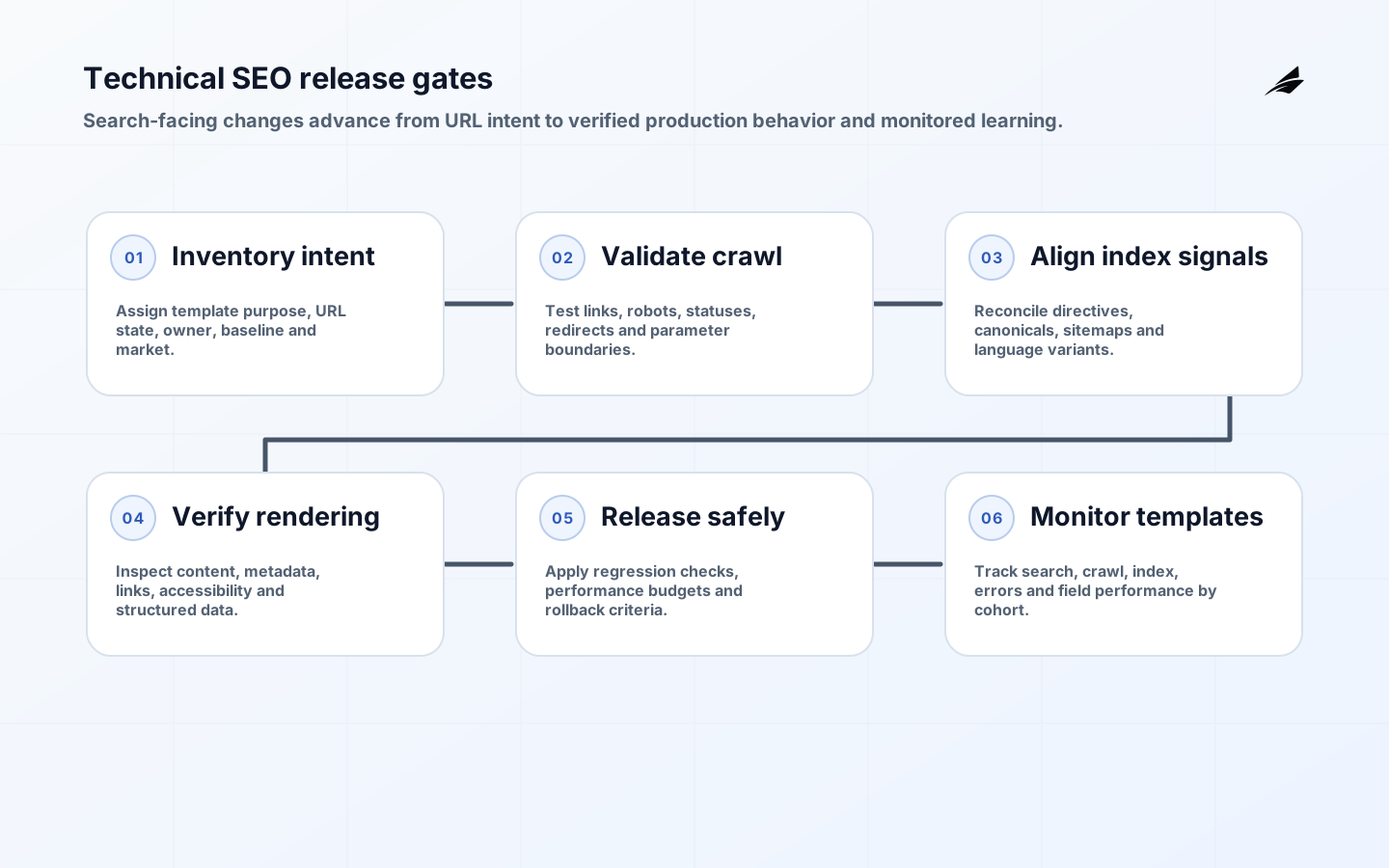
Use six technical SEO release gates
- Inventory templates and assign each URL state, search purpose, owner and baseline.
- Validate crawl paths, robots behavior, status codes and bounded parameter spaces.
- Align index directives, canonicals, internal links, sitemaps and language annotations.
- Render representative pages and verify content, metadata, accessibility and structured data.
- Release with automated checks, sampled inspection, performance budgets and rollback criteria.
- Monitor by template and market, diagnose changes and feed defects into platform standards.

Assign ownership and defect severity
Create a responsibility map across platform engineering, content operations, product, analytics and the technical SEO specialist. Platform teams own templates, routing and rendering; publishers own page purpose and visible accuracy; the search lead defines acceptance and diagnoses search-specific effects. Classify defects by affected inventory and business impact. A sitewide accidental noindex or redirect loop requires an incident response, while one stale description can enter routine backlog. Give critical search controls production monitoring, on-call routing and post-incident review.
Keep an implementation register with issue, affected templates, hypothesis, owner, release, validation method and observed result. Search changes can take time to propagate, so separate production correctness from later search outcomes. Confirm the technical change immediately, then observe crawl, index and traffic cohorts without claiming causation prematurely. This evidence prevents repeated audits from rediscovering the same defect and helps teams invest in platform-level prevention.
Key takeaways
- Assign explicit search intent and technical state to every important template.
- Keep crawl, index, canonical, internal-link and sitemap signals consistent.
- Treat robots.txt as crawl guidance, never as access control.
- Validate rendered production output and truthful structured data continuously.
- Ship migrations and performance changes with baselines, gates and template-level monitoring.
Frequently asked questions
How often should a technical SEO audit run?
Automate critical checks on every release and monitor production continuously. Run deeper template, log and architecture reviews quarterly or around major change, adjusted to publishing velocity and risk. A yearly spreadsheet audit is too slow for a frequently deployed site.
Can technical SEO guarantee higher rankings?
No. It can remove barriers, clarify preferred URLs, improve user experience and make content easier to discover and understand. Search systems still evaluate relevance, quality and many other signals. A responsible provider commits to implementation evidence and measurable technical health, not guaranteed positions.
Conclusion
Technical search quality is a production characteristic. Inventory URL intent, make discovery deliberate, align indexing signals, verify rendered content, protect performance and monitor every migration. When those controls live in platform and publishing workflows, technical SEO becomes durable engineering practice instead of recurring emergency repair.