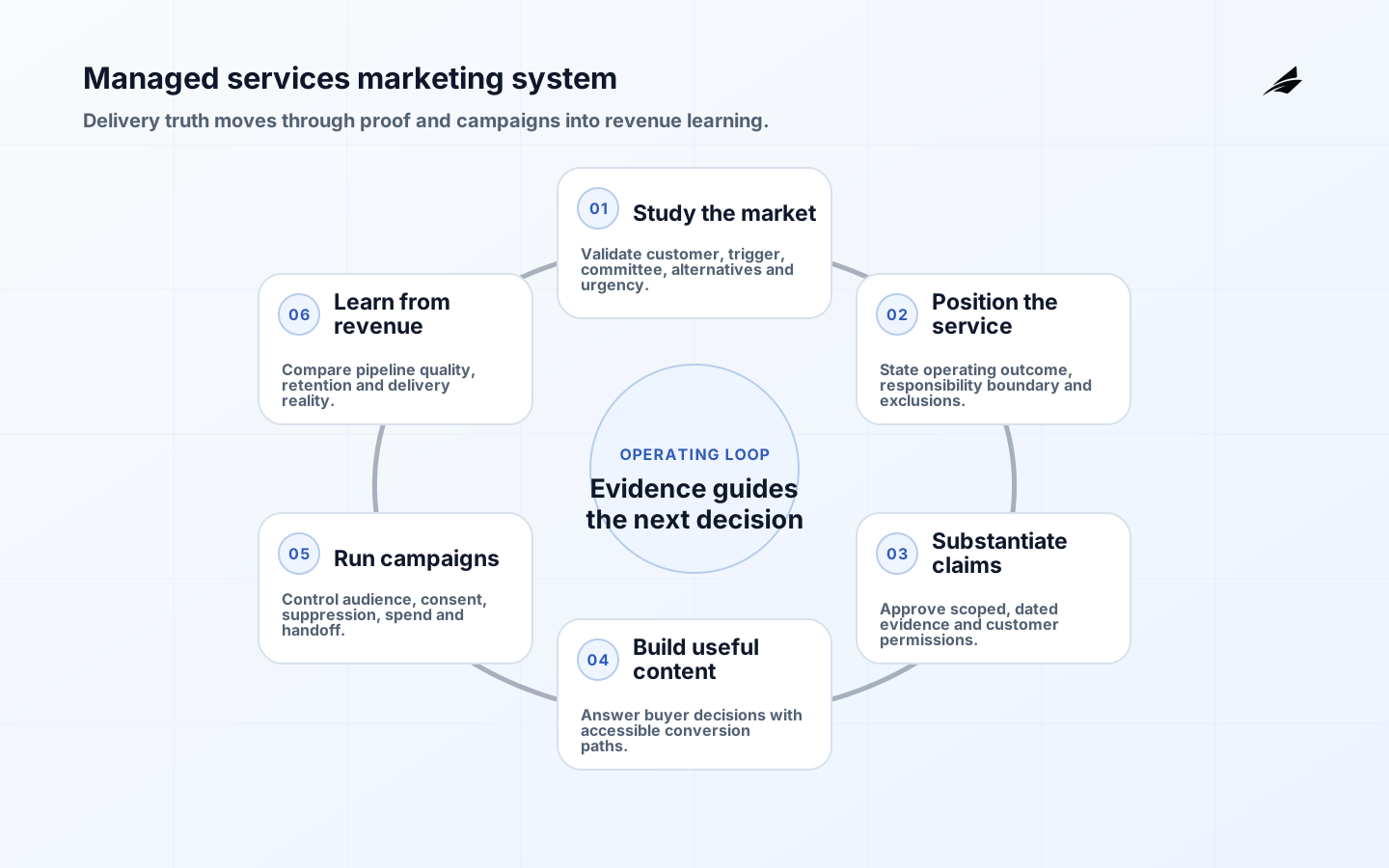
Managed services marketing has to sell an operating relationship, not a box of features. Buyers are evaluating whether a provider understands their environment, can assume defined responsibilities, will produce evidence, and can sustain outcomes after transition. This managed services marketing implementation checklist turns those concerns into positioning, proof, content, campaigns and revenue measurement that a technical and commercial team can operate together.
Pair it with the managed services marketing scope and delivery plan, managed services marketing FAQ and software engineering services delivery plan. Marketing should never invent certainty that delivery cannot support. The service catalog, responsibility model, customer evidence and operational metrics are the source material; campaign activity packages that truth for a defined buying situation.
1. Define the market and buying situation
Choose an ideal customer profile narrow enough to change decisions. Record industry, operating scale, technology estate, geography, regulatory pressure, service maturity, triggering event, buying committee and exclusions. “Mid-market companies needing IT” is not actionable. “Multi-site healthcare groups replacing an unsupported network provider before contract renewal” gives content, sales and delivery teams a shared problem, timeline and qualification rule.
Interview recent wins, losses, renewals and delivery leaders. Capture the words buyers use for operational pain, the evidence they requested, alternatives considered, objections, procurement stages and reasons deals stalled. Separate a problem people discuss from a problem with funded urgency. Build hypotheses, then validate them against CRM records, calls and proposal outcomes. A market claim is useful only when a team can state what evidence would disprove it.
| Marketing foundation | Decision to record | Evidence of completion |
|---|---|---|
| Ideal customer | Firmographics, environment, trigger, risk and exclusion criteria | Approved profile with examples and counterexamples |
| Buying committee | Operational user, technical evaluator, risk reviewer, finance and signer | Role-specific questions and proof needs |
| Service fit | Included outcomes, boundaries, dependencies and disqualifiers | Published service definition aligned to delivery |
| Commercial motion | Typical entry offer, sales stage, renewal path and expansion logic | CRM stages with entry and exit criteria |
| Measurement | Qualified pipeline, conversion, cycle, acquisition cost and retention influence | Baseline and named metric owners |
2. Position an accountable managed service
Write positioning around the buyer’s change in operating state: what becomes more reliable, visible, controlled or economical, for whom, and under which boundary. Distinguish the service by method and proof, not adjectives. For example, “24/7 monitoring” is common; “named response authority, monthly coverage reconciliation and tested recovery for every in-scope site” explains the operating difference. State exclusions so prospects can self-qualify and sales does not promise unsupported work.
Create a message hierarchy with one category statement, three buyer problems, three outcome claims and the evidence behind each. Tailor emphasis by role without changing facts. An infrastructure lead may care about alert ownership and backlog; a risk lead about controls and records; finance about variability and exit exposure. The FTC advertising guidance says claims must be truthful, non-deceptive and evidence-based. Apply that discipline to availability, savings, expertise, certifications and customer results.
3. Build proof before campaigns

Create a proof register for every material claim. Link the claim to source, scope, date, owner, limitations and approved language. Suitable proof includes defined service levels, anonymized operational trends, customer-approved case studies, architecture or control explanations, certifications with exact coverage, and demonstrations using realistic workflows. Avoid turning one customer’s result into a universal promise. Explain baseline, intervention, period and other factors so a buyer can judge relevance.
Obtain written approval for customer names, logos, quotations and metrics, including channel, geography and expiry. Review endorsements after mergers, role changes and service incidents. Give technical and legal reviewers a lightweight workflow so accuracy does not become a quarterly bottleneck. A proof library should make approved evidence easy to reuse and stale material easy to withdraw; scattered slide decks invite contradictory claims.
4. Build a useful content and conversion system
Map content to a real decision: understand the problem, compare operating models, evaluate a provider, construct a business case, reduce procurement risk, or prepare transition. A strong page answers the question fully, identifies who it is for, explains tradeoffs and points to the next sensible action. Google’s people-first content guidance emphasizes original, substantial and trustworthy help rather than pages made mainly to attract search visits.
- Publish service pages with scope, responsibilities, prerequisites, evidence, transition approach and clear exclusions.
- Use practical guides, checklists and FAQs to answer distinct buyer tasks instead of repeating one generic sales page.
- Connect related content with descriptive links and write clear, page-specific titles following the Google SEO starter guide.
- Design one primary conversion for each page, such as an assessment, consultation or relevant technical brief.
- Ask only for information needed at that stage; explain consent and route requests to a named team promptly.
- Test forms, downloadable assets, keyboard navigation, focus, errors and mobile layouts against WCAG 2.2.
5. Launch compliant, traceable campaigns
Start with a small audience and one message hypothesis. Define source, suppression rules, budget, creative, destination, attribution, sales follow-up and stop conditions before launch. Preserve campaign and consent records. For commercial email to US recipients, the FTC CAN-SPAM guide covers accurate headers, non-deceptive subjects, postal address, opt-out and prompt honoring of requests; it also notes that business-to-business messages are covered and responsibility cannot simply be contracted away.
Apply the applicable rules in every recipient jurisdiction and have counsel assess unfamiliar markets. Synchronize unsubscribes across marketing automation, CRM, event tools and agencies. Monitor ad and partner activity for unsupported promises. Give sales a response brief containing the prospect’s interaction, likely question, relevant proof and disqualification rules, but do not disguise tracking or infer sensitive facts. The handoff should improve relevance without surprising the person.
6. Measure revenue quality and learn
Measure the system from audience to retained customer. Impressions and clicks diagnose distribution; they do not prove commercial value. Track qualified-account engagement, accepted leads, opportunities, stage conversion, sales-cycle duration, sourced and influenced pipeline, acquisition cost, win rate, early churn and expansion. Define each metric, timestamp and attribution rule. Compare cohorts rather than claiming that the last touch caused a complex committee decision.
Hold a monthly revenue-learning review with marketing, sales, service delivery and customer success. Examine which problems produced qualified conversations, where evidence failed, which promises caused delivery friction and which customers retained or expanded. Feed those findings into positioning and the service itself. Pause campaigns when lead quality, complaint rate, proof freshness or delivery capacity crosses an agreed threshold; more demand is harmful if it sells a service the organization cannot fulfill.
| Signal | Useful interpretation | Required action |
|---|---|---|
| Qualified-account rate | Target accounts meeting fit and intent criteria, not raw form volume | Refine audience or offer when fit declines |
| Opportunity conversion | Accepted opportunities reaching a defined next stage | Review proof and sales discovery by segment |
| Sales-cycle time | Elapsed time between governed CRM stage events | Find missing evidence or approval bottlenecks |
| Early churn | Customers leaving or materially downgrading after sale | Compare promise, qualification and onboarding reality |
| Claim freshness | Material claims reviewed within their validity period | Withdraw or revalidate stale proof |
| Complaint and opt-out rate | Audience rejection of message or targeting | Stop, investigate source and correct suppression |
Key takeaways
Practical example: a network managed-service provider targets multi-site professional firms approaching a carrier renewal. Interviews show that buyers fear unclear incident ownership more than lack of monitoring tools. Marketing replaces a generic “always on” message with a page explaining site scope, escalation authority, monthly coverage reconciliation and tested failover evidence. A campaign sends qualified operations leaders to a network resilience assessment, and sales records whether each account meets site count, renewal timing and support prerequisites. After one quarter, the team compares accepted opportunities and early onboarding friction, withdraws an unsupported savings claim and turns repeated failover questions into a technical guide reviewed by delivery.
- Define the customer, trigger, buying committee and disqualifiers before choosing channels.
- Position the managed operating outcome and responsibility boundary, not a list of tools.
- Substantiate every material claim and preserve approval, scope, date and limitations.
- Create content for identifiable buying decisions, with accessible paths to a proportionate next step.
- Operate consent, suppression, partner oversight and campaign traceability as production controls.
- Optimize for qualified, retained revenue and feed delivery evidence back into the message.
Frequently asked questions
Which channel should a managed service provider use first?
Choose the channel where a validated buying situation is observable and the team can follow up well. Existing customer referrals, partner ecosystems, account-focused outreach and high-intent educational content often provide clearer learning than spreading a small budget across every network. Channel choice follows audience evidence, not fashion.
Can a case study omit the customer name?
Yes, if it remains specific and truthful. State the customer type, baseline, scope, intervention, period, result and limitations without details that re-identify the organization. Anonymous proof is weaker than a referenceable customer, so pair it with operational evidence and offer controlled reference calls where approved.
What is a reasonable attribution model?
Use a consistent model that supports decisions and disclose its limits. Record sourced pipeline, meaningful touches and cohort outcomes, then compare results with sales context. Do not pretend a single page view caused a six-month committee purchase. Attribution is a planning convention, not a complete causal account.
Conclusion
Use a launch gate before increasing spend: delivery confirms capacity and claim accuracy; legal or compliance confirms required reviews; revenue operations verifies source, consent, suppression and CRM routing; sales accepts the qualification and follow-up standard; and marketing confirms the page, form and attribution path work on representative devices. Record the audience, message, evidence version, budget, owner, review date and stop thresholds. This small control makes experiments reproducible and prevents a successful response rate from concealing stale proof, poor lead fit or a service team that cannot absorb new demand.
Managed services marketing becomes credible when market focus, delivery truth and revenue learning reinforce one another. Define the buying situation, state an accountable operating difference, build proof, publish decision-useful content, run compliant campaigns and measure customer quality through retention. That system earns attention without asking buyers to accept unsupported promises.