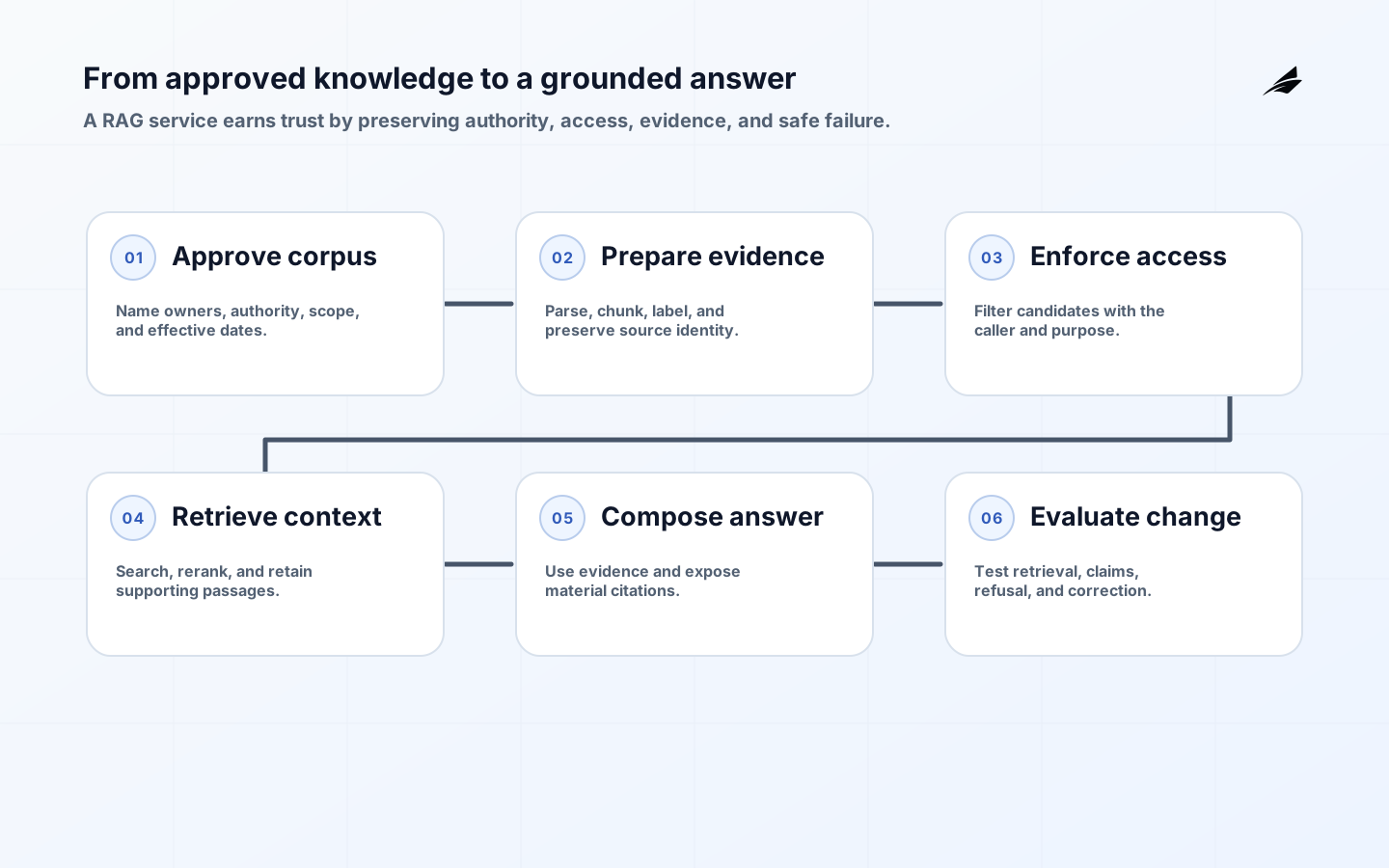
RAG meaning in AI is straightforward at the conceptual level: retrieval-augmented generation finds information outside a language model and supplies selected evidence as context for a response. The production meaning is more demanding. A useful RAG service must know which corpus is authoritative, inherit the caller's permissions, retrieve evidence at the right granularity, show where an answer came from, and decline when the evidence is missing or contradictory. The original retrieval-augmented generation paper combined a parametric model with explicit non-parametric memory. Enterprise implementation adds identity, document lifecycle, observability, and accountable review. Treating RAG as “chat over files” hides those responsibilities and produces systems that look persuasive before they are dependable.
What retrieval-augmented generation means in practice
A RAG system has at least four distinct jobs: ingest and classify source material, retrieve relevant passages for a query, generate a response using those passages, and record what occurred. The model is not the authority on the business fact; the governed source is. That distinction changes product decisions. A useful answer should identify its source, respect document-level and user-level access constraints, distinguish a quotation from an inference, and avoid inventing a policy when retrieval is weak. RAG is therefore a knowledge access pattern, not a substitute for records management, authoring discipline, or an approval process. Its value comes from shortening a verified path from a question to accountable evidence.
Define scope, ownership, and the authoritative boundary
Define the first release around a bounded corpus and audience. State the document owners, accepted formats, classification labels, publication route, retention rule, and the question types that the service will decline. A maintenance manual, service playbook, or controlled policy set is usually a safer starting point than every shared drive. Include source freshness in scope: an answer that cites a superseded procedure is not grounded in a useful sense. Decide whether the system only explains information or can prepare a draft, create a ticket, or invoke another tool. Each added action requires independent authorisation and validation; a model recommendation should never become the enforcement point for business policy.
| Decision question | Decision-ready answer | Risk if omitted |
|---|---|---|
| What is the protected outcome? | A defined business result supported by RAG meaning in AI. | The build optimises a feature instead of the operating decision. |
| Who owns the rule? | A named business owner approves policy while technical owners operate the service. | Technical configuration silently becomes business policy. |
| Where is authority? | A documented source record or policy decision is authoritative; displays and copies are not. | Teams resolve disagreement by choosing the most convenient screen. |
| What proves completion? | An observable result, record, and exception route are agreed before release. | A successful request is confused with completed business work. |
| Who repairs failure? | A named queue and response expectation handle failed, disputed, or delayed work. | Staff rely on inboxes, spreadsheets, and undocumented overrides. |
Design the operating path and evidence
Keep ingestion, retrieval, generation, and action boundaries visible. On ingest, record document identity, owner, version, classification, permissions, and extraction result. At retrieval, filter before ranking so a user cannot obtain a chunk merely because it is semantically similar. Give the model retrieved text as untrusted data with delimiters, not as instructions. At response time, return citations or links to the governing source and set a confidence or insufficiency rule that is based on tested evidence, not a model’s self-assessment. If the service feeds another workflow, pass structured, validated fields to that workflow and preserve the query, retrieved sources, response, and downstream outcome under an appropriate retention policy.
Build controls and exception handling into the work
Treat retrieved content as a security boundary. Review who can publish to the corpus, scan or quarantine untrusted uploads, and retain a way to remove or re-index material when a source changes. Test indirect prompt injection, sensitive-document probing, misleading near matches, and attempts to force a tool call. Apply access policy before vector search and at any source link, because an embedding does not erase the sensitivity of its source. Put an accountable human in the loop for consequential recommendations, especially where the answer could change payment, access, legal position, or customer treatment. Make model and retrieval configuration changes reviewable so that a quality regression can be located and reversed.
| Condition | Required response | Operating evidence |
|---|---|---|
| Required information is missing | Hold or decline the work with an actionable reason. | Validation result, source context, and named follow-up owner. |
| An automated step fails | Preserve context, apply a safe retry rule, and route unresolved work. | Correlation identifier, attempt history, and queue status. |
| Authority is unclear | Do not infer permission; escalate to the accountable owner. | Decision request, approver, and policy reference. |
| A material correction is needed | Correct through a governed path without obscuring the original state. | Reason, actor, effective time, and before-and-after record. |
| A control is bypassed | Contain impact, record the exception, and conduct follow-up review. | Exception evidence, expiry or remediation action, and outcome. |
Deliver a thin, operable first release
Evaluate before and after launch with a labelled set of real, permission-appropriate questions. Score retrieval relevance, citation correctness, answer completeness, refusal quality, and the effect of stale sources separately. Invite domain owners to review edge cases, not only polished demonstrations. Start with read-only assistance and clear escalation when the system cannot ground a response. During pilot, inspect questions that return no result, sources that are repeatedly retrieved but rejected by reviewers, and document updates that take too long to appear. That operating feedback is how the corpus and retrieval policy improve; prompt editing alone cannot repair an unclear source of record.
Measure the operating result, then review it
Track source coverage, grounded-answer rate, citation click-through, stale-source incidents, access-control denials, unsupported-answer reports, retrieval latency, and successful escalation to a subject-matter owner. Sample high-impact responses for evidence quality. A lower answer rate can be a positive signal if it reflects a disciplined refusal instead of plausible unsupported text.
Use an acceptance set that exposes retrieval failure
A RAG design review should connect model behavior to evidence management. The NIST Generative AI Profile recommends lifecycle risk management rather than a one-time model check, while the NIST AI RMF separates governance, mapping, measurement, and management responsibilities. OWASP's current LLM guidance is relevant because retrieved text is untrusted input: it can contain prompt injection, sensitive material, or misleading instructions. Preserve document provenance in a form that survives chunking; the W3C PROV model offers a useful vocabulary for entities, activities, and agents when a team needs traceable transformations.
| Evaluation layer | Decision question | Evidence |
|---|---|---|
| Corpus | Are the right sources present, current, and owned? | Inventory, owner, effective date, retention rule |
| Retrieval | Does the authoritative passage enter the candidate set? | Recall by question class and permission scope |
| Composition | Does every material claim follow from selected evidence? | Claim-level review with citations |
| Failure | Does the service abstain or escalate when evidence is weak? | No-answer and contradiction test results |
Create an evaluation set from real questions, difficult terminology, time-sensitive policies, permission boundaries, and cases where no answer should be returned. Judge retrieval before judging prose. Record whether an authoritative passage appeared in the candidate set, whether the selected passage supported the claim, whether a more current or higher-authority source existed, and whether prohibited material was excluded. Then evaluate the composed answer for attribution, completeness, unsupported claims, and appropriate abstention. Segment results by document type and user role; a healthy average can conceal complete failure for one department. Re-run the set when the embedding model, chunking rule, index, reranker, source connector, prompt, or policy changes. A release gate should identify the tolerated failures and the person authorized to accept them, not merely report a single similarity score.
Related implementation guidance
For implementation depth, compare the enterprise RAG architecture guide with Edilec's explanation of a system of record. Teams preparing release evidence can also use the internal LLM evaluation checklist to turn retrieval risks into repeatable tests.
Use governance and procurement evidence to make the decision durable
For a client team, the most useful RAG procurement evidence is a reviewable evaluation pack rather than a generic accuracy claim. It should contain permission-appropriate questions, expected source passages, examples of justified refusal, freshness scenarios, and attacks that test corpus poisoning or source leakage. Require the supplier to explain how an editor publishes a correction, how the index reflects it, and how a reader reaches the current authority when no answer should be generated. Contract terms should clarify model-provider data handling, retention, incident notification, and portability of source metadata and evaluation materials. A knowledge assistant is sustainable only when content owners can change and govern it without retraining a black box or relying on a vendor support queue.
Key takeaways for RAG meaning in AI
- Start with a bounded, owned corpus and a narrow question class.
- Filter retrieval by entitlement before relevance ranking.
- Treat retrieved passages as data, not model instructions.
- Show sources and distinguish evidence from inference.
- Evaluate retrieval, answers, refusals, and freshness separately.
- Keep tool permissions independent from model output.
Frequently asked questions
Does RAG eliminate hallucinations?
No. Grounding can improve answer quality, but systems can retrieve the wrong material, misunderstand it, or generate unsupported conclusions. Evaluation and source evidence remain necessary.
Can a RAG system use all company documents?
It should only use material with clear ownership, classification, and access rules. Broad ingestion without those controls creates both quality and disclosure problems.
What is the first useful RAG metric?
Citation correctness on a representative question set is a strong first metric because it tests whether the response is attached to the evidence the business recognizes.
Conclusion
RAG meaning in AI becomes a useful planning term when it is connected to a real decision, an accountable owner, a protected operating path, and evidence that a reviewer can understand. Do not begin with a vendor feature list or a generic architecture diagram. Start with the outcome that must be dependable, test the awkward cases with the people who will run the work, and make the first release small enough to observe. That approach gives a client team a clearer basis for investment and a service it can improve without losing control of the business facts that matter.