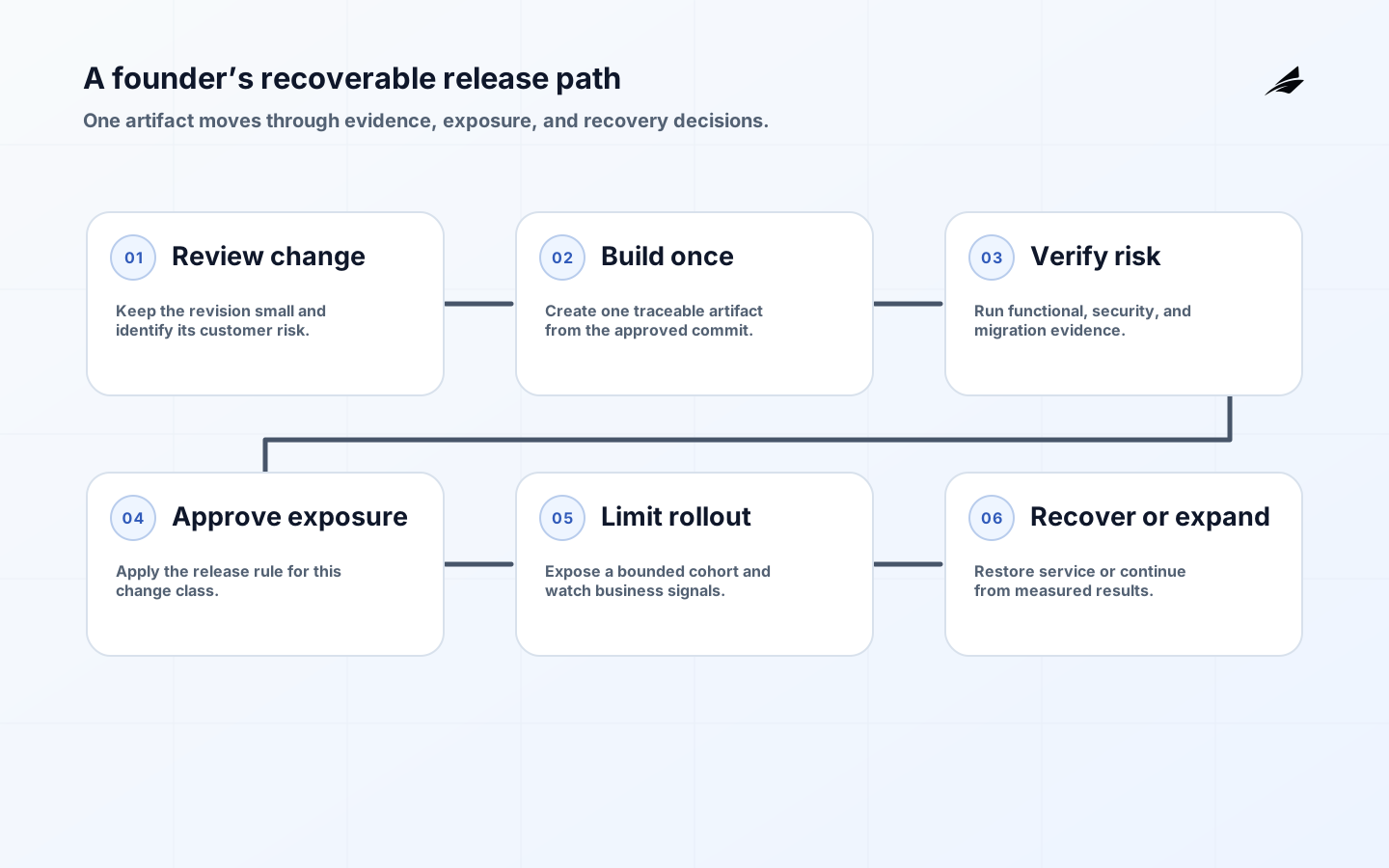
CI/CD for founders is a way to reduce the business risk of software change. Continuous integration asks developers to combine small changes frequently and verify each shared revision. Continuous delivery keeps a tested release candidate ready for an explicit production decision; continuous deployment goes one step further and releases every qualifying change automatically. A startup does not need the most elaborate platform. It needs a visible path from reviewed code to a versioned artifact, a production release, and a tested recovery. The founder’s job is to decide how much evidence is required for each risk class, who may accept production exposure, and how quickly the team must be able to restore service.
What CI/CD meaning for founders means in practice
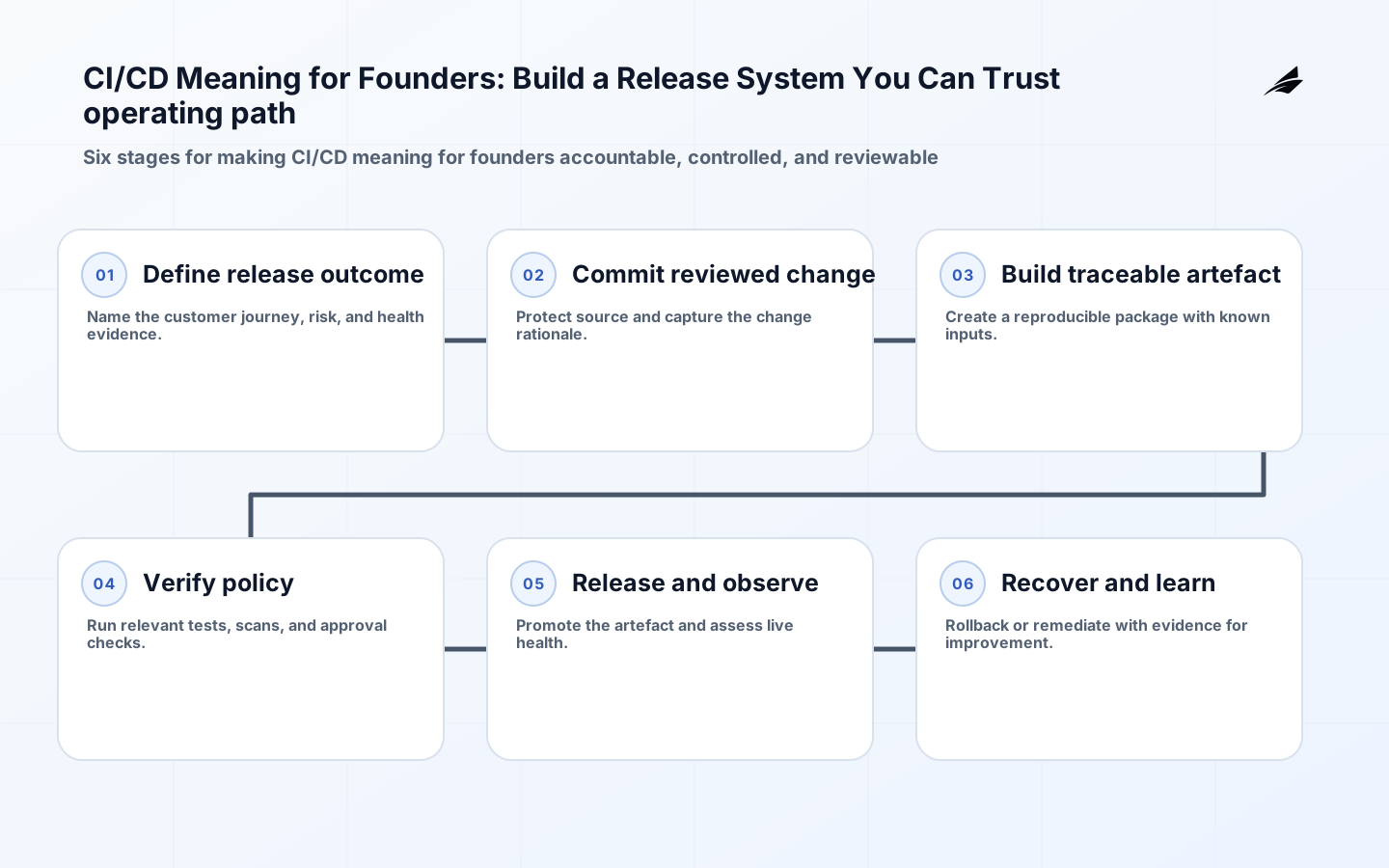
A credible pipeline is a chain of accountable decisions: a change is reviewed, built from known inputs, tested against relevant risks, approved by policy, released in a controlled manner, observed in production, and either retained or reversed. Automation supports that chain; it does not eliminate judgment. A test passing tells a narrow truth about the test, not that a commercial or security risk has disappeared. Founders should therefore define delivery outcomes in business language: a customer can use the affected journey, sensitive data remains protected, an incident can be diagnosed, and the team can restore a prior working version within an agreed window. Those outcomes determine the checks worth automating.
Define scope, ownership, and the authoritative boundary
Begin with a release map rather than a tool purchase. Identify source repositories, build dependencies, environments, secrets, deployment targets, data migrations, and external services. Separate changes that can be released independently from changes that require coordinated rollout. For each, decide what a developer can self-serve, what needs a reviewer, and what needs a change owner because the effect is irreversible or high impact. Keep production access exceptional and time-bound. A useful first scope might cover one application, a reproducible build, unit and integration checks, a staging deployment, a production approval policy, and a documented rollback. That is more valuable than a broad dashboard with untrusted checks.
| Decision question | Decision-ready answer | Risk if omitted |
|---|---|---|
| What is the protected outcome? | A defined business result supported by CI/CD meaning for founders. | The build optimises a feature instead of the operating decision. |
| Who owns the rule? | A named business owner approves policy while technical owners operate the service. | Technical configuration silently becomes business policy. |
| Where is authority? | A documented source record or policy decision is authoritative; displays and copies are not. | Teams resolve disagreement by choosing the most convenient screen. |
| What proves completion? | An observable result, record, and exception route are agreed before release. | A successful request is confused with completed business work. |
| Who repairs failure? | A named queue and response expectation handle failed, disputed, or delayed work. | Staff rely on inboxes, spreadsheets, and undocumented overrides. |
Design the operating path and evidence
Make artefacts and provenance first-class. The pipeline should build an immutable artefact from a tracked revision, record the build inputs and results, and promote the same artefact between environments rather than rebuilding it differently. Store secrets outside code and issue credentials with limited scope. Keep database migrations explicit: forward changes, compatibility windows, backup or restore choices, and the operator who approves the point of no return. Use environment configuration that can be reviewed and compared, because untracked production settings can defeat a perfect code review. Observability belongs in the release design too: record deployment version, time, actor or automation identity, targeted environment, and health evidence so a customer symptom can be connected to a change.
Build controls and exception handling into the work
Use layered checks proportionate to the release. Protect the source-control branch, require review where risk warrants it, scan dependencies and build configuration, and make critical tests hard to bypass without an audit trail. Separate the ability to modify pipeline definitions from the authority to approve production release. Treat a manual approval as a real decision with a stated criterion, not a ritual click. Define emergency change rules in advance: who may use them, what evidence is collected afterward, and how the normal control is restored. Supply-chain integrity matters as much as application code; know which third-party packages and build actions the process trusts.
| Condition | Required response | Operating evidence |
|---|---|---|
| Required information is missing | Hold or decline the work with an actionable reason. | Validation result, source context, and named follow-up owner. |
| An automated step fails | Preserve context, apply a safe retry rule, and route unresolved work. | Correlation identifier, attempt history, and queue status. |
| Authority is unclear | Do not infer permission; escalate to the accountable owner. | Decision request, approver, and policy reference. |
| A material correction is needed | Correct through a governed path without obscuring the original state. | Reason, actor, effective time, and before-and-after record. |
| A control is bypassed | Contain impact, record the exception, and conduct follow-up review. | Exception evidence, expiry or remediation action, and outcome. |
Deliver a thin, operable first release
Introduce CI/CD by proving a safe small path. Choose a service with a contained dependency graph and a clear health signal. Run the pipeline alongside the existing release method until the team trusts the artefacts, tests, and recovery steps. Rehearse failed deployment, bad configuration, unavailable migration, and a rollback after users have created new data. Progressive delivery techniques can reduce exposure, but only when telemetry and decision owners are prepared to act. After each release, compare intended outcome with operational evidence. When a check catches a meaningful defect, preserve it; when it never influences a decision, improve it or remove it rather than letting the pipeline become ceremonial.
Measure the operating result, then review it
Track lead time for a change, deployment frequency, failed-change rate, time to restore service, pipeline reliability, test signal quality, and percentage of releases linked to a reviewed artefact. Read these together. A faster cadence with rising rollback time is not maturity; it is a warning that release speed has outrun recovery capability.
Use governance and procurement evidence to make the decision durable
A founder should treat the delivery pipeline as a service with a small operating agreement. Ask for the current release path, the named owner for failed checks, the records kept for an emergency change, and the maximum time to restore the customer journey. Request a demonstration of a build from revision to artefact, a promotion to a non-production environment, and a failed deployment that is safely stopped. Commercially, ensure that hosted build runners, package registries, code signing, and monitoring do not become unowned dependencies. The best early pipeline is one the present team can understand during an incident. It should produce useful evidence and predictable recovery before it tries to optimise the number of releases per day.
Use one release scenario to design the pipeline
Suppose a six-person SaaS team must change invoice calculations before a customer renewal. A useful pipeline does more than run unit tests. It identifies the exact commit, builds one immutable artifact, checks the calculation against representative invoices, scans dependencies, deploys to a production-like environment, and records who approved exposure. GitHub’s continuous integration guidance explains why frequent integration makes failures smaller and easier to locate. NIST’s Secure Software Development Framework adds the security discipline: protect build components, produce well-secured releases, and retain a response path for vulnerabilities.
The release decision should be proportional. A copy change may move automatically after fast checks. A database migration, authorization change, or billing rule needs stronger evidence, staged exposure, and an owner watching customer and system signals. The Google SRE release engineering chapter treats reproducibility and automation as reliability properties, while SLSA requirements provide a vocabulary for provenance and build integrity. Pair those controls with the practical pipeline in Edilec’s CI/CD guide for growing products, the first-principles pipeline explainer, and the reliable cloud delivery guide.
| Release question | Minimum evidence | Founder-level decision |
|---|---|---|
| Can we identify what will run? | Commit, dependencies, build recipe, artifact digest | Reject releases assembled manually or rebuilt between stages |
| Did the change behave as intended? | Automated checks plus a risk-specific acceptance case | Define which failures block release and who may waive a check |
| Can exposure be limited? | Staged rollout, feature control, or small customer cohort | Choose the acceptable blast radius before deployment |
| Can service be restored? | Rollback or forward-repair procedure with elapsed-time target | Fund recovery work as part of the feature, not after an incident |
| Will anyone notice harm? | Business and technical signals tied to the release | Name the person who pauses rollout when thresholds are crossed |
Key takeaways for CI/CD meaning for founders
- Define CI, delivery, and deployment as separate operating choices.
- Promote the same traceable artefact through environments.
- Keep secrets and production authority outside ordinary developer access.
- Automate checks that support an explicit release decision.
- Plan migrations and rollback before the production approval.
- Review release evidence against real customer outcomes.
Frequently asked questions
Is continuous delivery the same as continuous deployment?
No. Continuous delivery keeps a verified release candidate ready for controlled release. Continuous deployment automatically releases changes that meet policy. A team can practice the former without adopting the latter.
Do founders need a full platform team first?
No. Start with a narrow reproducible path and clear ownership. Complexity should grow with the product’s risk and release volume, not with a template.
What is the most important rollback decision?
Decide how data changes affect reversal. Code can often be redeployed quickly; incompatible data migrations need a separate compatibility, backup, or compensation plan.
Conclusion
CI/CD meaning for founders becomes a useful planning term when it is connected to a real decision, an accountable owner, a protected operating path, and evidence that a reviewer can understand. Do not begin with a vendor feature list or a generic architecture diagram. Start with the outcome that must be dependable, test the awkward cases with the people who will run the work, and make the first release small enough to observe. That approach gives a client team a clearer basis for investment and a service it can improve without losing control of the business facts that matter.