Managed services marketing is the system for positioning, proving and generating demand for an ongoing service with recurring responsibilities. It must explain what is continuously operated, what the customer retains, how outcomes are evidenced and why the provider can sustain them. Marketing a managed service like a one-time project creates poor-fit leads and renewal disappointment; marketing it as effortless outsourcing hides customer obligations and risk.
This plan complements the managed services marketing implementation checklist, the managed services marketing FAQ, the small-business technical search services guide and the enterprise technical search services guide. It covers strategy through handover, with legal and privacy review appropriate to each market.
Define the managed service before marketing it
Create a service truth document with target customer, problem, prerequisites, included and excluded work, shared responsibilities, onboarding, service hours, outputs, service levels, dependencies, change process, minimum term, support, renewal and exit. Interview delivery, support, sales, finance, security and customers. Resolve contradictions before publishing. Marketing cannot create durable differentiation from capabilities operations does not reliably provide.
Choose a narrow ideal customer profile based on environment and trigger, not a broad industry label alone. A useful segment may be multi-site organizations with a small internal team, a regulated evidence requirement and a renewal in six months. Map the buying group: operational owner, technical evaluator, risk reviewer, procurement and economic buyer. State the cost of the current problem with a range and source, without manufacturing urgency.
| Message layer | Question answered | Required evidence |
|---|---|---|
| Category | What recurring responsibility is managed? | Service boundary and operating model |
| Problem | Which costly condition changes? | Customer research and baseline |
| Outcome | What becomes measurably better? | Defined metric and representative result |
| Trust | Why can the provider operate it? | People, process, controls and references |
| Fit | Who should and should not buy? | Prerequisites, exclusions and qualification |
Build offers around the buying decision
Package discovery, transition and steady-state operation distinctly. Discovery establishes fit and baseline. Transition covers access, migration, configuration and acceptance. Recurring service covers the control cadence, deliverables and support. Optional projects should not be implied in the base fee. Show how scope changes with users, locations, assets, volume, service hours, complexity or assurance.

Give prospects enough pricing structure to self-qualify. A range with drivers may be more honest than a low starting price that excludes normal onboarding. Explain minimum term, setup, usage, third-party licenses, incident surge or out-of-scope rates. Tie tiers to meaningful coverage and service, not arbitrary feature withholding. Coordinate packaging with unit economics and delivery capacity so campaigns do not sell an unstaffable promise.
Substantiate claims, comparisons and customer proof
Inventory every objective claim: savings, response time, availability, risk reduction, expertise, coverage and customer results. The FTC advertising substantiation policy states that advertisers need a reasonable basis for objective claims before dissemination. Match evidence to the exact claim, population, period and conditions. A result from one mature customer does not prove that every buyer will obtain it.
Case studies should state baseline, scope, period, method and material customer contribution. Obtain permission and protect confidential information. Disclose material connections and do not suppress or manipulate reviews. The FTC's updated endorsement guidance addresses incentivized reviews, employee reviews and clear disclosure. Legal review should cover each market and regulated claim.
| Claim | Evidence file | Safer expression |
|---|---|---|
| Reduce resolution time | Before/after definition, cohort and period | Observed range under stated workflow |
| 24/7 coverage | Staffing, escalation and excluded actions | Name monitored events and response boundary |
| Compliant service | Mapped controls and qualified assessment | Supports specified control obligations |
| Guaranteed savings | Contractual baseline and adjustment method | Estimated opportunity with assumptions |
| Expert team | Roles, credentials and allocation reality | Name relevant experience and service access |
Design content for the buying journey
Start with real decision questions from interviews, calls, proposals and onboarding. Publish clear service pages, scope guides, implementation checklists, FAQs, comparison criteria, architecture or operating diagrams, security and privacy information, and evidence-led case studies. Technical evaluators need boundaries and integrations; economic buyers need outcomes and total cost; procurement needs terms and supplier evidence. One generic brochure cannot serve every question.
Make content accessible and usable. WCAG 2.2 is the current W3C recommendation for web content accessibility. Provide meaningful headings, keyboard operation, visible focus, text alternatives, captions and accessible forms. Do not hide essential conditions in images or tiny footnotes. Accessibility supports more buyers and reduces the risk that a polished campaign blocks the people evaluating it.
Run demand generation with privacy and channel controls
Define permitted audiences, sources, purposes, consent or other lawful basis, suppression and retention before activating email, paid media, events or partners. The ICO direct marketing guidance explains that consent and legitimate interests are common data-protection bases and that electronic marketing rules may add requirements. Apply the law of the recipient and channel with qualified counsel; business contact data is not automatically unrestricted.
For U.S. commercial email, the FTC CAN-SPAM guide covers accurate headers and subjects, identification, address, opt-out and responsibility for vendors. Maintain a central suppression process across platforms and partners. Review purchased or enriched data provenance. The NIST Privacy Framework can help connect marketing data processing to enterprise privacy risk, controls and accountability.
Connect marketing to qualification, sales and capacity
Define lifecycle stages using observable criteria. An inquiry is not a qualified opportunity. Capture service fit, trigger, environment, timing, authority and constraints without forcing sales to collect excessive data. Route urgent existing-customer support away from lead forms. Establish lead response, rejection, nurture and recycle rules, and preserve source history through CRM changes.
Create feedback from discovery calls, losses, onboarding and renewal. If campaigns attract organizations outside delivery scope, fix positioning and targeting rather than pressuring sales to convert them. Share forecast with service operations and limit campaigns when specialist capacity or onboarding slots are constrained. Revenue operations should reconcile campaign, CRM, contract and billing data so reported pipeline is reproducible.
Measure contribution without false precision
Use a funnel from reachable audience to engaged account, qualified opportunity, accepted pipeline, win, onboarding, renewal and expansion. Track conversion and time between stages by segment and offer. Measure customer acquisition cost with an agreed allocation of people, media, tools and partners. Pair volume with fit, gross margin, churn and delivery capacity. A channel producing many low-fit leads can destroy value while appearing efficient.
Attribution is a decision aid, not proof of causation. Maintain consistent rules, show multi-touch context and compare experiments or matched periods where feasible. Investigate data gaps and offline influence. Report ranges where identity resolution or allocation is uncertain. Review leading indicators weekly, pipeline and cost monthly, and retention or cohort quality over a longer horizon appropriate to the sales cycle.
Plan cost, risks and phased delivery
Cost includes research, positioning, design, content, site work, proof development, media, events, marketing operations, data, tools, legal review and internal expert time. Separate setup from recurring operation and scenario-plan media and event commitments. Reserve capacity for updating claims, service changes, privacy requests and incident communication. The cheapest lead target is rarely the right budget objective.
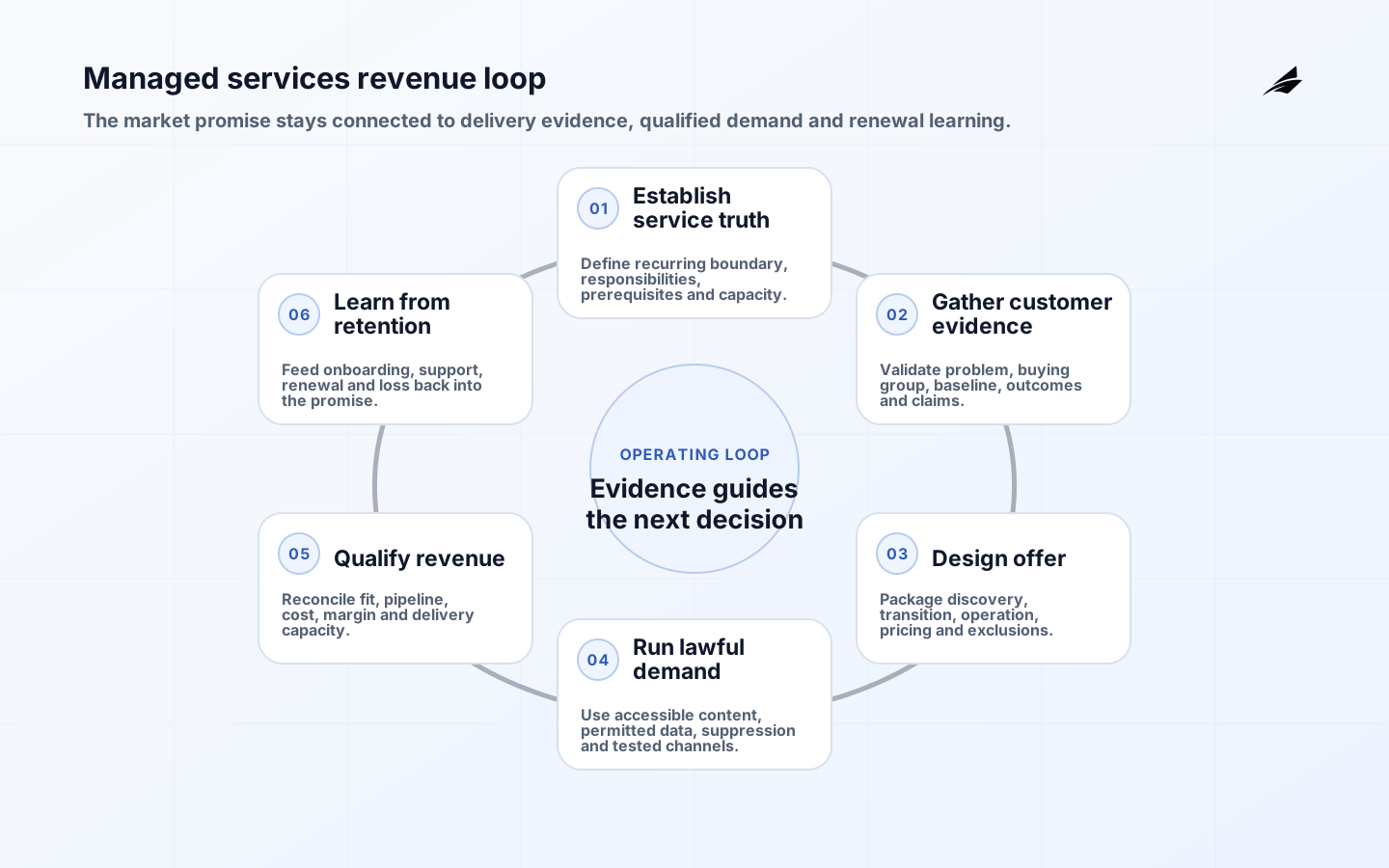
Deliver in six phases: service truth, customer evidence, positioning and offer, foundational content, bounded channel experiments, then repeatable operation. Gate each phase on evidence and delivery readiness. Major risks include unsupported claims, poor-fit demand, unlawful data use, inaccessible experiences, dependency on one channel, broken CRM lineage and selling beyond capacity. Assign owners and stop thresholds before campaigns launch.
Write a bounded campaign experiment brief
Define one segment, buying problem, offer, channel and decision. State the service capacity available, expected sales-cycle stage, budget, dates, lawful data source, suppression method, claim evidence and accessible destination. Choose a primary learning measure such as qualified conversations from target accounts, plus guardrails for complaint, poor fit, cost and sales follow-up. Record the current baseline and the minimum result that justifies continuation.
Change one material element where feasible and preserve audience and timing context. Reconcile platform responses with CRM qualification and eventual opportunity, rather than optimizing clicks alone. Review rejected leads and sales notes for message mismatch. Stop when privacy or claim controls fail, delivery capacity changes, complaint exceeds tolerance or the agreed spend buys no useful learning. At close, document result, uncertainty and next decision, update suppression and retention, and feed customer language and objections back into service truth and content.
Give sales and delivery a short pre-launch review window. Sales verifies qualification and follow-up; delivery verifies scope, proof and capacity; privacy or legal reviewers verify the planned data and claims. Record approval against the actual creative, audience and landing page. If content changes materially, repeat the relevant review. This prevents a small optimization in an advertising platform from bypassing the evidence and operating assumptions that made the campaign acceptable.
Key takeaways
- Market the recurring operating responsibility and shared boundary, not a vague promise of outsourcing.
- Build positioning from service truth, customer evidence and a narrow fit profile.
- Substantiate objective claims before publication and disclose material connections.
- Design lawful, accessible demand generation with central suppression and vendor oversight.
- Measure qualified revenue, retention, margin and capacity, not lead volume alone.
Frequently asked questions
Should a managed service provider hire a specialist agency?
A specialist can add research, creative or channel capacity, but the provider must retain service truth, claim approval, privacy accountability and revenue data access. Contract source files, account ownership, confidentiality, subcontractors, measurement definitions and transition. Do not outsource delivery expertise the agency needs to represent accurately.
How long until managed services marketing produces results?
It depends on sales cycle, existing reputation, segment reach, evidence, offer and channel. Set leading milestones for validated positioning, engaged target accounts and qualified conversations, then evaluate pipeline and revenue over the actual buying cycle. A promised universal timeline would ignore these dependencies.
Conclusion
Managed services marketing works when the promise matches the operated service and the measurement follows through to retention. Service truth, evidence-backed claims, useful buying content, privacy-aware demand generation and reconciled revenue operations form one system. That system earns trust before the sale and protects it after onboarding.