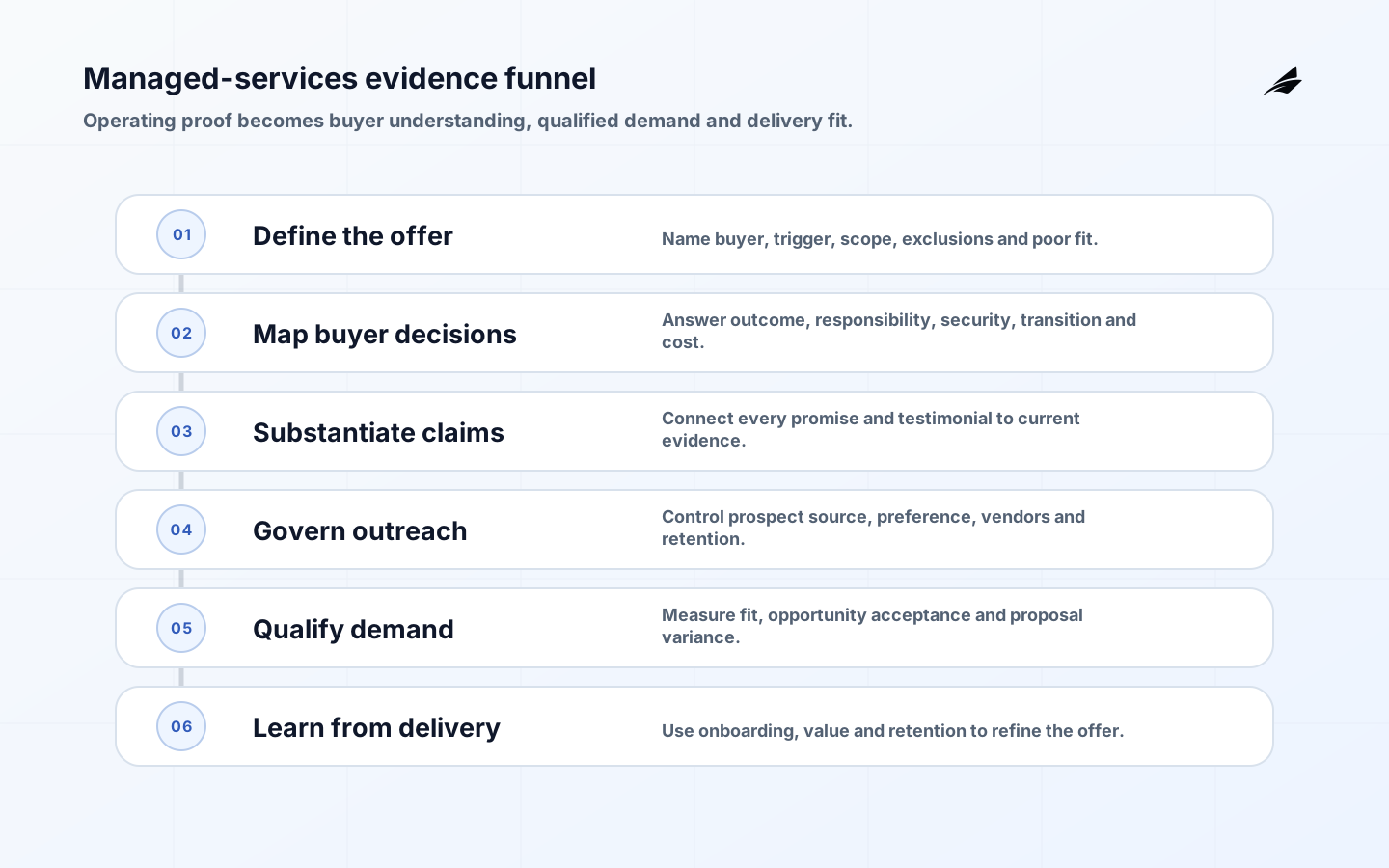
Managed services marketing is not a product purchase with a predictable outcome. It is an operating change spanning offer design, technical proof, buyer education, demand operations, privacy and sales handoff. The useful question is whether the proposed service improves a named workflow while preserving security, recoverability and accountable ownership. This guide turns that question into a sequence of decisions, evidence and release gates that buyers, architects and delivery leaders can use together.
Begin with the companion Edilec resources on managed services marketing scope and cost, the managed services marketing checklist, delivery model comparisons. They provide neighboring architecture and implementation detail. This article concentrates on the exact boundaries, delivery evidence and recurring management decisions that determine whether managed services marketing program remains useful after the first release.
What is managed services marketing?
Managed services marketing explains an ongoing operating promise: the provider assumes defined responsibilities, works to agreed service levels, reports evidence and improves the service over time. Buyers need more than a list of tools or twenty-four-hour language. They need to know the covered systems, exclusions, customer duties, transition method, security model, escalation, commercial unit and exit path. Marketing translates those facts into role-specific decisions without turning conditional performance into an absolute guarantee.
Define one offer for one ideal problem before choosing channels. A useful offer names the buyer, triggering condition, current cost of inaction, service boundary, onboarding prerequisites, operating cadence, outcome measures and situations that are a poor fit. Separate managed service, staff augmentation, consulting project and software resale. If sales can change the responsibility boundary in a call, the offer is not ready for scale and delivery will inherit avoidable expectation debt.
| Decision | What must be explicit | Acceptance evidence |
|---|---|---|
| Ideal customer | Operating context, scale, risk and buying trigger | Won/lost evidence and explicit disqualifiers |
| Service promise | Covered outcomes, exclusions and shared responsibilities | Approved service description and sample report |
| Proof | Claims, case evidence, references and limitations | Substantiation file with owner and review date |
| Journey | Question answered at each buying stage | Content-to-conversation path and handoff criteria |
| Data use | Prospect source, lawful use, preference and retention | Consent or other basis record and suppression test |
How should the offer and buyer journey be structured?
Organize the buyer journey around decisions. Early material helps a leader recognize a costly operating condition. Mid-journey material exposes scope, responsibility, migration, security and cost. Late material provides architecture evidence, service levels, sample reports, transition steps and references. Every asset should answer a real question and point to the next useful action. A content library arranged only by technology category often attracts research traffic while leaving qualified buyers unable to evaluate the offer.
Connect campaign, website, CRM, sales and delivery data with a small shared vocabulary: account, contact, source, consent or preference, opportunity, offer, stage, disqualification reason, contract and retained customer. Do not infer success from first-touch attribution alone. Preserve campaign detail, but evaluate cohorts through qualified conversation, proposal quality, fit, time to value and retention. Restrict enrichment and advertising data to declared purposes, document vendors and honor objections across every activation system.
How should claims, reviews and prospect data be governed?
Claims must be truthful, non-deceptive and supported before publication. Replace “eliminates downtime” with a defined availability objective and relevant exclusions; replace “fully compliant” with the exact controls, assessments or contractual commitments the provider can evidence. Reviews and testimonials need authentic provenance and appropriate disclosures. Marketing operations should maintain approved claim language, evidence, expiry dates, reviewer ownership and a correction path when the service changes.
The FTC’s advertising and marketing guidance explains truthfulness and substantiation, and its review and testimonial Q&A addresses prohibited review practices. Commercial email teams can use the FTC’s CAN-SPAM compliance guide. For UK-directed activity, the ICO’s current direct marketing guidance covers planning, collection and preferences. NIST’s Privacy Framework helps connect data processing to organizational risk.
| Control area | Implementation detail | Proof before scale |
|---|---|---|
| Claims | Named evidence, conditions, exclusions and review date | Sample trace from page statement to operating record |
| Testimonials | Authenticity, permission, material-connection disclosure and no suppression | Source record and publication review |
| Accurate identity, required disclosures, opt-out and vendor oversight | Seed test and suppression propagation | |
| Prospect data | Purpose, source, access, retention and objection handling | Field inventory and deletion exercise |
| Handoff | Approved scope, qualification and recorded buyer assumptions | CRM-to-discovery audit |
How do you build a credible program?
Start with interviews across existing customers, lost opportunities, sales, transition and delivery. Produce an offer brief and claim register before campaign assets. Build a small decision set: service page, scope guide, implementation checklist, sample report, security response and one evidence-rich case account. Instrument meaningful actions and train sales on disqualification. Launch to a narrow segment, review recorded questions and proposal variance, then improve the offer before adding channels or automation.

Treat every stage as a gate, not a calendar milestone. The owner records the decision, evidence, unresolved exceptions and rollback trigger. A stage closes only when representative users complete the workflow, telemetry explains failure, support can diagnose it, and recovery has been exercised. This keeps managed services marketing program from expanding on enthusiasm while operational debt remains invisible.
What should the budget include?
Budget includes positioning research, subject-matter interviews, writing and design, website implementation, marketing operations, analytics, privacy and legal review, media, events, CRM administration, sales enablement and ongoing evidence maintenance. Calculate cost per qualified opportunity and per acquired retained account, not only cost per lead. Include delivery time spent proving claims and supporting references. A low-cost lead source can be expensive when it creates poor-fit discovery, custom proposals and early churn.
For managed-services marketing, estimate lifecycle cost by workload and by responsibility. Include discovery, integration, migration, verification, security review, environments, observability, support, change management, vendor management, data movement, incident response and exit work. Keep contingency attached to known uncertainty rather than hiding it in a blended rate. Reforecast after the pilot with observed effort and consumption; that is more defensible than extrapolating a demonstration.
Common failure modes and practical responses
Common failures are generic “end-to-end” positioning, unsupported superlatives, purchased lists without governance, gated content that gives little value, case studies without baseline or limitations, and attribution models that reward form fills over fit. Another failure is marketing a standardized service while sales routinely promises bespoke coverage. Review disqualification, proposal exceptions, onboarding surprises and early support escalation; they reveal where the public offer and operating reality have diverged.
For managed-services marketing, the practical response is a small control loop: detect the condition, identify the accountable owner, limit exposure, preserve evidence, recover the workflow, and decide whether the underlying design must change. Record exceptions with an expiry date and compensating control. Repeated exceptions are architecture evidence, not administrative noise, and should change the roadmap or narrow the service boundary.
Example: marketing a cloud operations service
A provider markets a managed cloud operations service to regulated mid-market firms. Research shows buyers worry less about tool names than after-hours ownership, evidence for audits, change control and exit. The provider defines supported clouds, coverage hours, customer responsibilities, incident classes, reporting, onboarding and exclusions. Its core page links to a transition checklist, sample monthly report and security overview rather than promising universal savings.
A case account states the starting environment, migration period, measures used, customer contribution and observed result; it does not present one result as typical for every buyer. Email nurture follows expressed interest and keeps a synchronized suppression list. Sales accepts an opportunity only when platform scope, urgency, authority and operating fit are known. Delivery reports which assumptions were wrong, and marketing updates qualification and claim evidence quarterly.
For managed-services marketing, the team releases only the proven slice, monitors user and system outcomes through a full operating cycle, and keeps the previous route available until reconciliation closes. At the review, leaders compare baseline and observed results, examine near misses and support effort, and either expand, redesign or stop. That decision discipline matters more than completing every item in an original feature list.
How to measure value and operating health
Use a balanced funnel: decision-content engagement by target account, qualified conversation rate, disqualification reason, opportunity acceptance, proposal variance, sales cycle, acquisition cost, onboarding surprise rate, time to first value, expansion and retention. Review results by offer and segment. Privacy complaints, unsubscribe propagation, inaccurate claims and sales overrides are quality measures too. Marketing is working when more suitable buyers understand the service and fewer unsuitable commitments reach delivery.
| Measure type | Example measure | Decision it informs |
|---|---|---|
| Understanding | Target buyers reaching scope, security and transition material | Whether content answers evaluation questions |
| Qualification | Accepted opportunities and disqualification distribution | Whether targeting and offer clarity improve fit |
| Commercial | Proposal variance, cycle time and acquisition cost | Whether the offer is repeatable |
| Delivery | Onboarding surprises, time to value and early churn | Whether public promises match operations |
Key takeaways
- Market an explicit operating promise, not a collection of technologies.
- Keep every material claim connected to current evidence and conditions.
- Design content around buyer decisions from problem recognition through transition.
- Govern prospect data, preferences, vendors and review use across channels.
- Measure fit, delivery truth and retention alongside demand.
Frequently asked questions
What content works best for managed services?
Decision content usually matters most: responsibility matrices, transition plans, sample reports, security explanations, service-level definitions, cost drivers and evidence-rich case accounts. The mix should reflect questions heard in real buying and onboarding conversations.
Can a provider promise guaranteed outcomes?
Only make a guarantee when its terms, dependencies, remedy and evidence are precise and deliverable. Most operating outcomes depend on customer systems and shared responsibilities, so a defined objective with conditions is more informative than an absolute promise.
How long before managed services marketing shows value?
Leading evidence can appear within one buying cycle through better engagement and qualification. Acquisition and retention evidence takes longer. Set review periods that match sales, onboarding and renewal cycles instead of forcing every channel into a thirty-day revenue test.
Conclusion
Managed services marketing earns trust when the offer, evidence and operating model agree. Define the responsibility boundary, explain the buyer’s decisions, govern claims and prospect data, and connect demand measures to onboarding and retention. That produces fewer dramatic slogans but more useful conversations, better-fit contracts and a service the delivery team can actually stand behind.