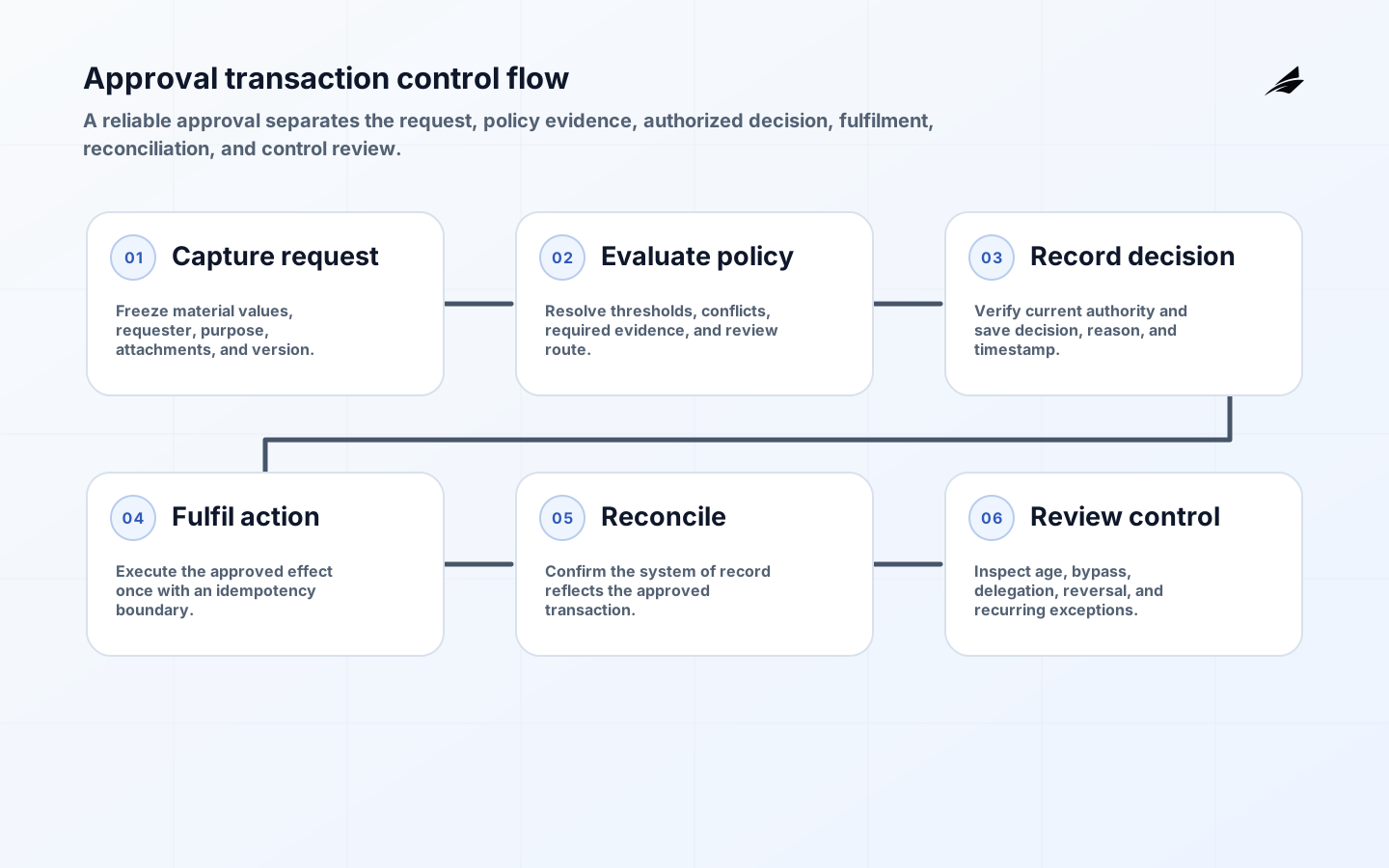
Approval workflow software should do more than send a request to the next person. It must preserve what was requested, determine which policy applies, verify that the reviewer currently has authority, record an informed decision, execute the approved business effect once, and expose failures that require recovery. If any of those boundaries remains implicit, a polished inbox can conceal stale authority, self-approval, changed amounts, duplicate fulfilment, or a downstream system that never received the decision.
Begin with the business transaction rather than a diagram of boxes. Interview requesters, approvers, fulfilment teams, system owners, and reviewers. Identify the authoritative record, the consequence of an incorrect approval or denial, and the exception that causes the most manual work. BPMN 2.0.2 offers a standard notation for processes and interactions, while DMN supports explicit decision logic. These models help communication, but the delivered system still needs precise state, identity, authorization, evidence, and recovery semantics.
Define the approval transaction and authority
Write the request as a versioned record. Capture requester identity, business purpose, material values, currency or unit, affected records, attachments, creation time, and policy context. Decide which fields may change before review. If a material field changes, invalidate earlier approvals or create a new version rather than silently applying an old decision to a new request. Keep comments and supporting evidence linked to the version the reviewer saw.
Authority is not the same as receiving a notification. Resolve eligible approvers from current role, organizational scope, threshold, qualification, conflict rules, and absence or delegation status. Separate a policy owner, who defines the rule, from an operational approver, who decides a case. For high-impact actions, prevent the requester from approving their own transaction and consider independent or sequential review. Record the authority source and policy version with the decision so a later reviewer can understand why it was valid at that time.
| Design question | Weak answer | Operable answer |
|---|---|---|
| What was approved? | The current form | Immutable request version and material fields |
| Who may decide? | Anyone in a mailing list | Current role, scope, threshold, and conflict check |
| What does approval permit? | Continue the process | Named action on a defined record and amount |
| How long is it valid? | Until used | Expiry or state-dependent validity |
| What if data changes? | Keep the approval | Reevaluate material change and version policy |
| How is fulfilment proven? | Email sent | Idempotent command and reconciliation result |
Model states, clocks, delegation, and cancellation
Use explicit states such as draft, submitted, under review, needs information, approved, rejected, cancelled, expired, fulfilment pending, completed, and failed. Define permitted transitions and the actor or system that may trigger each one. Avoid one ambiguous approved flag that cannot distinguish decision from execution. Time matters: set due times, reminders, escalation, expiry, and business calendars. Show queue age and breach risk to operators rather than hiding delay in email.
Delegation should identify delegator, delegate, scope, start, end, and reason. Verify that the delegate is eligible and does not create a prohibited conflict. Do not copy every future task blindly, and never allow a delegation to outlive the underlying authority. Cancellation needs similar clarity: who can cancel, which states allow it, whether an already approved action can be stopped, and which downstream effects require reversal rather than deletion.
- Version the request before review begins.
- Use explicit transitions instead of editable status fields.
- Make reminders and escalation separate from authorization.
- Expire delegation and temporary authority automatically.
- Distinguish cancellation from reversal of an executed action.
- Keep one visible owner for every waiting or failed case.
Secure the decision and its presentation
The OWASP Transaction Authorization Cheat Sheet emphasizes that authorization should be tied to significant transaction data and enforced server-side. Show the reviewer the material facts, source, policy reason, conflicts, attachments, and consequence. Require recent authentication or step-up assurance where risk warrants it. The decision endpoint must re-read authoritative state and current authority, not trust values rendered earlier in the browser.
Design against confused-deputy and cross-tenant failures. Verify the request belongs to the approver's scope, the requester cannot choose an unauthorized approver, and a guessed identifier cannot reveal another case. The OWASP Authorization Cheat Sheet recommends deny-by-default behavior and validation on every request. Protect bulk approval, export, reassignment, policy editing, and impersonation as separate privileged actions. Rate-limit high-impact commands and provide a clear confirmation when an action is difficult to reverse.
| Threat or failure | Control | Acceptance test |
|---|---|---|
| Request changes after review | Material version invalidates decision | Changed amount requires new approval |
| Self-approval | Conflict rule and independent reviewer | Requester cannot enter decision transition |
| Stale authority | Recheck role and scope at decision time | Removed approver is denied |
| Duplicate fulfilment | Idempotency key and state guard | Retry creates one business effect |
| Partial downstream failure | Durable outbox or recoverable job | Failed delivery remains visible and retryable |
| Inaccessible status update | Programmatic status message | Assistive technology receives the result |
Connect approval to fulfilment and reconciliation
Approval does not complete the business outcome. After the decision, issue a durable, idempotent command to the system of record. Record fulfilment attempts, external references, and final result. Reconcile approved requests against actual effects so a successful decision with a failed integration cannot disappear. For distributed systems, an outbox, queue, or workflow engine can separate transaction recording from downstream delivery while preserving retry and observability. The ERP, CRM, and workflow integration guide covers record authority and reconciliation in more depth.

Design queues and decisions for clear review
Approval interfaces should prioritize due work and consequence, not decorate every record with equal weight. Provide filters for owner, state, age, threshold, exception, and policy. Keep the decision controls close to the material evidence, make selected state visible without color alone, and support keyboard operation. WCAG 2.2 includes requirements for labels, error prevention in legal and financial data, and programmatically determinable status messages. Confirm that loading, submission, success, rejection, and validation states are announced without moving focus unpredictably.
Do not force reviewers to reconstruct context across many tabs. Show an attributable history, comparable before-and-after values, and links to the authoritative records. Present machine-generated recommendations as evidence, not as a preselected decision. If a policy automatically approves low-risk cases, make the rule, inputs, result, and exception route visible. The companion admin dashboard architecture guide explains how to shape operational queues and protected actions.
Release a vertical slice and measure control health
Implement one request type end to end: request capture, policy evaluation, one approval route, decision, fulfilment, reconciliation, search, evidence, and recovery. Migrate a controlled cohort and run the old path only with a defined exit plan. Reconcile open and completed cases during transition. Test expiry, reassignment, outage, duplicate submission, permission removal, downstream timeout, and reversal before increasing scope. The regulated process digitization checklist is useful when the workflow carries formal record or oversight obligations.
Track request age, time in each state, first-pass decision rate, requests returned for missing evidence, delegation use, self-approval blocks, expired cases, decision reversals, fulfilment failures, reconciliation gaps, and exception volume. Segment by request type, threshold, team, and policy version. A faster average is not progress if high-risk work is rushed or low-risk automation creates more correction. Review representative cases with policy owners and operators, then improve the rule, form, queue, and integration together.
Plan migration at the level of open work, not only user accounts. Inventory drafts, pending reviews, approvals waiting for fulfilment, failed deliveries, historical evidence, delegations, and scheduled escalations. Decide whether each case completes in the old system, moves to the new system, or becomes read-only. Preserve old identifiers and create a traceable mapping when identifiers change. Recalculate due times and authority only under an approved rule; otherwise migration can silently alter the decision a reviewer was expected to make. Reconcile case counts and financial or operational totals before declaring the old path closed.
Define support procedures for mistakes that software cannot reverse automatically. A mistaken rejection may be resubmitted, while an approved payment may require a separate compensating transaction. Operators need permission to view evidence and start recovery without editing history. Publish reason codes, escalation owners, and response times. Review manual corrections as control signals: repeated use may indicate unclear forms, a policy gap, stale routing, or unreliable integration. The goal is not zero exceptions; it is visible exceptions that reach an accountable resolution.
Key takeaways
- Treat an approval as a versioned transaction, not a message.
- Resolve current authority, scope, threshold, and conflicts at decision time.
- Model decision and fulfilment as separate visible states.
- Use idempotency and reconciliation to prove the approved effect occurred once.
- Design delegation, expiry, escalation, cancellation, and recovery explicitly.
- Measure control quality and exception patterns alongside speed.
Frequently asked questions
Can an approval be completed from email?
Email can notify and link to the request, but high-impact decisions are safer in an authenticated interface that shows current material data and authority. Signed links need short expiry, one-time use, and server-side revalidation; replying ‘approved’ rarely provides enough transaction integrity.
When should a workflow auto-approve?
Automate when policy is explicit, inputs are authoritative, consequence is bounded, exceptions are detectable, and results are reviewable. Start with low-risk cases and compare automated decisions with historical human outcomes before expanding.
Is an audit log enough evidence?
No. Evidence also needs the request version, policy and authority source, material data shown, decision, reason, fulfilment result, and reconciliation. Logs should make that chain reconstructable without retaining unnecessary secrets or personal data.
Conclusion
Professional approval workflow software turns policy into an operable transaction. It freezes the request that matters, verifies who may decide, protects the decision boundary, records the rationale, executes the effect once, and makes exceptions recoverable. Build one complete vertical slice, test stale authority and partial failure, and review control outcomes with the people who own the process. That approach produces faster decisions without sacrificing accountability.