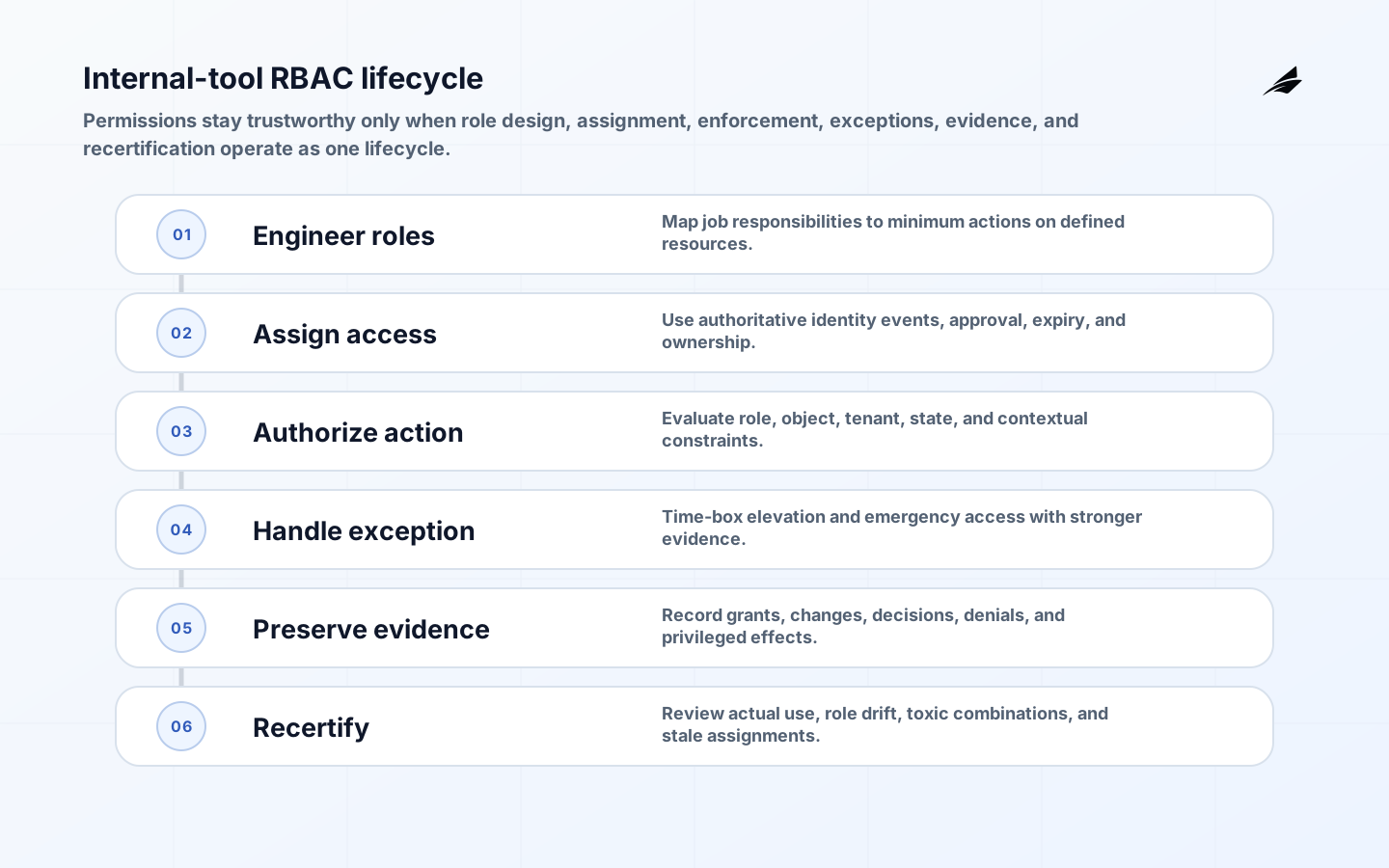
RBAC design for internal tools deserves the same care as customer-facing authorization. Internal applications often expose customer records, pricing, support interventions, exports, financial adjustments, configuration, and production controls to a small group of trusted people. That concentration makes an admin boolean especially dangerous. A dependable design identifies each consequential action, groups the minimum permissions into roles that reflect stable responsibilities, scopes those permissions to the right records, and governs assignments from request through removal.
Use the RBAC meaning in software guide for the underlying model, then treat the checklist here as an implementation and operating plan. NIST's RBAC project formalizes users, roles, permissions, sessions, hierarchies, and separation-of-duty relations. Internal tools usually need those role concepts plus contextual rules: a support agent may edit only assigned cases, a regional operator may act only in one market, and a finance reviewer may approve only below a value limit.
Inventory protected actions and resource boundaries
Walk through the real work with operators. Record read, create, update, delete, export, approve, impersonate, retry, refund, configure, and bulk actions separately. Mark the authoritative system and the consequence of an incorrect allow or deny. A permission called customers.manage is too broad when the interface separately supports viewing contact details, editing identity fields, exporting records, resetting authentication, and merging accounts. A granular contract makes review meaningful and allows the product to apply stronger controls only to the risky action.
Define object scope at the same time. Tenant, legal entity, region, team, queue, account, environment, and record ownership are common boundaries. The role answers which class of action is allowed; the policy must still ensure the selected object belongs within the subject's scope. Include background jobs and APIs. An internal user who cannot see an export button must not be able to call the export endpoint directly, and a scheduled job must use its own service identity rather than inherit a person's broad session.
| Action class | Example | Design requirement |
|---|---|---|
| Routine read | View assigned support case | Tenant and queue scope |
| Sensitive read | View identity evidence | Purpose, masking, and stronger audit |
| Business change | Correct an invoice address | State validation and attributable history |
| Financial action | Issue a refund | Threshold, separation, and reconciliation |
| Security action | Reset MFA | Recent assurance and independent evidence |
| Bulk action | Export customer records | Explicit scope, confirmation, rate limit, and review |
Build a role-permission catalog people can review
Create roles from recurring responsibilities: case responder, billing preparer, refund approver, customer administrator, security responder, and platform operator. For each role, publish purpose, permissions, eligible population, incompatible roles, assignment authority, expiry rule, and review owner. Do not model seniority by automatically inheriting every junior permission; a team lead may supervise work without needing to execute each high-risk transaction. Avoid personal roles and temporary role names that survive long after a project.
Represent constraints where the authorization engine can enforce them. Separation of duty may prevent the requester from approving the same transaction. A value threshold may route an action to a different role. Record state may prevent editing after settlement. Recent high-assurance authentication may be required before a credential reset. The NIST Digital Identity Guidelines help teams reason about authentication assurance, while authorization remains an application decision. Document signal failure behavior so an unavailable identity or policy service does not create an accidental bypass.
- Use deny-by-default behavior for every protected route and action.
- Keep production administration separate from business operations.
- Prevent incompatible role combinations where policy requires it.
- Use explicit tenant and object checks in addition to role membership.
- Require short-lived elevation for rare privileged tasks.
- Version role definitions and review their changes like application code.
Enforce RBAC in the service and test negative paths
The OWASP Authorization Cheat Sheet recommends server-side validation on every request. Put reusable checks in a common policy layer or service, but pass enough business context to decide correctly. The user interface should reflect permissions by hiding or disabling unavailable actions and explaining constraints, yet that presentation is secondary. The API must reject an unauthorized command before mutating state, and it must not trust a tenant, owner, or amount supplied by the client without verifying it against authoritative data.
Create a permission test matrix for each release. Include no role, correct role, wrong tenant, wrong object state, expired assignment, removed assignment with an existing session, conflicting roles, bulk endpoint, alternate identifier, background job, and direct API call. Verify that denial leaves state unchanged and creates a useful event. The OWASP Application Security Verification Standard provides testable application-security requirements that can support release acceptance rather than relying on a one-time penetration test.
| Control | Positive test | Negative test |
|---|---|---|
| Role check | Eligible role completes allowed action | Unassigned user is denied |
| Object scope | Operator accesses assigned entity | Same role cannot cross entity |
| State rule | Action succeeds in permitted state | Closed or settled record cannot change |
| Separation | Independent reviewer approves | Requester cannot self-approve |
| Revocation | Current grant works before removal | Removed grant fails at defined boundary |
| Elevation | Approved temporary role works in scope | Expired or broader action is denied |
Operate the full RBAC lifecycle
Assignments should originate from a named authority. Workforce roles may follow HR and identity events; business roles may require a manager or data owner; customer-tenant roles may be delegated to an accountable tenant administrator. Every temporary or exceptional grant needs purpose, scope, approver, start, expiry, and notification. Reconcile assignments when a person changes team, leaves, loses a qualification, or no longer supports a customer. NIST SP 800-171 Rev. 3 explicitly connects least privilege with reviewing privileges and removing those no longer necessary.
Design emergency and support access before it is needed
Break-glass access should not be a permanent superuser shared by the team. Require a named identity, strong authentication, incident or support reference, approved scope, short duration, visible activation, and automatic expiry. Record every protected action and review use after the event. If customer support needs temporary access to a tenant, show the operator and customer context prominently and prevent silent movement between tenants. Consider read-only or masked modes before granting full control.
Prepare for policy-service and identity outages. Decide which low-risk reads may continue, which actions fail closed, and how responders recover without editing authorization data directly. Test the route. The broader zero trust application guide helps place these decisions in a per-request identity and resource model. The admin dashboard architecture guide covers how the interface can present protected operational context and recovery.
Collect evidence and recertify meaningful access
Preserve assignment changes, role-definition changes, authorization decisions for high-impact actions, denials, elevation, and emergency use. Correlate the decision with the resulting business transaction. Protect logs from alteration and restrict access because they may reveal customer or security context. Use stable reason codes so operators can distinguish absent role, scope mismatch, expired grant, state conflict, and unavailable policy without exposing sensitive rules to an attacker.
During review, show a manager or resource owner what the role permits, why the person has it, who approved it, when it was last used, and what changed since the previous review. Prioritize privileged and dormant grants rather than treating every row equally. Track revocation delay, unexplained direct grants, expired exceptions, role count, unused permissions, cross-tenant denial, break-glass use, and recertification removals. Close the loop by updating roles and workflows when recurring exceptions reveal a legitimate responsibility that the model missed.
Service identities need their own review path. Assign each integration, scheduled job, and automation to a human owner and a specific workload. Record permissions, credential type, runtime environment, dependencies, rotation method, and expected traffic. Do not place service accounts in workforce roles merely because that is convenient. Test whether a workload can call an action outside its purpose, and remove credentials when the job is retired. Prefer short-lived workload identity over static secrets where the platform supports it. Alert on use from an unexpected environment and on long inactivity followed by a privileged request.
Deploy role and policy changes gradually. Evaluate the proposed rules against representative recorded requests, compare new decisions with the current policy, and investigate every unexplained difference. Release to one workflow or team, monitor denials and support demand, then expand. Keep a tested policy rollback that cannot restore access removed for an incident, leaver event, or expired exception.
Key takeaways
- Inventory actions and resource scope before naming roles.
- Model constraints such as tenant, state, amount, and separation explicitly.
- Enforce every action server-side and test horizontal as well as vertical privilege.
- Govern assignment, expiry, revocation, elevation, and emergency access.
- Record enough evidence to reconstruct a protected transaction.
- Review actual use and drift, not just a list of role names.
Frequently asked questions
Can a small internal tool begin with one admin role?
A very small prototype may, but separate sensitive reads, business actions, exports, security recovery, and production administration before real data and multiple teams arrive. Retrofitting object scope after broad access is in use is expensive and risky.
Should permissions be stored in tokens?
Tokens can carry scoped claims, but long-lived permission lists become stale. Keep lifetimes short, validate audience and issuer, and use current application policy for consequential or object-specific decisions. Define when a changed assignment takes effect.
How often should privileged roles be reviewed?
Set frequency by consequence and rate of change. High-impact production, finance, identity, and export roles may need continuous event-driven review plus periodic certification; ordinary stable roles can follow a longer cadence. Immediate leaver and incident revocation should never wait for the next campaign.
Conclusion
Strong RBAC design for internal tools connects product architecture with identity operations. Roles emerge from real responsibilities, permissions protect precise actions and resources, constraints reflect business rules, and assignments have an accountable lifecycle. Server-side enforcement, negative tests, emergency planning, evidence, and recertification keep the model trustworthy after launch. Begin with the few workflows that can change money, customer data, identity, or production, and expand only when the team can explain and operate the resulting control.