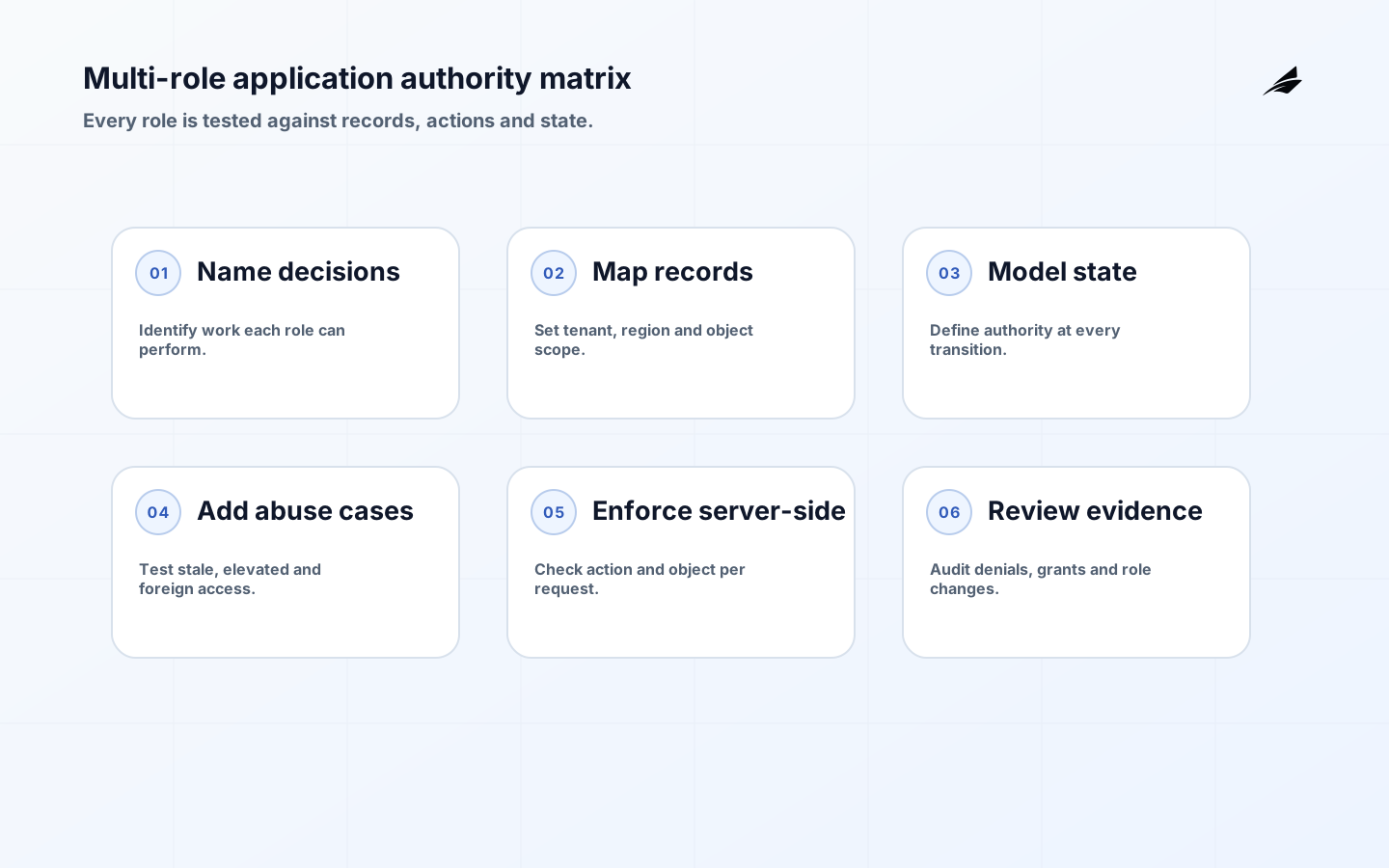
Multi-role business applications are difficult because different people need different views of the same work without receiving unlimited access to the same data or actions. A field technician, coordinator, manager, finance reviewer, and administrator may all touch one case, but their questions and authority differ. Planning that starts with a generic role matrix often produces a brittle list of page permissions. Begin instead with decisions and objects: who needs to see which work item, what can they change, under what conditions, and what evidence should remain afterwards? That framing exposes real business boundaries such as region, customer account, financial threshold, assignment, or temporary delegation. It also makes the interface more focused because each role receives the context needed to perform a legitimate task.
Test role design with business and abuse cases
Role workshops often stop after naming personas such as agent, manager and administrator. A stronger plan tests each proposed role against objects and actions. For every protected record, ask who may create it, view it in each state, change specific fields, approve it, export it, reopen it and delegate work. Then add negative cases: a manager from another region, a user whose department changed, a support operator impersonating a customer, and an administrator attempting an action that requires separation of duties. OWASP’s Application Security Verification Standard expects access control at a trusted service layer and least privilege across functions and data, so hiding a control in the interface cannot be the authorization mechanism.

| Scenario | Policy question | Acceptance evidence |
|---|---|---|
| Cross-tenant record URL | Does object scope survive a guessed identifier? | Server rejects access and records a safe denial event |
| Approval after role change | Is authority evaluated at action time? | Moved user cannot approve from an old session or cached grant |
| Emergency support access | Is elevated access purposeful and temporary? | Reason, approver, expiry and actions are reviewable |
| Bulk export | Are high-volume actions separately governed? | Scope, step-up authentication, limits and audit evidence are enforced |
Use these scenarios in product discovery, API design and automated tests. A role matrix is a starting hypothesis; the executable policy and its object-level tests are the durable control. Keep one authoritative workflow state so each role sees a tailored view of the same record rather than a separate spreadsheet or shadow queue. The interface must also meet WCAG 2.2 requirements for focus, labels, errors and status changes across role-specific screens. Continue planning with Edilec’s guides to workflow-first applications, approval workflow software and quality assurance for custom systems. Before development starts, require a reviewed policy table, representative fixtures and a vertical slice that crosses at least two roles and one exception.
Key takeaways
- Define roles through decisions, objects, and scope rather than navigation menus.
- Separate viewing, proposing, approving, administering, and exporting privileges.
- Evaluate authorization in the service for each requested action and resource.
- Design handoffs so ownership, responsibility, and evidence remain visible across roles.
- Review role grants and exceptional access as an ongoing operational control.
Map roles to decisions and objects
List the important objects in the application: account, case, order, attachment, report, assignment, or policy. For each object, identify the decisions a role makes, the data needed, the scope rule, and the outcome. A coordinator may assign cases for their region; a specialist may update evidence only on assigned cases; a manager may approve an exception within a limit. Use concrete scenarios to reveal collisions: what happens when a manager is also the requester's delegate, or when an employee changes regions during an open case? Avoid giving an administrator a universal business role simply because they can manage configuration. Administrative power should be controlled separately from the ability to act on customer or financial records.
| Role | Legitimate decision | Scope boundary |
|---|---|---|
| Coordinator | Assign incoming work | Team queue and service region |
| Specialist | Update case evidence | Items currently assigned to them |
| Manager | Approve defined exception | Delegated limit and reporting line |
| Administrator | Manage application configuration | No implied access to business records |
Design an access model that survives change
Use roles to describe stable job functions, then apply attributes and relationships for context such as tenant, branch, assignment, or amount. This avoids creating a new role for every combination of responsibility. Keep a clear source for organizational relationships and define how quickly changes must reach the application. Plan joiner, mover, and leaver events: a person moving teams must not retain access through a forgotten group, while an urgent replacement needs a controlled route to begin work. Document default denial, least privilege, and who approves exceptional access. The model should be understandable to process owners as well as engineers, because they are the people who recognize when a policy no longer reflects the business.
Enforce object-level controls
Server-side authorization must validate the requested object and action every time. A hidden button or client-side filter is a presentation choice, not a control. The query that lists records must enforce the same tenant and scope rules as the command that changes one. Review direct links, guessed identifiers, bulk actions, downloads, and background jobs because these are common routes around incomplete checks. The OWASP Application Security Verification Standard gives practical coverage for authorization testing and logging. Record significant decisions with actor, role or policy basis, object, time, and reason, while avoiding sensitive information that does not help an investigation.
| Interaction | Required check | Test case |
|---|---|---|
| Open detail | May this user read this exact object? | Guess another tenant's identifier |
| Update state | May this actor make this transition now? | Attempt update after reassignment |
| Bulk export | May this role export these fields and rows? | Request wider filter than visible UI permits |
| Delegated action | Is delegation valid for this object and time? | Act after delegation expiry |
Design role-specific work without fragmenting truth
Role-specific views should present a shared case from different working angles, not create competing copies of its state. A specialist sees the next task and evidence fields; a manager sees queues and exception reasoning; a customer-service role sees communication history. Each view needs enough provenance to explain its data and a route to the authoritative case. Build status feedback and form validation so it is accessible to people using keyboards, assistive technology, or a small screen in the field. WCAG 2.2 helps teams check focus order, labels, instructions, and error recovery. Test handoffs with real roles to ensure one person can understand what the previous person did without a private conversation.
Build a cross-role vertical slice
Select a journey that crosses at least two roles, such as intake assigning a case, a specialist supplying evidence, and a manager approving an exception. Include identity provisioning, scoped query, action checks, notification, audit event, and support diagnostics. This is a better proof than separate role homepages because it exposes inconsistent state or access decisions. Apply NIST SSDF practices for requirements, dependency control, code integrity, and verification. Run tests that change assignment, team membership, and delegation while the case is active. Multi-role behavior often fails at those moments, not when every identity is static in a demo environment.
Review the role model with practical scenarios
Hold the review with managers who assign work, not only administrators who maintain groups. Read each scenario as a story about a real employee and ask what they need to see, what they may change, and what must remain unavailable. Include organisational changes such as a transfer, temporary cover, contractor departure, and emergency incident. The best evidence is a test environment where reviewers can attempt the action with realistic identities and records, then inspect the resulting audit event. Pay special attention to convenience requests for broad access; a short-lived, approved exception is usually safer than changing a permanent role for one unusual case. Repeat the review when new workflow stages or integrations arrive, because role models become overbroad gradually through reasonable-looking additions.
| Scenario | Access decision to test | Expected evidence |
|---|---|---|
| New starter | How does a legitimate worker receive minimum access? | Approved role assignment, scope source, and activation record |
| Team move | What access disappears when responsibility changes? | Updated relationship data and tested revocation |
| Temporary cover | Can another person act during an absence? | Time-bounded delegation, scope, and manager approval |
| Cross-region case | May a user view work outside their normal area? | Explicit exception rule and audited request |
| Own request | Can a requester influence its final approval? | Segregation check and denial test |
| Bulk export | Which fields and rows can each role remove? | Export policy, server filter, and activity log |
| Support incident | How is elevated diagnostic access granted? | Purpose, approval, expiry, and post-use review |
| Administrator | Does configuration power imply business-data access? | Separate privilege tests and default denial |
| Service account | What non-human identity may automate actions? | Bounded permission, key rotation, and monitored use |
| Stale grant | How are obsolete memberships detected? | Periodic review, owner attestation, and remediation route |
| Direct link | Can an identifier bypass a visible filter? | Object-level authorization test and denial response |
| Audit request | Can an investigator explain a sensitive change? | Actor, policy basis, object, reason, and timestamp |
Review access and operational outcomes
Monitor denials, unusual privilege use, stale accounts, failed provisioning, queue handoff time, and work completed through exceptions. Use common correlation IDs to connect a user action with downstream effects; OpenTelemetry offers shared telemetry conventions. Review a sample of grants and high-impact actions with the responsible business owner. Also measure whether the new role design reduces delays and repeat work, rather than shifting them between teams. DORA research reinforces the value of linking delivery measures with organizational results. Revise a role or scope rule when evidence shows it is too broad, too restrictive, or no longer matches how responsibility is assigned.
Frequently asked questions
How many roles should a business application have?
Use the smallest set of stable job-function roles that can be combined with contextual rules such as tenant, assignment, and threshold. Too few roles create overbroad access; too many make administration and review unmanageable. Real scenarios are the best test of the balance.
Should administrators have access to all business data?
Not by default. Administrative capability and business-data access are separate privileges. Give temporary, approved, and auditable support access when an incident requires it. This limits exposure and produces evidence for sensitive investigations.
Conclusion
Multi-role business applications succeed when authority is as carefully designed as the interface. Map real decisions to objects and scope, enforce each action at the service boundary, and keep role handoffs legible. The result is a shared system that lets people do their work without blurring responsibility.