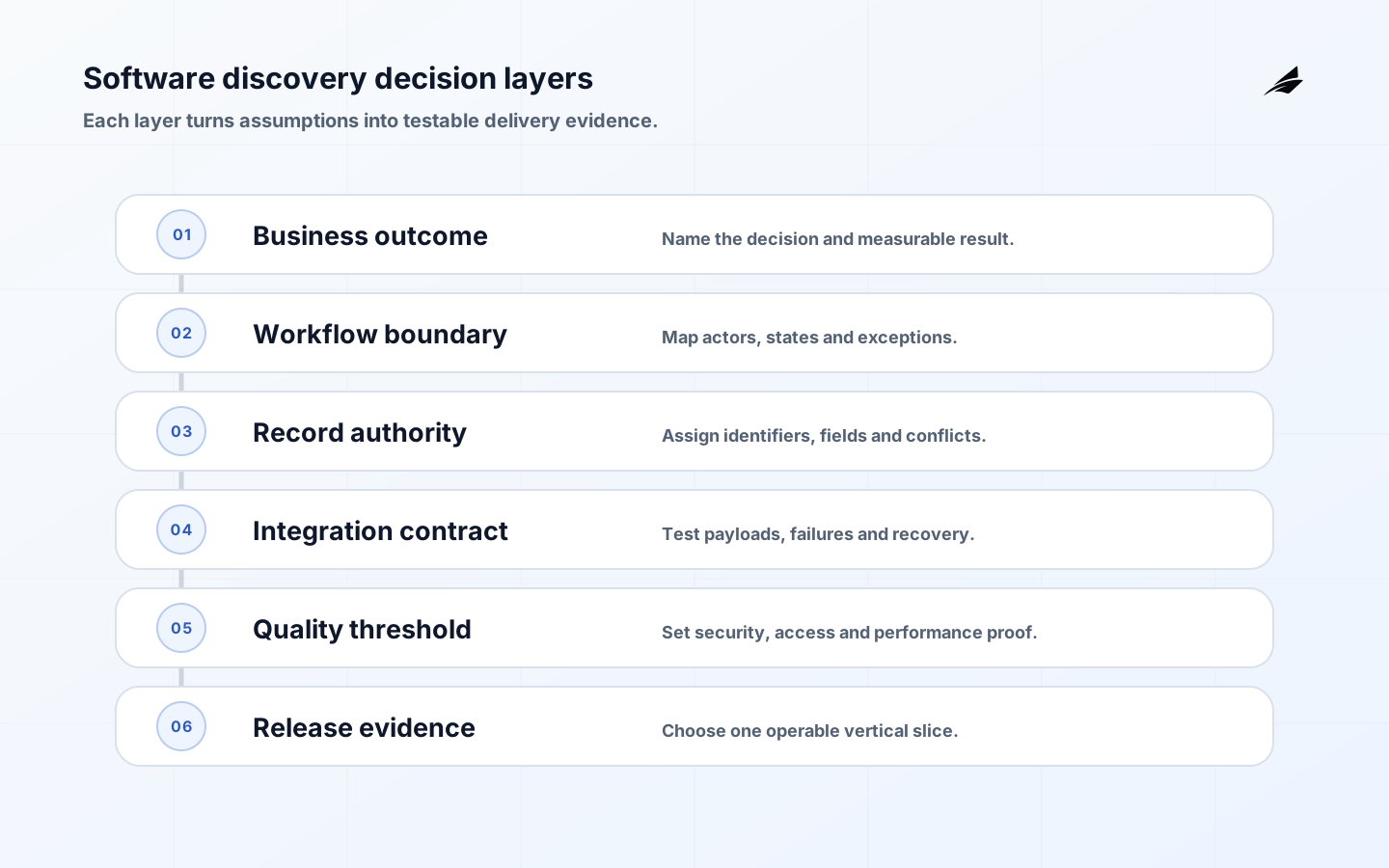
Custom software discovery should start with an operating commitment, not a wish to replace a spreadsheet or refresh a screen. The commitment is to give several teams a testable basis for deciding what to build first, which risks to resolve, and how to judge release. Before a team selects tools, it needs to see the present work as it is actually done. Study recent cases with frontline users through systems, policy decisions, handoffs, and exceptions. Notice where business owners, operational users, architects, security partners, and delivery teams wait for an answer, copy values, search several systems, or use a private escalation. Those moments reveal missing authority, unclear status, and recovery work that a future-state diagram can easily hide. A responsible first release makes one of those decisions safer and easier while retaining evidence for a later explanation.
Leave discovery with falsifiable delivery decisions
Custom software discovery is complete only when its important assumptions can be tested. Replace statements such as “the CRM will integrate” with a contract: the owning system, event or endpoint, required fields, identity, volume, latency, retry behavior, reconciliation method and named owner. Replace “the application must be secure” with misuse cases and verification requirements. Replace “users need a dashboard” with the decision, source, freshness and response the dashboard must support. This form of evidence turns a multi-team workshop into a buildable boundary rather than a collection of preferences.
| Discovery decision | Proof to obtain | Owner after discovery |
|---|---|---|
| Workflow boundary | Current-state example and target-state acceptance scenario | Business process owner |
| Record authority | Field-level source, identifier and conflict rule | Data or application owner |
| Integration contract | Sample payload, failure behavior and reconciliation test | Providing and consuming teams |
| Quality threshold | Security, accessibility, performance and recovery checks | Engineering and service owners |
| Release slice | One end-to-end outcome with operational telemetry | Product owner and delivery lead |
Maintain a decision log with status, evidence, owner, date and consequence of being wrong. A decision may remain open, but its uncertainty must influence scope and sequence. The NIST Secure Software Development Framework supports defining security requirements and preparing the organization before implementation, while OWASP’s threat-modeling guidance begins with scope and what can go wrong. Use Edilec’s guides to custom software discovery before development, API platform design and software modernization roadmaps for adjacent decisions. The discovery closeout should identify the first vertical slice, explicit exclusions, unresolved risks, test data and the evidence required to authorize release.
Key takeaways
- Frame custom software discovery around a measurable outcome and one bounded end-to-end journey.
- Name observed workflow evidence, named ownership, and testable acceptance conditions rather than an unranked wish list before designing copied data, automation, or interface polish.
- Model explicit states: problem framed, evidence gathered, assumptions tested, slice selected, ready to build, released, and reviewed.
- Enforce protected actions at the service boundary and preserve a recovery path.
- Release with representative IT managers and improve using observed exceptions, not opinions alone.
Define the custom software discovery boundary
Write the outcome in plain language and make its boundary testable. For this work, that means give several teams a testable basis for deciding what to build first, which risks to resolve, and how to judge release. Treat each delivery hypothesis as a working unit with a trigger, stable identifier, accountable owner, completion condition, and an understood error consequence. A boundary also names what is outside the first release. That protects the team when adjacent requests arrive from other parts of the organization. Review the boundary with business owners, operational users, architects, security partners, and delivery teams. Ask what evidence they need, which action they may take, and what happens when information is incomplete. The answer should be specific enough that a release reviewer can identify valid completion without interpreting a broad business aspiration.
| Question | Decision to document | Evidence to collect |
|---|---|---|
| Outcome | give several teams a testable basis for deciding what to build first, which risks to resolve, and how to judge release | Baseline timing, rework, and named business owner |
| Working unit | A delivery hypothesis with stable identity and lifecycle | Recent normal and difficult cases |
| Authority | observed workflow evidence, named ownership, and testable acceptance conditions rather than an unranked wish list | System owner, permitted editors, and policy reference |
| Completion | Durable result, visible confirmation, and recovery condition | Result record, receipt, and reconciliation rule |
| First release | One complete decision loop and its exceptions | Deferred work with owner and review date |
Model state, data, and authority
A state model prevents custom software discovery from degrading into a collection of disconnected pages. Use states that explain what happened, what may occur next, who can act, and what is blocking progress: problem framed, evidence gathered, assumptions tested, slice selected, ready to build, released, and reviewed. Avoid a generic pending status that hides whether the delivery hypothesis awaits data, a decision, a dependency, or manual repair. For material fields, record the authoritative source, effective time, update expectation, and permitted editors. A display copy can be useful, but it is not automatically allowed to correct the source. Retain the identifier that connects the initiating request, action, downstream call, and recovery activity. This gives operations and engineering a shared route to investigate disagreements without relying on inbox archaeology.
Design controls and recovery
Control design should fit the consequence of the action. In this case, make unresolved assumptions visible with an owner, decision date, and low-cost test. Apply permission at the command or API boundary using the current actor, object, relationship, and requested action. Hiding a menu can improve clarity, but it cannot secure a direct request. The OWASP Application Security Verification Standard gives practical checks for authorization, validation, logging, and session handling. Plan a legible response when an action is denied, a dependency times out, or records disagree. A visible exception owned by a real person is safer than a silent retry or undocumented workaround. Significant changes should retain prior state, actor, time, reason, and correlation identifier while avoiding unnecessary personal data in diagnostic records.
| Condition | Expected behavior | Operational evidence |
|---|---|---|
| Information missing | Hold work in a recoverable state and state what is needed. | Validation result and next owner |
| Unauthorized request | Deny at the service boundary without exposing unrelated records. | Actor, action, object scope, review event |
| Dependency failure | Use bounded retry or compensation and expose recovery. | Correlation identifier, attempt history, exception owner |
| Replay or duplicate | Prevent repeated effect and return known outcome. | Request identity, prior result, idempotency decision |
| Manual override | Require authority, reason, and follow-up where appropriate. | Before-and-after state and policy basis |
Build a thin operational slice
Prove the full path before broadening the surface. Produce an outcome statement, state map, data authority map, interface boundaries, risk register, prototype, and acceptance evidence. Include identity, retrieval of trusted context, allowed transition, usable outcome message, audit event, observable failure, and supportable recovery. Make integration behavior explicit: contract, expected time, duplicate behavior, and the owner who investigates a rejection or delay. The Secure Software Development Framework connects these requirements to secure design, implementation, verification, and release evidence. A thin slice is not a mock-up; it is a production-shaped capability whose behavior remains understandable when conditions are ordinary and when they are inconvenient.
Verify quality with real conditions
Challenge the discovery pack with exception, privacy, dependency, and receiving-team questions. Include keyboard users, assistive technology users, unreliable networks, and non-default data conditions in the review. WCAG 2.2 is useful for focus visibility, error identification, status messages, target size, and accessible authentication. Define acceptance evidence before implementation: expected outcome, protected boundary, error condition, data condition, and named observer. Pair workflow checks with contract and integration checks, then explore places where a person may misread status or take an irreversible action. Quality is not a release-day ceremony; it is credible assurance for the risks that would make this work unsafe or untrustworthy.
Operate and improve after release
Authorize one vertical slice and revisit assumptions during its demonstration using outcome and support evidence. Instrument intent and outcome, not merely page loads. A correlation identifier across browser, service, and dependency activity connects a reported issue to its actual path; the OpenTelemetry Specification provides common concepts for traces, metrics, and logs. Review cycle time, failed transitions, queue age, corrections, and recovery time alongside user observation. DORA research also encourages teams to look at delivery performance with organizational outcomes rather than treating deployment frequency as success by itself. Retire old reports, credentials, and manual steps only after the replacement has earned trust in real work.
Define release evidence
For custom software discovery, distinguish a decision from an assumption. A decision has a named owner, supporting evidence, and a consequence that the team accepts. An assumption is a proposition still worth testing, such as whether an integration can supply a field at the required time or whether a role can safely approve an exception. Give each assumption a small test, a date, and an owner. Prototype the riskiest transition with representative data where useful, but do not let a polished prototype substitute for permission, recovery, or operating ownership. At the end of discovery, the delivery group should be able to explain what is known, what remains uncertain, and why the selected slice is the right next investment. That shared clarity is what enables multi-team delivery; it reduces the need for later teams to infer intent from a backlog label or redesign a policy hidden in a workshop recording. Keep a decision log visible to every participating team so a changed assumption does not reappear later as a conflicting implementation choice.
Frequently asked questions
What belongs in the first custom software discovery release?
Discovery is complete enough when the first slice, owner, paths, source data, evidence, and risks can be stated clearly.
How should the team decide what to automate?
Workshops create language, but observed cases expose shadow systems, permission gaps, and recovery work.
Conclusion
Custom software discovery is successful when it makes consequential work legible, controlled, and easier to improve. Start with the operational outcome, establish data and decision authority, build one complete transition with recovery, and judge the result by what people can safely achieve. That sequence gives clients and internal teams a capability that remains useful when information is missing, dependencies fail, or the original project team is no longer nearby.