Approval workflow software for a new product launch should make consequential choices visible, timely, and reversible where possible. Founders often begin with a chat thread, a shared checklist, and good intentions. That works until launch decisions span pricing, legal claims, security, inventory, customer communications, and a deadline. The problem is not that people need another form; it is that the company needs to know what was approved, under which facts, by whom, and what happens when a fact changes. Start with the launch commitments that could create customer harm or material cost. Those decisions define the first workflow boundaries.
Key takeaways
- Separate launch approvals by decision type and consequence.
- Require evidence that is current and identifiable.
- Enforce reviewer authority where the approval command executes.
- Model expiration, invalidation, delegation, and rejection explicitly.
- Rehearse exceptional launch conditions before go-live.
Product launch approval
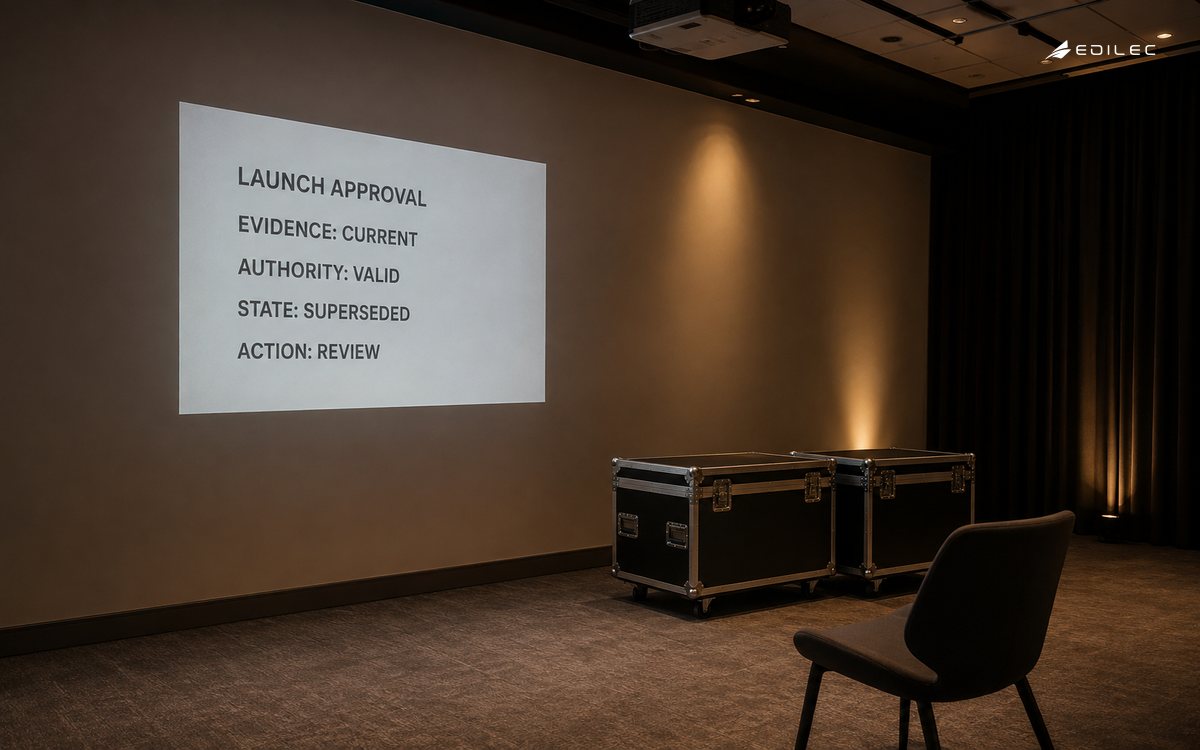
List approval types separately instead of making one universal launch gate. A reviewer who can approve a marketing claim may not be authorized to accept a security exception or discount policy. For each type, state the decision object, evidence required, monetary or risk threshold, delegate rule, expiration, and escalation. Make the request show its current state: incomplete, awaiting review, approved, rejected, expired, or superseded. A generic pending label conceals whether work is blocked by missing material or an absent decision maker. It also makes launch management depend on memory rather than a trustworthy queue.
| Planning element | Decision to make | Accountable role |
|---|---|---|
| Approval type | Define the decision and its risk or value threshold. | Policy owner |
| Required evidence | List documents, test results, and current facts. | Request owner |
| Authorized reviewer | Set role, delegation scope, and expiry. | Business owner |
| State transition | Specify approve, reject, invalidate, and escalate rules. | Workflow owner |
Design the approval workflow software operating boundary
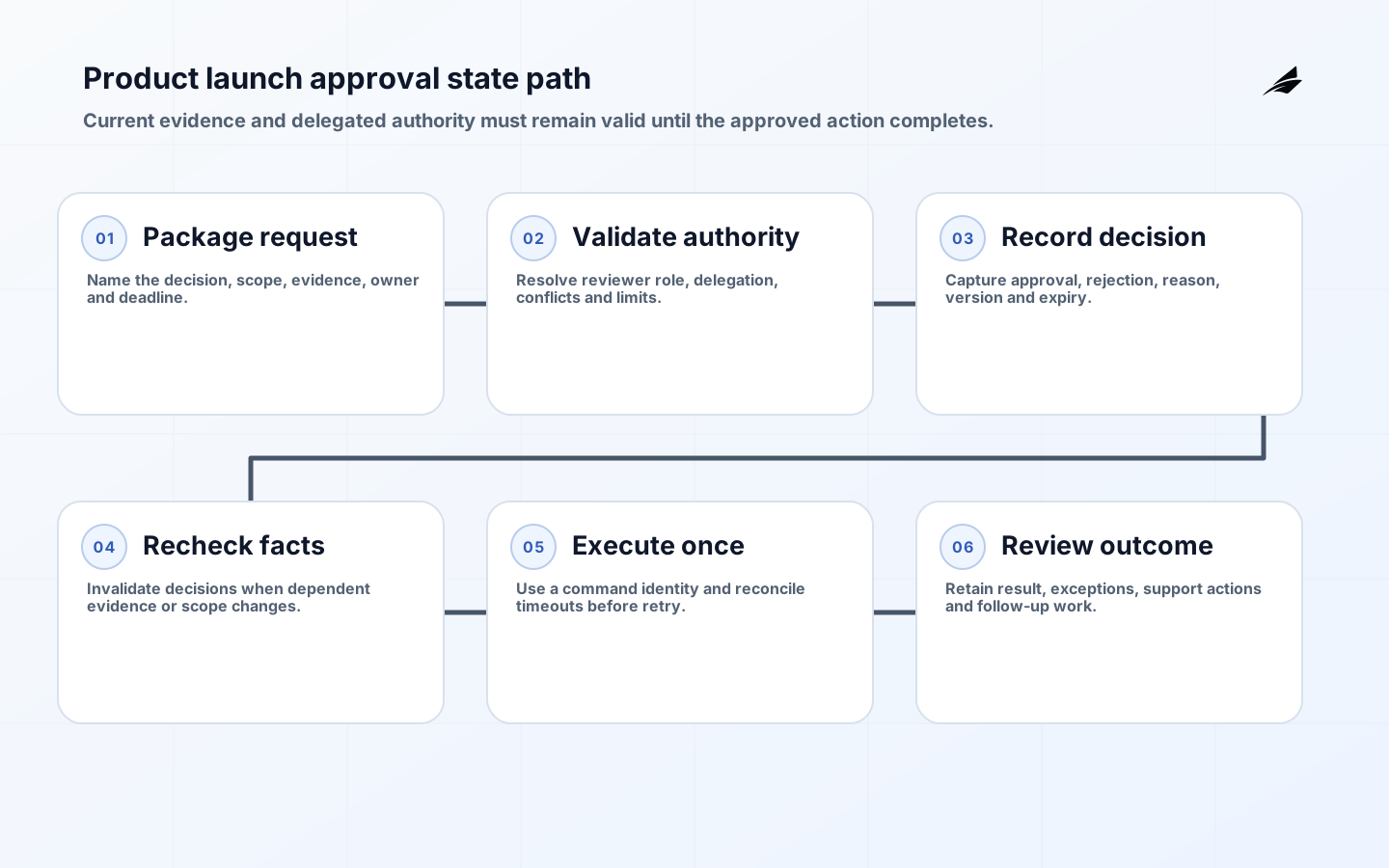
Treat the workflow as a stateful service, not a sequence of screens. The command to approve must validate the current state, reviewer relationship, evidence version, and any separation-of-duties rule at the server boundary. Retain a snapshot or reference to the facts reviewed, rather than silently attaching a later pricing sheet to an earlier approval. Where several approvals can proceed independently, model them as named decisions with their own deadlines; do not infer consent from the absence of a response. Build an explicit change path that invalidates affected approvals when material launch facts change.
Build controls and evidence
Authorization needs to be both clear and inspectable. OWASP’s ASVS is a sound reference for enforcing permissions on protected actions and recording security-relevant events. Avoid relying on a hidden button or a front-end role check. When an approval is denied, the requester should see a useful explanation without seeing confidential reviewer notes. When a reviewer delegates, preserve the original authority, the temporary delegate, scope, and expiry. A small audit trail of request creation, evidence updates, decisions, overrides, and notifications is usually more useful than a large log nobody can interpret.
| Condition | Control or test | Owner |
|---|---|---|
| Reviewer unavailable | Use time-limited delegated authority with traceability. | Escalation owner |
| Evidence changes | Invalidate dependent decisions and request review again. | Request owner |
| Deadline passes | Move to expired state; do not infer approval. | Launch manager |
| Emergency exception | Record rationale, authority, duration, and follow-up. | Executive sponsor |
Roll out with real work
Rehearse the workflow with a real launch package before making it compulsory. Simulate missing evidence, a reviewer on leave, a rejected claim, an urgent security finding, and a decision made after a deadline. Ask launch operators to find the current status, identify the blocker, and explain the next authorized action without a private message. Connect the workflow to the release calendar only after these paths work. The initial adoption goal is not every possible approval; it is a reliable path for the decisions whose failure would make launch unsafe or misleading.
Measure and improve
Watch for both control quality and delivery friction. Measure time in each state, percentage of requests returned for missing evidence, expired delegations, late material changes, manual overrides, and the rate at which approvals are invalidated correctly. A fast workflow that accepts incomplete evidence is not mature. Review exceptions after launches to see whether a rule is unclear, a reviewer queue is understaffed, or the request template does not reflect the actual decision. Adjust the process from observed work, not from the neatest diagram.
Design the request around evidence quality
The request form should make it easier to submit a complete, reviewable decision than to route around the process. Use structured fields for the facts that drive policy, validate obvious omissions early, and distinguish required evidence from useful context. Avoid forcing teams to attach a long narrative when a test result, product identifier, or approved claim reference would be more reliable. Show requesters why a field matters when that explanation improves quality. A good form reduces reviewer interpretation work and gives the launch manager a clear view of readiness without turning every decision into administrative ceremony.
Handle notifications as prompts, not proof
Notifications should direct a person to the current decision record; they should not be treated as durable evidence of approval. Include enough context to prioritize work without exposing confidential launch information in email or chat previews. Re-send or escalate based on explicit deadlines and owner rules, and make sure a changed request cannot leave an old notification looking authoritative. Track delivery failures for critical notices. In a high-tempo launch, a quiet missing notification can be more dangerous than a visible rejected request because it creates a false belief that someone else is reviewing the work.
Review launch governance after the launch
After release, compare the approved assumptions with what actually happened: which requests changed, which exceptions were used, where reviewers lacked context, and whether a late approval was a real emergency or a planning failure. Look for patterns by decision type rather than blaming an individual delay. A recurring override may show that the authority limit is wrong, the evidence arrives too late, or the workflow is serving a decision that should be delegated. Publish the resulting changes before the next launch cycle. This turns approval history into better operating policy instead of an archive consulted only during a dispute.
Set an operating cadence
Founders should also define a launch decision calendar that reflects the cost of late change. Set earlier deadlines for evidence that affects several approvals, such as pricing, claims, or security review, and preserve a narrow route for genuine emergency decisions. This prevents the approval system from becoming a ceremonial bottleneck on the final day. Reviewers need capacity signals as well as notifications; a dashboard showing requests due soon, incomplete evidence, and decisions invalidated by change lets the launch manager intervene before a deadline turns into a crisis. The workflow’s value comes from creating time for sound judgment, not from recording a hurried signature.
Practical acceptance example
Practical example: a launch team changes a subscription discount after finance approval but before public release. The pricing version changes, so the workflow invalidates the dependent finance and legal approvals while leaving a completed accessibility check intact. The launch manager can see the exact blocker, the new reviewers, and the deadline risk. Acceptance evidence includes a test showing that changed pricing triggers re-approval, an audit entry preserving the prior decision, and a successful rehearsal with a delegated reviewer. The key decision criterion is materiality: any change that alters the reviewed commitment must be visible to the authority that accepted its consequence.
Implementation checklist
- Separate launch approvals by decision type and consequence.
- Require evidence that is current and identifiable.
- Enforce reviewer authority where the approval command executes.
- Model expiration, invalidation, delegation, and rejection explicitly.
- Rehearse exceptional launch conditions before go-live.
Frequently asked questions
Should every launch decision require a formal approval? No. Formalize choices where consequence, delegated authority, or later evidence matters. Routine tasks can remain in a delivery checklist, provided the checklist does not masquerade as authorization. Over-approving creates delay and teaches teams to route around the system.
What should happen when a launch fact changes after approval? The software should identify which approvals depend on that fact, mark them superseded or invalid, and route a new decision to the appropriate authority. Do not rely on a reviewer remembering a changed attachment. A visible re-approval path is safer and easier to explain.
Run a launch-day approval drill
Before the launch window, rehearse a decision with the people who will actually request, review, execute, and support it. Use a realistic evidence package and introduce one changed fact, one unavailable reviewer, and one failed execution. Confirm that delegation is bounded, expired approvals cannot execute, rejection returns a useful reason, and a retried command does not repeat a release or notification. The drill should also show where the authoritative decision record lives and how an incident lead pauses the workflow. Treating approval software as a state machine makes these outcomes explicit: requested, awaiting evidence, approved, rejected, expired, superseded, executing, completed, and failed are materially different states, not labels for an email thread. Capture the drill's defects as owned launch work rather than informal observations.
| Drill event | Expected control | Evidence after the drill |
|---|---|---|
| Evidence changes | Dependent approval becomes superseded | New version and renewed decision |
| Reviewer unavailable | Named delegation with scope and expiry | Delegation record and acting identity |
| Execution times out | Status is reconciled before retry | Command ID and authoritative outcome |
| Launch is stopped | Authorized pause prevents new actions | Stop decision and affected cases |
| Emergency override | Reason, limit, review, and expiry are mandatory | Exception record and follow-up owner |
The approval state model should be derived from real launch work. Start with custom software discovery to identify consequential decisions, use the multi-role application checklist to define authority, and connect acceptance evidence to the quality assurance guide before the launch window begins.
Conclusion
A launch approval workflow is a compact operating system for accountable decisions. Keep authorities specific, facts versioned, exceptions visible, and evidence close to the action so speed does not quietly replace judgment.