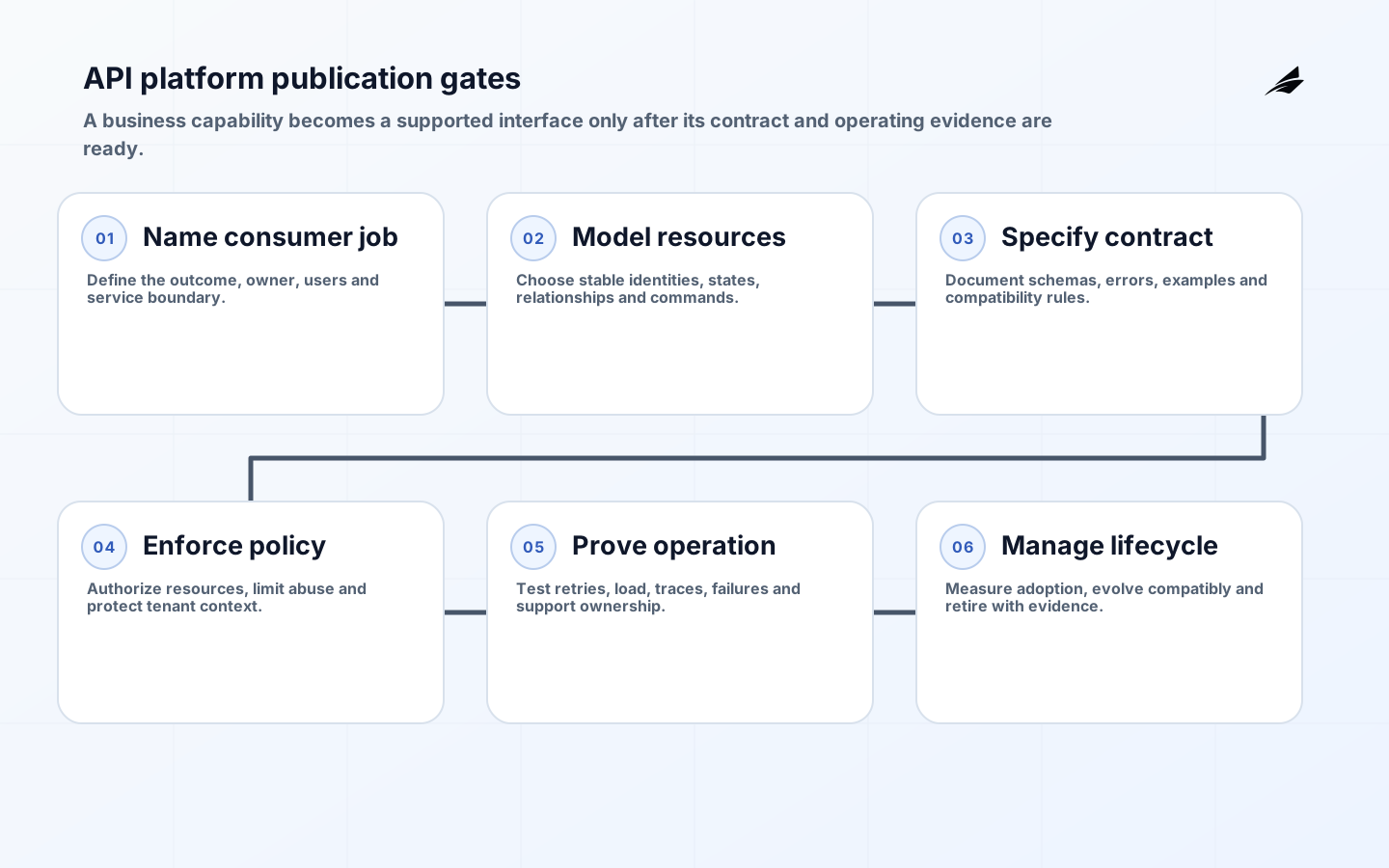
API platform design is the work of making service boundaries dependable for the people and systems that rely on them. It is not solved by putting an endpoint catalogue in front of every database table. Service businesses should begin with a consumer outcome: submit a request, obtain a reliable status, reconcile a charge, or retrieve a permitted record. The API must make that outcome understandable when the network is slow, a call is repeated, a downstream system is unavailable, or an authorization decision changes. Those conditions shape the contract more than the happy response does. Planning early lets a team decide which capabilities deserve a stable interface and which remain internal implementation details while the business process is still changing.
Key takeaways
- Design around consumer jobs and business capabilities, not database tables.
- Publish explicit contracts for inputs, outputs, failures, pagination, and compatibility.
- Authorize every request against the caller, action, resource, and relevant business context.
- Plan retries, idempotency, rate limits, and dependency failure before launch.
- Give each API a named owner, telemetry, support route, and retirement policy.
Choose product boundaries and consumers
Map the consumers before proposing a shared platform. A customer integration, a partner portal, an internal workflow, and a mobile application may all need access to the same business fact, but they differ in identity, latency expectations, and change tolerance. Group operations around a capability with a clear owner, such as quote management or service scheduling. Avoid a universal API that exposes every field simply because it is convenient for the first caller. Instead, name the permitted jobs and the data each job requires. This provides a basis for product priorities, access control, documentation, and versioning. It also creates a useful question for every new endpoint: which consumer decision does this enable, and who will maintain the contract when the underlying system changes?

| Consumer | Need | Contract concern |
|---|---|---|
| Partner system | Create and check a request | Stable identifiers, idempotency, documented limits |
| Internal application | Read current operational state | Authorization scope and freshness semantics |
| Customer portal | View own account activity | Tenant isolation and understandable errors |
| Data process | Receive change events | Ordering, replay, retention, and schema evolution |
Make contracts precise
A contract should state what a caller sends, what it receives, what can go wrong, and what remains stable over time. Use examples drawn from realistic records, including missing optional fields and rejected requests. The OpenAPI Specification is a practical format for keeping interface descriptions close to implementation and generating tests or client support. Describe pagination, filtering, sorting, dates, money, locale, and null values explicitly; these details create more integration failures than a missing resource name. Use HTTP semantics deliberately rather than inventing surprising behavior. RFC 9110 is a reliable reference for method and status-code meaning. Contract review should include a consumer who can point out whether the proposed response supports their actual decision.
Design for repetition and failure
Networks duplicate messages, time out, and deliver responses after the caller has given up. For commands that create or change a business item, define an idempotency strategy that lets a legitimate retry converge on the same result. Specify which failures may be retried, how long a request token is remembered, and how the caller learns the final state. Rate limits should protect a service without leaving an integration unable to recover. For asynchronous work, make the acceptance, processing, and outcome stages visible through a status resource or event. A clear failure model saves support time because it distinguishes an invalid request, a temporary dependency problem, an authorization denial, and a completed change whose response was lost.
| Condition | Contract behavior | Operational evidence |
|---|---|---|
| Duplicate create request | Return or locate original outcome by idempotency key | Request key and resulting resource ID |
| Dependent system unavailable | Return retryable failure or accepted pending state | Dependency name, correlation ID, retry count |
| Schema change | Add compatible field before removing old representation | Version notice and consumer adoption data |
| Limit exceeded | Return documented response with reset guidance | Caller identity, limit, and timestamp |
Apply contextual authorization
Authentication answers who presented credentials; authorization decides whether that identity may perform this action on this resource now. Plan the second decision in detail. A supplier may submit documents only for its own contract, while an employee may read a case but not alter its financial status. Enforce tenant and object checks where the data is fetched or changed, not only in a gateway configuration. The OWASP Application Security Verification Standard is helpful for reviewing access control, input handling, secrets, and audit behavior. Keep sensitive fields out of general-purpose responses when a narrower representation serves the caller. This reduces accidental exposure and makes permission reviews easier to reason about.
Operate the platform as a product
A platform needs a published ownership model: who approves a change, responds to an incident, supports a consumer, and decides when an interface can retire. Instrument latency, error class, saturation, request volume, dependency health, and consumer-specific failures. Use a correlation ID that a support person can request from a caller. The OpenTelemetry Specification provides shared telemetry concepts that reduce translation between teams. Track contract adoption before removing an older representation, and offer a migration window that matches the business impact. Documentation is part of operations: it should tell consumers how to authenticate, recover, test safely, and contact the responsible team.
Run an API platform readiness review
Review the proposed interface with at least one real consumer before treating the contract as stable. Ask that consumer to implement the happy path, an invalid request, a retry after a timeout, a paginated read, and a permission denial using only the published material. Their questions will often reveal missing field semantics, error information, or operational guidance that the owning team has internalized. Include an operations representative who can assess whether the planned telemetry identifies a particular caller and downstream dependency without exposing sensitive payloads. Agree how compatibility decisions are made and where consumers receive advance notice. This review is not an approval gate for its own sake; it is a low-cost way to discover whether a contract is a usable product or merely an internal representation with a URL.
| Readiness area | Question to answer | Concrete evidence |
|---|---|---|
| Consumer fit | Does the resource support a real caller decision? | Consumer scenario reviewed with representative request and response |
| Naming | Are operations and fields understandable outside the owning team? | Glossary, examples, and explicit units or date semantics |
| Validation | What inputs are rejected before work begins? | Negative examples, field constraints, and error response contract |
| Repeatability | Can a client retry a timed-out command safely? | Idempotency rule, retention period, and duplicate test |
| Limits | How are expensive or abusive requests contained? | Documented quotas, pagination, and overload response |
| Security | What identity, resource, and context checks are required? | Authorization matrix and tests for guessed identifiers |
| Observability | Can a support person follow one failing call? | Correlation propagation, error classes, and safe diagnostic access |
| Compatibility | Which changes are additive and which require migration? | Deprecation policy and consumer inventory |
| Availability | What should a caller do during dependency disruption? | Retry guidance, timeout behaviour, and pending-state design |
| Documentation | Can a new consumer integrate without private knowledge? | Authentication guide, sandbox rules, and working examples |
| Ownership | Who approves changes and receives incident pages? | Named service owner, support channel, and escalation process |
| Retirement | How will unused operations be removed safely? | Usage measurement, notice period, and migration confirmation |
Verify and evolve
Verification should exercise the contract from both sides. Run schema checks, authorization tests, negative cases, load tests for critical paths, and compatibility checks against representative consumers. Maintain a sandbox or controlled test environment only if its behavior is close enough to catch meaningful integration problems. Apply NIST SSDF practices to protect the build, review dependencies, and retain evidence of verification. Release one capability with a measured consumer cohort, then examine support contacts and telemetry before expanding. API platform design succeeds when change becomes more predictable for consumers, not when the endpoint count grows.
Frequently asked questions
Does an API gateway solve API governance?
No. A gateway can help with routing, authentication, limits, and common policy, but it cannot decide service ownership, data meaning, consumer suitability, or compatibility. Governance still needs clear contracts, review, lifecycle decisions, and accountable teams.
When should an API use a new version?
Use a new version when a necessary change cannot be made compatibly for existing consumers. Prefer additive evolution where possible, communicate the migration with examples, measure adoption, and retire the old behavior only after the agreed transition window and risk review.
Use a consumer scorecard before platform expansion
A platform should not add a new API simply because a service can expose one. Review the proposed interface against a consumer scorecard: Is the business capability stable? Can a consumer understand the resource and error semantics without internal knowledge? Is the action safe to retry, or does it support an explicit idempotency mechanism? Are authorization and tenant context enforced at the resource boundary? Can operators trace a request across dependencies? The OpenAPI specification can describe operations and schemas, while RFC 9110 defines HTTP semantics such as safe and idempotent methods. Neither decides whether the business contract is durable. That decision belongs to the owning team and should be recorded before publication.
| Scorecard dimension | Evidence | Do not publish when |
|---|---|---|
| Capability boundary | Named owner and stable business meaning | The endpoint mirrors a temporary database shape |
| Contract clarity | Examples, errors, constraints, and compatibility tests | Consumers need undocumented conventions |
| Retry safety | Method semantics or idempotency-key behavior | A timeout can duplicate a material action |
| Security | Resource-level authorization and abuse limits | Trust depends on a client-supplied role |
| Operations | Service objective, traces, and support route | Failures cannot be attributed or reconciled |
Platform review benefits from decisions already made elsewhere in delivery. The custom software discovery guide helps establish the consumer job, the workflow-first application guide identifies the business states the contract must preserve, and the web performance planning guide connects API latency and reliability to the actual user journey.
Conclusion
Thoughtful API platform design makes business capabilities usable without exposing every internal decision. Start with a consumer job, create a precise and secure contract, plan for the unreliable network, and operate each interface as a maintained product. That foundation supports integrations that can evolve without constant surprise.