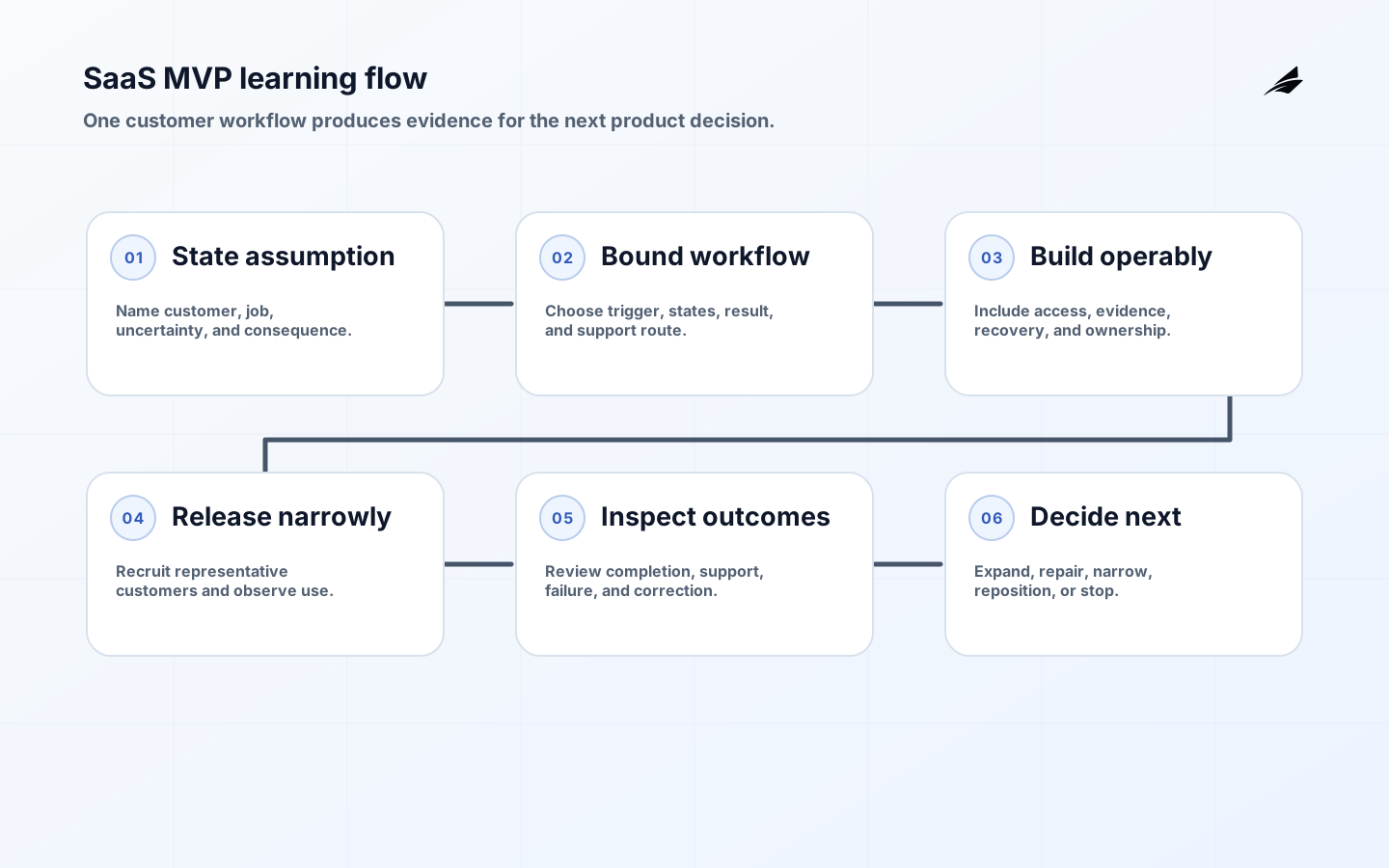
SaaS MVP planning is not a feature checklist. For founders, it is a way to make one valuable customer workflow that can be delivered, supported, and learned from. Start with the real case: a customer attempts the core job in the first release, not the interface a team hopes to build. Follow one representative case from its trigger through its durable records, permissions, automated decisions, human handoffs, and customer-visible result. This exposes the questions that decide whether a release is operable: who owns the decision, which record is authoritative, what evidence is retained, and how a person recovers when the ordinary route fails. The guide focuses on those choices so the work can survive launch pressure instead of becoming an attractive but ambiguous workflow.
Define the SaaS MVP planning operating boundary
A useful boundary starts by naming target customer, job, workflow state, assumption, release criterion, and support case. Those are not merely data fields; together they explain why the system took an action and who can correct it. Write down the initiating event as a customer attempts the core job in the first release. Then test the model with a normal case, a late or duplicate event, a request from an unauthorized actor, and a case that requires support intervention. The difficult example is often the one that reveals a missing state or unclear owner. Do not delegate this work solely to an implementation ticket. Product, engineering, support, finance where relevant, and security need the same vocabulary before their work can fit together.
| Boundary question | Decision to make | Evidence before release |
|---|---|---|
| Outcome | What completed result proves value? | one valuable customer workflow that can be delivered, supported, and learned from |
| Authoritative record | Which data settles a disagreement? | target customer, job, workflow state, assumption, release criterion, and support case |
| Decision right | Who may approve, override, or reverse? | Named role and reviewed policy |
| Failure route | What happens when the normal path breaks? | a broad feature list ships without a usable happy path, exception path, or way to learn |
Design decisions before interfaces
Treat the workflow as a sequence of decisions, not a sequence of screens. For SaaS MVP Planning, each transition should have a triggering fact, a permitted actor, a visible state, and a consequence that can be checked later. Put policy in one reviewable place rather than scattering it among browser conditions, background jobs, and operator memory. Where an integration participates, preserve its event identifier and ordering information; retries without idempotency can quietly produce a second grant, charge, report, or message. The design should also distinguish customer action from staff action. Support may need limited tools, but broad impersonation or unlogged edits destroy the evidence needed to resolve a dispute.

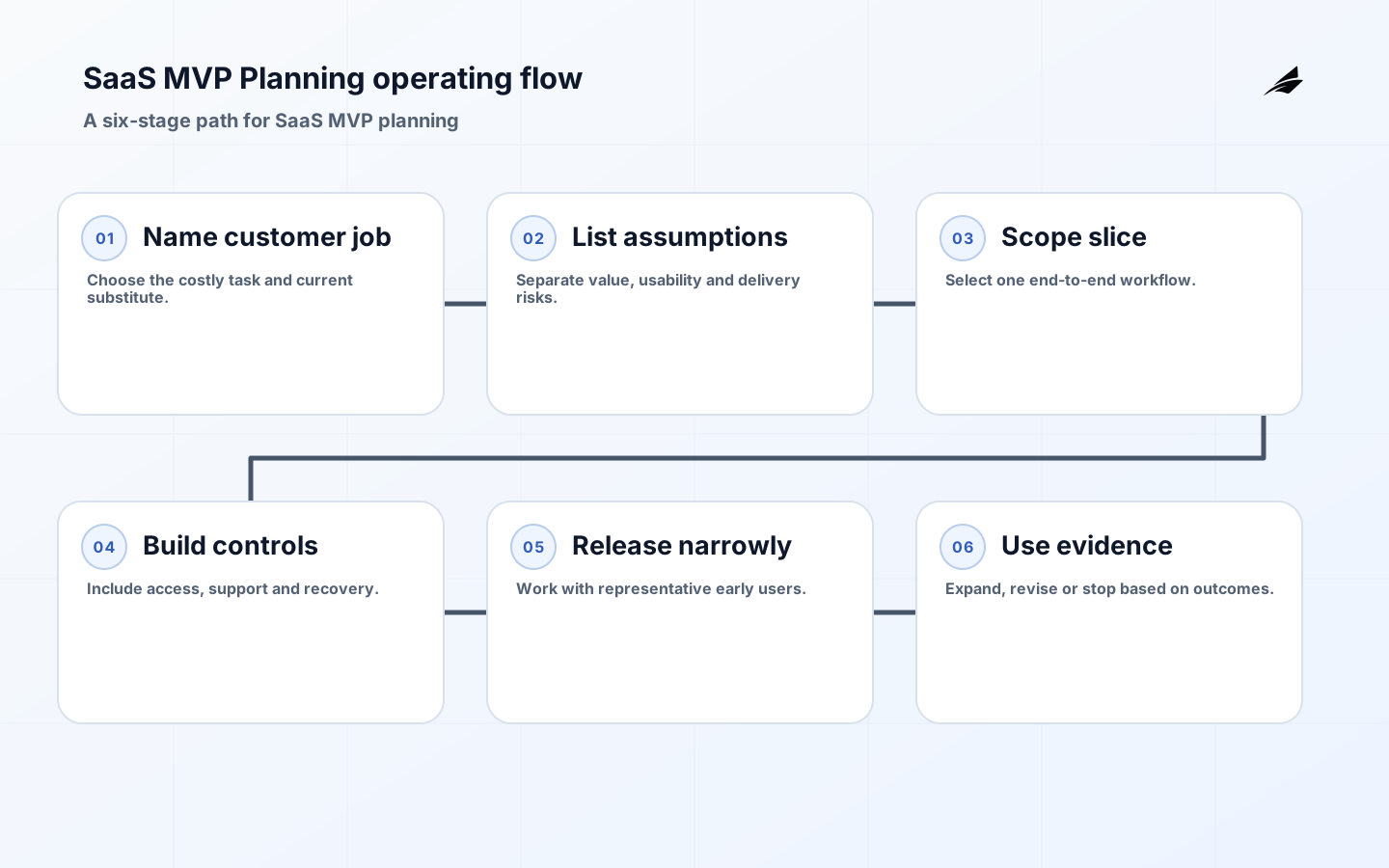
- Describe the smallest complete path from a customer attempts the core job in the first release to one valuable customer workflow that can be delivered, supported, and learned from.
- Give every state a plain-language definition and an accountable owner.
- Record why an override is allowed, who may apply it, and how it is reviewed.
- Keep identifiers that connect the customer view, service logs, and downstream record.
- Make failed work visible in a queue instead of silently retrying indefinitely.
- Design the recovery message so a customer or operator knows the next safe action.
Build SaaS MVP planning controls into delivery
Security, accessibility, and reliability are part of the customer experience here. An authorization decision should be evaluated at the point an action is requested, with tenant or account context carried through services and jobs rather than inferred from a convenient client value. Logging should capture an actor, target, action, decision, and correlation reference without dumping sensitive payloads. For customer-facing steps, keyboard operation, labels, focus management, error identification, and understandable status changes are release criteria, not polish. Finally, exercise recovery in a non-production environment: restore the expected state after a malformed event, temporary dependency failure, revoked access, and staff correction. The resulting runbook is evidence that the design can be operated. For SaaS MVP Planning: A Practical Guide for Founders, the controls must protect the particular outcome this workflow promises, rather than serve as a generic delivery checklist.
| Control area | Practical question | Release check |
|---|---|---|
| Authorization | Can a valid actor cross the intended boundary? | Negative tests cover role, tenant, object, and action |
| Integrity | Can retries or out-of-order messages duplicate work? | Idempotency and ordering cases are exercised |
| Accessibility | Can people complete and understand the workflow? | Keyboard and error paths are reviewed |
| Operations | Can the team locate and repair a failed case? | Runbook, alert owner, and audit trail are tested |
Review a real operating case
An MVP scope is strongest when a founder can narrate a customer day without skipping the awkward parts. Pick a real starting condition, the first action, the data required, the moment value becomes visible, and the situation that causes the customer to ask for help. A concierge step is acceptable when it teaches the team something that software cannot yet prove, but it needs an owner and a stop condition. Do not automate a vague policy simply to make the prototype look complete. Instead, use the early release to learn which exceptions recur, which information customers can provide reliably, and which outcome makes them return. That learning is the asset that justifies the next engineering investment.
Measure the outcome, not activity
Instrument the behavior that would change the next product decision. For this guide, a central measure is number of representative customers who reach the promised outcome without assisted workarounds. Pair it with a quality measure such as failed transitions, support-assisted completions, policy denials, reconciliation adjustments, or time spent in an exception queue. Segment results by the customer, plan, entry route, or tenant type that matters to the decision; a blended average can hide a damaging failure for a valuable group. Review a small set of representative records alongside the dashboard. Quantitative signals say where to look, while the underlying case reveals whether the model, interface, integration, or operating procedure needs attention.
Establish an MVP learning review
Schedule an MVP learning review while the workflow is still small enough to inspect. Bring a handful of completed records, one failure or near miss, and the measure that shows whether the intended result is improving. For SaaS MVP planning, examine customer outcomes, manual workarounds, and unresolved assumptions. Ask whether the policy was understood at the point of action, whether the durable record matches what the customer saw, and whether recovery required an undocumented workaround. The purpose is not status theater. It is to give founders, design, and engineering teams a regular place to resolve ambiguity before it becomes an irreversible product promise. Write down the decision, owner, and next observation so the next review begins with evidence rather than recollection.
Write the MVP learning contract before the backlog
An MVP learning contract states the riskiest assumption, the smallest representative customer group, the behavior that would support or challenge the assumption, the observation window, and the decision that follows. For example: 'Independent service firms can invite a technician, schedule one job, record parts used, and issue a customer summary without founder assistance; if five of eight representative firms complete the path twice within fourteen days, expand onboarding, otherwise repair the dominant failure before adding modules.' This is stronger than a launch date because it tells the team what evidence matters and prevents unrelated feature requests from redefining success.
Attach operability criteria to the same contract. A customer outcome does not count if staff repaired hidden records, bypassed permissions, manually triggered background work, or cannot explain a charge. Record support touches, failed transitions, time to recovery, accessibility blockers, and the age of unresolved exceptions beside activation. NIST's Secure Software Development Framework places secure practices throughout the lifecycle, and the Cybersecurity Framework helps assign governance and recovery outcomes. Use the OWASP Application Security Verification Standard to make security checks testable, WCAG 2.2 to define accessible interaction, and Google's Site Reliability Engineering guidance to plan service objectives and operational response. An MVP is not exempt because its feature set is small. A founder can reduce scope while retaining a credible operating path. That is the foundation of Edilec's SaaS product engineering, not a promise to finish quality later.
Key takeaways for SaaS MVP planning
- Scope the release around one accountable outcome: one valuable customer workflow that can be delivered, supported, and learned from.
- Model target customer, job, workflow state, assumption, release criterion, and support case before selecting screens or integrations.
- Test the failure that matters most: a broad feature list ships without a usable happy path, exception path, or way to learn.
- Treat access, auditability, accessibility, and recovery as product requirements.
- Use number of representative customers who reach the promised outcome without assisted workarounds to decide whether to expand the workflow.
Frequently asked questions
How much should the first release automate? Automate only the portion of a customer attempts the core job in the first release whose inputs, policy, and correction path are understood; route ambiguous or consequential cases to a named reviewer. Is a dashboard enough to prove progress? No. The team needs traceable records and sampled cases showing that the measured outcome is genuine. When should the scope grow? Add adjacent paths after the core route reaches one valuable customer workflow that can be delivered, supported, and learned from reliably and the support team can explain exceptions. What should be documented? State definitions, decision rights, integration contracts, access rules, recovery steps, and the metric review cadence. That compact operational record is more valuable than a broad promise of future capability.
Conclusion
SaaS MVP Planning becomes dependable when the service can explain its own behavior. Define the boundary, make decisions and records explicit, build controls into the normal path, and use operating evidence to decide what changes next. That discipline gives founders a smaller but more useful release: one that can produce one valuable customer workflow that can be delivered, supported, and learned from, surface its exceptions, and improve without losing the trust of the people who depend on it.