Scaling product operations should be planned as an operating promise, not a late implementation detail. It determines how cross-functional delivery work moves through people, systems, and customer-facing consequences. Before building, the product operations owner should follow one ordinary case and one difficult case from trigger to verified outcome. Ask what creates a customer-impacting operating request, which system can change its meaning, who can explain the result, and how a customer can challenge it. That walk-through makes state changes, approvals, delayed data, and manual handoffs visible. It also exposes why a polished interface can fail operationally. A durable SaaS service starts by choosing an accountable result and arranging product, engineering, support, and governance around that result. This guide makes scaling product operations concrete enough to deliver, recover, and improve.
Define the scaling product operations decision model
Write the operating promise in one testable sentence: an authorized person or service can complete a defined outcome involving cross-functional delivery work, while its purpose, authority, and result remain understandable. The decisive planning question is which requests need a standard route, an exception owner, or a product change. Name the customer-visible result, accountable owner, initiating trigger, required context, and stopping condition. Collect a routine request, a delayed request, a disputed request, and a request handled outside the intended system. Those examples show where policy changes, where records become stale, and where an exception needs an explicit owner. A narrow first release is useful when it preserves a complete decision path. A partial route that forces an invisible handoff at the final step transfers risk to the team and customer.

| Question | Decision to record | Evidence at release |
|---|---|---|
| What is the outcome? | A specific customer or operator result. | Completed example with start and end state. |
| Who is accountable? | One policy owner and one service owner. | Named escalation and review cadence. |
| What changes state? | Trusted trigger, inputs, and preconditions. | Tests for accepted and rejected paths. |
| How is it explained? | Plain-language explanation and correction route. | Readable record linked to decision. |
Map actors, states, and handoffs
Build a small state map before selecting architecture. For scaling product operations, list the initiator, accountable owner, automated service, reviewer, support role, and person who experiences the outcome. At each transition write the current state, permitted next state, input that authorizes it, and record it should leave behind. Teams often model success and treat retries, reversals, expiry, and correction as technical trivia. They also assume an internal role needs broad access when a scoped view would be safer. Distinguish observation from authority: someone may inspect a case without changing it, and a job may suggest work without final approval. The map should be legible to product, finance, support, and engineering because disagreements here are substantive delivery choices.
Model trusted data and boundaries
Treat every value affecting cross-functional delivery work as a claim with an origin, effective time, and owner. Decide which service is authoritative, which representations are derived, and how a late or corrected value propagates. The model must answer an investigation plainly: what did the service know at decision time, what has changed since, and why? Include stable references for account, workspace or tenant, actor, correlation, policy version, and source event. Avoid collecting context merely because it may become useful; retain what fulfills the operating promise or supports investigation. This discipline directly prevents a growing queue is handled through memory, private messages, and contradictory priorities. It also makes integrations safer because contracts describe meaning, not just fields. Version important changes and decide how older records remain interpretable.
Design controls and a usable experience
Controls succeed when people can use them under ordinary pressure. Design the scaling product operations workflow so someone can see relevant context, the allowed action, the likely consequence, and a recovery path before a consequential choice. Separate routine actions from those needing approval, a second look, or delayed effect. Require a reason only when it supports a later explanation; a free-form note is not a policy decision. Accessible labels, clear status, keyboard-operable controls, and messages that describe the next action improve inclusion and operational accuracy together. For automated decisions, retain the rule version, inputs that mattered, output, and whether a human reviewed it. A notification is not evidence. The record must survive handoffs and make sense to an authorized colleague days later.
| Path | Minimum control | Recovery design |
|---|---|---|
| Routine completion | Authenticated actor, validated input, idempotent command. | Show outcome and correlation reference. |
| Denied request | Explain unmet precondition without exposing protected data. | Offer a permitted next step or escalation. |
| Delayed dependency | Preserve pending state and expected owner. | Retry safely and show wait age. |
| Correction | Limit amendments and capture a reason. | Keep before and after state with review link. |
Make delivery testable before launch
A delivery plan for scaling product operations needs more than a backlog. Describe normal, denied, duplicate, dependency-failure, and correction paths as observable scenarios. For each, state the input, expected state change, visible message, evidence produced, and owner of the next action. Test realistic account and permission combinations rather than an all-powerful internal account. Include late arrivals, expiring approvals, retries after timeouts, and records corrected after customers have seen them. These cases expose hidden coupling between interface, data, and policy. They give engineering and operations practical acceptance criteria. Launch readiness means the team can demonstrate a happy outcome, how it avoids worsening a bad state, how it tells people what happened, and how it returns to a known state.
Prepare operations and recovery
Operations begins when a customer depends on the result, not when traffic reaches a particular number. Give the product operations owner a concise runbook with signals, likely failure modes, ownership boundaries, and safe actions. Decide which incidents require a pause, which can be retried, and which need customer communication or a commercial adjustment. Make idempotency and replay behavior explicit for changes repeated by a browser, queue, person, or vendor. Put correlation references where support can find them without broad production access. Review privileges for actions that expose data, alter entitlement, or affect money. The objective is a calm response: stabilize the service, identify affected accounts, preserve evidence, and communicate a resolution without inventing process during an incident.
Measure outcomes, not activity
Choose measurements that help make a decision rather than decorate a dashboard. Start with queue age, handoff delay, reopened work, and verified resolution. Define each metric in plain language, including numerator, denominator, time window, exclusions, source system, and owner. Segment only when comparison leads to action, such as release cohort, plan, tenant size, or route. Volume alone can be healthy or alarming depending on whether it represents customer value, retries, or failure; pair it with completion and quality. Instrument modeled state transitions, then test that aggregations retain meaning when an account is retried, merged, paused, or corrected. Annotate material releases and policy changes. Historical context prevents future teams from mistaking altered instrumentation for a sudden change in customer behavior.
Use the six-stage scaling product operations flow
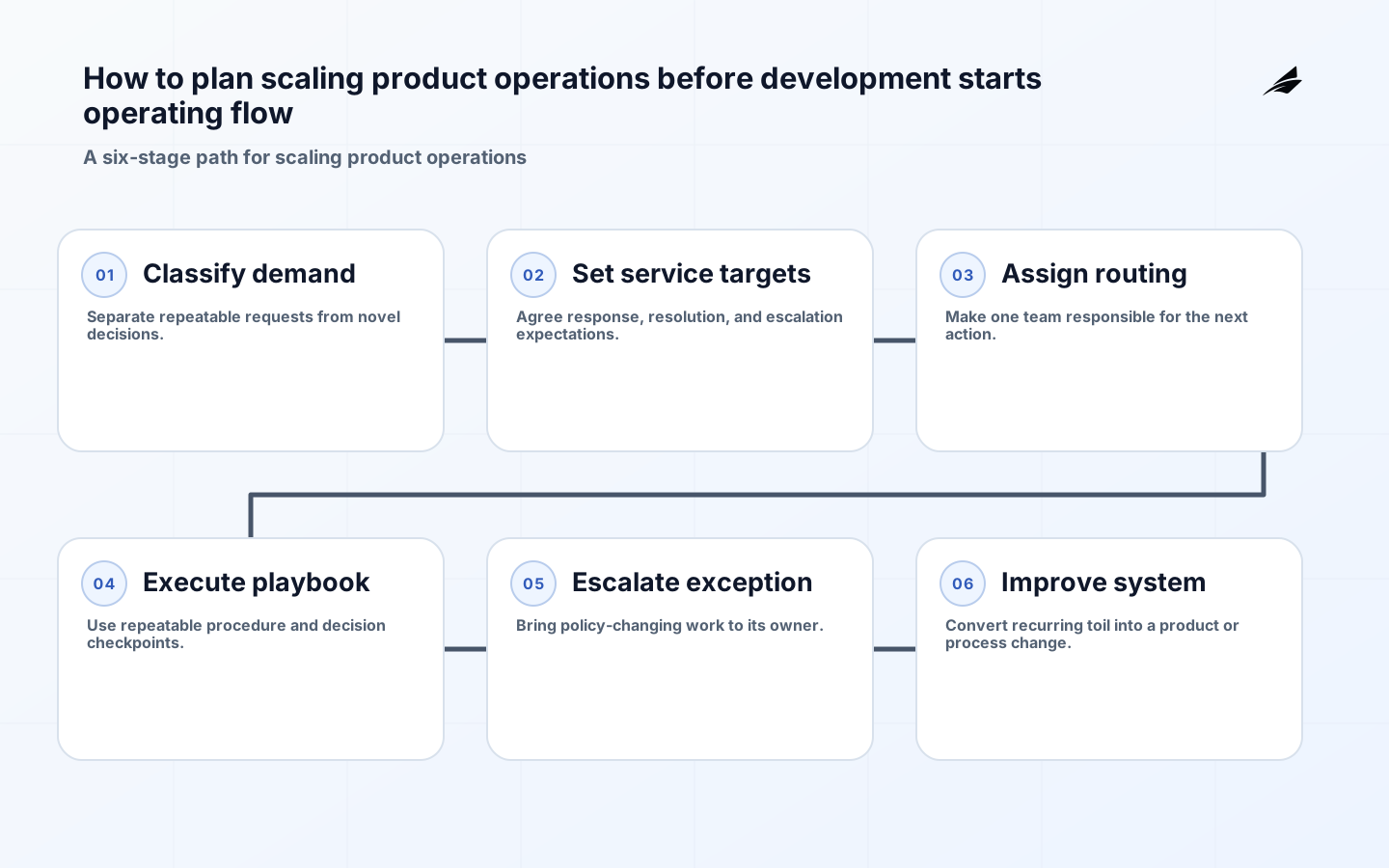
For scaling product operations, use the local diagram as a case-review tool rather than a presentation asset. Trace a real cross-functional delivery work case from its first signal through each of the six stages with product, engineering, support, and governance present. At every point ask what is known, who may act, which condition stops the flow, and what evidence remains for a later investigation. A dependency on a private message, undocumented query, or one particular person is a delivery risk worth recording. The exercise often identifies a smaller, more honest first release: it may defer a variation, but it does not hide the operational work that variation will eventually require. Repeat the review after early customer use and after any integration or policy changes the decision.
Key takeaways
- Define scaling product operations as an accountable result rather than interface tasks.
- Model authority, timing, state, and evidence before integration details.
- Test denied, delayed, duplicate, and correction routes with the normal path.
- Give operations scoped access, safe actions, and useful correlation evidence.
- Measure completion and quality so the next decision has a factual basis.
Frequently asked questions
How narrow should the first scaling product operations release be?
Scope the first scaling product operations release around one complete result involving cross-functional delivery work. The target user should be able to begin, understand progress, finish or receive a clear denial, and reach an appropriate correction route without staff silently completing the final step. Postpone variations that do not change authority, customer safety, or the meaning of the decision. For each deferred variation, name its owner and the evidence needed to decide whether it deserves product work. This protects the release from turning into a vague collection of exceptions while still treating those exceptions as real operating needs.
What evidence should the system retain?
Evidence for scaling product operations should let an authorized reviewer reconstruct how cross-functional delivery work reached its result. Keep stable account or workspace references, actor or service identity, time, source, relevant rule version, outcome, and a correlation reference. Retain sensitive values only when they are necessary for an obligation or investigation, and scope access to people with a specific operating reason. The purpose is not exhaustive surveillance. It is a reliable explanation that supports a customer question, a safe correction, and a better next version of the workflow.
Conclusion
Strong scaling product operations begins with an operating commitment. Define the outcome, authority, state transitions, evidence, recovery, and measures before asking engineering to optimize implementation. That sequence gives a SaaS team more than a feature specification: it creates a shared model for delivering a result, explaining it when challenged, and improving it as customer reality arrives. Build the smallest complete route, observe it carefully, and let recurring exceptions guide the next investment.