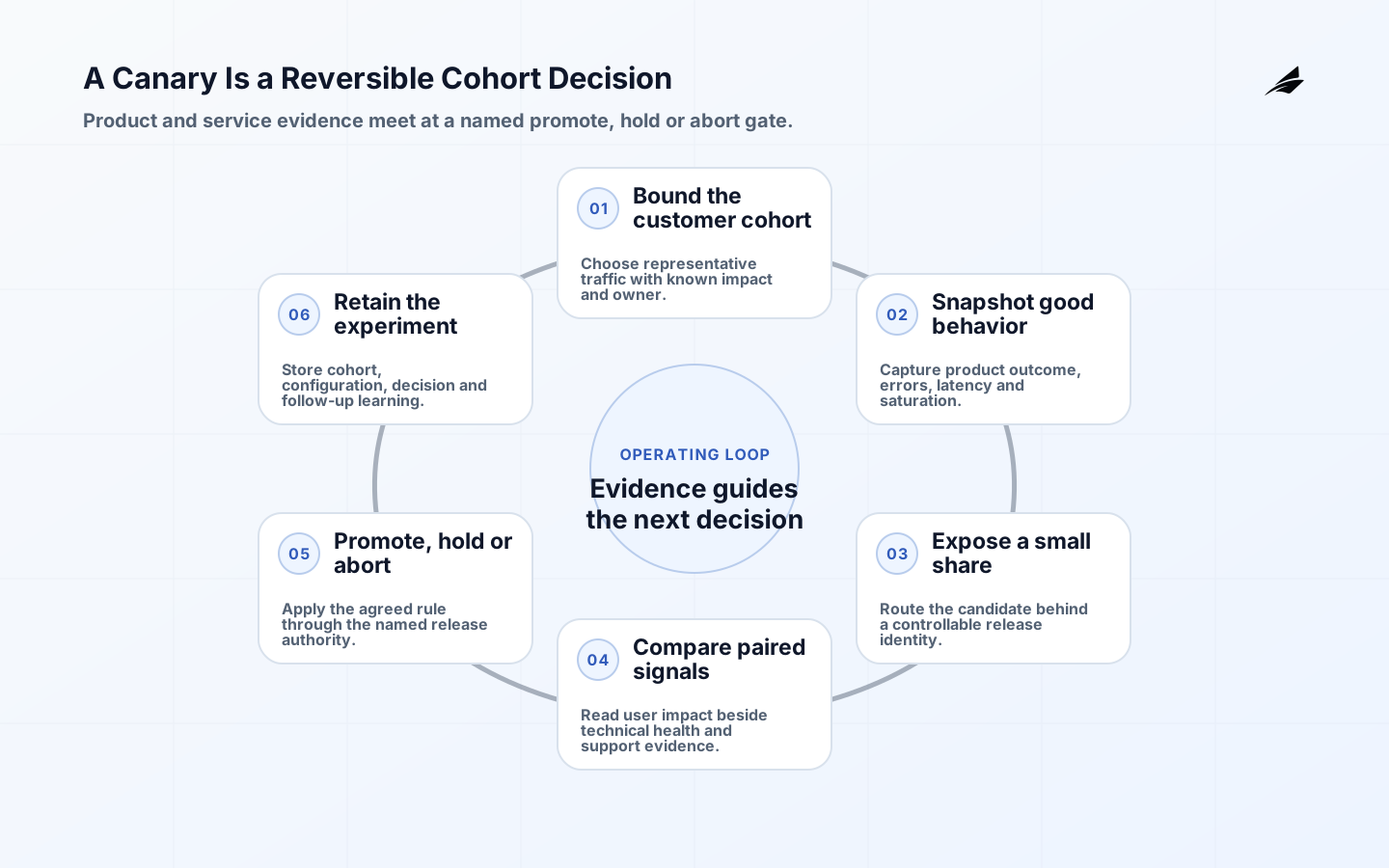
A canary release lets a product team learn from a bounded group of users before exposing a change to everyone. The technique is valuable because it connects release decisions to customer behavior, service health, and the team's ability to reverse or contain the change. It is not a guarantee that a defect will be found early. A poorly chosen cohort, weak baseline, hidden dependency, or unclear promotion rule can turn a small release into a confusing experiment. Product teams should decide what they are learning, who is exposed, how success is judged, and what happens when the evidence is mixed.
Choose the cohort for the question
A cohort should represent the decision the team needs to make. If the change affects a particular plan, device, region, workflow, or permission, include users who exercise that path. Keep the first group small enough to contain harm but large and active enough to generate meaningful behavior. Avoid selecting only friendly internal users when the risk concerns ordinary customers. Record inclusion and exclusion rules, the feature state, and the owner who can stop exposure. A cohort is a product boundary, so customer communication, support readiness, privacy, and fairness matter alongside technical controls.
Establish a useful baseline
Before exposure, describe the current experience for the same journey and cohort. Capture conversion or completion, latency, errors, support contacts, and any domain-specific measure that shows whether the feature helps. Account for seasonality, traffic mix, and unrelated launches. A canary comparison is stronger when the control group and treatment group are measured consistently, but the design should remain understandable to the people making the promotion call. Define the observation window and the minimum evidence needed to continue. Do not declare success because a dashboard is green if the target customer action has not been attempted.

Use feature flags with discipline
Feature flags provide control over exposure, but they also create state that must be owned. Give each flag a purpose, default behavior, audience rule, expiry condition, and removal owner. Keep sensitive or irreversible actions behind a flag only when the underlying code can safely handle both states. Test evaluation failure, stale configuration, cache delay, and a flag service outage. A flag that cannot be switched quickly or whose targeting is not observable is a weak recovery control. The team should know what users see when the flag is unavailable and how to restore a previous experience without editing production code.
| Decision | Working rule | Evidence |
|---|---|---|
| Purpose | Define a bounded customer cohort. | Owner and scope. |
| Dependencies | Expose feature, service, data, and flag state. | Versioned change record. |
| Authority | Name the person who can pause promotion. | Decision log. |
| Recovery | Test reversal and customer verification. | Runbook and exercise. |
Define promotion and reversal signals
Agree the signals before the first user is exposed. Product measures can include completion, adoption, task time, quality, retention, or support contacts. Service measures can include errors, latency, saturation, queue depth, and dependency failures. Set a rule for clear degradation, but also define what happens when product and service signals disagree. A feature may improve completion while increasing load, or remain technically healthy while confusing customers. Assign a decision owner and a pause authority. Promotion should be a deliberate choice based on the agreed window, not the default result of waiting.
Include support and accessibility signals
Product outcomes are broader than clicks and completions. Ask support whether customers are confused, whether a new path creates more handoffs, and whether reports cluster around a device, language, accessibility mode, plan, or region. Check that the cohort selection does not exclude users whose experience carries a different risk. A canary that improves the average while degrading a smaller group needs investigation before expansion. Give support a way to identify treatment state and report the issue without asking customers to repeat sensitive details.
Distinguish product learning from noise
A canary result can be distorted by a holiday, a campaign, a pricing change, a concurrent release, or a change in instrumentation. Record those factors with the cohort and do not force a binary conclusion when the evidence is inconclusive. Extend the observation window, narrow the question, or run a second controlled step when that will resolve the uncertainty. When the result is clearly harmful, reverse exposure promptly and preserve the learning. When it is positive, confirm that the benefit survives a broader audience before making the experience permanent.
Protect trust during experimentation
A product team should know whether the canary changes consent, pricing, eligibility, safety, or access to a core function. Avoid exposing a vulnerable group to a known uncertain behavior merely because it is easy to target. Keep personal data out of cohort definitions unless it is necessary and permitted, and explain the treatment to support and privacy owners. If the experience is materially different, make the decision and customer impact easy to trace. Responsible experimentation protects the people who provide the evidence and gives the team a stronger basis for deciding whether the change belongs in the general experience.
- Select users who exercise the actual risk or value proposition.
- Record the control experience, treatment state, and observation window.
- Measure customer outcomes beside service and dependency health.
- Give the team a fast way to pause exposure and explain the change.
- Remove temporary flags and record the learning after promotion or reversal.
Expand exposure in deliberate steps
Move from the initial cohort to broader groups only when the evidence answers the original question. Keep the release identity and flag configuration tied to each step. Watch for changes in usage mix, geography, device, plan, and support volume as exposure grows. A result from early adopters may not predict the experience of customers with different workflows. Pause between steps long enough to observe delayed effects such as asynchronous jobs, billing, exports, or notifications. Each expansion should have a named approver and a clear point at which the team will stop for investigation.
Prepare a customer-aware reversal
Reversal may restore the interface without undoing an action already taken. Identify what the feature writes, sends, charges, schedules, or changes. Make those effects idempotent where possible and define reconciliation for the cases that are not. If a customer has seen a new workflow, support may need a clear explanation when it disappears. Preserve the treatment and control context so the team can identify affected users. The blue-green deployment guide is useful when a canary change also requires a broader environment cutover.
Turn results into product learning
After promotion or reversal, record the hypothesis, cohort, comparison, unexpected behavior, decision, and follow-up. Separate an outcome caused by the feature from a change in traffic, instrumentation, pricing, or support practice. Retain the reason for accepting a trade-off when the result is not uniformly positive. Remove obsolete flags and simplify the user experience once the decision is settled. A useful learning record is short enough to read and specific enough to guide the next release. It also helps new team members understand why a control exists before they change it.
Include the decision owner, exposure duration, and the evidence that was considered insufficient or decisive. Note whether the result applies only to the tested audience or to a broader product promise. This distinction prevents a successful narrow experiment from being treated as proof for every customer and preserves the question that the next release still needs to answer.
Keep the experiment legible after the flag is removed. Record the final audience, the comparison period, the customer and service measures, and the reason for the decision. That context helps a later team distinguish a settled product choice from an unfinished rollout and avoids rebuilding a control simply because its history was lost.
Use explicit canary promotion rules
A canary release needs a representative cohort, a trustworthy comparison, a stop rule, and an owner who can act. Without those decisions, gradual exposure merely delays discovery of the same uncontrolled failure.
| Canary decision | Evidence to inspect | Promotion rule |
|---|---|---|
| Cohort | Tenant, user, region, device, workload shape, data sensitivity, and support coverage. | Choose a bounded cohort that can reveal the intended risk without concentrating harm. |
| Comparison | Baseline version, traffic mix, errors, latency, saturation, and customer outcome. | Compare like with like and label important differences in exposure. |
| Stop rule | Threshold, observation window, minimum evidence, rollback action, and decision owner. | Pause automatically or manually when a defined safety condition is breached. |
| Promotion | Stable signals, unresolved exceptions, support feedback, capacity, and next exposure step. | Expand deliberately and preserve the ability to reverse each material step. |
Key takeaways
- Choose a cohort that matches the product question and risk.
- Compare customer outcomes with service and dependency signals.
- Give feature flags owners, defaults, targeting rules, and expiry.
- Expand exposure only after the agreed evidence is available.
- Plan for side effects, support, and reconciliation before reversal.
Frequently asked questions
How large should a canary cohort be?
It should be small enough to contain harm and active enough to answer the decision question. The right size depends on traffic, risk, latency of the outcome, and how narrowly the audience can be defined.
Which signals should product teams watch?
Pair a customer outcome such as completion or quality with service health such as errors, latency, saturation, or dependency failures. Neither view is sufficient alone.
When should a feature flag be removed?
Remove it after the exposure decision is settled, the fallback path is no longer needed, and affected data and support flows have been checked. Keep a replacement control only when it has a current owner and purpose.
For implementation context, consult Kubernetes documentation and Google SRE Book; these references help teams verify platform behavior and operating controls against maintained primary guidance. For adjacent decisions, continue with Edilec's How IT Managers Should Think About Platform Engineering and Docker Images: Build, Secure, and Promote Trusted Artifacts.
Conclusion
Canary releases help product teams make better decisions when exposure is bounded and learning is intentional. Choose the right cohort, establish a credible comparison, pair customer outcomes with service signals, and prepare a reversal that accounts for side effects. Promotion then becomes an evidence-based product decision, while a pause or rollback becomes a practiced response rather than an improvised reaction.