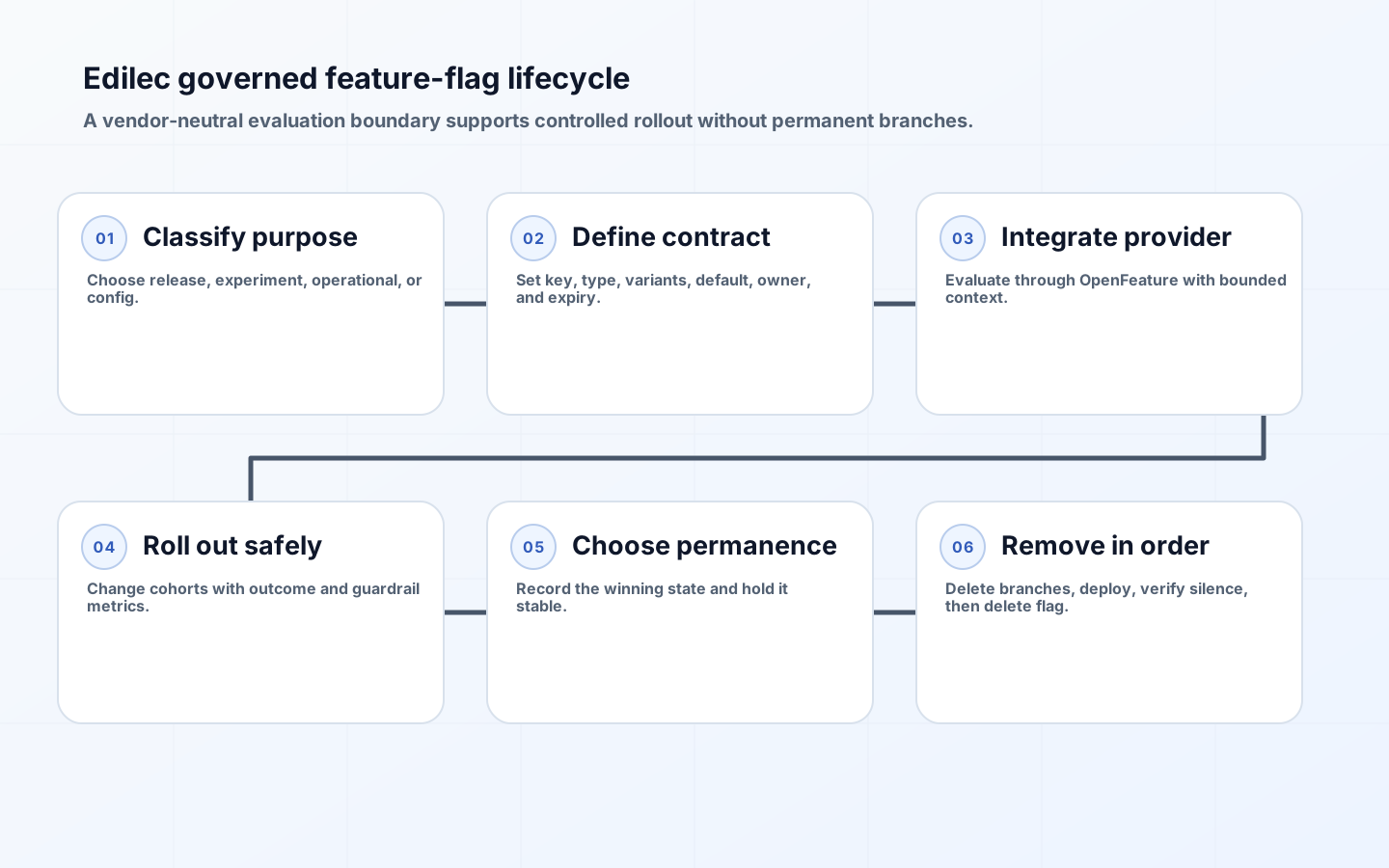
Feature flag lifecycle management is the discipline of making every runtime branch temporary, owned, observable, and removable unless it is intentionally a long-lived operational control. Without that discipline, flags accumulate as undocumented alternatives to architecture. Teams stop knowing which value is normal, targeting rules become a shadow authorization system, old SDK calls constrain vendor changes, and incident responders face combinations that no test suite covers. The cost is paid long after the rollout that justified the first if statement.
OpenFeature helps by standardizing how applications ask for flag values while providers integrate the underlying management system. The OpenFeature specification defines evaluation APIs, context, providers, hooks, events, and tracking across languages. It does not decide who owns a flag, when it expires, or whether a targeting rule is ethically and legally appropriate. Use it as the technical boundary inside a governance process, not as a substitute for one.
Classify the flag before creation
A creation request should name the flag type, business purpose, owner, affected services, default, fail behavior, targeting attributes, expected lifetime, removal issue, and success and guardrail metrics. Release flags separate deploy from launch and should usually disappear quickly. Experiment flags require analysis and privacy review. Operational kill switches may remain but need drills and restricted writers. Permission flags are dangerous because a general flag system may not provide the audit, consistency, and denial guarantees of an authorization service. Configuration flags need schema and range validation rather than boolean assumptions.

| Class | Typical lifetime | Failure default | Closure evidence |
|---|---|---|---|
| Release | Days to a few weeks | Previously stable behavior | Rollout complete and old path removed |
| Experiment | One analysis cycle | Control variant | Decision recorded and assignment removed |
| Operational | Long-lived with review | Service-specific safe state | Periodic drill and owner attestation |
| Entitlement | Avoid or tightly govern | Deny | Migrated to authorization policy |
| Configuration | As long as need exists | Validated default | Schema and consumers retired |
Design a stable flag contract
Use a durable key unrelated to a ticket title or vendor account. Define the value type and semantic variants; control, candidate, and disabled communicate more than true and false. Document whether evaluation happens on the server, client, or edge, and never expose secret targeting rules through a client SDK. Set an explicit code default for provider failure, then test it. A default is an operational decision: returning the new path during provider outage may amplify an incident, while returning the old path may be unsafe after a one-way data migration.
Keep evaluation context minimal, typed, and purpose-limited. A stable targeting key supports consistent assignment, while attributes such as region, plan, application version, or organization should have defined provenance and sensitivity. Do not send free-form personal data because a vendor console makes it convenient. Specify precedence when API, client, invocation, and transaction contexts merge. Review high-cardinality or sensitive fields before telemetry records them, and never let a mutable context object leak values between concurrent requests.
Adopt OpenFeature as the application boundary
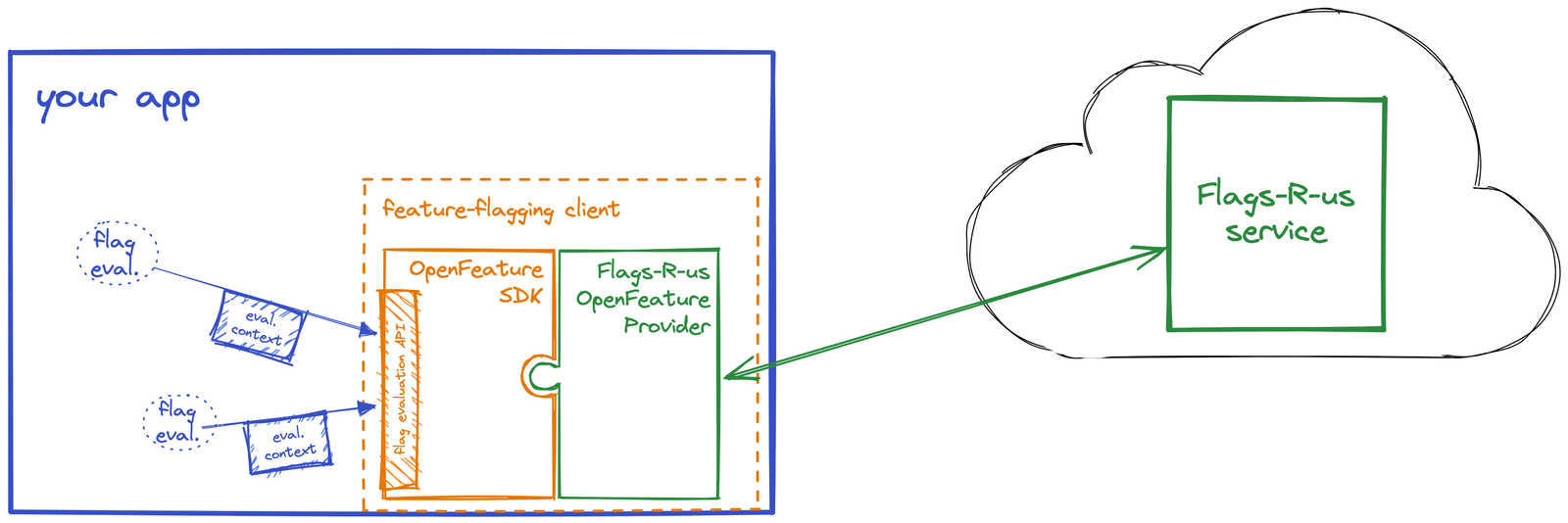
Application code imports the OpenFeature SDK and evaluates typed values; a provider translates those calls to a vendor, local file, relay proxy, or in-house service. The specification's provider requirements include provider metadata, typed resolution methods, evaluation details, and lifecycle behavior. Hide vendor-specific APIs behind provider or platform modules rather than scattering them through business logic. Keep provider initialization explicit and expose readiness, error, stale, and configuration-change states to health and operations surfaces.
Use domains or named clients to separate logical flag sets, but do not create one client per request or tenant. Define a test provider with deterministic values and resolution details. Unit tests should exercise both meaningful branches and provider errors; integration tests should verify context mapping, default behavior, and event handling. For local development, a file or memory provider is useful only if it follows the same key and type contract. Generated flag catalogs can prevent typographical keys and make ownership metadata available to static analysis.
Instrument evaluation without leaking context
OpenFeature hooks run around evaluation and can add validation, telemetry, or error handling at API, client, invocation, or provider scope. Keep them fast and non-blocking because they execute on application paths. Emit the flag key, semantic variant, provider, reason, ruleset version, error code, and service release where useful. Sample high-volume events and avoid raw evaluated structures or context attributes. A telemetry failure must not break the customer request unless evaluation evidence is itself a regulated requirement with an explicit policy.
The current OpenTelemetry feature-flag semantic conventions are development-stage as of July 13, 2026. They define evaluation-event attributes including feature_flag.key, feature_flag.provider.name, feature_flag.result.variant, feature_flag.result.reason, and ruleset version. Prefer the semantic variant over raw result value when the value may be large or sensitive. Pin a convention version in instrumentation, because adopting unstable names without version control can break dashboards during an upgrade.
| Signal | Question answered | Action |
|---|---|---|
| Evaluation volume by variant | Is the flag still used and by whom? | Find dormant consumers |
| Default or error reason | Is the provider unavailable or misconfigured? | Investigate fallback use |
| Ruleset version | Which targeting state produced behavior? | Correlate release and incident |
| Expiry date | Is temporary control overdue? | Escalate to owner |
| Code references | Can configuration be deleted safely? | Remove or migrate consumers |
| Variant outcome metrics | Did rollout improve the intended result? | Promote, pause, or reverse |
Govern rollout and rule changes
Separate flag definition from targeting change and from application deployment. Require review appropriate to blast radius: changing an internal test cohort is not equivalent to enabling a payment path globally. Use progressive steps with minimum sample and observation windows, customer-facing SLIs, business outcomes, and resource guardrails. Preserve a complete change history with actor, reason, previous and new rules, approval, and incident reference. Limit emergency writers, protect production projects, and use service identities for automation instead of shared human tokens.
Provider events can signal ready, error, stale, or configuration changed states, but local delivery and consistency behavior vary. Document propagation delay, cache lifetime, offline semantics, and ordering. For safety-critical flags, verify state from several application instances before increasing exposure. Do not make a provider outage a reason for every service to block startup indefinitely; choose fail-open or fail-closed behavior per flag class and test degraded operation. Maintain a global emergency procedure for disabling a harmful release without depending on the same failing control plane.
Remove stale flags safely
Expiry starts a workflow, not an automatic configuration deletion. First choose the permanent variant and hold it long enough to observe normal load. Change code so behavior is unconditional, remove tests for the obsolete branch while preserving tests for the retained behavior, deploy everywhere, and use code search plus evaluation telemetry to confirm no consumers remain. Only then delete targeting rules and the provider definition. For multi-service flags, track consumer versions individually; an infrequently deployed worker may continue evaluating after the main API has moved on.
Automate inventory checks in CI. Flag registrations without owner, expiry, type, or removal issue fail review. Static analysis finds literal keys and wrappers; runtime events find dynamic or rarely executed consumers. A weekly report should distinguish flags approaching expiry, expired but active, configured but not evaluated, and evaluated only through default or error paths. Measure median age by class, overdue count, time from 100 percent rollout to code removal, owner coverage, provider-error rate, and stale references after deletion. Reward closure, not the number of flags created.
Migrate providers without changing decisions
OpenFeature reduces application coupling, but provider data models still differ. Export the flag catalog, types, defaults, rules, segments, prerequisites, and audit history. Map unsupported semantics explicitly. In shadow mode, evaluate both providers for the same sanitized context, return the incumbent result, and record disagreements by reason and cohort. Resolve differences involving hashing, missing attributes, rule order, time zones, and percentage allocation before switching reads. Freeze or dual-write configuration during cutover, then retain a rapid return path until the new provider is stable.
Feature flag lifecycle key takeaways
- Classify every flag and define owner, expiry, safe default, metrics, and removal work at creation.
- Use typed semantic variants and a minimal, governed evaluation context.
- Keep application code on the OpenFeature boundary and provider-specific logic in integrations.
- Instrument variant, reason, provider, and ruleset version without exporting sensitive context.
- Treat targeting changes as production changes with review and audit history.
- Remove code before deleting configuration, and confirm every deployed consumer has stopped evaluating.
Feature flag lifecycle FAQ
Does OpenFeature store flags? No. It standardizes application-facing evaluation and provider integration. A provider connects to a management system, relay, file, or custom service that stores definitions and rules.
Should all flags have expiry dates? Temporary release and experiment flags should. Long-lived operational controls can use a review date instead, with an owner, drill cadence, and documented reason for permanence.
Can a feature flag replace authorization? Usually not. Authorization requires denial semantics, policy consistency, audit, and threat modeling that general rollout systems may not provide. Keep permissions in an authorization control plane.
Conclusion
A flag is healthy when its purpose and end state are clearer than its convenience. OpenFeature provides a portable evaluation boundary, while metadata, review, observability, expiry, and deletion controls keep that boundary from filling with permanent branches. Govern the entire path from proposal through removal, and progressive delivery remains a reversible release capability instead of becoming a second, less visible codebase.