Blue-green deployment for business applications keeps two production-capable environments: the current version and a candidate version. Traffic moves after the candidate passes defined checks, while the former environment remains available for rapid reversal. The pattern can reduce infrastructure and code rollback time, but it does not make every release safe. Shared databases, irreversible events, caches, background jobs and external integrations can prevent a clean return even when traffic switches instantly.
Use blue-green when environment duplication is feasible, traffic can be controlled and a short parallel period provides meaningful risk reduction. Compare it with rolling and canary methods for the actual architecture. Related planning includes service-level objectives for client portals and container security for web applications. The method should follow a written cutover and data-compatibility plan rather than a color convention alone.
Define what belongs inside each environment
Inventory compute, configuration, network routes, certificates, secrets references, queues, schedules, caches and data stores. Decide which components are duplicated and which are shared. Keep infrastructure and application configuration versioned so the candidate can be reproduced. Environment parity means equivalent behavior and policy, not necessarily identical capacity. Candidate credentials should be real enough to test required dependencies but constrained so validation cannot create unintended production effects.
Assign stable release identity to artifacts and telemetry. Ensure logs, metrics and traces distinguish blue and green without exposing the color as a permanent architectural concept. Validate health from customer journeys, not only process readiness. A service can answer a health endpoint while failing authentication, producing stale reports or rejecting a critical integration. Define which synthetic and business checks must pass and for how long.
| Boundary | Cutover question | Rollback risk |
|---|---|---|
| Traffic | Can requests be shifted and drained predictably? | Sticky sessions or DNS delay |
| Database | Can both versions use the same schema safely? | New writes old code cannot read |
| Messages | Which version consumes each queue? | Duplicate or incompatible processing |
| Schedules | Are jobs active in only one environment? | Double billing or notifications |
| Integrations | How are callbacks and credentials routed? | External side effects persist |
Make database change backward and forward compatible
AWS guidance recommends decoupling schema change from application cutover and keeping shared relational changes compatible with both versions. Use expand-and-contract: add compatible structures, deploy code that can work across versions, migrate or backfill data with reconciliation, then remove old structures after rollback is no longer needed. Avoid renaming or changing meaning in one step. Test old code against the expanded schema and new code against the pre-existing state.
Write a data rollback rule. If green accepts records that blue does not understand, traffic rollback may restore availability while corrupting business behavior. Prefer additive writes or dual-readable formats during the decision window. Backfills need throttling, restartability and progress evidence. For destructive migrations, define backup, restore and reconciliation, but recognize that restoring the database may conflict with payments, emails or external events already emitted.
Control queues, jobs, sessions and caches
Decide whether both versions can consume messages. If schemas and side effects are compatible, versioned consumers may coexist; otherwise drain, pause or route queues explicitly. Make handlers idempotent and preserve event identity. Activate scheduled jobs in only the intended environment, with a lease or deployment-controlled switch. Validate delayed and dead-letter work before retiring blue. A request cutover does not move background processing automatically.
Externalize sessions or support version-compatible session data so users do not lose work when traffic changes. Define cache key and invalidation compatibility, particularly when response shape or authorization changes. Warm green carefully without masking cold-start behavior. For webhooks and callbacks, preserve stable public endpoints and route internally, or coordinate endpoint change with providers. Verify secrets and certificates before the release window.
Use staged validation before and after traffic switch
Deploy green from the same approved artifact path used for production. Run configuration, dependency, migration, security and synthetic checks. Where routing supports it, send internal or a small controlled cohort first; otherwise execute dark reads that do not create side effects. Compare key outputs between environments where deterministic. Record all gate results and require one cutover owner who confirms data, operations, product and support readiness.
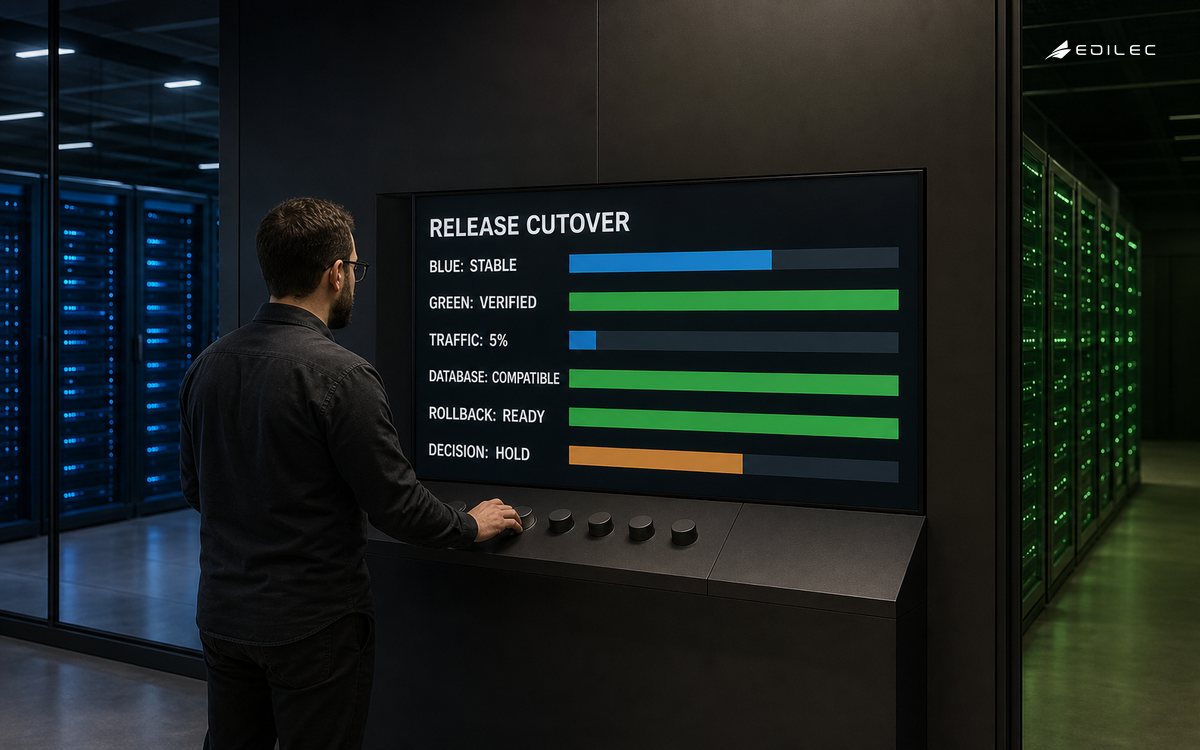
Shift traffic in measurable steps when possible, watching user-centered SLIs, error rate, latency, correctness, queue age and resource saturation. Keep a clear observation window and decision threshold. Avoid waiting for every dashboard to look perfect; specify which signals matter and who can stop or reverse. Drain in-flight work from blue and account for long-lived connections. Announce the release and changed behavior to support and incident responders.
Define rollback as a business-safe action
State automatic and human rollback triggers before cutover: objective burn, failed critical journey, data invariant breach, severe security finding or integration failure. Name the decision owner, command, expected duration and verification. A rollback includes traffic, consumers, schedules, feature configuration and perhaps schema compatibility. Preserve green for investigation only if doing so is safe; otherwise isolate it. Record which customer transactions occurred during exposure.
Sometimes forward repair is safer because data or external actions cannot be reversed. Define that option in advance with containment and approval. After rollback, validate customer journeys and reconcile state rather than assuming the former color is healthy. Keep the incident and release record connected. Rehearse rollback under realistic load periodically; a command last tested before several routing and identity changes is not a dependable control.
| Gate | Evidence | Stop condition |
|---|---|---|
| Candidate ready | Artifact, config, migration and dependency checks | Unknown version or missing access |
| Business ready | Critical journeys and support controls pass | Incorrect or inaccessible workflow |
| Data safe | Compatibility and reconciliation tests pass | Old version cannot read new state |
| Cutover healthy | SLIs and invariants within threshold | Objective burn or correctness breach |
| Rollback viable | Traffic, jobs and consumers rehearsed | Unreconciled irreversible effect |
Operate blue-green without doubling confusion
Automate environment creation, release, tests, traffic shift and retirement through one controlled pipeline. Restrict manual console changes and detect drift. Manage the extra capacity window explicitly; long-lived idle environments increase cost, patching and security exposure. Retire the old environment only after the rollback window, delayed-work verification, data compatibility and incident threshold pass. Preserve artifacts and evidence rather than keeping obsolete infrastructure indefinitely.
Measure whether the method improves change safety: release lead time, failed-deployment recovery, change failure, customer impact and operational effort. DORA metrics should be reviewed as a system, not targets for individual teams. If duplicated environments add complexity without reducing exposure, use canary, rolling or feature-level controls instead. Deployment strategy should follow product risk and architecture, not become a ritual applied to every service.
Blue-green release sequence
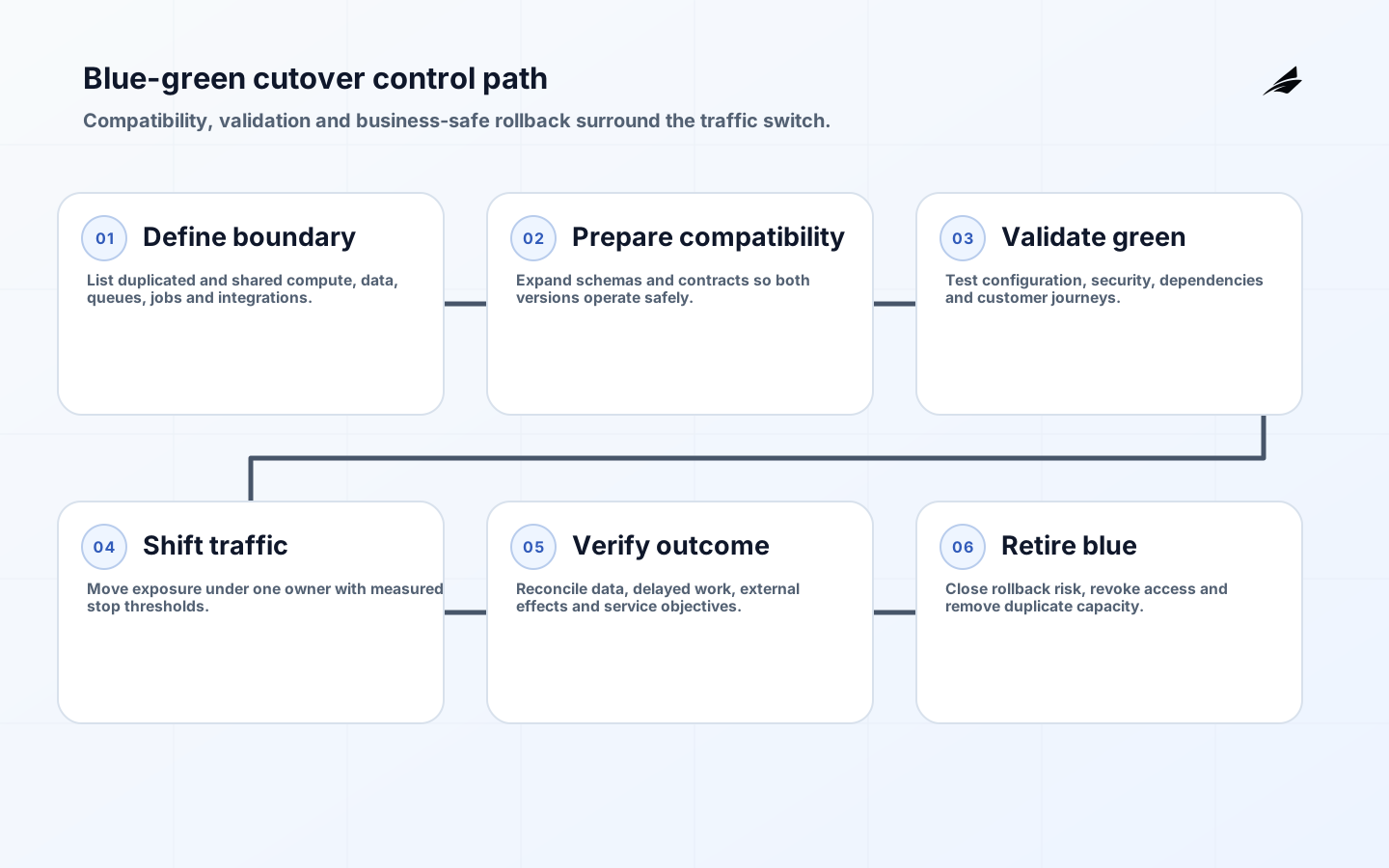
- Define duplicated and shared boundaries, release identity and ownership.
- Prepare backward-compatible schemas, messages, sessions and integrations.
- Deploy green and run technical, security and customer-journey gates.
- Shift traffic with explicit thresholds, command and communication.
- Validate data, background work and external effects through stabilization.
- Retire blue only after rollback risk and delayed work are closed.
Key takeaways
- Define the environment boundary beyond compute instances.
- Decouple schema and code change with compatibility windows.
- Control messages, jobs, sessions, caches and callbacks explicitly.
- Use user-centered gates and predetermined rollback authority.
- Retire duplicate capacity after data and delayed-work evidence passes.
Frequently asked questions
Does blue-green guarantee zero downtime?
No. It can reduce cutover interruption, but DNS, connections, migrations, dependencies and application behavior may still affect users. Define and measure the actual service objective rather than relying on the deployment label.
Should blue and green share a database?
Often they do during cutover, provided both versions are compatible. Separate databases introduce synchronization and reconciliation complexity. Choose from data consistency, rollback requirements and architecture, then test the complete plan.
When is canary deployment preferable?
Canary is useful when gradual exposure provides meaningful production evidence and requests can be segmented safely. Blue-green may be preferable for a clean environment switch. The patterns can also be combined, with canary traffic sent to green before full cutover.
Include security and access in parity checks. Green should use approved identities, network policy, secret references, certificates and logging before receiving traffic. Do not copy long-lived secrets into a temporary environment or leave blue privileged after retirement. Vulnerability and configuration scans should identify release and environment so responders can distinguish candidate findings from active exposure.
Coordinate customer and support expectations for visible changes. Feature flags can keep new behavior disabled during infrastructure cutover, but flags themselves need ownership, expiry and consistent evaluation. If a schema or workflow change cannot be hidden, publish the maintenance and rollback implications. Keep the status page and incident path ready during the observation window.
For multi-region systems, define whether blue and green exist in every region and how routing, replication lag and failover interact. Avoid changing application version and regional topology in one untested step. Validate the release under loss of one region if that resilience is promised, and ensure rollback does not direct traffic toward stale or incompatible data.
Document capacity assumptions for the overlap period. Green validation, production traffic and blue rollback readiness may temporarily require nearly double compute, database connections, addresses or provider quota. Confirm limits before release and monitor both environments. Cost controls must not automatically scale down the rollback environment during stabilization. Remove temporary quota and capacity deliberately after blue is retired so safety headroom does not become permanent waste.
Conclusion
Blue-green deployment is a controlled compatibility exercise, not merely two colored server groups. Design shared state, background work and external effects before switching traffic; use explicit customer-centered gates; and rehearse rollback as a complete business action. When those controls are automated and observable, the pattern can shorten recovery without giving the team false confidence about irreversible change.