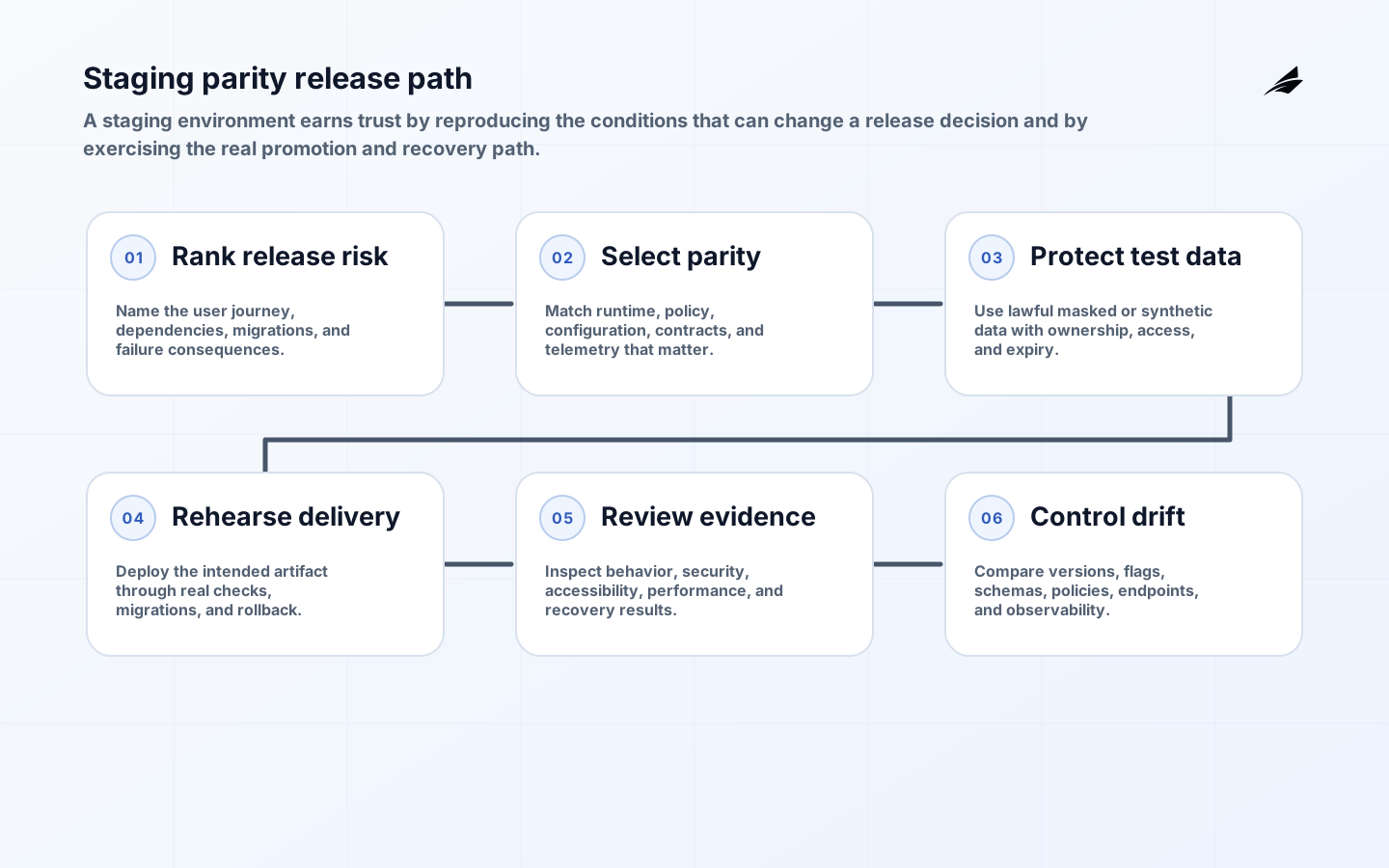
Staging environment design is the discipline of creating enough production-like evidence to decide whether a release is safe to promote. It is not an expensive duplicate of every production resource, nor is it a shared test space where anything can change. Enterprise teams should choose parity based on the failures a release could introduce: identity configuration, network policy, database migration, queue behavior, third-party contract, scale characteristic, observability and rollback path. Begin with a critical user journey and list the production dependencies whose behavior could change the release decision. Then make environmental differences explicit. A staging environment is useful when a reviewer can say what it proves, what it cannot prove and what additional release control compensates for that gap.
Define meaningful parity
Classify each production dependency by required parity. Some require the same infrastructure pattern, access model and configuration shape. Others can use a faithful simulator with documented limits. For example, an authentication integration may need real redirect, token and role behavior, while a payment provider may need a controlled sandbox plus a production monitoring plan. Keep infrastructure and application configuration in version control so staging is not manually assembled from memory. Compare configuration categories at build time: image version, schema version, feature flags, secrets reference, network rules, resource policy and observability settings. Never copy production secrets or unrestricted customer data merely to make staging convenient. The aim is representative behavior with controlled exposure.

| Area | Parity question | Evidence |
|---|---|---|
| Identity | Do roles and token flows behave as in production? | Automated authorization tests |
| Data | Are schema and edge cases representative? | Approved synthetic or masked dataset |
| Infrastructure | Can scale and failure behavior be observed? | Versioned environment definition |
| Dependencies | Which contracts are real, simulated or isolated? | Contract tests and limitations |
| Operations | Will telemetry and rollback work after promotion? | Release exercise |
Control data and access
Treat staging as a separate security boundary. Use synthetic data where possible and masked, minimized data only under approved conditions. Document who may load data, who can inspect it, how long it remains and how it is removed. Test the migration and data-repair procedures against representative states without opening a path to production records. Access should be role-specific: developers may deploy through a pipeline, testers may exercise journeys, and administrators may change environment policy under review. Shared administrator credentials, manual secret copying and untracked direct edits weaken the very evidence staging is meant to provide. Audit configuration changes and make emergency access time-bounded and reviewable.
Data shape matters as much as data privacy. Include empty accounts, high-volume accounts, historical records, invalid inputs, delayed events and records affected by new schema versions. A release may pass with a clean sample and fail when an old integration sends an unexpected value. Build resettable fixtures and idempotent setup tools so teams can recreate a known starting point. When a test requires production-like load, use approved load profiles and guardrails to protect shared dependencies. State the limitations of the dataset in the release review. Staging results should increase confidence without claiming to reproduce every production condition exactly.
| Release risk | Staging validation | Promotion control |
|---|---|---|
| Schema change | Forward and rollback migration test | Backup and compatibility gate |
| Feature behavior | Critical journey and negative-path test | Feature flag and cohort rollout |
| Dependency contract | Sandbox or contract test | Timeout and fallback plan |
| Performance regression | Representative load and trace review | Rate limit and monitor |
| Configuration drift | Automated comparison | Approved change record |
Validate the release path
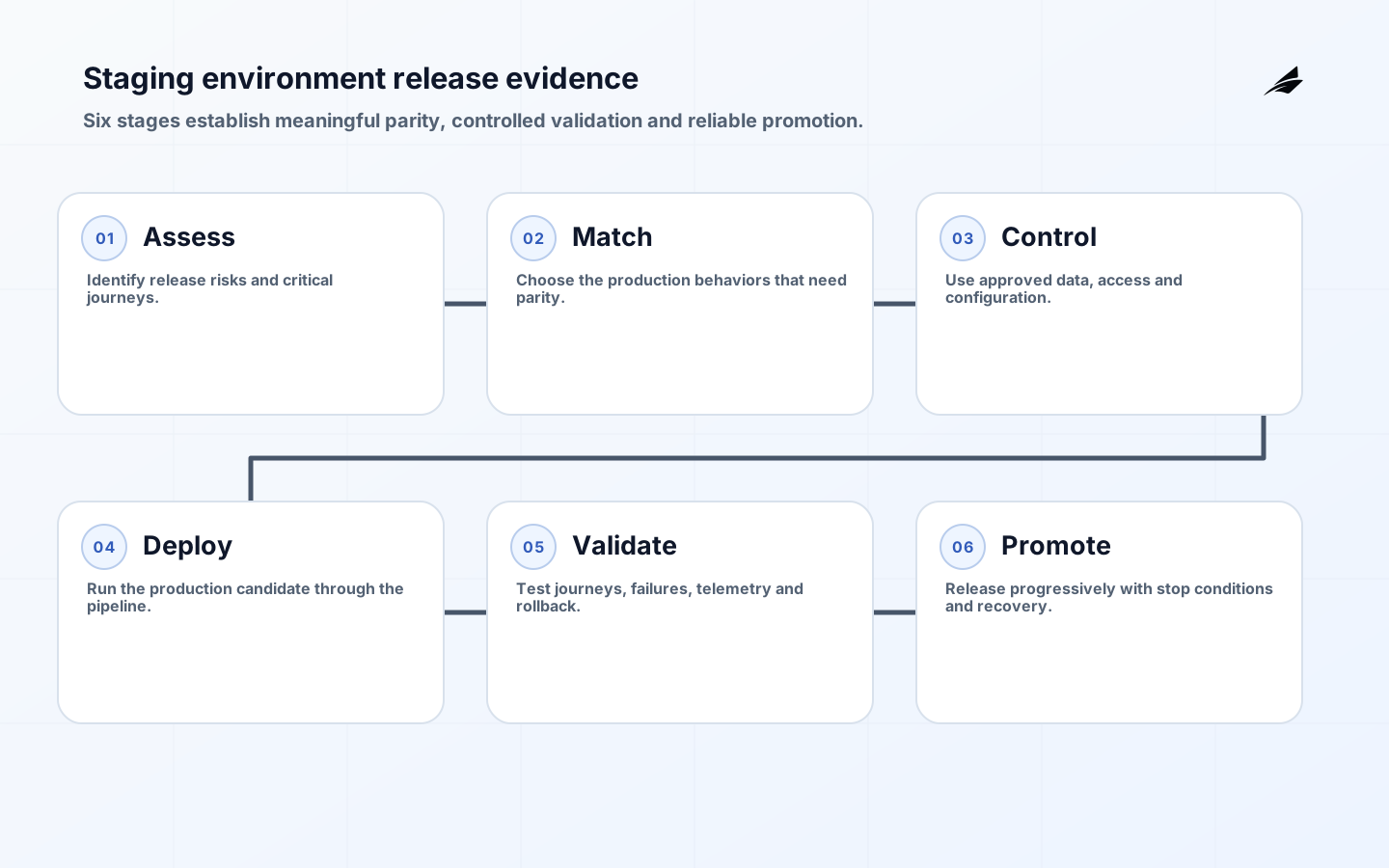
Deploy to staging using the same artifact and as much of the same pipeline logic as production. A manual staging deployment can hide the permission, packaging or orchestration failure that appears at promotion time. Verify artifact provenance, environment-specific configuration, database change order, health checks, telemetry and feature flags. Run automated checks first, then human acceptance against the critical journey and an important exception path. Capture release evidence in a compact record: artifact identifier, changes, test results, known limitations, approver, monitoring plan and rollback owner. The record should make a later incident easier to understand, not become a ceremonial form detached from the actual pipeline.
- Deploy the production candidate artifact through a repeatable pipeline.
- Check a critical journey, a negative path and recovery behavior.
- Validate telemetry, alerts and dashboards before promotion.
- Record environment limitations and the controls that compensate for them.
- Assign a rollback decision owner and exercise the path regularly.
Promote gradually and recover cleanly
Staging validation reduces uncertainty; it does not eliminate it. Use progressive delivery when consequence warrants it: a small traffic cohort, a feature flag, a deployment slot swap or another reversible exposure mechanism. Define the success indicators, observation window and stop conditions before production change begins. Rollback must account for data and compatibility. Reverting code may not undo a one-way migration, an emitted event or a changed external record. Design forward-compatible schema changes, retain old readers where needed and prepare a reconciliation route. During promotion, watch the user journey and business state, not only infrastructure health. A clean, practiced rollback makes teams more willing to detect and contain a real problem early.
Maintain staging as a service
Staging becomes unreliable when nobody owns its drift, capacity, test data or access. Give it a service owner, an expected availability level, a change policy and a backlog for recurring friction. Track failures that staging should have caught, failures it produced spuriously and time lost waiting for a usable environment. Periodically compare its configuration posture to production and retire stale integrations or fixtures. Avoid turning staging into a permanent home for experiments that cannot be reproduced; use explicit ephemeral environments where appropriate. A maintained staging service helps release teams learn quickly while preserving the confidence that a passed check represents meaningful evidence.
Prioritize parity by release risk, not visual similarity
Production-like does not mean an expensive clone of every production resource. It means the conditions that can invalidate the release decision are represented. Rank parity across runtime versions, configuration, identity, network policy, integrations, data shape, traffic behavior, deployment mechanism, and observability. A missing authorization rule may be more important than a smaller database; a fake queue may hide retry and ordering failures even when the interface looks identical. Microsoft’s environment guidance treats environments as governed parts of the delivery system. Record intentional differences and the risk each difference leaves for progressive delivery or production verification.
| Parity dimension | Evidence to compare | Acceptable difference test |
|---|---|---|
| Runtime and configuration | Versions, flags, environment variables, and policy bundles | Difference is documented and cannot alter the tested behavior |
| Dependencies | Protocols, timeouts, retry behavior, and failure responses | Substitute reproduces the contract and material failure modes |
| Data | Schema, volume shape, edge cases, retention, and permissions | Dataset is lawful and exercises the release risk without exposing live records |
| Delivery path | Artifact, deployment automation, migrations, health checks, and rollback | The same promotion controls execute and produce reviewable evidence |
Control drift with versioned infrastructure and configuration, but also verify behavior. Schedule a parity check that compares deployed revisions, feature flags, schemas, policies, certificates, dependency endpoints, and telemetry. Run the real promotion and rollback path from the same artifacts intended for production. Where realistic personal or regulated data is necessary, create masked or synthetic datasets with explicit owners and expiry; do not solve test realism by making staging a poorly protected production copy. The NIST Secure Software Development Framework supports protecting software and producing well-secured releases. In staging, that means access, evidence, and data handling remain controlled even though the environment exists for experimentation.
Teams can place staging evidence in a wider release system by reading CI/CD Pipelines for SaaS Teams: A Practical Delivery Guide, Environment Strategy for Web Apps: Reliable Paths from Development to Production, and Production Incident Response: Restore Service, Preserve Learning.
Key takeaways
- Choose parity based on the release failures that matter.
- Version configuration and use controlled, representative data.
- Run the production candidate through a production-like release path.
- Validate journeys, negative paths, telemetry and rollback together.
- Promote progressively because staging cannot prove every production condition.
- Give staging ownership so its evidence remains trustworthy over time.
Frequently asked questions
Should staging be an exact production copy?
Usually no. Exact duplication can be costly and may create data or access risk. Match the components, policies and behaviors that affect release decisions, then document differences and apply compensating production controls for what staging cannot demonstrate.
Can one staging environment support several teams?
Yes, if ownership, reservations, data reset, compatibility and change coordination are explicit. When contention is frequent or tests need isolation, add ephemeral environments rather than accepting unpredictable shared state as normal.
Avoid environment coupling and queueing
A shared staging environment can become a delivery bottleneck when releases, test data or configuration changes collide. Make reservations, deployment ownership and reset expectations visible, and separate experiments that need unstable configuration from release validation that needs a known baseline. Where architecture permits, create short-lived environments from versioned definitions for branch or integration work, then reserve staging for the production candidate. Monitor wait time, failed validation caused by unrelated change, restore time and environment availability. These measures reveal when the organization is treating a scarce, unreliable environment as a normal delivery dependency. Improving isolation often raises release confidence more than adding another layer of manual approval.
Make release evidence reviewable
Release evidence should be concise enough for an accountable reviewer to inspect without reopening every pipeline log. Summarize the artifact, changed components, migrations, environment comparison, critical journey results, known exceptions, monitoring plan, promotion conditions and rollback route. Link detailed records for an investigator who needs them. The review should surface unanswered questions rather than encourage a signature ritual. If a validation result is waived, state who accepted the residual risk, why it is acceptable now and when the condition will be revisited. Capture the production observation window and the person authorized to halt promotion if a stop condition appears. Include the expected behavior of scheduled jobs and asynchronous consumers after the release, because they may expose compatibility faults after the interactive test is complete. Add explicit acceptance criteria for each migration: compatible readers remain available, a representative rollback was rehearsed, monitoring can distinguish old from new behavior, and queued messages can be processed without duplication after promotion. These checks make a release decision concrete when an apparently healthy interactive path would otherwise conceal a delayed background failure. This keeps staging evidence connected to an actual decision and gives incident responders useful context when a release behaves differently in production.
Conclusion
A good staging environment does not imitate production for its own sake. It creates credible release evidence, makes limits explicit and supports a promotion and recovery path that operators can trust under real pressure.