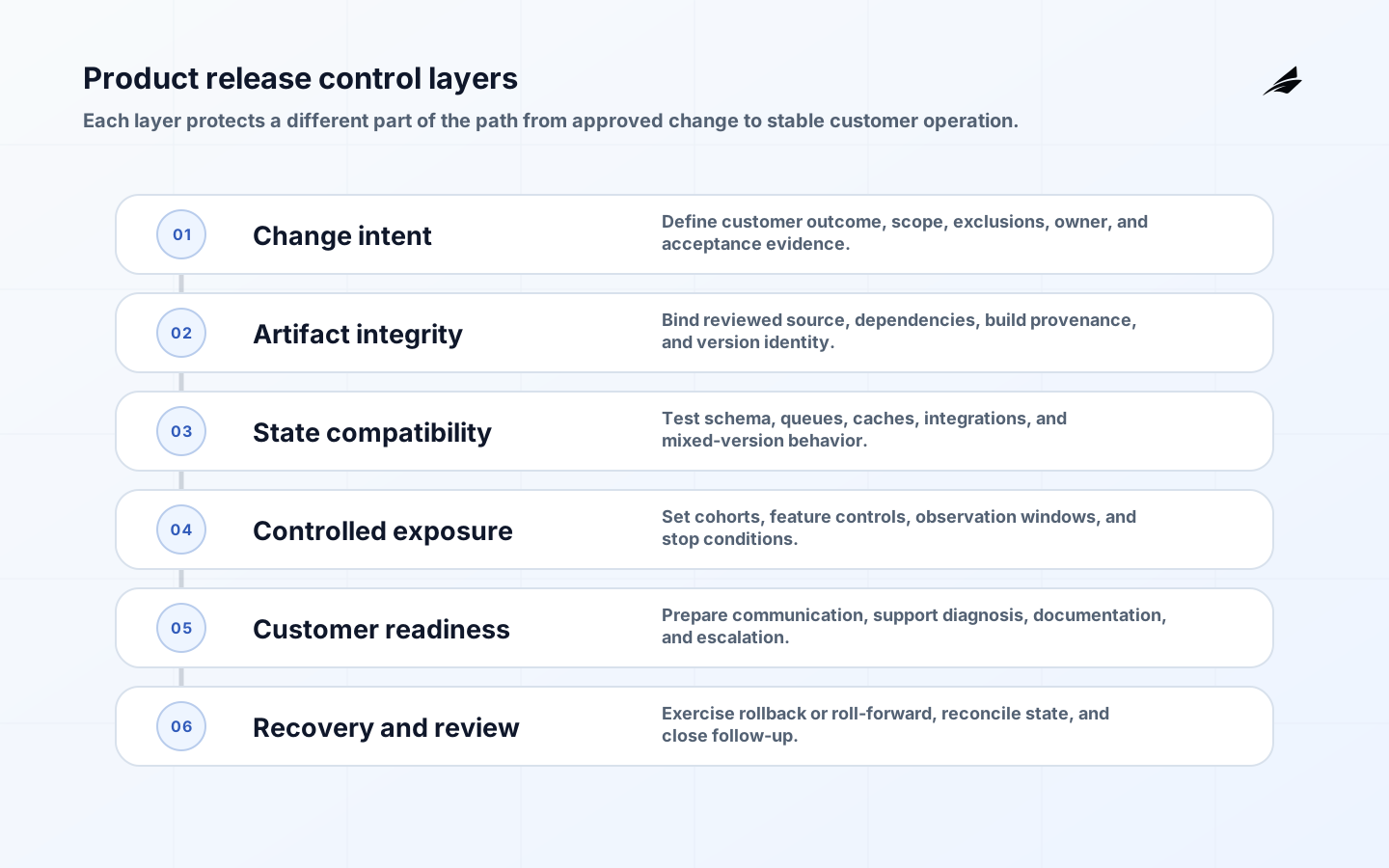
Release management for products is most useful when it gives a named team a safer, clearer way to make a recurring production decision. Client-facing releases affect more than code. They can change permissions, integrations, invoices, notices, training, and support volume. It turns those dependencies into a shared decision process without making every routine change wait for a committee. This checklist starts from the service and its failure consequences, then turns that context into a bounded design, an operating test, and evidence for the next decision.
Keep one release decision record
A release decision record connects the planned change to the version customers actually receive. It should name the owner, customer capability, included work, excluded work, artifact identity, dependency and data changes, security evidence, deployment sequence, exposure controls, support preparation, rollback or roll-forward criteria, and final decision. Keep links to source evidence rather than copying volatile status into a document that immediately becomes stale.
| Release checkpoint | Question | Required evidence |
|---|---|---|
| Build integrity | Is this the reviewed source and dependency set? | Immutable artifact identity, provenance, signatures or attestations where used |
| Data change | Can old and new application versions coexist safely? | Migration test, compatibility window, backup or recovery procedure |
| Exposure | Who receives the change first and how is expansion stopped? | Cohort rule, feature control, monitoring window, and decision owner |
| Customer readiness | Will users, support, and account teams understand material change? | Release note, workflow guidance, known limits, and escalation path |
| Recovery | What condition triggers rollback or roll-forward? | Observable threshold, operator, tested procedure, and data reconciliation plan |
Artifact integrity and deployment are related but distinct. The SLSA specification provides a framework for supply-chain provenance, while the NIST SSDF integrates secure development practices across the lifecycle. A verified artifact can still be operationally unsafe if a migration is irreversible, a feature flag does not cover background jobs, or support has no way to identify affected customers.
Use Edilec guides for the broader release management operating model, release planning before development, and release-management implementation questions. These resources help product, engineering, support, and operations make one release decision from shared evidence.
Google's release engineering guidance describes consistency, repeatability, and automation as release-engineering goals, but a product team must connect them to customer exposure and recovery. Its service-level objective workbook helps teams select service indicators and objectives that can inform rollout and stop decisions. Use both references as design inputs; the release owner still needs product-specific thresholds, customer communication, and state-reconciliation rules.
Key takeaways
- Start release management for products with a specific customer or business outcome and an accountable owner.
- Define the operational boundary before selecting tools, environments, or automation.
- Treat access, change history, and recovery evidence as part of the design, not audit paperwork added later.
- Run a realistic pilot with the people who will operate the service under pressure.
- Use results to improve a supported path instead of standardizing untested local practice.
What release management for products needs to solve
A deployment can be technically successful while customers cannot complete a new workflow, a support team has no explanation, or a partner integration receives an unexpected contract change. The release record needs customer and business evidence alongside engineering checks.
| Decision area | Checklist question | Evidence that makes it real |
|---|---|---|
| Business outcome | Which customer action or control depends on release management for products? | A named service owner agrees on what healthy and harmful look like. |
| Operating boundary | What is included in the first release management for products implementation, and what is deliberately excluded? | Dependencies, data, identities, and exceptions are recorded. |
| Decision authority | Who can approve, pause, contain, and validate a material change? | Roles and escalation routes are usable outside normal office hours. |
| Recovery proof | How will the team know the business outcome is restored? | A rehearsal reaches customer or record validation, not only a green technical check. |
Set the first operating boundary
Do not begin release management for products as an organization-wide replacement program. Classify releases by customer impact and reversibility. Define a light path for routine compatible changes and a deeper plan for entitlement, pricing, workflow, data, integration, or regulatory changes. Do not use a calendar entry as a substitute for risk assessment. Write down the assumptions that would invalidate the choice, including volume, availability, data handling, dependency behavior, and skills. This keeps the first implementation reviewable and prevents a useful control from becoming an open-ended platform promise.
Make the boundary usable by writing a short decision record. It should say why this scope was selected, which alternatives were considered, what evidence is still missing, and the date or event that will trigger reconsideration. For release management for products, a decision record is most valuable when it exposes a trade-off before it becomes an incident: a service may accept slower change in return for stronger evidence, or accept a narrower pilot in return for a faster learning cycle. The record should also identify the owner who can accept that trade-off; technical feasibility alone does not settle a customer or control consequence.
Design the release management for products operating path
Link the change intent, version, audience, enablement plan, dependencies, observation period, support route, and recovery option in one release record. Separate deployment from exposure: a feature can be present technically while product owners control who can use it and when.
| Design element | Practical decision | Failure to prevent |
|---|---|---|
| Ownership | Name the service, platform, product, and control owners that have a decision to make. | A material issue waits while teams debate responsibility. |
| Change evidence | Keep the intent, reviewed revision, validation result, and exception decision together. | A responder cannot explain what changed or restore a known state. |
| Health evidence | Use customer and service signals with a stated observation window. | A technical success masks a damaged workflow. |
| Recovery boundary | State what can be reversed, what must be reconciled, and who confirms completion. | Traffic recovers while records, access, or downstream work remain wrong. |
Put release management for products controls in the normal workflow
Protect production promotion, use clear approval rules for high-impact releases, retain customer communication decisions, and give support a current source of truth. Avoid broad all-hands permissions; a defined release manager role can coordinate evidence without owning every technical action.
Design an exception path alongside the ordinary release management for products workflow. An exception request should identify the operational reason, the temporary control, the approving authority, the expiry date, and the work needed to return to the supported path. This is more useful than an informal emergency channel because it preserves speed while making accumulated risk visible. When the same exception recurs, ask whether the standard is too narrow, the service has an unaddressed dependency, or the team needs a distinct operating model. Do not normalize a workaround merely because it is familiar.
- Give routine work a documented self-service path and make exceptions visible to the owner of release management for products.
- Use scoped identity and short-lived access wherever the underlying platform supports it.
- Record meaningful approvals, overrides, and production changes with enough context for a later review.
- Keep a current runbook that names the signal, first action, escalation route, and business validation step.
- Review recurring friction as a design problem before adding another manual gate.
Pilot release management for products under realistic conditions
Use a narrow audience or pilot customer group when representative feedback matters. Confirm access, documentation, analytics, support routing, and reversal behavior before expanding. The pilot should have a stated success condition, not merely an end date.
| Pilot question | How to exercise it | Decision enabled |
|---|---|---|
| Can the service be operated? | Have the nominated owners use the normal path without private administrator help. | Clarify ownership or reduce complexity before wider use. |
| Can a harmful change be contained? | Introduce a bounded failure or rejected condition and follow the stated response. | Improve stop conditions, access, or automation. |
| Can recovery be proven? | Restore the needed state and verify the actual customer or business workflow. | Accept the recovery objective or redesign the path. |
| Can the evidence be explained? | Ask a reviewer to reconstruct the decision from retained records and telemetry. | Fix gaps in traceability, monitoring, or documentation. |
Measure whether release management for products supports better decisions
Track customer completion for the changed journey, support contacts by release, time from detection to communication, percentage of releases using the appropriate path, rollback or feature-disable use, and unresolved follow-up actions. Interpret these in context of release type.
Set a review cadence that matches the rate and consequence of change. During an initial rollout, review evidence after meaningful releases, exercises, or exceptions while details are still available. Once the path is stable, use a regular service review to inspect trends, decisions that were deferred, and controls that no longer match the work. Keep the review small and action-oriented: each material signal should end with an owner, a due date where appropriate, or a recorded decision to accept the current risk. This turns release management for products into an operating practice rather than a checklist completed once and forgotten.
Frequently asked questions about release management for products
Who owns a product release?
Ownership is shared but explicit: engineering owns technical execution, product owns customer outcome and exposure, support owns readiness to help users, and a release manager may coordinate the record and decision cadence.
Are release notes enough for customer communication?
Not always. A material workflow, integration, or entitlement change may need targeted notice, in-product guidance, training, or partner coordination. Choose the communication from the customer impact, not a publication habit.
Keep release management for products current after the first rollout
The first accepted implementation is a baseline, not a permanent answer. Revisit release management for products when the service gains a new customer journey, regulated data class, region, integration, runtime, or dependency that changes the original assumptions. The review should begin with the evidence already collected: what operators had to do manually, which alerts did not lead to action, which approvals delayed an urgent decision, and whether recovery produced the intended business outcome. Update the owned service record, runbook, templates, and training materials together so that the documented path remains the path people can use. Where a change creates a new risk, repeat a focused exercise rather than relying on an old successful test. Confirm that replacement owners can perform the required actions and find the same evidence without oral handover. This maintenance work is deliberately modest: it preserves the value of release management for products by making operational knowledge durable as teams, systems, and responsibilities change.
Conclusion
Release management for products protects customer confidence by joining technical control to product accountability. Make the audience and decision gates visible, observe the real workflow after exposure, and close the release only after follow-up work has an owner.