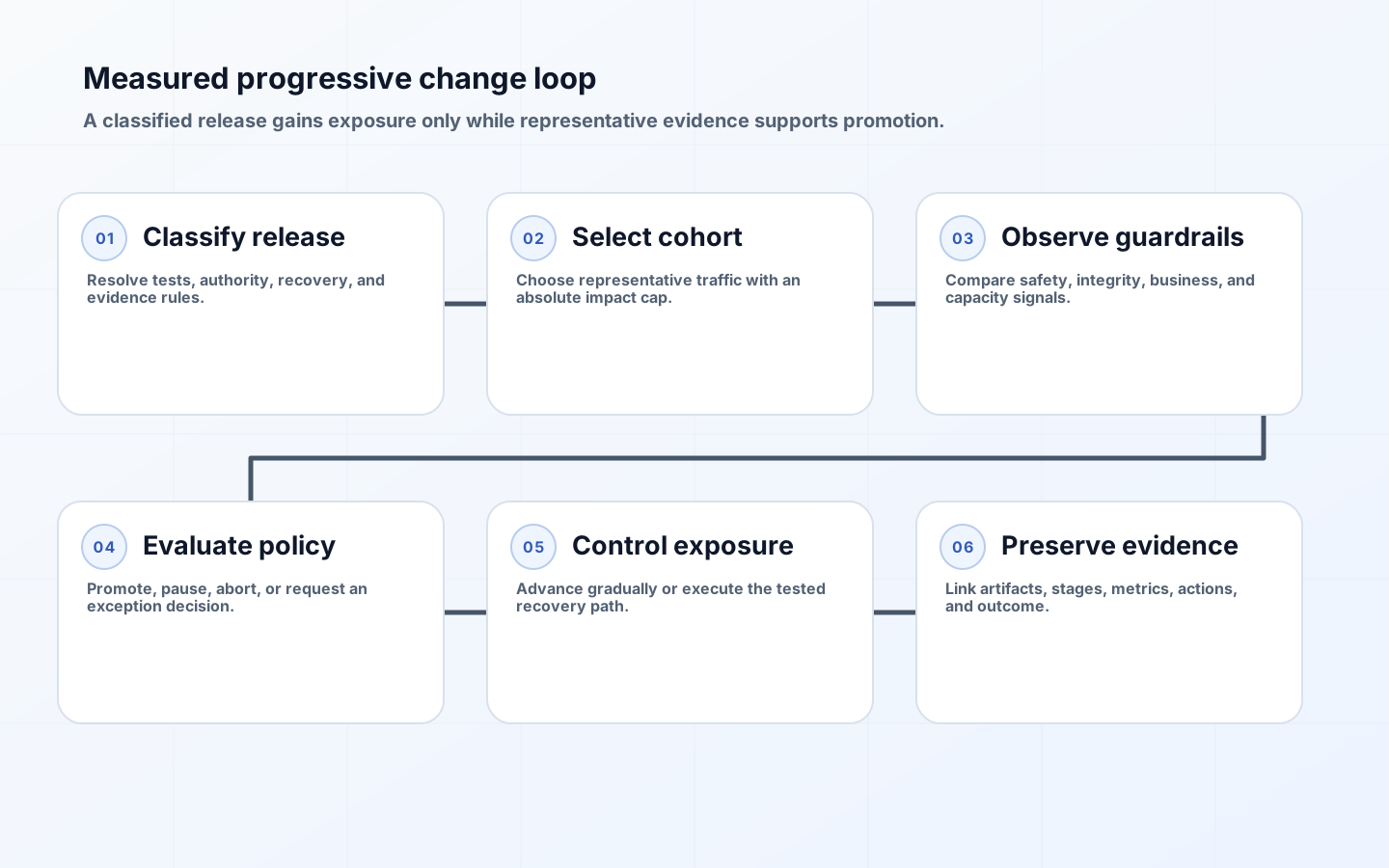
A progressive delivery strategy changes how an organization controls production risk. Instead of predicting every outcome in a meeting and releasing to everyone at once, the delivery system exposes a change to a bounded cohort, evaluates service and business evidence, and then promotes, pauses, or reverses it. Human review remains important for exceptional or inherently consequential changes, but routine risk control moves closer to the production facts.
This is not simply a canary tool purchase. It is a change-enablement operating model with explicit release classes, trusted metrics, independent policy, automated rollback, and retained evidence. DORA treats continuous delivery as the capability to release safely and sustainably on demand. Progressive delivery supplies runtime controls for that capability, while governance defines when those controls are sufficient and when an additional decision is required.
Translate change policy into release classes
Classify changes using factors the pipeline can evaluate: customer impact, data migration, security boundary, reversibility, affected tier, novelty, dependency change, and maximum exposure. A routine stateless patch with tested rollback may qualify for standard progressive execution. A destructive schema migration, cryptographic policy change, or regulatory disclosure flow may need specialist approval even if traffic can be canaried. Emergency changes use a shortened path but tighter observation and retrospective review.
The class determines required tests, initial cohort, dwell time, guardrails, approvers, rollback mode, and evidence retention. Avoid labels such as low, medium, and high without executable consequences. Version the policy separately from application code and record the resolved class with each release. Teams may propose a classification, but centrally governed checks should prevent a service from declaring every change routine.
| Release class | Example | Runtime control | Human decision |
|---|---|---|---|
| Standard reversible | Stateless bug fix | Small canary, automatic analysis and rollback | None after policy checks |
| Elevated | New dependency or major feature | Longer stages and business guardrails | Service owner approval |
| Data consequential | Backfill or incompatible migration | Shadow/read validation and bounded writes | Data owner and recovery review |
| Security or regulatory | Access or consent behavior change | Dedicated cohort and audit evidence | Control-owner approval |
| Emergency | Urgent vulnerability or outage fix | Narrow first exposure and continuous observation | Incident authority with later review |
Design cohorts that reveal risk without concentrating harm
A canary must be representative enough to detect the failure modes that matter. Choose cohorts by region, tenant, device, workload, request header, feature flag, or replica set. Exclude customers for whom experimentation or degraded behavior is unacceptable, but do not always send internal users or tiny tenants first if their traffic cannot reveal scale, locale, or data-shape defects. Google SRE's canary guidance emphasizes comparing a candidate population with a control population and evaluating meaningful signals.
Set stage size and dwell time from event volume and expected failure latency, not a fixed corporate template. Fast request errors may surface in minutes; cache behavior, batch jobs, or customer conversion may require hours or a full cycle. Define the maximum simultaneous exposure and ensure the routing layer can hold it. A percentage without a stable denominator is dangerous when traffic shifts suddenly, so support absolute caps for customers, requests, or write volume.
Create a guardrail contract for every service
Promotion needs a small set of decision-grade indicators. Include direct failure signals such as error ratio, latency, saturation, crash rate, or data-quality violations; a customer or business outcome where the stage has enough volume; and infrastructure constraints that could make expansion unsafe. Compare canary and baseline as well as absolute service objectives. A shared upstream incident can make both unhealthy, while a subtle regression may leave both under the broad SLO threshold but still show a material difference.
| Signal role | Example | Promotion rule | Common trap |
|---|---|---|---|
| Safety | Error ratio or failed writes | No material regression and below hard ceiling | Averaging away one critical endpoint |
| Performance | Tail latency and saturation | Candidate comparable to baseline | Using only median latency |
| Integrity | Reconciliation or invariant failures | Zero severe violations | Waiting for customer reports |
| Business | Checkout completion or task success | Within agreed uncertainty | Acting on too little volume |
| Capacity | CPU, queue lag, connection pool | Headroom remains at next stage | Scaling the canary differently from baseline |
Separate promotion policy from deployment mechanics
The deployment controller should manage replicas, traffic, and stage transitions, while an analysis service evaluates metrics and policy. Argo Rollouts, for example, provides canary and blue-green strategies, metric analysis, traffic integration, pauses, and promotion controls on Kubernetes. Keep metric queries and thresholds reviewable, testable, and versioned. The application team owns service-specific signals; the platform team owns reliable execution and common safety controls.
Promotion is a state transition with an immutable release identity. Verify that the artifact, configuration, feature flags, database compatibility, and analysis policy remain the versions that were evaluated. A new build or configuration change resets evidence. Protect the controller identity from application credentials and restrict manual promotion. An authorized manual override should capture actor, reason, current evidence, intended next stage, and expiry rather than silently editing rollout state.
Automate rollback only when rollback is actually safe
Rollback works well for an immutable stateless artifact when the previous version remains compatible. It is not a universal answer for database writes, external messages, billing effects, or security-policy changes. Classify each effect as reversible, forward-fixable, compensable, or irreversible. Before release, test the chosen path under realistic traffic and confirm that the routing layer can stop new exposure quickly. Kubernetes Deployments preserve rollout history and support rollback, but application and data compatibility remain the team's responsibility.
Use hard abort signals for severe integrity or security failures and softer pause signals for ambiguous changes. On abort, freeze expansion, stop unsafe writes, route traffic, and preserve evidence. Do not repeatedly bounce between versions when metrics oscillate. Apply a cooldown and require diagnosis after one failed automatic recovery. For stateful releases, rollback may mean disabling a feature while leaving a compatible schema in place, then remediating data through an accountable workflow.
Make runtime evidence the change record
A progressive release should produce a durable record containing change purpose, commits and artifact digests, policy class, tests, approvers where required, cohort definitions, exposure timeline, metric queries, analysis results, manual actions, rollback, and final disposition. This evidence is more useful than a prefilled ticket that says risk was reviewed. Link it to incidents and customer communications, and retain it according to the service's audit requirements.
Change managers can review patterns rather than each routine deployment. Look for services with frequent overrides, weak or noisy guardrails, repeated rollback, excessive dwell, missing business indicators, or classifications that differ from outcomes. Update policy based on observed failure modes. Segregation can be maintained by separating code author, policy owner, production controller, and exceptional approver even when standard releases no longer wait in a meeting queue.
Adopt progressive delivery as a shared operating model
Platform engineering should provide artifact promotion, traffic control, analysis adapters, policy checks, evidence storage, access control, and emergency stop capabilities. Service teams supply objectives, endpoint criticality, cohort constraints, data compatibility, rollback procedures, and accountable ownership. Security, privacy, and risk teams define consequential change classes and evidence requirements. This division keeps control consistent without requiring a central group to understand every service metric.
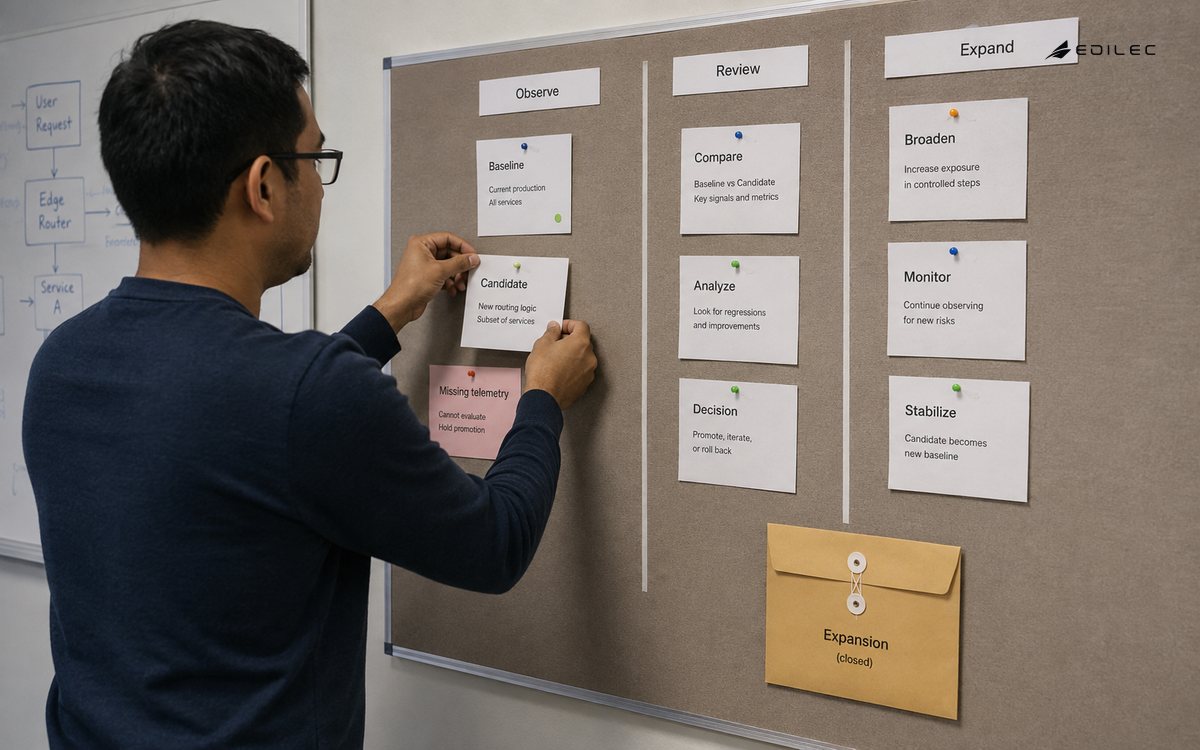
Begin with one service that deploys frequently and has reliable telemetry. Run the progressive path in observation mode, comparing its recommendations with existing decisions. Enable automatic pause, then automatic rollback for one well-understood failure mode, and finally policy-based promotion. Exercise metric outages, contradictory signals, routing failure, controller restart, and manual cancellation. Expand to higher-risk changes only after the control plane itself has production evidence.
Measure flow and control effectiveness together
Track lead time, deployment frequency, failed change recovery, and service reliability alongside progressive-specific measures: time spent in stages, automatic promotion rate, false pauses, overrides, rollback success, exposure at detection, and guardrail coverage. Faster releases are not evidence of safer change if defects reach more customers. Conversely, many pauses may show that the system is detecting real risk early. Review the customer impact avoided and the quality of diagnosis.
Do not optimize for a target percentage of auto-approved changes. The correct proportion depends on the portfolio. Aim for routine, reversible changes to move on trusted evidence and for consequential exceptions to receive focused judgment. Retire unused flags, obsolete metric queries, and stale release classes. Periodically test that rollback still works and that control and candidate populations remain comparable as architecture and traffic evolve.
Key takeaways
- Translate governance into executable release classes with distinct tests, cohorts, guardrails, and decisions.
- Choose representative cohorts and dwell times based on failure latency, volume, and maximum acceptable exposure.
- Evaluate canary versus baseline and hard service limits using safety, integrity, business, and capacity signals.
- Treat rollback as an effect-specific strategy, not a generic controller feature.
- Use retained runtime evidence to review the change system and focus human attention on genuine exceptions.
Frequently asked questions
Does progressive delivery eliminate change approval? It can remove per-release approval for standard changes whose policy, tests, exposure, signals, and rollback meet delegated authority. Consequential classes and overrides still require the appropriate owner or control function.
How large should the first canary be? Large enough to observe expected failure modes within the dwell window, but no larger than the acceptable impact if the change is bad. Use both percentage and absolute exposure caps when traffic varies.
What happens when metrics are unavailable? Missing or stale evidence should pause promotion. Define whether traffic remains at the current bounded stage, reverts after a timeout, or requires operator action. Never interpret missing telemetry as a pass.
Conclusion
Progressive delivery turns change control from a prediction exercise into a measured production process. Its value comes from reliable cohorts, explicit policy, trustworthy signals, bounded exposure, and recoverable effects, not from automation alone. With those foundations, organizations can let ordinary changes flow while giving exceptional risk the timely, informed attention it deserves.