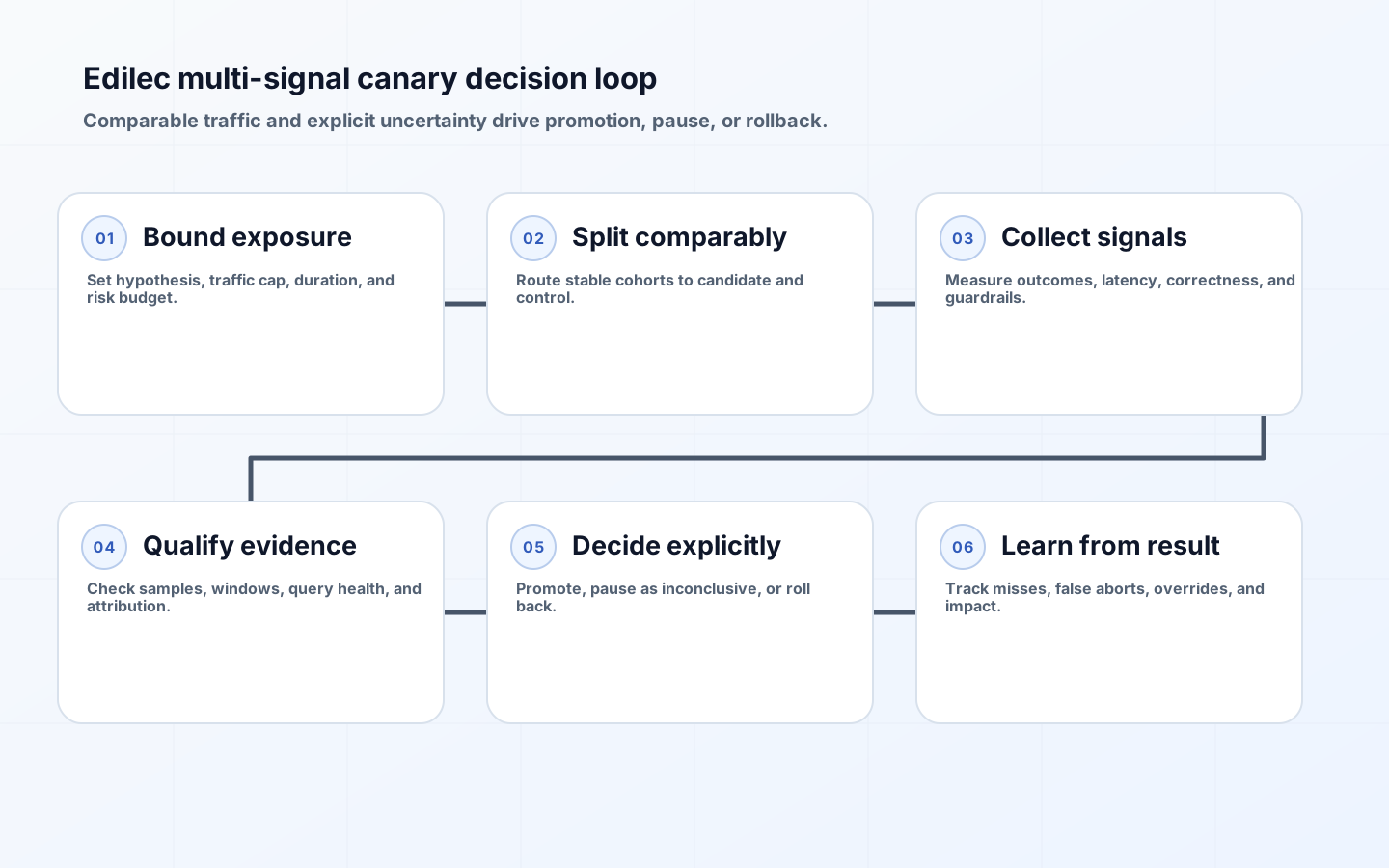
Automated canary analysis is a release decision system, not a traffic-shifting timer. It exposes an immutable candidate to a bounded production population, compares attributable evidence with a concurrent control, and chooses promote, hold, or abort. The hard work is not configuring 5, 25, and 50 percent steps. It is selecting signals that represent customer harm, setting windows that contain enough observations, controlling confounders, and deciding what missing or contradictory evidence means before a release is underway.
Google's Canarying Releases defines canarying as a partial, time-limited deployment and evaluation. It recommends metrics that indicate real problems, are representative, and are attributable to the candidate, with a simultaneous control preferred over risky before-and-after comparison. Automation should encode those principles while preserving a visible human override. A controller that promotes on silence or aborts on every noisy metric will quickly lose operator trust.
State the release hypothesis and risk budget
For each service, write what the canary is intended to prove: the candidate does not materially worsen successful customer outcomes, latency, correctness, dependency health, or resource saturation under representative traffic. Set maximum exposed traffic, maximum observation time, and maximum acceptable error-budget spend. A candidate that could corrupt durable state needs a much smaller first cohort and shadow or read-only checks; a stateless UI change can tolerate a larger sample. Specify rollback time because exposure multiplied by failure rate and mitigation delay determines customer cost.

| Signal | Role | Comparison | Decision use |
|---|---|---|---|
| Successful user outcome | Primary | Candidate versus control and SLO | Fail on material degradation |
| Latency distribution | Primary | Comparable routes and cohorts | Fail on tail regression |
| Business correctness | Primary | Invariant or reconciliation | Immediate abort |
| Dependency errors | Guardrail | Per candidate request | Abort before propagation |
| CPU, memory, queue | Guardrail | Normalized by work | Hold or abort near saturation |
| Novel exception | Diagnostic | Candidate release label | Investigate with minimum count |
Create comparable candidate and control populations
Route by a stable unit such as account, session, region, host, or work item, and keep that unit on one variant when state or caching matters. Random request routing can mix a user's workflow and contaminate both populations. Balance geography, tenant tier, device, route, and load where these influence outcomes. Run candidate and control concurrently so time-of-day, dependency incidents, and traffic composition affect both. Avoid overlapping canaries on the same service because attribution becomes ambiguous; serialize releases or use disjoint cohorts with clear labels.
Instrumentation must carry release identity from edge through important dependencies. Query candidate and control using the same aggregation, filters, and windows. Exclude expected user-caused failures consistently, but do not filter away a new candidate behavior merely because its status code is client-facing. Normalize resource metrics by requests or completed work when traffic differs. Protect against cardinality growth by using bounded release labels and expiring them after the analysis-retention period.
Select a small set of multi-signal guardrails
Begin with two or three customer SLIs and a few guardrails, generally fewer than a dozen signals. Every metric needs an owner, query, expected direction, minimum sample, success condition, failure condition, missing-data behavior, and rationale. Hard invariants such as data corruption, authorization bypass, crash loops, or incompatible schema errors should abort immediately. Customer outcome and latency deserve strong weight. CPU increases may be acceptable when headroom remains; treat them as hold conditions or bounded regressions rather than equal votes with failed checkouts.
| Condition | Minimum evidence | State | Action |
|---|---|---|---|
| Correctness invariant fails | One verified event | Failed | Abort and isolate writes |
| Candidate error ratio materially above control | Minimum events and two intervals | Failed | Rollback traffic |
| All primary signals pass | Required samples and consecutive successes | Successful | Advance one step |
| Guardrail near capacity | Two intervals | Inconclusive | Pause for review |
| Metric missing or query errors | Configured consecutive failures | Inconclusive or failed | Never promote on silence |
| Control also breaches SLO | Concurrent evidence | System incident | Stop release and respond |
Choose windows and thresholds from traffic
Duration follows event volume and failure latency. A high-throughput endpoint may reveal an error regression in minutes, while a daily workflow cannot be judged after a ten-minute pause. Require minimum counts in addition to time. Use a warm-up delay for startup, cache fill, JIT compilation, or metric ingestion, but keep warm-up exposure small and retain hard safety checks. Analysis intervals must be no longer than the stage they evaluate, and queries should not include pre-canary history. Compare distributions or meaningful ratios rather than averages that hide tail failures.
Choose absolute and relative limits together. Candidate must remain within the service SLO or safety boundary even when control is unhealthy, and must not degrade materially relative to control when both are within bounds. Tune thresholds from historical good and bad releases, not from convenient round numbers. Backtest queries across incidents, traffic troughs, deploys, and ordinary variance. Track false aborts, escaped bad releases, time to decision, and error budget consumed before rollback, then change one policy element at a time.
Encode pass, fail, and inconclusive states
Argo Rollouts analysis templates define metric providers, intervals, success and failure conditions, failure limits, consecutive-success requirements, delays, and inconclusive outcomes. An inconclusive state is essential when a value meets neither condition, traffic is insufficient, or evidence conflicts. It should pause and request a time-bounded human decision, not quietly become success. Limit retries so a broken query cannot leave a canary serving forever. Set analysis-run TTL separately from audit evidence retention.
Flagger's metrics analysis similarly supports thresholds, intervals, and custom metric templates. Whichever controller is used, version analysis templates with the service, review query changes, test them against a staging metric endpoint, and pin provider behavior. Make controller identity least-privileged: it needs permission to shift traffic and revert the rollout, not broad cluster administration. Emit an event for every measurement and transition with candidate digest, query version, result, and reason.
Design rollback and human override together
Abort should immediately stop further promotion, route new traffic away from the candidate, and verify recovery. Decide whether in-flight work drains, is retried, or remains pinned. Application rollback cannot undo sent messages, writes, or third-party side effects, so use backward-compatible schemas, idempotency, and separate write canaries where needed. Keep the last known-good artifact deployable and test reversal latency. Page only when human action is required; routine automated rollback can create a ticket with evidence unless customer impact persists.
A human may promote, extend, or abort an inconclusive run, but the interface must show signal values, sample counts, control comparison, SLO state, and estimated exposure. Require reason and identity, and disallow bypass for hard safety failures without a separate emergency authority. Overrides expire at the next stage rather than disabling analysis for the entire rollout. If operators regularly override one metric, improve or remove that metric; habitual bypass is evidence that the automated policy no longer represents risk.
Operate canary analysis as a measured program
Roll out automation in shadow mode. Let humans make release decisions while the engine records what it would have done, then investigate disagreements. Introduce automatic abort for high-confidence invariants first, automatic promotion for well-understood high-volume services next, and retain manual gates for sparse or irreversible workflows. Rehearse metric absence, control outage, controller restart, rollback failure, and conflicting signals. Keep a manual traffic control path that does not depend on the analysis provider.
Review the program quarterly and after every release incident. Measure bad candidates detected, bad candidates missed, good candidates falsely stopped, analysis availability, median decision time, manual override rate, rollback completion, and customer impact contained. Prometheus alerting practices emphasize actionable symptoms and useful context; apply the same discipline to canary notifications. Remove low-value metrics and add a new signal only when a real failure mode justifies its maintenance cost.
Automated canary analysis key takeaways
- Define the release hypothesis, exposure limit, and rollback time before choosing traffic steps.
- Compare candidate and control concurrently using stable cohorts and release-aware telemetry.
- Prioritize customer outcomes and correctness; use resource signals as contextual guardrails.
- Require minimum event counts, explicit missing-data policy, and an inconclusive state.
- Combine relative comparison with absolute SLO and safety boundaries.
- Measure false aborts, escaped releases, overrides, and error-budget cost to improve the policy.
Automated canary analysis FAQ
How many metrics should a canary use? Usually a focused set below a dozen. More signals increase query failures, false positives, and maintenance. Add only metrics tied to a credible release failure and a clear action.
Should missing data pass or fail? It should never silently pass. Classify it as inconclusive for a bounded retry or fail when the signal is mandatory and absence may indicate broken instrumentation or no serving candidate.
Can low-traffic services automate promotion? Yes, but they need longer windows, synthetic transactions, larger cohorts, or workflow-specific evidence. Some releases will still need a manual decision because the sample cannot support a confident automated conclusion.
Conclusion
Safe progressive delivery comes from bounded exposure and trustworthy decisions, not from a fashionable rollout shape. Comparable populations, a concise signal hierarchy, traffic-aware windows, explicit uncertainty, absolute guardrails, rapid rollback, and measured overrides let a controller distinguish evidence from noise. Automate gradually, audit every decision, and keep canary policy aligned with the customer outcomes the service exists to protect.