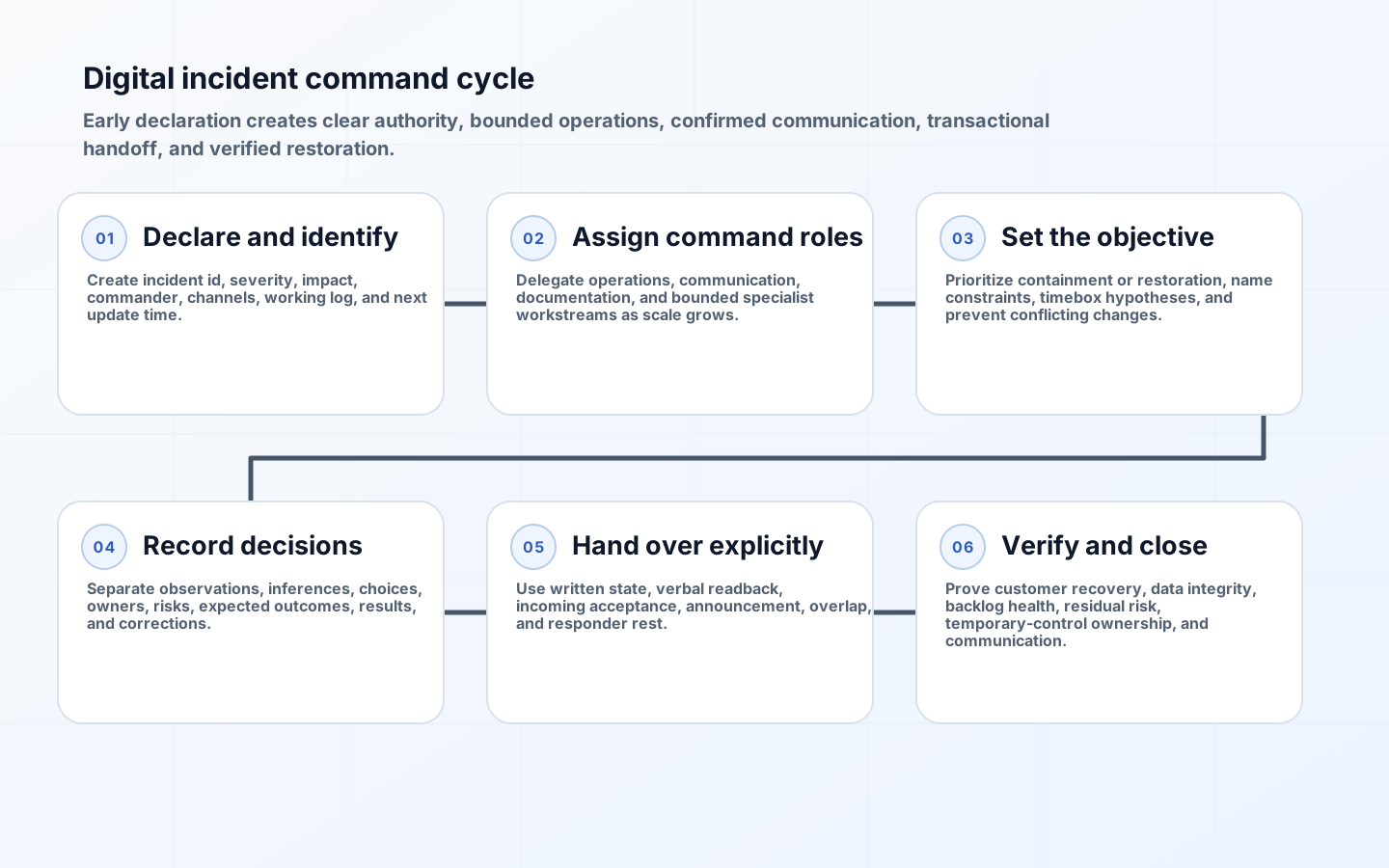
Incident command for IT separates managing the response from diagnosing the technology. During a major digital-service incident, dozens of capable people can slow restoration if authority, objectives, communication, and work ownership are unclear. Engineers repeat tests, leaders interrupt for updates, changes collide, and an exhausted responder carries critical context in memory. A lightweight command structure protects attention and makes the response legible.
The structure should scale with the incident. One responder can hold all roles initially; as impact and participation grow, the incident commander delegates operations, communications, documentation, and specialized workstreams. Command does not require the most senior person or deepest subject-matter expert. It requires someone able to maintain customer-impact awareness, establish objectives, authorize coordinated action, and hand authority over explicitly.
Declare early and establish one clear command line
Define declaration criteria before the event: broad or severe customer impact, safety or security concern, uncertain cross-service failure, sustained SLO burn, regulatory notification possibility, data integrity risk, or coordination beyond one team. Any responder should be able to declare under a bias toward early structure. Declaration creates an incident id, severity, commander, channel, bridge, working log, affected services, known impact, and next update time.
Google's Incident Response chapter emphasizes a clear command line, defined roles, a working record, and early declaration. Its model is adapted from the Incident Command System and identifies Incident Commander, Communications Lead, and Operations Lead. Use common language but tailor the depth. A two-person incident does not need bureaucracy; it does need an acknowledged decision owner and one current source of truth.
| Role | Accountability | Should avoid | Handoff evidence |
|---|---|---|---|
| Incident Commander | Impact, objectives, priorities, role assignment, escalation, close decision | Deep solo debugging and writing every update | Current state, objectives, risks, decisions |
| Operations Lead | Coordinates technical workstreams and mitigation execution | Unapproved conflicting changes | Hypotheses, actions, results, next probes |
| Communications Lead | Internal, customer, support, legal, and executive updates | Speculation and unreviewed root cause | Audience cadence, issued messages, pending approvals |
| Scribe or Planning | Timeline, decisions, action ownership, resource picture | Turning the log into a transcript of chatter | Structured chronology and open items |
| Subject-matter lead | Owns a bounded technical objective | Expanding scope without reporting | Workstream state and evidence |
Set objectives, workstreams, and an operational cadence
The commander maintains a short incident action plan: customer impact, current severity, safety and data risks, immediate objective, active workstreams, constraints, next decision point, and communication cadence. The first objective is usually containment or restoration, not complete root-cause proof. A reversible traffic shift can be preferable to a speculative code fix. State stop conditions and rollback for every material action.
The operations lead assigns bounded workstreams such as recent-change review, dependency health, capacity, data integrity, mitigation, and customer verification. Each has one lead, objective, timebox, and reporting path. Cap simultaneous speculative actions because interacting changes destroy evidence. Require teams to report observation, inference, action, result, and recommendation separately. The commander resolves contention for shared systems and scarce experts.
Maintain a concise timeline and decision log
Use a durable incident record independent enough to survive the affected service. Capture timestamps with zone, author, observed customer impact, alerts, declarations, role changes, hypotheses, decisions, commands or change references, expected outcome, actual result, communication, and recovery evidence. Link to dashboards and tickets rather than pasting uncontrolled sensitive data. Preserve raw logs under normal retention and access policy; the command log is an operational index, not a forensic dumping ground.
Mark facts, hypotheses, and decisions distinctly. A useful entry reads: 14:22 UTC - Decision: shift 25% of checkout traffic from region A to B; owner N.; rationale: region-A database saturation; guardrail: region-B CPU below 70%; rollback if errors rise; review at 14:32. This supports concurrent understanding and later learning. Avoid silently editing earlier beliefs; append corrections so the evolution of evidence remains clear.
| Entry type | Required content | Example purpose | Anti-pattern |
|---|---|---|---|
| Observation | Time, source, measured fact | Errors concentrated in one region | Unattributed screenshot |
| Hypothesis | Claim, supporting and contradicting evidence, owner | Connection exhaustion may drive timeouts | Stating cause as fact |
| Decision | Choice, authority, rationale, risk, review time | Disable new feature for affected cohort | Action with no owner |
| Action result | Change reference, expected and measured outcome | Rollback reduced errors but not latency | Only saying done |
| Communication | Audience, approved message, delivery time | Customer update issued | Different facts per channel |
| Role or handoff | Outgoing and incoming acknowledgement | New commander assumes authority | Quiet shift change |
Communicate confirmed impact, action, and update time by audience
The communications lead establishes templates and cadence for responders, support, executives, customers, legal, regulators, and partners. Each update states what users are experiencing, scope and start time if known, what the team is doing, available workaround, and next update. Do not publish a root cause during response unless confirmed and approved. Say what is unknown. Align status-page components with real customer journeys rather than internal host health.
Keep the technical channel usable by routing broad questions through command or communications. Leaders need impact, risk, decisions, and requested help, not a stream of debug output. Customer support needs symptoms, affected segments, safe workarounds, and what not to promise. Security, privacy, safety, and legal teams should be activated by predefined triggers. NIST SP 800-61 Rev. 3, published in April 2025, places incident response within broader cybersecurity risk management and should inform cyber-specific escalation and recovery obligations.
Execute command and workstream handoffs as transactions
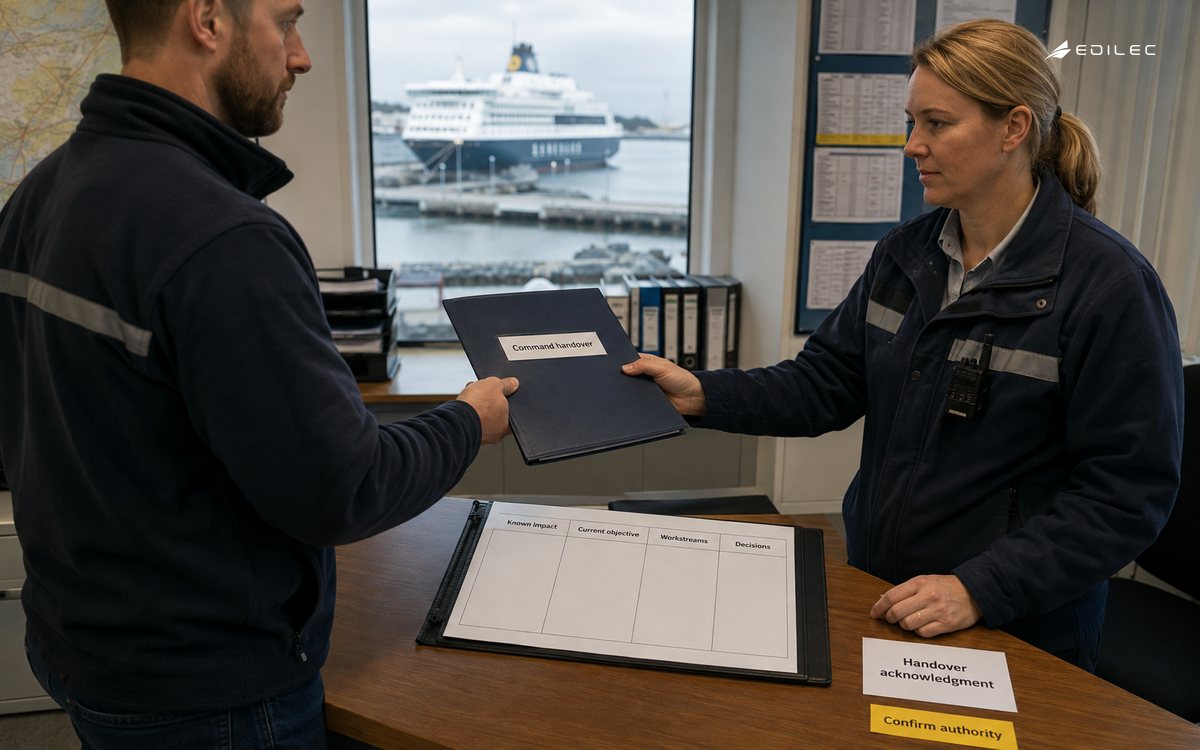
Set maximum sustainable role duration and identify relief before fatigue becomes acute. The outgoing commander prepares a verbal and written handoff: incident identity, impact, severity, objectives, roles, system state, confirmed facts, active hypotheses, changes in flight, risks, stakeholder commitments, next update, and decisions due. The incoming commander reads back priorities, asks questions, and explicitly accepts command. Announce the transfer with time in every command channel.
Handoff technical workstreams similarly. Do not transfer only a chat link. Include queries run, dashboards, access, mitigations, failed paths, current hypothesis, unsafe actions, and next discriminating test. Keep outgoing personnel available for a short overlap, then release them to rest unless a unique emergency need remains. FEMA's NIMS command and coordination overview provides the public-sector origin for scalable command concepts; digital teams can adopt clear authority and modular roles without copying field operations literally.
Verify recovery, scale down, and close command deliberately
Mitigation is not closure. Verify user-facing indicators, synthetic transactions, backlog drain, data integrity, dependency health, affected regions and cohorts, and support signals over a defined observation period. Confirm temporary controls, disabled features, traffic shifts, and manual workarounds are documented with owners and expiry. Decide whether the service is restored, degraded but stable, or still active. Communicate status accurately.
The commander closes or downgrades the incident, records end time and residual risk, assigns post-incident owner, and transfers open operational work to normal systems. Preserve evidence and access history. Schedule an appropriate review, but do not demand a polished root cause before responders rest. Google's Managing Incidents chapter reinforces role delegation and preparation. Exercise the command process with realistic scenarios, including communications failure and shift handoff, then update the playbook.
Exercise command failure, not only technical failure
Design simulations that force role scaling and handoff: the first commander loses connectivity, the primary chat service is affected, an executive requests an unverified estimate, two mitigations compete for the same database, and the incident crosses a shift boundary. Observers should score declaration time, impact statement, role clarity, objective quality, decision logging, change collision, update accuracy, handoff readback, and recovery verification. Do not score whether participants guessed a hidden root cause quickly.
After the exercise, update contacts, access, templates, alternate channels, role cards, and tooling. Track actions with owners and proof, then rerun the weak transition. Include customer support, communications, security, legal, and vendors when their decisions matter. A tabletop can test authority and notification, while a controlled technical game day tests whether commands, rollback, telemetry, and alternate communication paths actually work under realistic latency and partial failure.
Incident command takeaways
- Declare early when impact or coordination exceeds one responder and assign one commander.
- Separate command, technical operations, communication, and documentation as participation grows.
- Set a mitigation-first objective and bound every workstream with one lead and reporting path.
- Keep facts, hypotheses, decisions, actions, and results distinct in a durable log.
- Transfer command through a written and verbal readback with explicit acceptance and announcement.
- Close only after user recovery, data integrity, residual risk, and temporary controls are verified.
Incident command for IT FAQ
Must the incident commander be the most senior engineer?
No. The commander needs authority appropriate to the event, command skill, and enough technical literacy to coordinate decisions. A deep specialist is often more valuable leading a technical workstream. Senior leaders can remove constraints without taking command.
What if an incident is declared too early?
Scale it down or close it with a short record. The cost of briefly applying structure is usually lower than delaying coordination during a broad incident. Tune declaration criteria from exercises and real events rather than discouraging reasonable early calls.
Is the chat transcript enough as an incident log?
No. Chat contains noise, parallel threads, edits, and missing decisions. Retain it under policy, but maintain a concise timeline and decision record that points to technical evidence and names owners, rationale, action, and result.
Conclusion
Incident command gives responders a stable way to think together under pressure. One line of authority, delegated work, audience-specific communication, a decision-quality log, and explicit handoffs reduce coordination load while specialists restore service. Practiced before the outage and scaled to the event, the structure preserves both speed and accountability without turning response into ceremony.