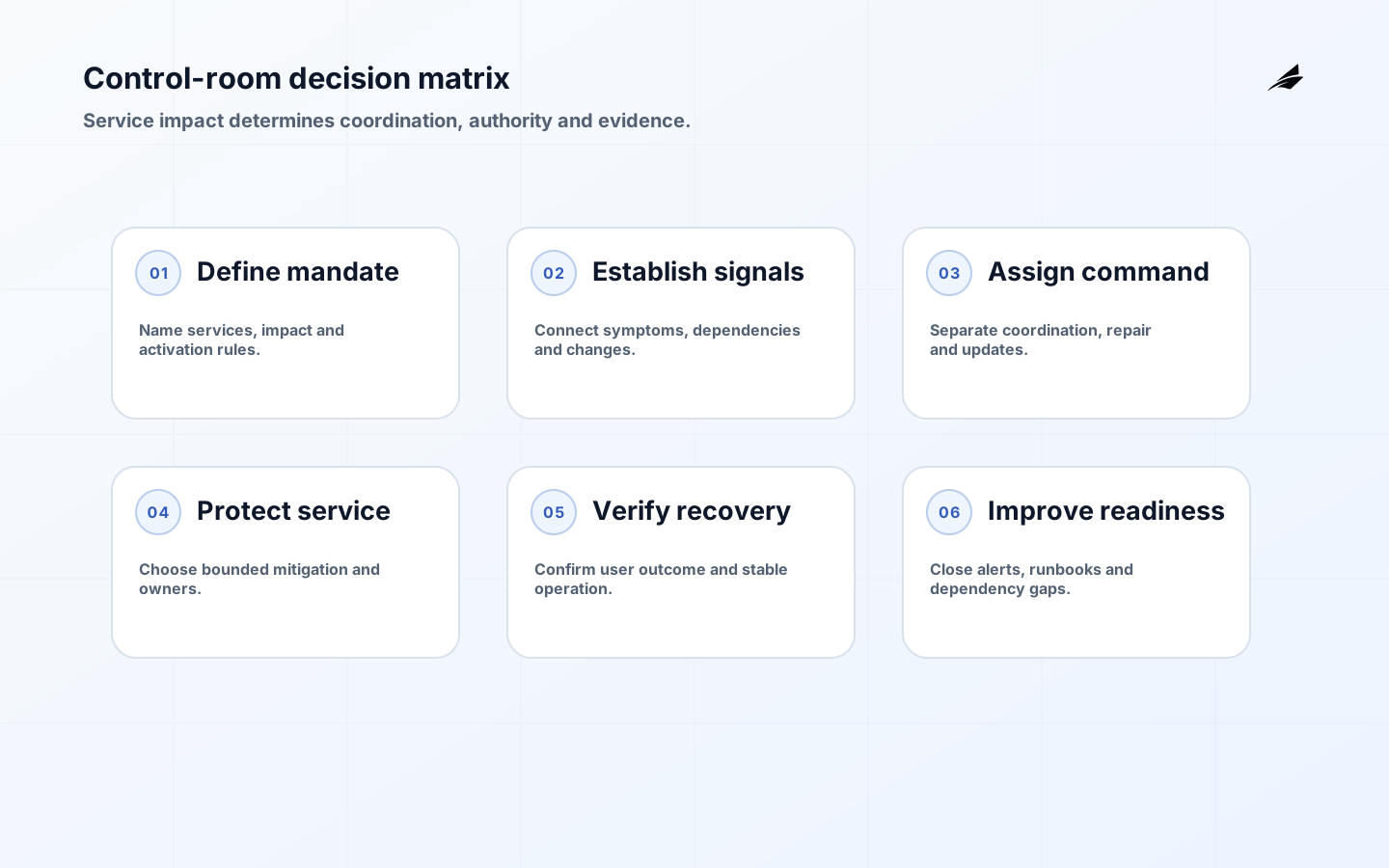
Operations control rooms work when they shorten the path from a material signal to a coordinated decision. A wall of dashboards, a dedicated channel and a senior audience do not create control by themselves. The room needs a defined service boundary, current ownership, trustworthy evidence, decision rights and a way to record what was tried. It must support quiet operational review as well as high-pressure incidents without turning every anomaly into an emergency.
Treat the control room as an operating capability rather than a physical place. It may be a virtual incident workspace, a staffed network center or a temporary command structure. The operations control room playbook covers response routines, while the production incident response guide provides complementary recovery and learning practices.
Key takeaways
- Organize the room around customer and business services, not tool ownership.
- Page on actionable symptoms with a named responder and runbook.
- Separate incident command, technical work, communications and evidence capture.
- Use one current timeline and decision log during a response.
- Rehearse degraded telemetry, unavailable experts and long-running incidents.
Define the mandate and entry criteria
State what the room controls and what it only observes. A digital operations room may coordinate customer-facing service degradation, critical batch failures, security events and third-party outages, but it may not own the underlying applications. Define activation thresholds through impact: affected customers, unavailable capability, financial exposure, safety concern, data integrity or regulatory deadline. A threshold based only on CPU or ticket volume invites noise and misses subtle business failure.
Create a service register containing the customer promise, owner, support hours, dependencies, recovery objective, status channel and escalation route. Ownership must be current at 3 a.m., not merely correct on an architecture slide. The enterprise control room guide can help connect this register to broader business-system operations.
| Situation | Control-room posture | Required authority |
|---|---|---|
| Normal service | Review trends, readiness and recurring exceptions | Service owner |
| Single-service degradation | Assign lead, validate impact and coordinate mitigation | Incident commander |
| Cross-service incident | Activate shared command, communications and dependency owners | Major-incident commander |
| Suspected security event | Preserve evidence and invoke security response | Security incident lead |
| Recovery complete | Validate customer outcome and assign follow-up | Service owner and incident lead |
Design telemetry for decisions, not decoration
Start with service-level symptoms: can users complete the critical action, within the expected time, with correct data? Then add dependency signals that explain likely causes. Google SRE's monitoring guidance distinguishes urgent, actionable alerts from diagnostic information. A page should mean that a person must act now. A dashboard may carry richer context, but every prominent measure still needs an owner, expected range and response.
Correlate traces, metrics and logs rather than asking responders to align timestamps manually. The OpenTelemetry signals model describes these complementary views. Propagate request and business identifiers across service boundaries, but avoid placing secrets or unnecessary personal data in telemetry. Also monitor the monitor: missing data, delayed collection and an expired synthetic-test credential are operational states, not proof that the service is healthy.
| Signal class | Question answered | Example response |
|---|---|---|
| Customer symptom | Is a promised action failing? | Declare impact and protect users |
| Service level | Is reliability consuming its allowed tolerance? | Slow change and investigate |
| Dependency | Which boundary is degraded? | Engage the owning team or supplier |
| Change | What recently altered the system? | Pause rollout or compare versions |
| Telemetry health | Can current evidence be trusted? | Switch to independent checks |
Assign response roles before pressure arrives
One person should coordinate the incident without simultaneously leading every technical investigation. Use explicit roles for incident command, operations or technical lead, communications and scribe; add domain specialists as needed. Google SRE's incident response chapter emphasizes structured coordination and clear communication. Record role transfers so a long incident does not depend on an exhausted responder or an ambiguous handoff.
Keep one decision log with timestamps, owners, evidence and expected result. Technical discussion can occur elsewhere, but decisions should return to the common record. Declare what is known, inferred and unknown. Set the next update time even when there is no resolution. Customer and executive communication should describe impact and action without publishing speculative causes. The commander's job is to maintain a coherent response, not to reward the most confident theory.
Make on-call and escalation sustainable
A control room that depends on one expert is a queue with impressive screens. Define primary and secondary rotations, escalation delay, coverage boundaries and fatigue limits. Google SRE's on-call guidance connects response duties with diagnosis, mitigation and escalation. Give responders access to current runbooks, service ownership, safe operational tools and recent change information before they enter the rotation.
Review pages that did not require action, alerts that arrived after users complained, repeated manual mitigations and follow-up work that never closed. Do not measure responders by incident count or mean time alone; those numbers can encourage premature closure. Track detection delay, time to protective action, communication timeliness, handoff quality, repeated causes and the age of corrective actions. The case management security review offers useful patterns for controlled evidence and ownership.
Run a control-room readiness exercise
Choose a scenario that crosses boundaries: checkout latency rises after a release while the primary dashboard is delayed and the payment provider reports normal status. Inject evidence gradually. Observe whether the team declares impact, assigns command, protects customers, finds an independent signal, records decisions and communicates. Add a shift handoff and an unavailable subject-matter expert. The objective is to expose coordination assumptions, not to test whether people guess the scripted root cause.
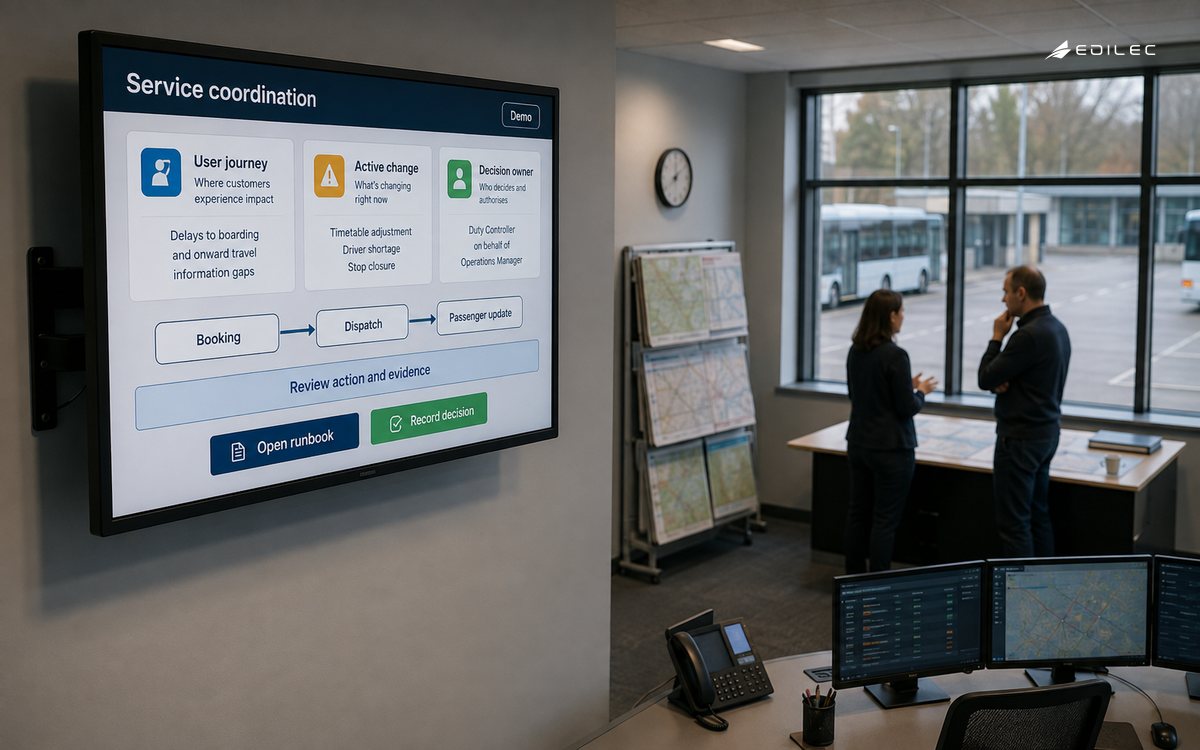
After the exercise, separate immediate readiness gaps from deeper engineering work. Fix broken contacts, missing access and unusable runbooks quickly. Assign larger work, such as adding an end-to-end probe or removing a fragile dependency, to a visible backlog with accountable dates. NIST's Cybersecurity Framework 2.0 is a useful lens because governance, identification, protection, detection, response and recovery remain connected rather than becoming isolated teams.
Design the working surface and decision rhythm
Build the room around a small set of operational objects: active incidents, service health, recent risky changes, unresolved exceptions, supplier status and corrective actions. Each object needs a canonical owner and source. A copied screenshot may help communication, but it should not become the only record of a changing incident. Link the service view to the current timeline, runbook, dependency map and change record so a responder can move from symptom to accountable action without opening a dozen unrelated tools.
Use a deliberate rhythm during an incident. At activation, state impact, commander, technical lead, communication owner and next update time. At each checkpoint, review what changed, whether the mitigation achieved its expected result, which risks remain and who owns the next action. For a prolonged event, schedule handoffs before fatigue dictates them. The incoming team should receive current service impact, actions attempted, evidence still trusted, temporary changes in force and decisions that must not be repeated without new information.
Decision thresholds should make reversible protection easier. A traffic shift, feature disablement or queue pause can be pre-authorized within defined limits, while destructive data repair, broad credential rotation or regulatory communication may require additional authority. Document the trigger, expected benefit, known side effects, verification window and rollback condition for each common mitigation. This gives the commander useful choices without pretending that every incident can be reduced to an automatic runbook.
Consider a payroll integration that stops acknowledging outbound files on a deadline day. The control room should first confirm employee and payment impact, preserve the rejected file and correlation identifiers, and prevent duplicate submissions. One owner engages the supplier while another validates whether a bounded manual path is authorized. Communications states what is delayed without exposing employee data. Recovery is complete only after accepted files, payroll totals and downstream confirmations reconcile, not when the integration endpoint merely returns to green.
Keep routine review distinct from incident command. A daily or weekly service review can examine error budgets, recurring exceptions, capacity risks and overdue actions without declaring an incident. When activation criteria are met, open a separate record, assign roles and increase the update cadence. After recovery, move corrective work back into normal governance with service owners and due dates. This separation protects attention: teams can study weak signals thoughtfully while preserving a clear mode for urgent, authoritative coordination.
Operations control room checklist
- Critical services have current owners, dependencies and impact definitions.
- Activation thresholds are based on user or business consequence.
- Pages are actionable and route to staffed responders with usable access.
- Incident command, technical lead, communications and scribe roles are documented.
- A single timeline records decisions, actions, evidence and handoffs.
- Independent checks exist for telemetry and provider failure.
- Exercises include long duration, missing expertise and communication pressure.
- Corrective actions are reviewed until verified or deliberately accepted.
Frequently asked questions
Does an operations control room need a physical room?
No. Co-location can help in some environments, but shared authority, communications, evidence and roles matter more. A virtual room can work well when its tools remain available during an incident and participants know where decisions, status and handoffs are recorded.
How many dashboards should the room display?
Use the fewest views needed to orient responders around impact, major dependencies and active change. Diagnostic views should be discoverable rather than permanently competing for attention. Retire a dashboard when nobody can name the decision it supports or the owner who corrects it.
What proves the control room is effective?
Evidence includes earlier recognition of real impact, faster protective action, clearer updates, fewer ownership gaps and completed prevention work. Review incident samples alongside measures. A lower average response time can hide one severe event, while a higher count can reflect improved detection rather than worse reliability.
Conclusion
A useful operations control room turns fragmented signals into accountable decisions. Define its mandate, orient telemetry around service impact, assign roles and preserve a shared record. Rehearse the difficult conditions that dashboards cannot solve. The result is not a command center aesthetic; it is a calmer, more reliable way to protect and restore important services.