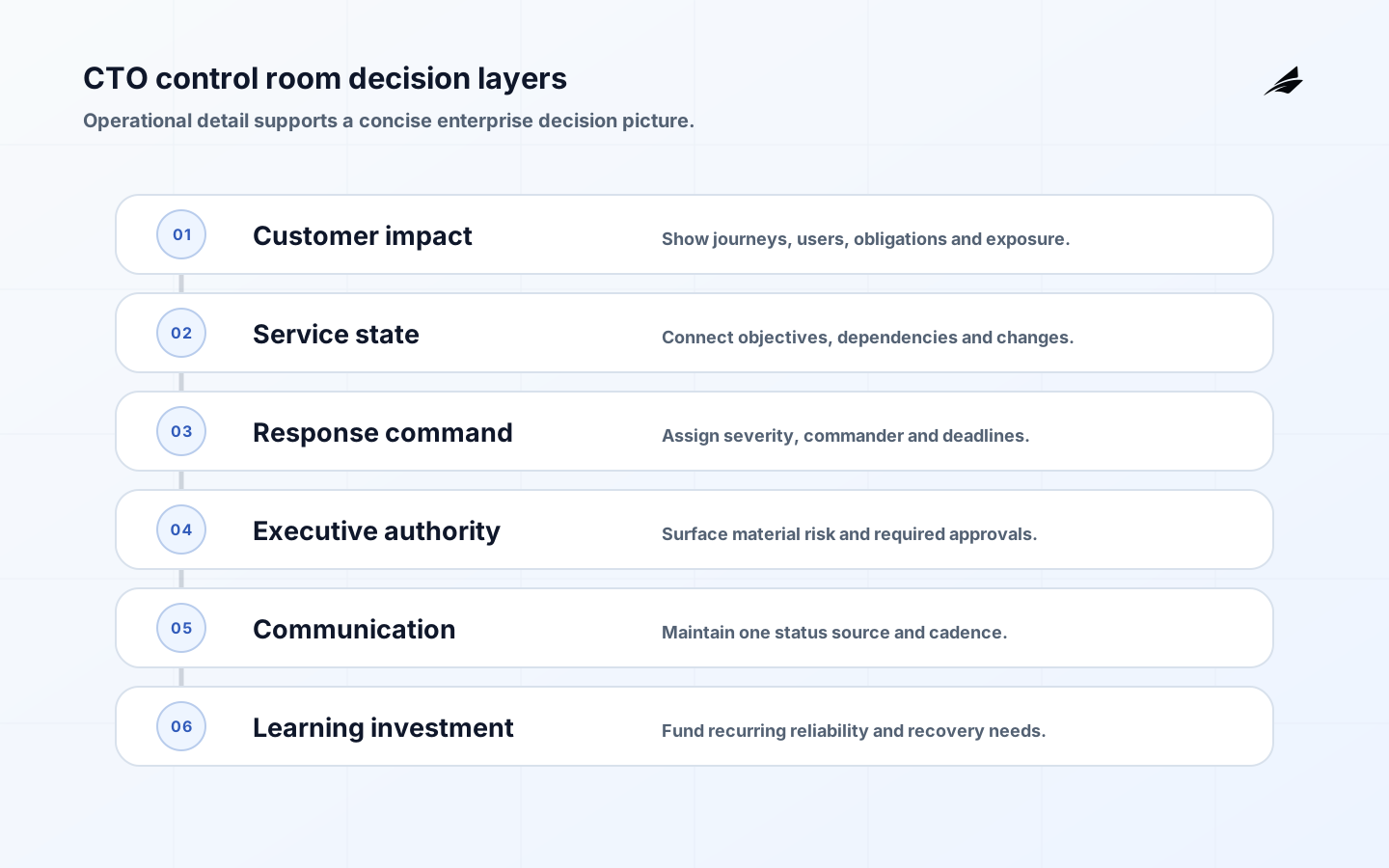
A control room should make a customer-impacting service state, its owner, dependencies, and next decision visible. It is not a wall of charts. Define normal, degraded, unavailable, and unknown before deciding which telemetry deserves prominence. For CTOs, the first useful scope is one valuable path with an explicit correction boundary, not a broad platform replacement.
Edilec’s ticketing workflow checklist covers ownership, the service delivery systems guide explains integration, and the workflow exceptions guide handles cases normal automation cannot resolve.
Define service states before selecting a dashboard
Choose one critical customer journey and define the states leadership and responders must distinguish. For checkout, those might be healthy, impaired, unavailable, recovering, and unverified. Each state needs observable entry conditions, an accountable service owner, an incident authority, and a rule for moving back to normal. Identify the source of truth for impact, the timestamp that starts the shared incident clock, and the evidence needed to declare recovery. Also specify what the room will not manage, such as routine tickets that have no service-level impact. This narrow definition keeps the first control-room view oriented toward decisions and exposes gaps in ownership or telemetry before additional services make the ambiguity harder to see.
| Decision | Working rule | Evidence to retain |
|---|---|---|
| Critical journey | Which user outcome is important enough for coordinated response | Journey owner, included services, business threshold, and exclusions |
| Shared state | Which conditions mean healthy, impaired, unavailable, recovering, or uncertain | Calculation, data freshness, state history, and declaration role |
| Decision rights | Who declares severity and authorizes containment, rollback, communication, or risk acceptance | Named incident roles, delegation limits, and executive escalation |
| Recovery proof | How the team confirms that the journey—not merely a component—is stable | Verification check, observation window, residual risk, and closure owner |
Build a signal model for decisions, not spectacle
Separate metric collection, alert evaluation, diagnostic evidence, visualization, and response coordination. Link alerts to service ownership, current changes, and runbooks so responders do not reconstruct basic context during an incident.
Rehearse checkout latency after a configuration rollout while a tax provider is unstable. The room should reveal journey impact, dependency condition, incident lead, communications, and recovery verification rather than a flood of derivative alerts.
| Failure mode | Design response | Review signal |
|---|---|---|
| Journey error rate crosses its material threshold | Open coordinated response and group derivative alerts under one incident | Affected attempts, regions, value, and time of first breach |
| External dependency becomes slow or unavailable | Show contractual fallback and the service owner able to reduce exposure | Dependency calls, timeouts, fallback use, and supplier update time |
| Recent change correlates with impact | Present release and configuration history with bounded rollback authority | Changed digest or version, cohort, approver, and rollback observation |
| Telemetry is contradictory or missing | Declare the state uncertain and run a verified user-journey check | Missing signals, synthetic result, sampling evidence, and investigation owner |
Use evidence and controls deliberately
Ground control-room permissions and evidence in established guidance. The NIST Cybersecurity Framework helps leadership make governance, response, and recovery responsibilities explicit. The NIST Privacy Framework supports decisions about why customer or employee data is displayed and who needs it during response. Use OWASP ASVS when implementing privileged mitigations, authorization checks, and audit records. Google's monitoring guidance is valuable for distinguishing a page-worthy symptom from the diagnostic details used after someone responds. Convert those ideas into organization-specific roles, thresholds, retention choices, and tested controls; adopting framework vocabulary alone does not make an incident action safe.
- Define material impact and uncertain state for each critical journey before selecting panels or alert rules.
- Use one incident clock, service catalog, change history, and decision record across executive and responder views.
- Grant mitigations through narrow roles with visible limits, confirmation, and a reliable reversal route.
- Protect sensitive traces and customer details while retaining enough evidence for investigation and communication.
- Close an incident only after journey-level verification and assigned follow-up, not because one graph returned to baseline.
Coordinate response and recovery in one operating record
Keep coordination in a durable incident record rather than distributing the story across chat, dashboards, tickets, and memory. It should carry the incident identifier, declared state, affected journeys, start time, current lead, hypotheses, decisions, mitigations, communications, and recovery checks. Link supporting telemetry and traces without copying unrestricted data into a broadly visible room. Every action needs an owner and next update time; superseded claims should remain visible as history. Exercise dependency loss, delayed data, a failed rollback, and disagreement over impact so the team learns how uncertainty is declared and resolved. The ticketing workflow checklist helps connect this incident record to accountable follow-up after the immediate response ends.
Design separate surfaces from the same operating facts. Responders need current symptoms, topology, dependency behavior, recent changes, diagnostic links, and only the mitigations their role permits. Support needs customer-safe status, affected products, known workarounds, and an escalation route without privileged controls or private traces. Executives need material exposure, response ownership, major choices, communication commitments, and the next verification point. A privacy or security reviewer may need access provenance and evidence preservation. Synchronize definitions and timestamps while limiting data and action by role. When an incident policy changes, update role grants, runbooks, interface language, integrations, and exercises together so the visible control room does not instruct people to follow a retired authority model.
Measure detection, learning, and dependency health
Measure whether the room shortens uncertainty and improves decisions. Useful indicators include material incidents first found by customers, actionable-page rate, detection and acknowledgement delay, time to an authorized containment choice, time to verified journey recovery, and communication delivered against commitment. Track how often missing ownership, stale runbooks, absent change data, or weak dependency signals delay response. Review follow-up completion and recurrence by causal theme, not just raw incident counts. Discuss the evidence with on-call engineers, service owners, support, security, communications, and business leaders. If results worsen, repair the signal, authority, integration, or practice that created delay instead of treating faster individual effort as the only remedy.
| Signal | Question it answers | Action when it worsens |
|---|---|---|
| Customer-reported detection | Did the organization learn about material impact after affected users did? | Close the missing journey coverage or threshold and assign its signal owner |
| Unactionable pages | Did a notification lack ownership, impact, or a credible next check? | Remove or regroup noise and improve routing and runbook context |
| Mitigation decision delay | Was authority or evidence missing when the team needed to contain harm? | Clarify bounded decision rights and rehearse the disputed scenario |
| Recovery re-opened | Did the declared stable state fail journey verification or regress soon afterward? | Strengthen closure checks, observation window, and dependency confirmation |
Build a controlled first release
Launch around one journey whose failure has a known business consequence and an existing service owner. Include the engineers who operate its components, the leader who accepts customer risk, support staff who hear impact first, and the communication path. Agree on state thresholds, incident roles, safe mitigations, required evidence, and recovery confirmation. Limit the first version to the signals and actions necessary for those choices. Real traffic and dependencies must be represented, but the surface should remain small enough that the team can inspect why every panel, alert, and permission exists.
Write acceptance tests as incident stories. A material journey breach should create one correlated incident, assign the correct lead, show the current release and dependency state, and start the common clock. A responder with the right role should be able to execute a bounded mitigation, while an unauthorized viewer is denied. Support and executive views should update from the same declared state without exposing restricted diagnostics. A recovery declaration must cite a successful journey check and observation period. Include missing telemetry, a false alert, ambiguous ownership, and a policy change so the team proves how uncertainty is handled rather than demonstrating only a perfectly instrumented outage.
Run a game day in which the obvious mitigation does not work. Make a supplier update late, remove one telemetry source, and cause rollback to fail its first check. Observe how responders declare uncertain impact, obtain extra authority, choose an alternative containment, protect evidence, and revise communications. Require every attempted change to record scope and result. The exercise should finish through a customer-level verification route and produce specific owners for gaps. This is the proof that the room supports judgment when the normal runbook stops being enough.
Review a deliberately varied incident sample each month: one quickly contained event, one protracted diagnosis, one false or noisy activation, and one near miss. Reconstruct the moment each material decision was made. Was journey impact visible? Did the right owner have authority? Were change and dependency facts current? Did support and executives receive a consistent, understandable state? Did recovery verification reflect the user path? Convert each recurring obstacle into a platform, service, supplier, policy, or training improvement with a due date and measurable expected effect. At the next review, inspect whether that change reduced the original delay or confusion. This closes the loop between incident learning and investment instead of allowing retrospectives to accumulate unowned observations.
Add journeys or regions only after the current service definitions, roles, views, and exercises produce consistent decisions. Onboard each new service through an ownership check, impact definition, signal review, dependency map, communication plan, and mitigation rehearsal. Version thresholds and incident policies, announce changes to affected responders, and preserve the prior configuration for controlled reversal. Growth is successful when responders can absorb the added scope without rising noise, slower authority, or weaker recovery evidence—not when a central screen displays more systems.
Separate executive and responder views
Example: a checkout disruption
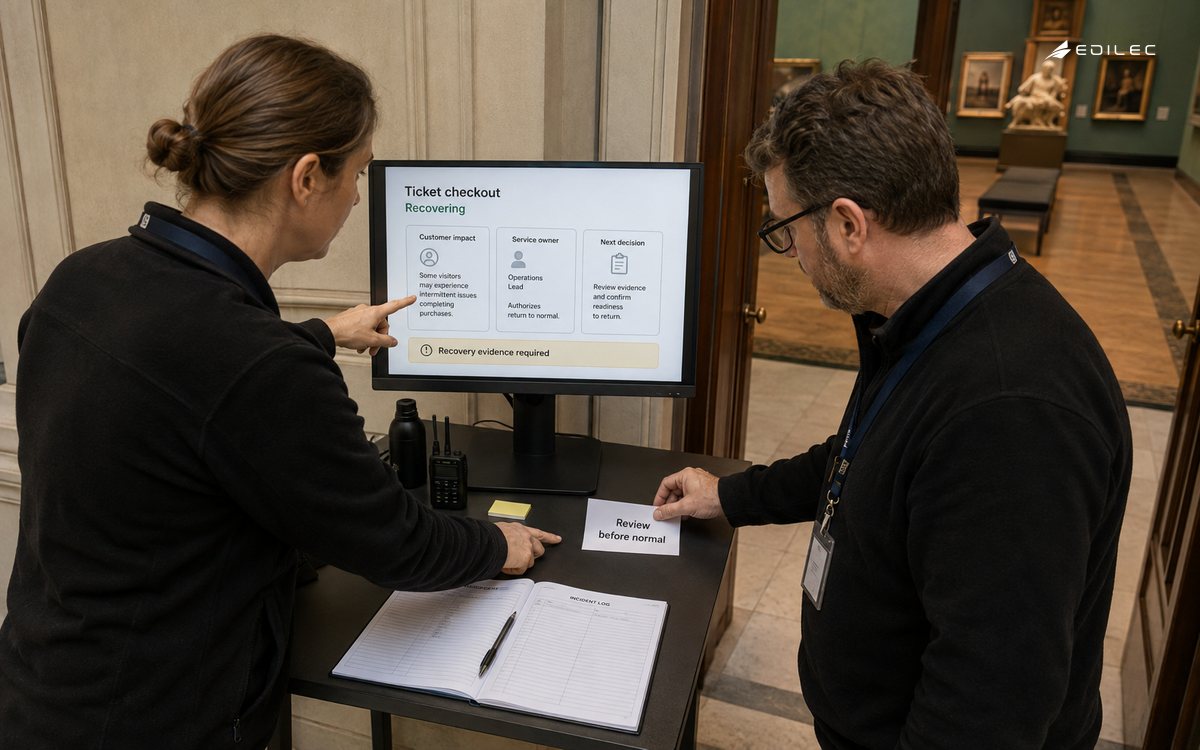
Responders need errors, latency, dependency state, recent changes, queue depth, regional variation, traces, logs, and safe rollback controls. The CTO and business leadership need a smaller view: affected journeys, current exposure, incident commander, containment, decision deadlines, communication owner, and next verified update. Both views should use the same incident clock and service definitions, but they should not compete for one screen or require responders to translate every technical fluctuation.
Use exercises to test missing telemetry, an incorrect update, failed rollback, privacy-sensitive impact, and a supplier that misses its cadence. Observe who declares severity, authorizes risky mitigation, contacts customers or regulators, protects evidence, and decides stability. Remove panels that do not change a decision. Sponsor improvements that recur across incidents, such as identity recovery, dependency visibility, configuration safety, and service ownership, rather than treating each outage as an isolated team failure.
Key takeaways
- Organize the control room around critical journeys and pre-agreed healthy, impaired, unavailable, recovering, and uncertain states.
- Share an incident clock and operating record while tailoring evidence and actions to responder, support, executive, and review roles.
- Preauthorize narrow mitigations, preserve decision history, and require journey-level recovery confirmation.
- Use game days and representative incident reviews to expose missing signals, ownership, supplier context, and authority.
- Scale when noise, decision delay, communication, and verified recovery remain controlled as coverage grows.
Frequently asked questions
Does a small company need a control room?
It needs shared service state, incident roles, communication, and decision records. A dedicated room or platform can wait.
What should a CTO see during an incident?
Customer impact, service state, ownership, containment, material risk, pending decisions, and the next communication point.
What is the first practical step for operations control rooms?
Do small teams need a control room? Yes, as a disciplined status and incident view; a dedicated room or platform can wait.
How should teams handle exceptions?
What belongs in an executive view? Customer impact, current risk, accountable lead, and next communication point; deep diagnostics belong with responders.
Conclusion
A CTO should judge an operations control room by decision quality under stress. Build it around critical journeys, shared evidence, explicit authority, practiced communication, and separate views for leaders and responders. Turn recurring lessons into platform investment.