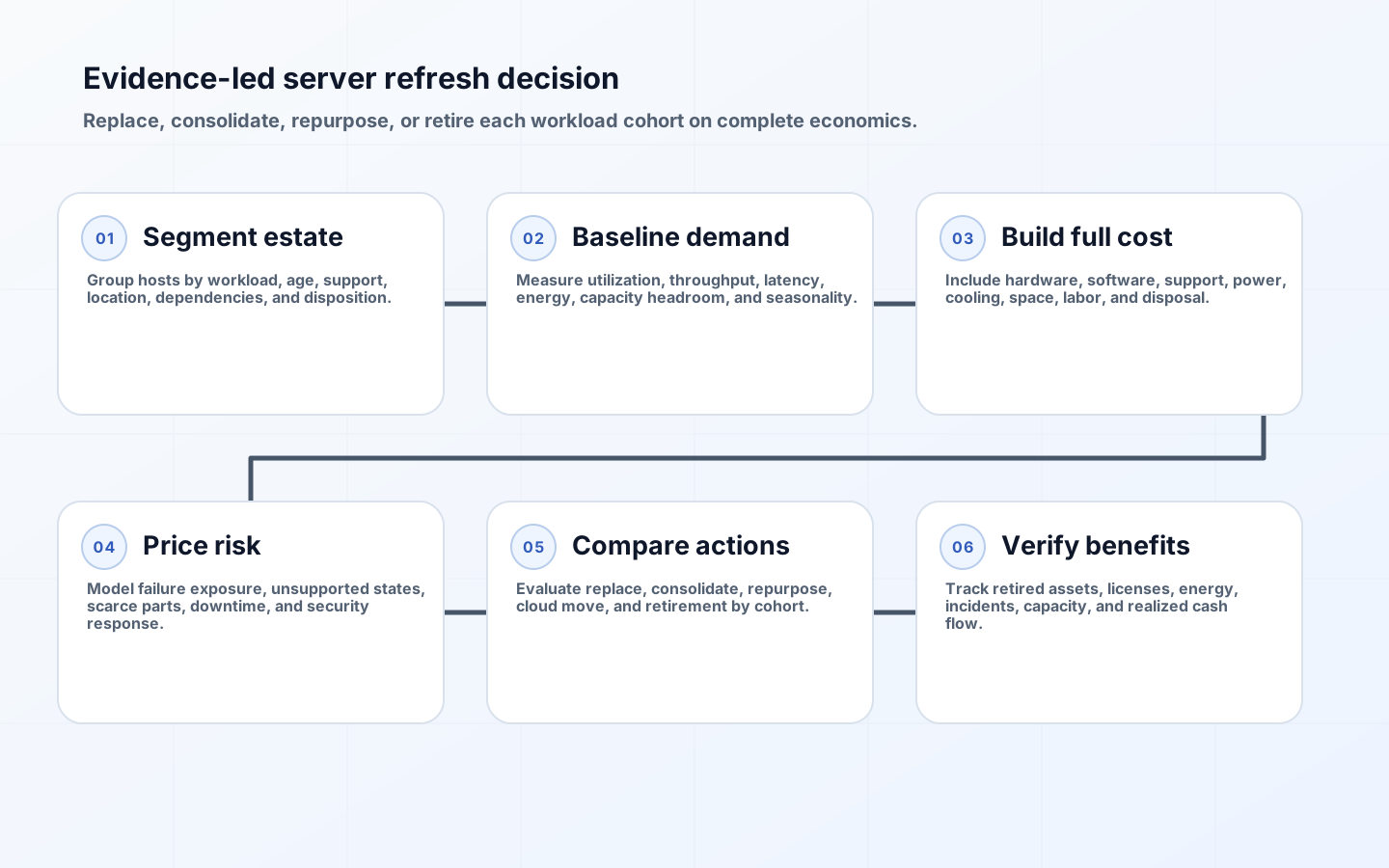
Server refresh cycle cost is not the purchase price of new hardware minus an estimate for old-server electricity. It is the change in cost, capability, and risk for a defined workload portfolio over a decision horizon. Keeping a server avoids immediate capital expense, but may retain software licenses, support premiums, fragmented capacity, aging storage, scarce parts, manual operations, and exposure to unsupported firmware. Replacing it introduces migration effort, new licenses, facility work, depreciation, and execution risk.
The useful unit of analysis is a workload cohort, not an arbitrary age threshold. A lightly used appliance with a contractual hardware dependency differs from a stateless compute farm that can consolidate onto newer hosts. A sound case connects asset and dependency inventory, measured demand, full cost, risk-adjusted scenarios, and post-change evidence. It allows replace, consolidate, repurpose, move, and retire decisions to coexist instead of assuming every old server deserves the same destination.
Segment the estate by workload and disposition
Reconcile configuration records with hypervisor, operating-system, network, storage, backup, support, facilities, and finance data. For each physical server, identify hosted workloads, application and business owners, location, age, warranty, support end dates, firmware state, management interface, CPU architecture, memory, accelerator or adapter dependencies, storage attachment, cluster membership, and power readings. Mark uncertainty explicitly. An unowned host is not automatically unused; verify traffic, jobs, scheduled processes, authentication, and backup activity before retirement.
Create cohorts with similar constraints: highly consolidatable general compute, licensed-per-core databases, latency-sensitive applications, hardware-bound appliances, accelerator hosts, development systems, retention-only archives, and confirmed idle assets. Give each a proposed disposition and evidence gap. This segmentation prevents a high headline consolidation ratio from masking a few expensive exceptions. It also lets procurement negotiate the configurations actually needed rather than buying one standardized server that is oversized for most workloads and unsuitable for the rest.
| Disposition | Good candidate | Primary value | Important constraint |
|---|---|---|---|
| Replace in place | Workload remains strategic and location-bound | Performance, support, efficiency, capacity | Migration and compatibility testing |
| Consolidate | Low-utilization compatible workloads with common controls | Fewer hosts, licenses, ports, and support contracts | Failure-domain size and noisy-neighbor risk |
| Repurpose | Capable hardware displaced from critical duty | Avoid purchase for lower-tier use | Energy, support, wiping, and new owner |
| Migrate platform or cloud | Workload benefits from a different operating model | Elasticity, managed capability, or exit objective | Data movement, recurring cost, service dependence |
| Retire | No verified demand or successor has absorbed it | Eliminates complete run cost and risk | Dependency proof, records, secure disposal |
Baseline useful work, utilization, and service objectives
Measure CPU, memory pressure, storage capacity and IOPS, network throughput, accelerator duty, latency, queue depth, errors, and seasonal peaks over a representative period. Average CPU alone is a poor sizing basis: memory, licensed cores, storage latency, single-thread performance, or a month-end burst may be binding. Connect infrastructure metrics to useful work such as transactions, builds, simulations, virtual desktops, or database operations. This enables an energy or cost-per-work comparison rather than rewarding a new server merely for consuming more total power while doing far more work.
Record service objectives and failure-domain requirements. Consolidating forty small workloads onto one powerful host can improve utilization but enlarge maintenance and hardware-failure impact. Price the cluster capacity needed during one-host loss and maintenance. Include network, storage, backup, and restore throughput in the target design. If the new estate cannot meet recovery objectives or creates an untested hardware concentration, apparent savings are borrowed from resilience.
Build a full lifecycle cost model
Separate cash, accounting, and operational views. Include hardware, racks, adapters, network ports, storage, backup capacity, virtualization or operating-system licensing, application licensing tied to sockets or cores, support, extended warranty, power, cooling, space, monitoring, security tooling, administration, planned downtime, migration labor, parallel-run cost, training, disposal, and financing or depreciation as finance requires. Use the same time horizon and discounting policy across scenarios. Show taxes and regional energy prices transparently rather than burying them in a blended rate.
Model power from measured baseline and candidate performance data at expected utilization. ENERGY STAR server specifications and product data help compare efficiency features, but workload qualification remains essential. Translate IT energy to facility energy with a documented method; do not apply a single PUE to a small room without knowing what that meter includes. Software can dominate the business case. A newer high-core-count processor may consolidate hosts yet increase per-core application licensing unless cores can be limited or the contract is renegotiated.
| Cost or benefit | Current-state basis | Candidate-state basis | Sensitivity to test |
|---|---|---|---|
| Compute hardware | Support and remaining value of retained hosts | Purchase, integration, spares, and financing | Configuration and discount |
| Software licenses | Actual licensed sockets, cores, editions, and support | Required entitlements after consolidation | Metric interpretation and audit position |
| Energy and cooling | Metered kWh and documented facility multiplier | Qualified load profile and facility impact | Utilization, tariff, and power policy |
| Operations | Incidents, patching, parts, hands-on work, and tooling | Automation, fleet size, training, and vendor support | Labor rate and achievable reduction |
| Migration | None for retain case, but include deferred remediation | Assessment, testing, parallel run, cutover, rollback | Application complexity and outage window |
| Risk | Failure, unsupported state, capacity shortage, and recovery exposure | Concentration, new-platform defects, and supplier risk | Probability ranges and business impact |
Adjust for support, security, and failure risk without fake precision
Do not invent a universal failure curve or claim that an old server will fail on schedule. Use local incident history, hardware health, vendor support status, parts availability, firmware and operating-system support, environmental conditions, and recovery evidence. Describe risks as ranges and scenarios: expected incident cost, a severe but plausible outage, delayed security remediation, or capacity unavailable during peak demand. Keep assumptions reviewable by operations and finance. Risk adjustment should make uncertainty visible, not transform guesses into a precise return percentage.
The candidate estate also has risk. New firmware, drivers, processor architecture, NUMA behavior, storage paths, and management automation can create regressions. Concentration increases the number of services affected by one host. Supply lead times and vendor dependence can weaken recovery. Fund qualification, burn-in, spare strategy, rollback, and coexistence in the refresh case. A staged cohort move often has a lower expected cost than a single deadline even when it delays part of the energy saving.
Compare scenarios and verify that benefits become real
Present retain, targeted refresh, broad refresh, and alternative-platform scenarios with a common workload forecast. Show annual cash flow, one-time cost, recurring run cost, capacity, risk notes, and operational prerequisites. Use sensitivity bands for energy price, licensing, migration effort, hardware discount, utilization, and retirement timing. Avoid counting benefits that require another unfunded program. If labor is shown as a saving, name the work that stops or the capacity that is redirected; reduced server count rarely creates automatic cash reduction.
Procure against the qualified workload cohorts and outcome measures, not a single processor generation. Require candidate configurations, firmware support duration, management interfaces, energy and performance evidence, component lead times, spare and replacement terms, secure supply-chain records, warranty response, and data-bearing media handling. Keep benchmark conditions comparable and prohibit substitutions that invalidate qualification without review. Negotiate a staged delivery or acceptance model when demand is uncertain. This preserves leverage while avoiding a large early purchase that sits idle, consumes warranty life, or forces every application onto a configuration chosen before migration evidence was available.
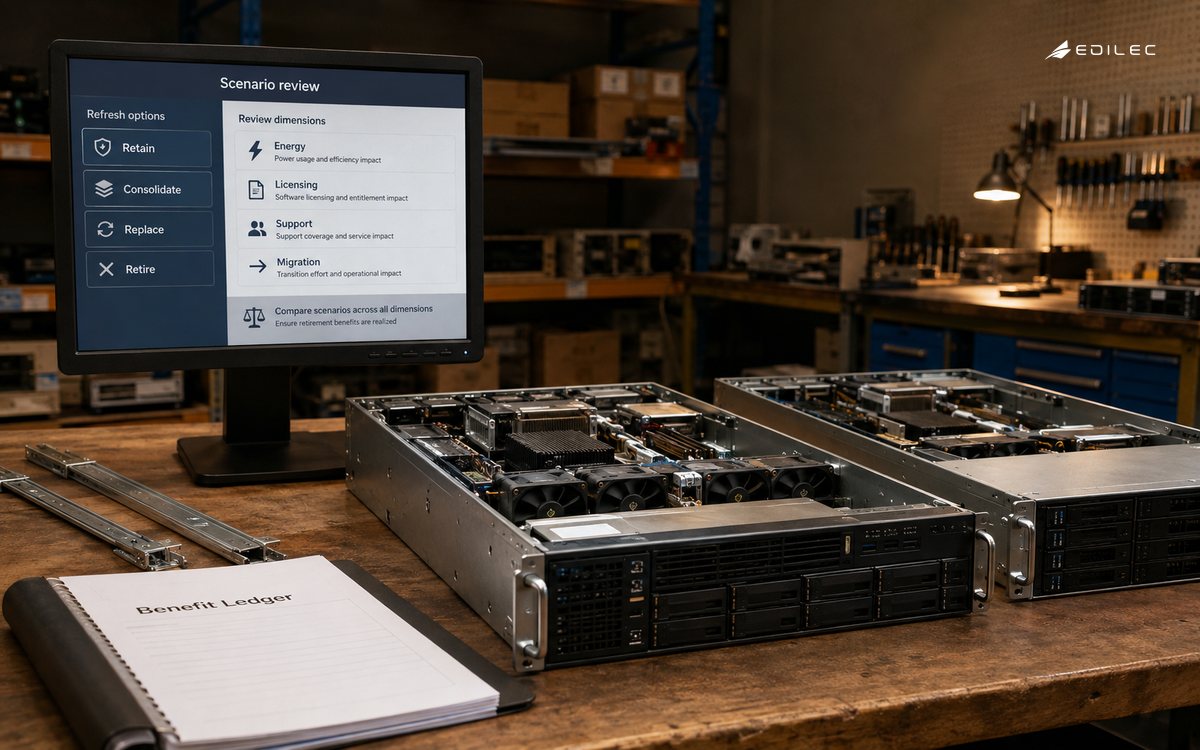
After approval, establish a benefit ledger. Reconcile decommissioned hardware, terminated support, surrendered licenses, closed network and monitoring records, reduced power, recovered rack capacity, incident trends, and workload performance. Securely erase and dispose of retired assets under policy. Review exceptions that remained on the old estate, because a few stragglers can preserve a whole platform contract. DMTF Redfish can support consistent hardware inventory and telemetry, but ownership and reconciliation turn those records into financial evidence.
Key takeaways
- Analyze workload cohorts and dependencies, not age alone.
- Measure useful work and binding resources so candidate efficiency and capacity comparisons are fair.
- Include licensing, support, facilities, operations, migration, parallel run, disposal, and risk in the cost model.
- Price risk with local evidence and ranges; qualification and concentration risk belong in the new-state case.
- Track asset, contract, license, energy, capacity, and incident outcomes after migration so forecast benefits are actually realized.
FAQ
How many years should a server refresh cycle be?
There is no universal interval. Support terms, workload fit, efficiency, reliability evidence, security support, facility constraints, and migration cost differ. Use an annual portfolio review and trigger cohort decisions when the economic or risk case changes.
Is a fully depreciated server free to keep?
No. Book value is only one view. The server still consumes power, cooling, space, licenses, support, administration, backup, and risk capacity. It may still be the right choice, but compare its forward cost rather than its sunk purchase price.
Can energy savings justify a refresh by themselves?
Sometimes, especially after substantial consolidation, but qualify the workload and include facility effects. In many estates, software licensing, support elimination, capacity, or risk drives more value than electricity. Show each contribution separately.
Conclusion
Server refresh economics becomes credible when each disposition follows workload evidence and complete forward cost. The best portfolio may replace critical hosts, consolidate compatible demand, repurpose capable equipment, migrate selected services, and retire what no longer earns its operating burden. A benefits ledger closes the loop, ensuring that unplugged hardware also becomes canceled support, recovered licenses, lower energy, usable capacity, and reduced operational exposure.