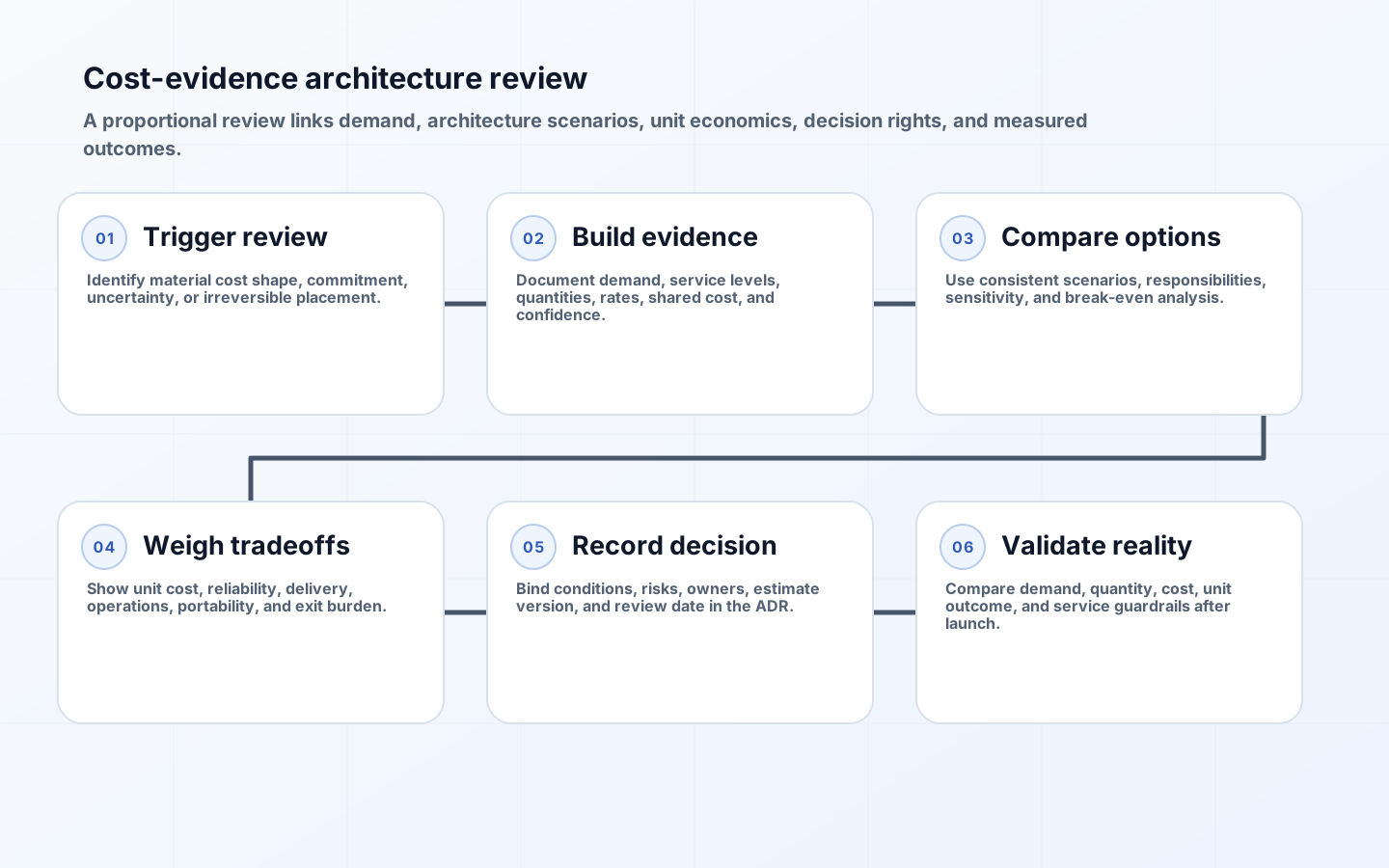
Most cloud-cost tooling begins after resources exist. By then, a team may already have selected a data model, consistency boundary, region strategy, managed service, recovery objective, and tenancy pattern that determine most of the workload's economic shape. A FinOps architecture review moves cost evidence to the point where those choices are still reversible. It does not ask architects to optimize every cent before learning anything; it asks them to make material economic assumptions visible beside reliability, security, performance, and delivery evidence.
The cloud providers' well-architected guidance consistently treats cost as an architectural concern, while the FinOps Framework connects architecture and workload placement to business value. The practical challenge is governance: a cost gate can become either a rubber stamp or a finance veto. A better review defines proportional evidence, explicit decision rights, uncertainty ranges, and post-launch verification. The outcome is an accountable architecture decision, not a promise that an estimate equals an invoice.
Scope the review around reversible decisions
Trigger review when a proposal creates a material cost commitment or changes a unit-cost curve. Examples include a new managed service, additional region, high-retention dataset, GPU workload, dedicated tenant footprint, minimum capacity tier, large data transfer path, or long-term purchase. Define thresholds locally using expected annual cost, uncertainty, irreversibility, and blast radius. A small experiment should not carry the evidence burden of a multi-region platform, but an inexpensive choice with severe exit cost can still deserve review.

Review the architecture increment, not the whole system from scratch. Name the decision, alternatives, affected workloads, intended lifetime, and date by which it can be revisited. Separate must-have constraints from preferences. Data residency or recovery requirements may rule out a cheaper option; recording that constraint prevents later reviewers from treating the premium as unexplained waste. Likewise, challenge inherited assumptions that have no current owner or evidence.
| Change type | Why review it | Minimum cost evidence | Likely decision owner |
|---|---|---|---|
| New managed service | Rate shape and switching cost | Demand range, service estimate, exit path | Architecture owner |
| Additional region | Replication, transfer, and idle reserve | Traffic, data, recovery scenario | Product and reliability owner |
| Dedicated tenancy | Per-tenant minimum capacity | Tenant cohorts and allocation rule | Product owner |
| Long retention | Compounding storage and scan cost | Growth, copies, lifecycle, deletion | Data owner |
| Commitment purchase | Fixed financial obligation | Eligible baseline and downside case | FinOps and finance |
Require a concise evidence packet
A useful packet begins with demand: users, transactions, data volume, concurrency, growth, geography, and service-level expectations. It then maps demand to resource quantities and rates. State source dates and confidence. Provider calculators can help with pricing, but their output is only as credible as the workload inputs and omitted services. Include engineering effort, support burden, observability, backup, network, security, and shared-platform charges when they differ materially among options.
Keep a cost boundary statement at the top. Specify whether numbers include taxes, support plans, discounts, credits, commitments, labor, and shared services. Record list and effective rates separately when procurement assumptions matter. Include an architecture diagram only if it clarifies quantity and transfer paths; decorative diagrams do not improve the estimate. Every material line should trace to demand, a design rule, a rate, or an explicit allowance.
- Decision and alternatives, including the option to defer
- Demand scenarios and nonfunctional requirements
- Resource quantity model and pricing date
- Monthly, annual, and unit-cost ranges
- Sensitivity, uncertainty, and break-even points
- Operational ownership, exit cost, and post-launch validation plan
Compare coherent architecture scenarios
Compare options under the same demand and service-level assumptions. One design should not receive average traffic while another receives peak traffic. Model low, expected, and high demand, plus one failure or recovery scenario that changes capacity. If alternatives provide different capabilities, expose the difference rather than forcing cost parity. A managed database may include backups and failover that a virtual-machine estimate silently omits; normalize the responsibility boundary before comparing totals.
Use sensitivity to locate the decision boundary. A serverless option may be attractive below a request volume, a reserved cluster above it, and a managed platform worth its premium if it removes scarce operating work. Break-even analysis should include migration and transition cost, not just steady-state rates. Avoid assuming every workload reaches the high-volume crossover: expected lifetime and growth probability affect whether an optimization can repay its implementation cost.
| Dimension | Option A example | Option B example | Question for reviewers |
|---|---|---|---|
| Cost shape | Usage-proportional | Fixed minimum plus lower marginal rate | Where is break-even? |
| Reliability | Regional service | Multi-region active capacity | Which failure objective requires the premium? |
| Operations | Provider-managed | Team-operated | Is labor and on-call capacity available? |
| Portability | Provider-specific API | Portable runtime | What is the credible exit event? |
| Delivery | Fast start | Longer build with later control | Does time-to-value dominate first-year cost? |
Set a unit-cost target with guardrails
Total cost answers a funding question; unit cost answers whether the architecture scales economically. Select a business-relevant denominator such as order, active tenant, processed document, training run, or streamed hour. Define numerator and denominator precisely, including shared cost and failed work. Show how unit cost behaves across demand scenarios. Fixed capacity may produce high unit cost at launch and improve with utilization, while tier thresholds or data amplification can make it worsen later.
A target should connect to a product or operating decision. It might protect gross margin, cap the cost of a regulated workflow, or determine whether a feature belongs in a premium tier. Pair it with reliability and performance guardrails so teams cannot meet cost by removing required resilience or degrading users. When a product has heterogeneous customers, use cohort unit economics; a blended average can hide a tenant type whose architecture is structurally unprofitable.
Make tradeoffs and opportunity cost explicit
The lowest estimated cloud bill is rarely the complete answer. Include engineering time, operational load, incident exposure, compliance work, and delivery delay where they differ. Do not monetize every risk with invented precision. Use qualitative severity and evidence when probability is weak, and show a quantified range where data is defensible. The review should reveal what the organization buys with a premium: recovery speed, reduced toil, isolation, product latency, or future option value.
Also document optimization debt. A deliberate overprovisioning choice for launch may be sensible if it has an owner, expiry, and measurement plan. A provisional architecture becomes permanent when nobody records the condition for revisiting it. Conversely, demanding perfect utilization before launch can delay revenue and learning. Treat time, uncertainty, and team attention as constrained resources alongside cloud capacity.
Run the review as a decision, not a tribunal
Invite product, architecture, engineering, reliability, security, FinOps, and finance only when they own an assumption or decision right. Circulate the packet before the meeting and use the session for disputed assumptions and tradeoffs. Outcomes should be approve, approve with bounded conditions, request specific evidence, or reject with a named reason. Record dissent and the accountable decision owner. FinOps supplies economic analysis; it should not silently inherit authority over product and reliability choices.
Write the result into an architecture decision record: selected option, alternatives, demand baseline, estimate version, unit target, accepted risks, conditions, review date, and validation owner. Link calculations as versioned artifacts rather than pasting an untraceable total. Conditions should be testable, such as validating storage amplification within thirty days or proving commitment eligibility before purchase. Avoid conditions like 'monitor cost closely' that create no decision rule.
Validate the decision after launch
Schedule validation when representative traffic exists, not merely on the deployment date. Compare demand, resource quantities, effective rates, total cost, unit cost, and nonfunctional outcomes. Explain variance by layer. A cost miss caused by unexpectedly strong adoption is different from a workload coefficient that was wrong. Confirm whether the architecture still meets latency, resilience, security, and support expectations; cheaper operation is not success if another requirement failed.
Feed results back into estimation defaults and future reviews. Update reusable coefficients, price sources, and known omissions. Close temporary conditions or create an owned remediation with a deadline. Track review effectiveness through decision outcomes and material variance, not by counting meetings. If most reviews produce no changed assumption or action, narrow the trigger or improve the packet rather than adding more approvers.
Introduce cost evidence incrementally
Pilot the practice on one high-cost, still-reversible decision. Provide a short template, a quantity-and-rate worksheet, and access to FinOps help. Prepopulate current effective rates and shared-cost guidance. Time-box analysis according to materiality and capture uncertainty openly. After two or three reviews, examine which fields changed decisions and remove ceremony that did not. Automate calculator inputs or telemetry only once definitions are stable.
A mature program can integrate evidence checks into design workflows without making one universal gate. Small changes may use self-attestation; medium changes receive asynchronous review; high-commitment choices receive a cross-functional decision. Maintain an exception path for incidents and urgent regulatory work, with retrospective validation. Governance is effective when teams can move quickly and the organization can still explain why it accepted a recurring cost.
Key takeaways
- Review decisions that materially change cost shape, commitment, or reversibility.
- Compare alternatives with the same demand, service-level, and responsibility assumptions.
- Use unit cost, sensitivity, and break-even points alongside monthly totals.
- Record what reliability, speed, or operating benefit a cost premium purchases.
- Make post-launch validation part of approval so estimates improve instead of disappearing.
Frequently asked questions
Should every design pass a cost gate?
No. Use proportional triggers based on expected cost, uncertainty, irreversibility, and risk. Routine changes can follow approved patterns. A universal meeting creates delay and teaches teams to minimize what they disclose.
Is a provider calculator enough evidence?
It is useful for rates and service dimensions, but it does not validate demand, architecture, utilization, data transfer, shared services, support, or labor. Preserve calculator dates and inputs, then reconcile them with a workload quantity model.
What if the workload has no production data?
Use benchmark measurements, load tests, comparable workloads, and explicit ranges. Approve a learning budget with an early validation milestone. Unknowns are acceptable when visible and bounded; a single unsupported number is not.
Conclusion
A FinOps architecture review brings economic evidence into the same conversation as reliability, security, performance, and delivery. Its value lies in exposing demand assumptions, cost shape, unit economics, sensitivity, and retained obligations before they harden into production. With proportional governance and a required validation loop, teams can spend intentionally without turning architecture into a finance approval exercise.