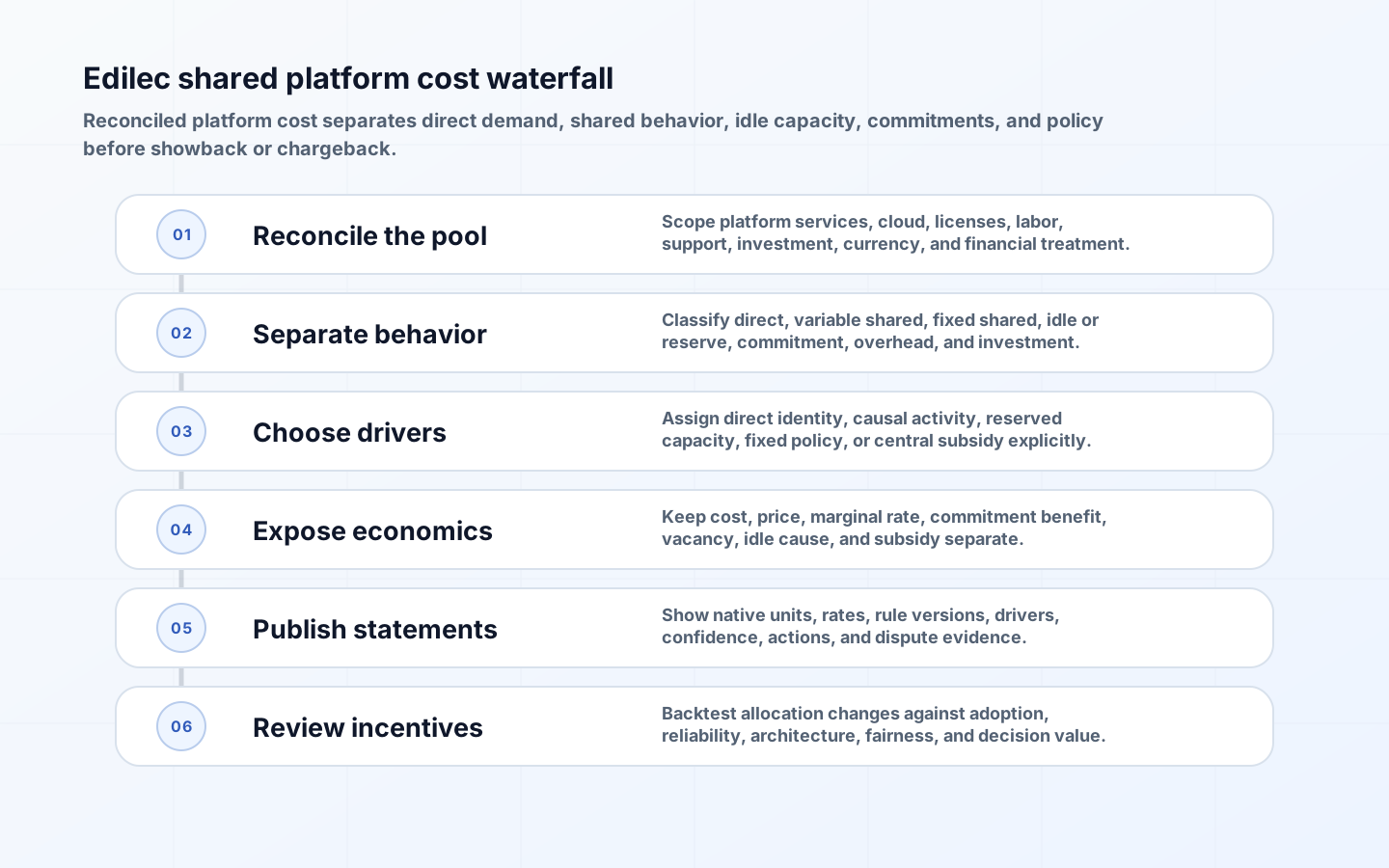
Shared platform cost allocation is a policy for making economics visible, not a scientific discovery of who caused every dollar. Internal platforms combine variable cloud resources, fixed control planes, licenses, support labor, security controls, idle headroom, commitments, and one-time investment. A single proportional split can balance the ledger while concealing which costs change with consumption and which exist to provide organizational capability. Preserve those layers before choosing who sees or pays them.
The FinOps allocation capability calls for explicit allocation, tagging, and shared-cost strategies. For a platform, the strategy should support decisions such as whether to rightsize a tenant, increase shared capacity, retire an offering, negotiate a license, or invest in automation. Start with showback and a reproducible cost pool. Chargeback comes later, after service owners can inspect lineage, challenge rules, and predict how behavior changes their statement.
Define the shared platform cost pool
Set the platform boundary: portal, orchestration, clusters, networking, observability, security, data services, licenses, support, and people may be included or excluded, but ambiguity is unacceptable. Reconcile included provider charges and internal expenses to finance. Tag each amount as direct, variable shared, fixed shared, idle or reserve, commitment, overhead, or investment. Preserve provider, account, service, billing period, currency, owner, and rule version.
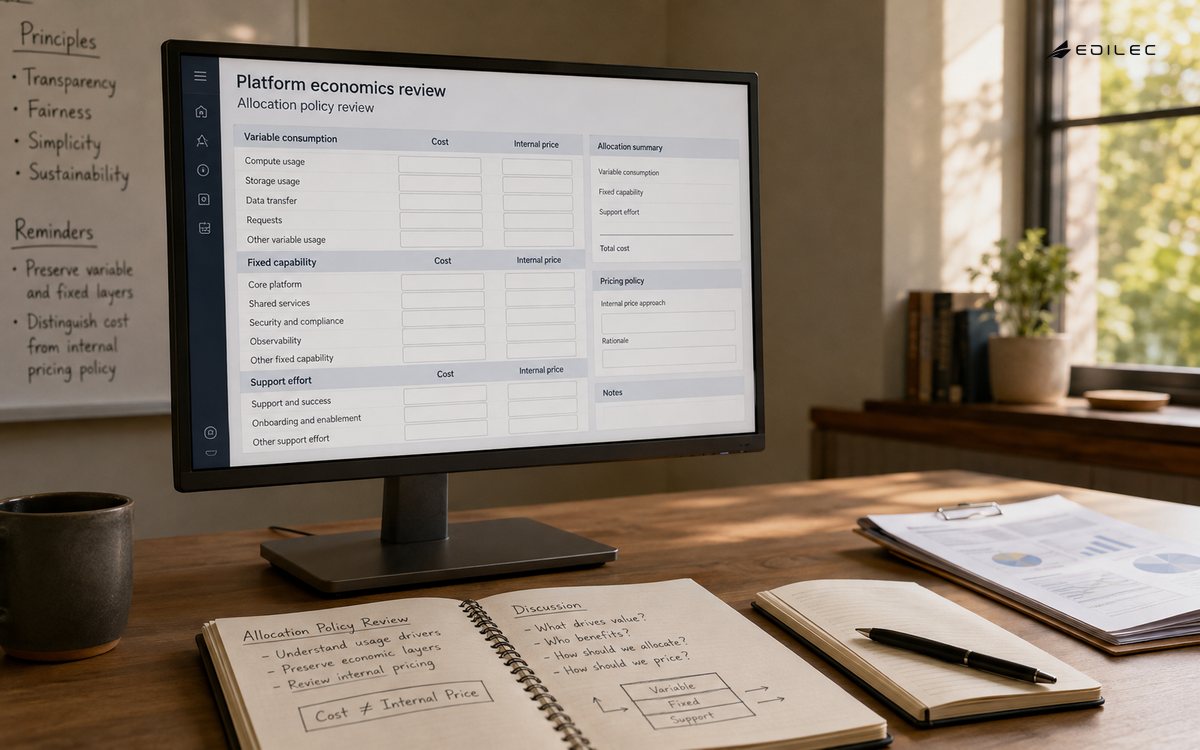
Separate cost from price. Cost describes resources consumed to operate the platform; an internal price may include subsidies, markups, smoothing, or strategic incentives. Publish both when they differ. Do not call an allocated fixed control-plane charge “usage cost.” Keep depreciation, capitalization, and labor treatment aligned with finance policy. A platform product manager needs economic truth even when leadership chooses not to charge consuming teams.
| Layer | Behavior | Useful reporting treatment | Example decision |
|---|---|---|---|
| Direct tenant | traceable to one consumer | assign directly | delete abandoned database |
| Variable shared | changes with measured activity | allocate by causal driver | reduce build minutes or egress |
| Fixed shared | persists within current capacity band | show separately or fixed allocation | consolidate control planes |
| Idle or reserve | unused but may protect reliability | name capacity policy and beneficiary | change headroom target |
| Commitment | contractual rate instrument | allocate benefit and vacancy explicitly | resize renewal |
| Investment | future capability work | separate from run cost | fund roadmap or stop project |
Choose drivers that match cost behavior
Use direct assignment whenever reliable identity exists. For variable shared cost, choose a causal activity: CPU and memory time, storage bytes, requests, build minutes, data processed, seats, or measured service units. For fixed cost, equal allocation, revenue share, budget share, or central funding may be reasonable policy choices; label them as such. Avoid using revenue to allocate a resource that genuinely scales with bytes merely because revenue data is convenient.
Test sensitivity. Calculate statements under plausible drivers and identify teams whose amount changes dramatically. Extreme sensitivity often means the pool is too broad or the driver is a weak proxy. Keep a minimum materiality threshold; complex activity-based costing can cost more to operate than the decision value it creates. Revisit drivers when architecture changes, such as moving from dedicated clusters to a shared control plane or introducing a consumption-priced vendor.
| Method | Strength | Weakness | Best use |
|---|---|---|---|
| Equal fixed share | simple and predictable | small teams may subsidize large ones | membership-like common capability |
| Proportional spend | easy to reconcile | repeats provider price rather than platform causality | broad overhead |
| Measured activity | connects behavior to variable cost | metering and attribution burden | compute, storage, CI or data processing |
| Reserved capacity | reflects guaranteed service | can charge unused reservation | dedicated quota or capacity |
| Marginal price | guides next-unit decisions | does not recover all fixed cost | adoption and architecture choices |
| Central subsidy | supports strategic adoption | can hide demand and total cost | mandatory or incubating capability |
Preserve idle capacity and commitment economics
Idle capacity has causes: resilience reserve, growth headroom, indivisible infrastructure, delayed deprovisioning, or abandoned resources. Assigning all idle cost to active consumers can make an efficient service look expensive and hide the decision owner. Report the amount, policy, beneficiary, and age. Reliability reserve may be shared deliberately; orphaned resources need remediation; a platform-selected capacity block belongs to platform economics until a consumer explicitly reserves it.
Commitment discounts separate use from rate. Allocate eligible usage and the discount benefit under a published rule, then show unused commitment, or vacancy, separately. Do not make a team appear cheaper merely because another team carries unused commitment. For marginal decisions, show the next unit’s expected rate: additional use inside an already-paid commitment has different short-term cash behavior from use above coverage, but long-run pricing should still reflect renewal economics.
Design showback before chargeback
A useful platform statement includes direct cost, variable shared allocation, fixed share, idle or reserve, commitment benefit and vacancy, subsidy, and total internal price. Add native units, unit rates, change drivers, confidence, and actions. Compare teams to their own demand and service tier, not a leaderboard that rewards avoiding the platform. A product can have higher total cost and lower cost per successful deployment because adoption and throughput increased.
Move to chargeback only when finance mappings, close timing, exceptions, and corrections are stable. The invoicing and chargeback capability connects allocation outputs to financial systems and requires alignment with ledger structures and period processes. Version files, approve material manual adjustments, and true up estimates transparently. Never rewrite a closed period silently because an allocation rule changed.
Govern policy and adoption incentives
Create a council with platform, FinOps, finance, and representative consumers. Review reconciliation, coverage, disputes, driver sensitivity, idle causes, subsidies, and behavioral outcomes. Publish change proposals with backtested impact before activation. Allow appeal when identity or measurement is wrong, not simply because a statement is unwelcome. Give every cost pool and rule an owner and review date.
Watch for incentive failures. Per-request chargeback can discourage health checks or testing; equal splits can encourage heavy users to ignore demand; platform-wide markups can drive teams to ungoverned alternatives. Use the unit economics capability to pair platform cost with outcomes such as successful deployments, recovered incidents, or developer hours avoided. The goal is better value and architecture, not full cost recovery at any behavioral price.
Model capacity steps when publishing unit rates. A shared cluster may have low marginal cost until it crosses a node, database, or license threshold, after which the next consumer creates a visible jump. Averaging that jump across all current users is valid for cost recovery but poor guidance for the next architecture decision. Show current average, marginal capacity band, and expected long-run rate. This helps product teams understand why a temporary subsidy or apparently free increment cannot be assumed forever.
Create worked examples for disputes. Show how two teams with different CPU, storage, support tier, and reserved capacity move through every pool and rule. Include a platform outage, an idle development tenant, and a strategic onboarding subsidy. The examples should reconcile exactly to a sample ledger and demonstrate corrections. They become regression tests for the allocation engine and training material for finance and engineering. A policy people can reproduce from a small example is far more durable than one explained only through a dashboard total.
Set service-level economic objectives cautiously. A platform may target a cost range per deployment, environment, or active developer, but pair it with success rate, lead time, reliability, and adoption. When the unit rises, identify whether fixed investment preceded expected growth, demand became less efficient, or allocation changed. When it falls, confirm quality and support did not deteriorate. Use these objectives to trigger investigation and product choices, not automatic budget punishment. Shared platforms create option value and standardization that one consumption denominator cannot fully represent, so retain qualitative roadmap evidence beside the cost model.
Retire cost pools deliberately when a platform capability closes. Stop new allocation at the service date, reconcile residual invoices and credits, decide how decommissioning expense is treated, and preserve prior rule versions. Spreading late charges across whichever teams remain can distort current consumption and punish successful migration. A closure statement should show final direct cost, shared true-up, asset disposal, and any continuing contractual obligation.
Key takeaways
- Reconcile a scoped cost pool and preserve direct, variable, fixed, idle, commitment, and investment layers.
- Match measurable activity drivers to variable cost and label fixed allocations as policy choices.
- Keep cost, internal price, subsidy, and marginal rate distinct.
- Publish inspectable showback before integrating chargeback with financial close.
- Review allocation rules for adoption, reliability, and architecture incentives as well as ledger balance.
Frequently asked questions
Is an equal split ever fair?
It can be a reasonable, explicit policy for a fixed membership-like capability. It is usually a poor proxy for variable resources whose demand can be measured.
Who should pay for idle platform capacity?
Classify its cause and beneficiary first. Reliability reserve may be shared; abandoned resources follow ownership; platform-selected headroom remains visible as platform economics.
What is the practical difference between showback and chargeback?
Showback provides cost visibility without posting financial charges. Chargeback feeds formal accounting, so it requires stricter mappings, controls, close timing, and corrections.
Conclusion
A strong allocation model does not force every platform dollar through one formula. It preserves economic behavior, uses causal drivers where available, names policy where not, and lets consumers reproduce their statement. With transparent showback and incentive review, shared cost becomes evidence for product and capacity decisions rather than an argument disguised as arithmetic.