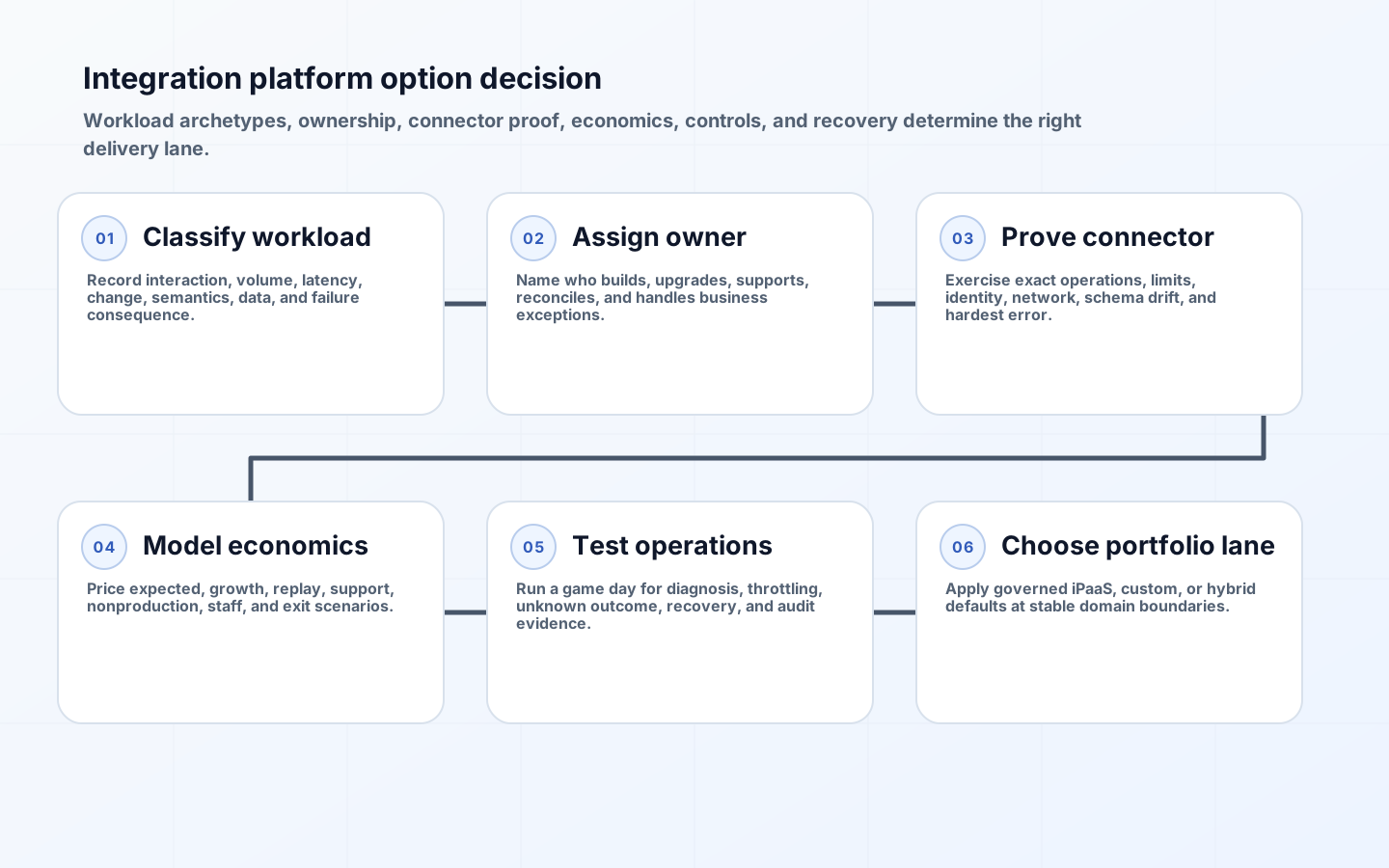
The iPaaS vs custom integration decision is not a contest between low-code speed and engineering purity. Both approaches must authenticate systems, transform meaning, move data, handle partial failure, respect quotas, expose business state, and evolve contracts. The durable question is who can own those responsibilities at the estate's connector count, throughput, change rate, compliance level, and failure consequence.
An integration platform as a service can supply managed connectors, workflow tooling, deployment, schedules, secrets integration, and operational dashboards. A custom layer can offer precise semantics, code-level testing, workload-specific performance, and portability. Most enterprises need a portfolio: platform flows for standard orchestration, custom services for differentiated or high-scale paths, and clear rules preventing every team from making a fresh technology decision.
Inventory integration workloads before products
Catalog source and target, business owner, direction, trigger, sync or async behavior, schedule, payload, volume, peak, latency, consistency, ordering, data classification, retention, replay, outage tolerance, and support window. Salesforce's integration patterns distinguish request-reply, fire-and-forget, batch synchronization, remote call-in, and virtualization; these interaction needs are more useful selection inputs than a raw interface count.
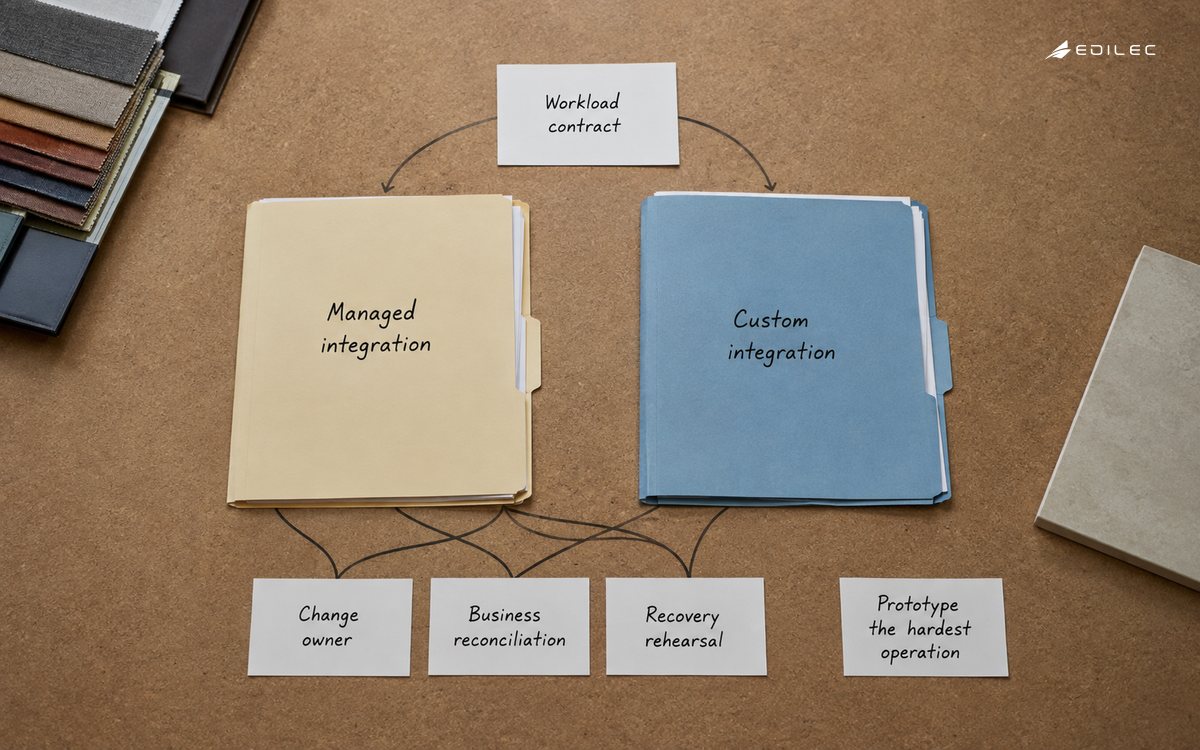
Group flows by archetype. Employee onboarding across common SaaS tools differs from high-frequency order events, large nightly product files, customer-facing synchronous credit checks, and legacy message bridging. Evaluate each archetype, then apply portfolio economics. A platform can be excellent for eighty routine connectors and poor for one terabyte-scale stream; a custom service can excel at that stream while being wasteful for routine SaaS administration.
| Workload trait | Often favors iPaaS | Often favors custom | Evidence required |
|---|---|---|---|
| Connector fit | Supported API and common actions | Unsupported protocol or deep proprietary semantics | Prototype against exact operations and limits |
| Change ownership | Analyst-led mapped workflow with guardrails | Product engineers own domain contract | Release frequency and skills |
| Throughput | Moderate predictable workload | High, bursty, or specialized streaming | Peak tests and full cost curve |
| Latency | Human or batch timescale | Tight customer-path budget | End-to-end percentile target |
| Control | Platform controls satisfy policy | Custom isolation or runtime control is mandatory | Security and compliance assessment |
Choose an operating owner, not only a builder
Name who handles connector upgrades, schema drift, credentials, failed records, capacity, incidents, audit requests, and after-hours support. iPaaS does not eliminate engineering; it moves work into configuration, vendor governance, and platform operations. Custom code does not guarantee control unless a team is funded to maintain runtimes, libraries, deployment, observability, and security patches. Include staff continuity and on-call load in the decision.
Define a responsibility matrix across platform team, flow owner, source owner, target owner, security, and business operations. The platform team can provide paved paths and guardrails, but the business owner decides how to resolve a rejected invoice or conflicting customer record. If every semantic exception routes to central middleware specialists, the architecture creates a queue regardless of how quickly a flow was initially built.
Test connector depth and lifecycle
A catalog logo is not proof of fit. Verify the exact API version, objects, fields, pagination, bulk operations, webhooks, event replay, attachments, custom entities, rate-limit handling, authentication grants, regional endpoint, and private network support. Determine who releases connector updates and whether a forced upgrade can alter behavior. Prototype the hardest operation and an error path using realistic volume.
Price connector escape hatches. Can the platform call a generic HTTP endpoint, run code, use a custom connector, or bridge a message system without losing tracing and policy? Microsoft describes messaging bridges as components that connect different messaging infrastructures while leaving systems unaware of each other. Whether platform or custom, isolate protocol translation from business semantics so a transport replacement does not rewrite every mapping.
Protect domain meaning with canonical boundaries
Avoid one enterprise canonical model that tries to represent every system. Define stable domain contracts for orders, customers, employees, or products, then use adapters at boundaries. An anti-corruption layer translates between systems with different semantics so one model does not distort another. This pattern adds latency and an operated component, but it makes ownership explicit. It can be implemented in iPaaS mappings or custom services.
Version mappings, fixtures, and expected business outcomes. Test nulls, deletions, duplicates, retries, timezone, currency, units, and referential order. Visual mapping tools still need code review equivalents, promotion controls, and rollback. Custom code still needs accessible operational views for business exceptions. Select the implementation that makes semantics testable and maintainable by the actual owner.
Model cost across volume and change
For iPaaS, include base subscription, environments, premium connectors, executions, messages, data volume, compute steps, API management, private connectivity, log retention, support tier, nonproduction capacity, and overage. For custom, include engineers, platform services, runtime, networking, monitoring, incident response, upgrades, security, testing, and opportunity cost. Use expected, high-growth, and incident-replay scenarios rather than one average month.
Change rate alters economics. Platform composition can accelerate common mappings, but highly customized flows may accumulate hard-to-test scripts and vendor-specific constructs. Custom libraries can make repeated domain patterns cheap after initial investment, but only when teams reuse them. Measure cost per active flow, per million messages, per change, and per recovered incident. Include exit work and data or configuration export.
| Cost area | iPaaS question | Custom-layer question | Scenario to price |
|---|---|---|---|
| Runtime | Which meter grows with steps, messages, or data? | Which compute and broker tiers scale? | Peak month plus replay |
| Delivery | Who can build and review mappings? | How much shared framework exists? | New standard and exceptional connector |
| Operations | What logs, retention, and support are included? | How many on-call services are created? | Weekend source outage |
| Change | How are connector upgrades imposed? | Who updates SDKs and runtimes? | Breaking API and credential rotation |
| Exit | Can flows, state, and history be exported? | How coupled is code to cloud services? | Vendor replacement or regional move |
Demand business-level observability
A green workflow run does not prove an order posted correctly. Require correlation from source business key through every transformation, queue, and target result. Expose pending, applied, duplicate, rejected, retried, and dead-lettered states without leaking payloads. Retain immutable deployment and mapping versions. Operators need safe retry or correction actions with approval and audit, not only developer logs.
Test unknown outcomes, throttling, partial batches, expired credentials, target downtime, schema drift, duplicate delivery, and replay. Compare platform and custom options on diagnosis time and recovery ergonomics. A polished design canvas is not operational evidence. Run a game day with the people who will support the flow and observe whether they can identify business impact and restore it within the required objective.
Compare security and compliance boundaries
Assess credential storage, per-flow identity, least privilege, key rotation, private networking, data residency, encryption, customer-managed keys, payload logging, admin segregation, audit export, vulnerability response, and subprocessor obligations. Managed service controls can reduce operational burden, but they also create a concentrated integration control plane. Custom services offer isolation choices while increasing patch and configuration duties.
Prevent shared super-credentials. Use separate workload identities and restrict production publication. Separate flow authors from approvers where financial or regulated data demands it. Apply data minimization in both implementations; moving a full customer record because the connector makes it easy increases exposure. Map every copied field to a purpose and retention owner.
Design a governed hybrid portfolio
Set default lanes. Standard SaaS orchestration and moderate batch mappings may default to iPaaS. High-throughput event streams, core product paths, complex domain logic, or unsupported protocols may default to custom services. Exceptions use a short decision record. Share identity, contract registry, secrets, observability conventions, and business reconciliation across both lanes so hybrid does not mean fragmented governance.
Keep custom functions inside an iPaaS narrow, versioned, and independently tested. Keep custom integration services from rebuilding every platform feature. Review the portfolio quarterly for idle flows, cost outliers, unsupported connectors, duplicated mappings, exception age, and ownership gaps. Migration between lanes should be possible at domain contract boundaries rather than requiring source and target changes together.
Key takeaways
- Classify integration archetypes before comparing products or frameworks.
- Choose the team that can operate changes and failures for years.
- Test connector depth, not catalog presence.
- Model cost under growth, replay, nonproduction, support, and exit scenarios.
- Require business correlation and reconciliation in either implementation.
- Use governed default lanes and stable domain contracts for a hybrid portfolio.
Frequently asked questions
Is iPaaS always cheaper than custom middleware?
No. It can reduce delivery and platform work for common connectors, while metered execution, premium features, and specialized skills can dominate at scale. Compare full scenarios and operating ownership.
Can business analysts own production integrations?
They can own appropriate mapped workflows within guarded templates, review, testing, and release policy. Complex semantics, security, performance, and failure recovery still need engineering and business accountability.
Does a hybrid approach create more complexity?
It can, unless default lanes, shared contracts, identity, telemetry, and decision rights are explicit. Hybrid is useful when workload differences are real, not when every team chooses independently.
Conclusion
The best integration layer is the one the organization can change, observe, secure, and recover at the workload's scale. iPaaS brings managed capabilities and connector leverage; custom services bring precision and product-level control. An evidence-based portfolio, grounded in ownership, throughput, semantic complexity, cost curves, and exit boundaries, avoids both platform sprawl and unnecessary reinvention.